



Communication habits continue to shift from traditional voice calls toward texting and messaging apps. People and businesses increasingly choose messaging for convenience, speed, and higher engagement. From WhatsApp’s 3 billion+ monthly users to near‑universal SMS open rates, messaging now plays a central role in daily interaction across the US and worldwide. These changes affect everything from consumer customer support to marketing outcomes for small businesses and global brands. Explore the latest data below to understand how calls and messaging compare in today’s communication landscape.
Editor’s Choice
- SMS open rates remain around 98% in 2026, one of the highest for any communication channel.
- 90% of text messages are read within 3 minutes of delivery, driving quick engagement.
- Text message response rates average ~45%, far above email benchmarks.
- US smartphone users send and receive text messages about 5× more than they make or receive calls daily.
- WhatsApp leads global messaging with ~3 billion monthly active users.
- 80% of consumers prefer SMS for business interactions they’ve opted into.
- SMS campaigns exhibit conversion rates up to 32% in some use cases.
Recent Developments
- SMS communication continues to outperform many channels, with higher visibility and rapid response rates versus email.
- Messaging apps combining text, voice, and media have expanded global reach beyond traditional SMS.
- Businesses investing in SMS automation report higher customer engagement and conversion lift.
- Messaging adoption spans demographics, with even older age segments increasingly comfortable with texting.
- Hybrid messaging stacks (SMS + app notifications) are becoming core to customer outreach strategies.
- Rates of telemarketing calls being ignored continue to climb as texting becomes preferred.
- Mobile carriers are integrating richer messaging standards to support business and consumer texting.
- Consumer demand for multi‑channel communication (text, call, email options) is rising.
Global Calls vs Messaging Usage
- WhatsApp tops the global messaging charts with ~3 billion monthly users, far ahead of other platforms.
- Facebook Messenger and Telegram each maintain 1 billion+ users worldwide.
- Messaging apps have overtaken voice calls as the default communication mode in many regions.
- SMS remains universal, supported on virtually all mobile phones globally.
- Messaging growth continues as smartphone penetration expands into new markets.
- Many countries blend SMS and data‑based messaging for personal and business use.
- Cross‑platform messaging (text + multimedia) enhances user experience.
- Messaging app ecosystems now include voice and video features, blurring lines with traditional call functions.
SMS Marketing vs Phone Calls: Effectiveness Comparison
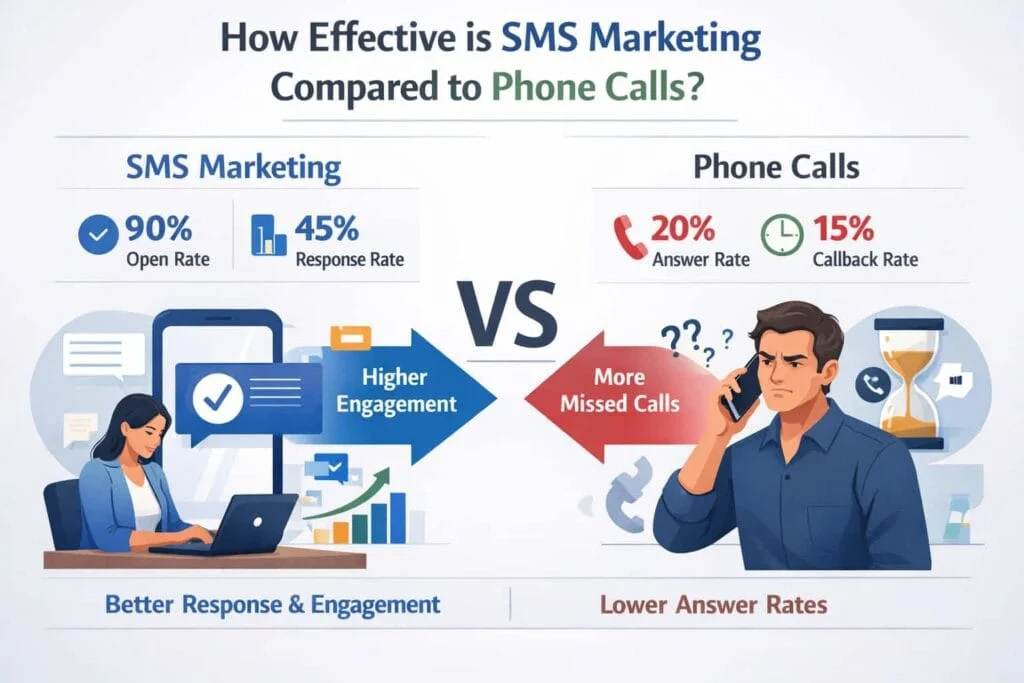
- SMS marketing achieves a massive 90% open rate, showing that text messages are far more likely to be seen than phone calls.
- With a 45% response rate, SMS campaigns drive stronger two-way engagement and faster customer action.
- The data highlights higher engagement through SMS, making it a preferred channel for marketing communication.
- Phone calls record only a 20% answer rate, indicating that most calls go unanswered.
- Call-based outreach also suffers from a low 15% callback rate, limiting follow-up success.
- The comparison reveals that phone calls result in more missed interactions, reducing overall effectiveness.
- Overall, SMS marketing delivers better response and engagement, while phone calls struggle with lower answer rates in modern communication behavior.
Daily Texting vs Calling Frequency
- US smartphone users engage in texting about 5× more than phone calls daily.
- 81% of Americans use text messaging frequently, contributing to billions of texts sent daily.
- The average person sends ~13 SMS messages per day.
- Many consumers attempt to reply by text after missing a call.
- Voicemails from unknown callers receive callbacks less than 3% of the time.
- Messaging usage persists through routine tasks like scheduling updates or alerts.
- The ease of texting during meetings or travel supports its dominance over calling.
- Texting remains the preferred method for quick confirmations and reminders.
Open and Response Rates Comparison
- SMS open rates sit near 98%, significantly above email engagement.
- 90% of SMS messages are read within 3 minutes, showing immediacy.
- Average SMS response rates are ~45%, compared to around 6% for email.
- SMS click‑through rates hover around 19–20%, outperforming email.
- SMS opt‑out rates in campaigns remain below 3%, suggesting tolerance.
- Text messages are read more often than voicemails are retrieved.
- Messaging apps’ engagement varies but often matches or exceeds SMS rates.
- Immediate noticeability makes texting ideal for time‑sensitive alerts.
Consumer Preferences for Communication
- Consumers overwhelmingly prefer texting brands over phone calls, with 75–78% favoring texts.
- 90% of people read texts from businesses within 3 minutes, compared to emails.
- 70% of smartphone users want tech support via text messaging.
- 98% of SMS messages achieve an open rate, far exceeding email’s 20%.
- Consumers respond to business texts in an average of 90 seconds, versus 90 minutes for emails.
- 45% response rate for texts dwarfs email’s 6% and calls.
- 72% of Gen Z customers prefer messaging support over other channels.
- 52% of customers choose text as their top customer service channel.
- 69% prefer texts from unfamiliar brands over calls.
- 37.6% select texting as their primary communication preference over calls or email.
How Quickly People Read Messages After Receiving Them
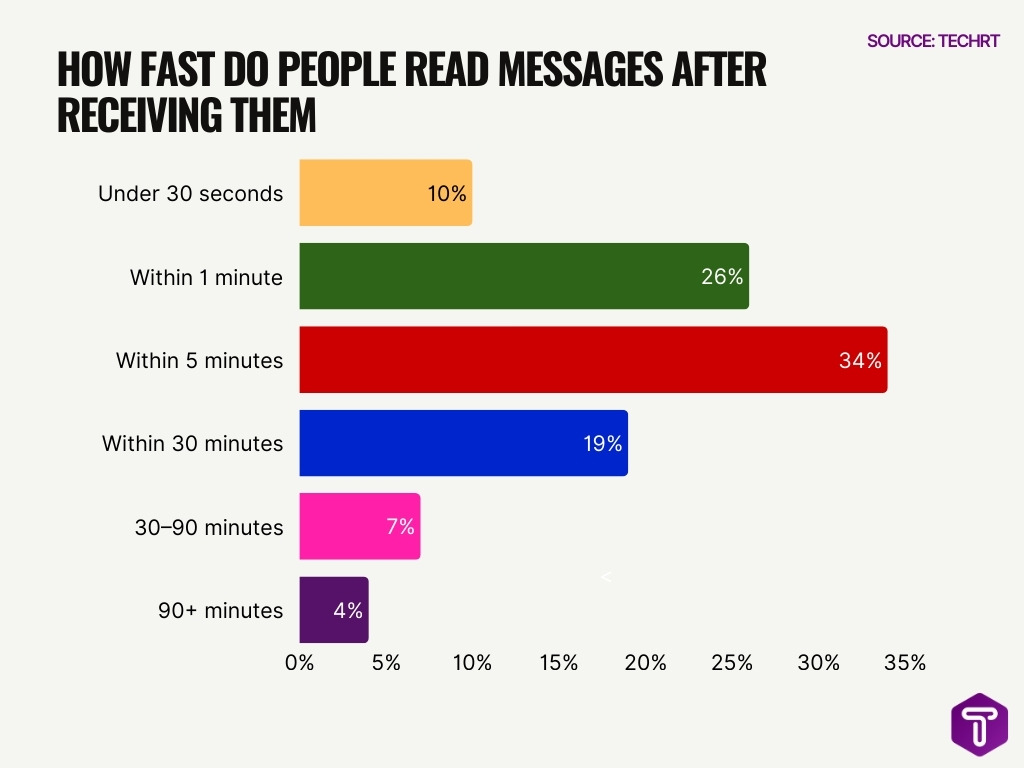
- 34% of people read messages within 5 minutes, making this the most common response window and highlighting the near-instant nature of messaging.
- 26% open messages within 1 minute, showing how frequently users check their phones for new notifications.
- 10% read messages in under 30 seconds, reflecting real-time engagement immediately after delivery.
- 19% of recipients view messages within 30 minutes, indicating strong short-term visibility even beyond instant opens.
- Only 7% read messages after 30–90 minutes, suggesting delayed engagement is relatively uncommon.
- Just 4% take more than 90 minutes to read messages, confirming that most messages are consumed quickly after being received.
Response Times, Texts vs Phone Calls
- SMS messages are often read quickly, with 90% read within minutes of delivery due to immediacy and mobile access.
- SMS response rates average around 45%, showing higher interaction than traditional phone callbacks.
- Approximately 30% of consumers respond to text messages within 5 minutes of receipt.
- The average SMS response time can be as short as around 90 seconds, far faster than many phone conversations.
- Many consumers expect quick replies, 57% expect business responses within 15 minutes, reflecting changing communication standards.
- Voicemails and calls often go unreturned, with callbacks for unknown voicemails as low as 3%.
- Texts allow multitasking and asynchronous replies, aiding faster overall engagement compared to live phone demands.
- Calls frequently face hurdles like busy signals or voicemail screening, slowing direct response compared to immediate text delivery.
Generational Differences in Usage
- Gen Z checks text messages more than 10 times per day at a 48% rate.
- 91% of consumers, especially younger generations, text daily.
- 49% of 18-24-year-olds prefer SMS/texts for family communication.
- Millennials show a 45% response rate to promotional SMS, outpacing email.
- 70% of 18-29-year-olds send text messages via mobile.
- 73% of those 50+, including Boomers, text daily, up from 61% in 2021.
- Boomer phone call preference for family dropped from 65% to 53%.
- SMS has a 98% open rate, read by 90% within 3 minutes across all ages.
- 45% of SMS get responses, vs 6% for email, favored by under 40.
Missed Calls vs Text Delivery Stats
- 58% of consumers respond to a company’s missed call with a text message.
- 82% ignore voicemails from unknown numbers.
- Texts achieve a 45% response rate, compared to 6% for email.
- Only 18% listen to voicemails from unrecognized numbers.
- Voicemail average response rate stands at 4.8%.
- SMS boasts a 98% open rate versus 20% for email.
- 93% of consumers text daily, with 45% checking more than 10 times a day.
- 90% of texts are read within 3 minutes.
- 67% ignore voicemails even from known contacts.
- SMS response rates are 295% higher than phone calls.
Most Effective Business Communication Channels
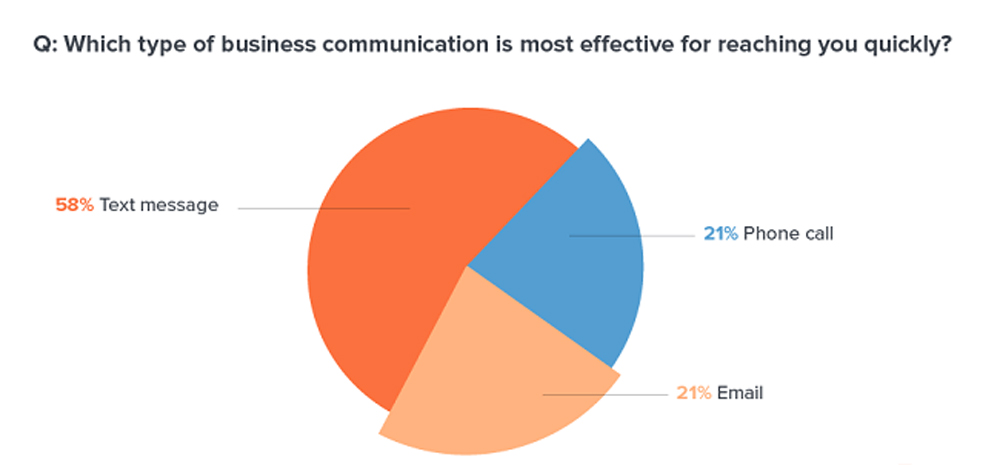
- Text messages dominate quick business communication, with 58% of respondents saying texts are the fastest way to reach them.
- Phone calls account for 21%, showing that calls remain relevant but are far less preferred than messaging for urgent contact.
- Email also stands at 21%, indicating it is equally as slow as calls for immediate communication needs.
- The data highlights a clear shift toward instant, low-friction communication, where texting outperforms traditional methods.
- For businesses prioritizing speed and response rates, SMS emerges as the most effective channel for rapid outreach.
Customer Service Channel Preferences
- 89% of consumers prefer texting over phone calls for business interactions.
- 83% of consumers favor texting over email or calls.
- 74% of people have zero unread texts, enhancing SMS visibility.
- SMS boasts a 98% open rate, far exceeding email’s 20%.
- 45% average response rate for SMS, versus 6% for email.
- Live chat satisfaction is at 73%, higher than phone at 44%.
- 69% prefer text-based support for simple issues.
- 90% of SMS messages are read within 3 minutes.
- 64% of consumers want more SMS communication from companies.
SMS Marketing vs Call Effectiveness
- SMS marketing shows open rates up to ~98% in 2026, outperforming most call outreach visibility.
- SMS response rates (~45%) far exceed typical phone call engagement, especially in marketing contexts.
- Consumers prefer receiving texts from brands over calls, with 85% favoring texts over calls or email.
- SMS delivers high ROI, with some reports indicating substantial return per dollar spent.
- SMS click‑through rates outperform many voice‑based call‑to‑action outcomes.
- Calls often encounter screening and rejection, limiting effectiveness compared to opt‑in SMS.
- Automated SMS campaigns scale more cost‑effectively than manual call support teams.
- Text messaging allows easy personalization.
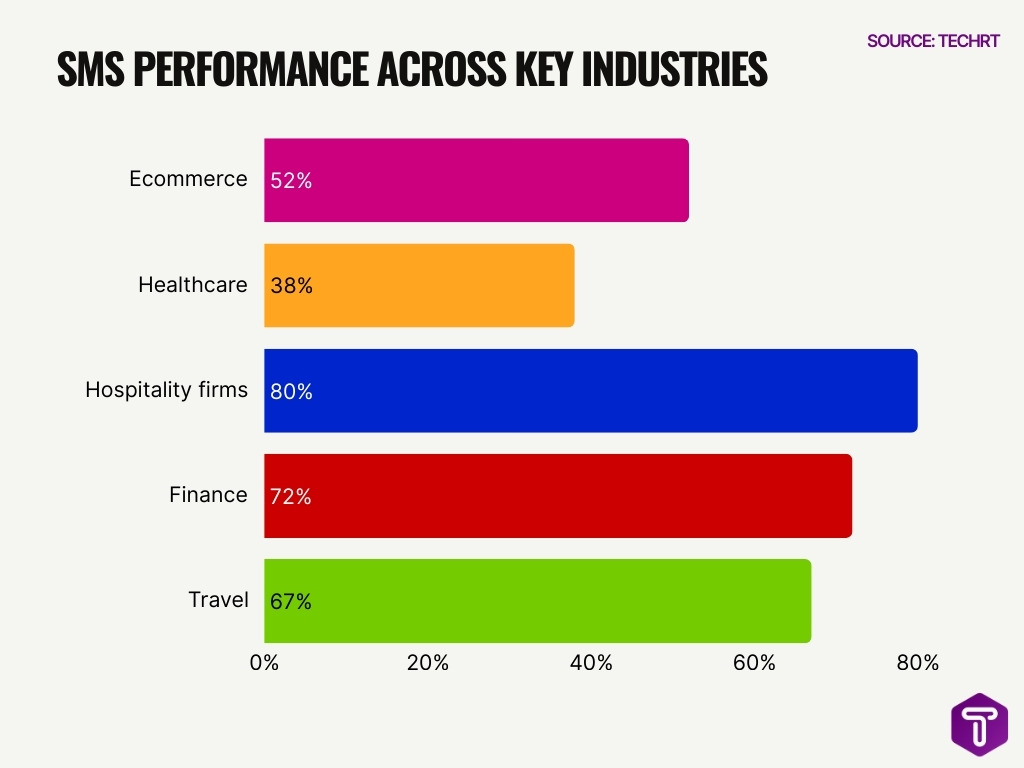
Industry-Specific Communication Stats
- 52% of ecommerce consumers get SMS from 4+ brands, fueling high multi-brand engagement.
- Healthcare SMS reminders slash no-show rates by up to 38%, boosting patient adherence.
- 80% hospitality firms use SMS for booking confirmations, lifting conversions by 20%+.
- Finance SMS campaigns hit CTR above 20% for 72% of users, thanks to urgent alerts.
- Delivery status SMS achieves 90-98% open rates, crushing email’s 28.6%.
- A2P SMS market hit $78.18B in 2024, powering retail and healthcare.
- India‘s Southern region tops SMS commerce adoption, led by e-commerce hubs.
- Travel SMS updates raise booking conversions by 67% via instant confirmations.
- Messaging delivers 45% response rates in minutes, trumping calls for efficiency.
Mobile Activity, Texts Over Calls
- Globally, 25 billion text messages are sent daily in 2025.
- The average user sends/receives 85 texts per day under the age of 45.
- Smartphones account for 86.9% of mobile connections worldwide.
- WhatsApp boasts 3 billion monthly active users in 2026.
- The average person makes/receives 8 calls daily worldwide.
- 83% of consumers prefer texting over calls or email.
- 57% of mobile users rely on messaging apps at least half the time.
- The A2P SMS market grows at 4.2% CAGR to 2035.
- US smartphone penetration reaches 160.6 million units in 2025.
- Texting tops as the preferred communication at 37.6%.
Cold Calling vs Text Outreach Success
- Cold calling remains in use, with about 69% of buyers open to receiving calls when relevant.
- Even so, cold call success rates average around 2.3%, showing limited direct conversion compared to some messaging outcomes.
- Personalization increases cold call effectiveness; AI‑enhanced calls see up to 36% higher meeting conversion rates.
- Multiple contact attempts improve call connections; most conversations occur by the third attempt.
- Text outreach campaigns often achieve higher engagement with opt‑in audiences than unsolicited calls.
- SMS delivers nearly universal reach because it doesn’t depend on app installs or internet connectivity.
- Buyers may reject calls but still engage with texts, especially for transactional notifications.
- Cold calls may still be crucial in B2B sales, but integrating text outreach boosts total touches and response opportunities.
Text Opt-In and Engagement Trends
- 84% of consumers opted in to receive texts from businesses in 2025, up 35% since 2021.
- 52% of subscribers receive texts from four or more brands.
- 55% of businesses saw SMS opt-in rates grow over the past year.
- 86% of consumers opt in for fast, personalized SMS communication.
- 90% of Gen Z check texts within five minutes of receipt.
- 98% SMS open rate drives higher engagement than email’s 20-37%.
- 45% average response rate for SMS campaigns reflects strong interaction.
- 76% of consumers opt in for appointment reminders via text.
- 91% of customers want to receive text messages from businesses.
- 42% of US mobile users subscribe to texts for discounts or coupons.
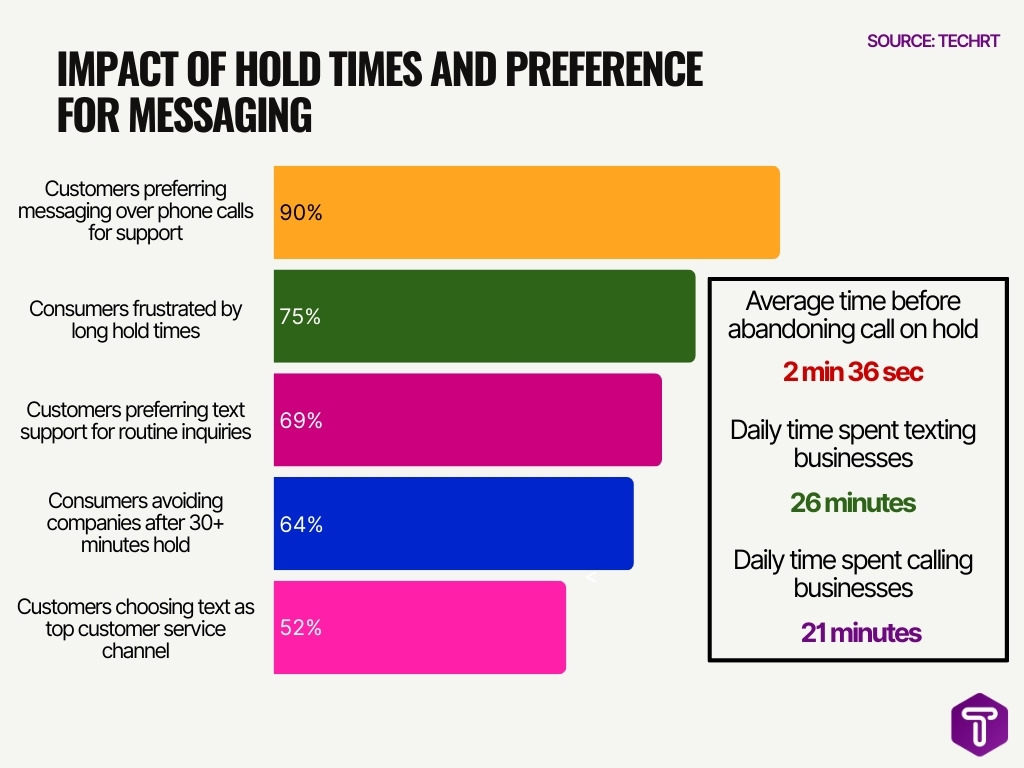
Hold Times and Frustration Levels
- 75% of consumers report frustration from long hold times in customer service.
- Customers abandon calls after an average of 2 minutes 36 seconds on hold.
- 64% avoid companies after 30+ minutes waiting on hold.
- Consumers spend 26 minutes daily texting vs 21 minutes calling businesses.
- 90% of customers prefer messaging over phone calls for support.
- 52% choose text as the top customer service channel.
- 69% prefer text support for routine inquiries over phone holds.
- Texts get responses in 90 seconds vs longer call wait times.
Economic Impact of Channels
- Mobile technologies, including messaging, contribute about 5.8% of global GDP, equating to $6.5 trillion in value.
- The global mobile messaging market was valued at about $136.2 billion in 2025 and is poised for further growth.
- The mobile messaging market is projected to grow at nearly 15.9% CAGR through 2035.
- Messaging channels often deliver higher return on investment (ROI) than traditional ads due to low costs and direct reach.
- Opt‑in SMS campaigns can increase sales and conversions, strengthening revenue streams.
- Messaging’s scalability supports economic efficiency across business sizes and sectors.
- By replacing or supplementing call centers, texting can lower operational costs.
- Messaging’s universality helps bridge digital divides where internet‑based channels lag, expanding economic access.
Future Trends in Calls and Messaging
- RCS business messaging traffic to hit 50 billion messages globally in 2025, up from 33 billion in 2024.
- RCS users are expected to reach 3.9 billion by 2025, leading rich messaging channels.
- Global RCS market projected at $28.2 billion by 2035 with 12.17% CAGR.
- The AI personalization market grows at 17.5% CAGR, adding $2.71 billion by 2029.
- Smartphone owners to reach 5.12 billion in 2026, boosting messaging audiences.
- 58% of consumers rank SMS as the top outreach channel past 2026.
- 80% prefer SMS over apps for business communications.
- Over 40% of voice calls are now via the internet, alongside messaging.
- AI messaging achieves 65% deflection rates, cutting agent needs in 2026.
Frequently Asked Questions (FAQs)
What percentage of text messages are opened compared to other channels?
98% of SMS messages are opened, vastly higher than typical email open rates, around 20–30%.
How much more frequent is texting compared to phone calls for average US smartphone users?
US users send and receive texts at a rate 5× greater than making or receiving phone calls daily.
What share of consumers prefers texting with businesses over calls and email?
About 83% of consumers prefer texting over calls or email for communication.
How many people use WhatsApp, the leading messaging app globally?
WhatsApp has reached approximately 3 billion monthly active users, making it the most widely used messaging platform worldwide.
What is the response rate for SMS compared to emails?
SMS messages have a ~45% response rate, while email response rates are around 6%, showing higher engagement for text messaging.
Conclusion
The landscape of communication shows a clear lean toward texting and messaging as primary channels for personal, commercial, and operational use. Messaging delivers exceptional engagement, rapid response, broad opt‑in adoption, and strong economic impact compared with calls. Yet, calls still play a role in complex outreach and B2B interactions, particularly when personalized or aided by AI. Moving forward, organizations that blend messaging with call strategies and adopt richer messaging technologies will be best positioned to meet diverse user preferences and maximize communication outcomes.

Leave a comment
Have something to say about this article? Add your comment and start the discussion.