



The creator economy has transformed individual expression into measurable economic value. Fueled by social media platforms, digital tools, and direct-to-audience business models, millions now earn income by creating content online. From independent educators selling courses to entertainers engaging global fans, the impact spans industries. Brands increasingly commit budgets to creator collaborations, and creators diversify revenues through subscriptions, sponsorships, and products. Read on for a deep dive into the most important statistics shaping this dynamic market.
Editor’s Choice
- The global creator economy market was valued at approximately $254.4 billion in 2025.
- Market growth forecasts estimate it could exceed $800 billion by the early 2030s at a 22.7% CAGR.
- North America held over 35% market share of the global creator economy in 2025.
- U.S. creator economy valuations range from $50.9 billion to $66.78 billion in recent estimates.
- Sponsored content is projected to account for approximately 59% of creator revenue in 2026.
- Over 200 million people worldwide identify as content creators in 2025.
- Nearly 70% of creators spend 10 hours or less per week on content creation.
- Digital products such as courses and templates show 70% to 90% profit margins for creators.
Recent Developments
- The sector continues to experience rapid investment, with mergers and acquisitions rising significantly in 2025.
- AI tools are increasingly adopted by creators, with 91% using some form of AI for content creation.
- Major creator platforms are shifting toward enhanced brand matching and monetization tools.
- Paid creator tools now include podcast management, analytics upgrades, and ad-free video options.
- Advertising budgets are increasingly directed into creator channels, growing faster than traditional media spends.
- Income distribution within the creator economy is becoming more unequal, with the top 10% receiving a growing share of total brand payments.
- Some platforms surpassed $2 billion in total creator payouts by late 2025.
- Brands are moving toward structured creator programs instead of ad hoc sponsorships.
Creator Economy Market Growth
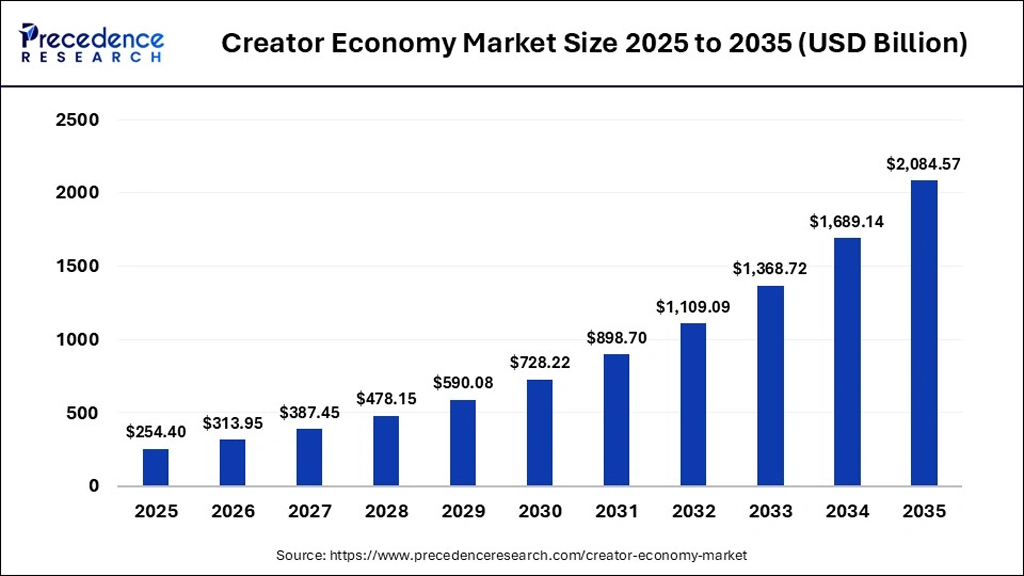
- The global creator economy market is projected to grow from $254.40 billion in 2025 to $2,084.57 billion by 2035, reflecting more than 8× market expansion over a decade.
- Between 2025 and 2027, the market is expected to rise steadily from $254.40 billion to $387.45 billion, showing strong early-stage momentum.
- By 2028, the industry is forecast to cross $478.15 billion, highlighting the accelerating adoption of creator-led platforms and monetization tools.
- In 2029, the market size is estimated to reach $590.08 billion, approaching the $600 billion milestone.
- The creator economy is projected to surpass $700 billion in 2030, reaching $728.22 billion, driven by brand partnerships and digital commerce.
- By 2031, the market is expected to climb to $898.70 billion, moving close to the $1 trillion threshold.
- In 2032, the industry is forecast to exceed $1.1 trillion, reaching $1,109.09 billion, signaling large-scale institutional and corporate participation.
- The market is projected to expand to $1,368.72 billion in 2033, reflecting rapid growth in subscription, NFT, and creator tools ecosystems.
- By 2034, the total market value is expected to reach $1,689.14 billion, indicating strong global monetization maturity.
- In 2035, the creator economy is forecast to peak at $2,084.57 billion, establishing it as a multi-trillion-dollar digital industry.
Market Growth Projections
- A sustained 22% to 26% CAGR is projected through the early 2030s.
- Creators could generate over $800 billion in value by the early 2030s.
- Some forecasts suggest up to 10 times growth from 2024 valuations.
- The U.S. segment alone may reach well over $300 billion by 2034.
- Asia-Pacific markets are expected to grow fastest despite North America’s current lead.
- Subscription-driven creator revenues are forecast to expand rapidly.
- Video streaming remains the dominant content format, driving growth.
- Digital products and education are projected to become major revenue contributors.
Number of Creators Worldwide
- More than 200 million content creators are active globally.
- Around 45 million-plus creators operate professionally.
- In the United States, over 162 million individuals identify as creators.
- The number of paid creators more than doubled on several major platforms between 2023 and 2025.
- Nearly 50% of creators earn less than $15,000 annually.
- Only approximately 4% earn above $100,000 per year.
- The typical time to first creator income is about 6 to 7 months.
- Many newer creators spend under 10 hours per week on content production.
Key Insights: Community Creator Archetypes in 2026
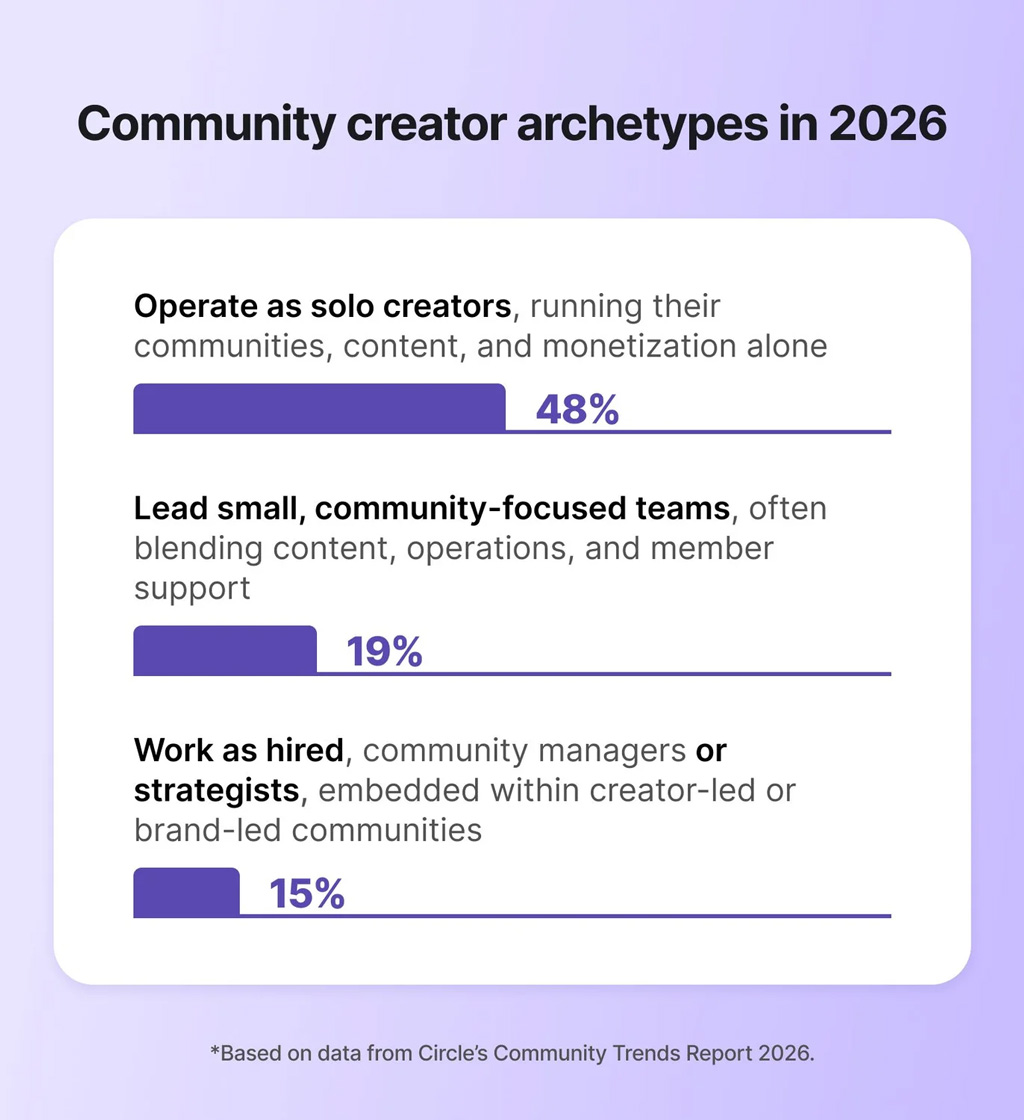
- Nearly half of creators (48%) operate as solo creators, independently managing communities, content, and monetization, highlighting the dominance of self-managed creator models.
- Only 19% of creators lead small, community-focused teams, indicating that lean operations remain more common than fully staffed organizations.
- About 15% of creators work as hired community managers or strategists, showing steady demand for professional community management within creator-led and brand-led ecosystems.
- The strong 48% solo creator share suggests that automation tools, AI platforms, and creator management software are becoming essential for handling multiple responsibilities alone.
- With just 19% running small teams, most creators still prefer flexible, low-cost structures over traditional company-style operations.
- The 15% professional hire segment reflects growing opportunities for freelancers and consultants specializing in community strategy and engagement.
- Overall, the data highlights a clear trend toward independent and lean creator businesses, with over 82% of creators either working solo or in small teams, shaping the future of the creator economy in 2026.
Creator Demographics and Age
- Over 80% of digital creators are aged 18–34 years.
- 52.83% of TikTok creators fall in the 18–24 age group.
- Millennials comprise 42–48% of all content creators.
- 71% of creators are over age 30, averaging 37 years.
- Men represent 55% of creators overall, varying by niche.
- 43% of U.S. creators aged 25+ hold a four-year college degree.
- 53% of creators work part-time alongside other employment.
- Short-form platforms like TikTok skew toward younger creators under 30.
- Older creators (50+) make up 20% of global social media users.
Geographic Distribution and Regional Market Shares
- North America accounted for 35% to 40% of the global creator economy market share in 2025.
- The United States represents more than $66.78 billion in creator economy value.
- Asia-Pacific is projected to be the fastest-growing region through 2030.
- India has over 80 million content creators, with rapid growth in regional language segments.
- Brazil ranks among the top countries for Instagram and YouTube creators.
- Europe represents approximately 20% to 25% of global creator economy revenue.
- Influencer marketing spending in the Middle East and North Africa grew by over 20% year over year in 2025.
- Over 50% of digital creator earnings come from international audiences on major platforms.
Top Platforms for Creators
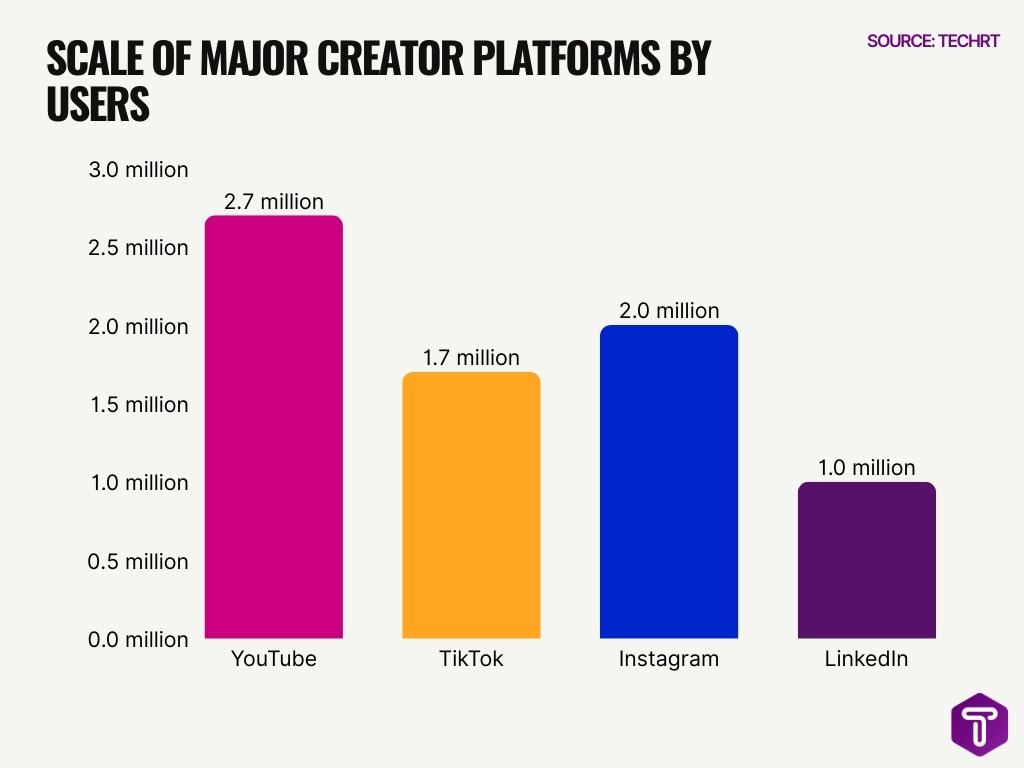
- YouTube has over 2.7 billion monthly active users globally.
- TikTok surpassed 1.7 billion monthly active users in 2025.
- Instagram maintains more than 2 billion monthly active users.
- Patreon supports over 250,000 active creators.
- Substack surpassed 35 million monthly active readers.
- Twitch hosts approximately 7 million monthly streamers.
- OnlyFans generated over $6.6 billion in gross payments in 2024.
- LinkedIn surpassed 1 billion members, with creator mode driving engagement growth.
- Shopify reported sustained growth in creator-led ecommerce storefronts.
Top Niches by Popularity
- Fashion & lifestyle influencers captured the largest market share in 2025.
- The gaming market hit a record $197 billion in revenue by the end of 2025.
- Personal finance creators saw surging brand partnerships with fintech firms in 2025.
- The digital education market reached $32.36 billion in 2025.
- Health & fitness influencers achieved up to 11.72% engagement rates on platforms.
- The AI-powered content creation market grew to $4.35 billion by 2025 at 31.4% CAGR.
- 74% of millennial parents involve kids in decisions, boosting family content engagement.
- Food & beverage reels on TikTok averaged 3.7% engagement rates.
- Gen Z spends over 3 hours daily on social media, fueling productivity communities.
Creator Revenue Streams
- Brand partnerships account for approximately 50% to 60% of total creator income.
- Affiliate marketing spending surpassed $17 billion globally in 2024.
- Digital product sales often generate 70% or higher profit margins.
- Merchandise sales continue to expand through ecommerce integrations.
- Ad revenue from platform partner programs remains significant.
- Live streaming tips and virtual gifting contribute meaningful revenue in select markets.
- Podcast advertising surpassed $2 billion in US ad revenue.
- Online courses and coaching services continue to expand revenue diversification.
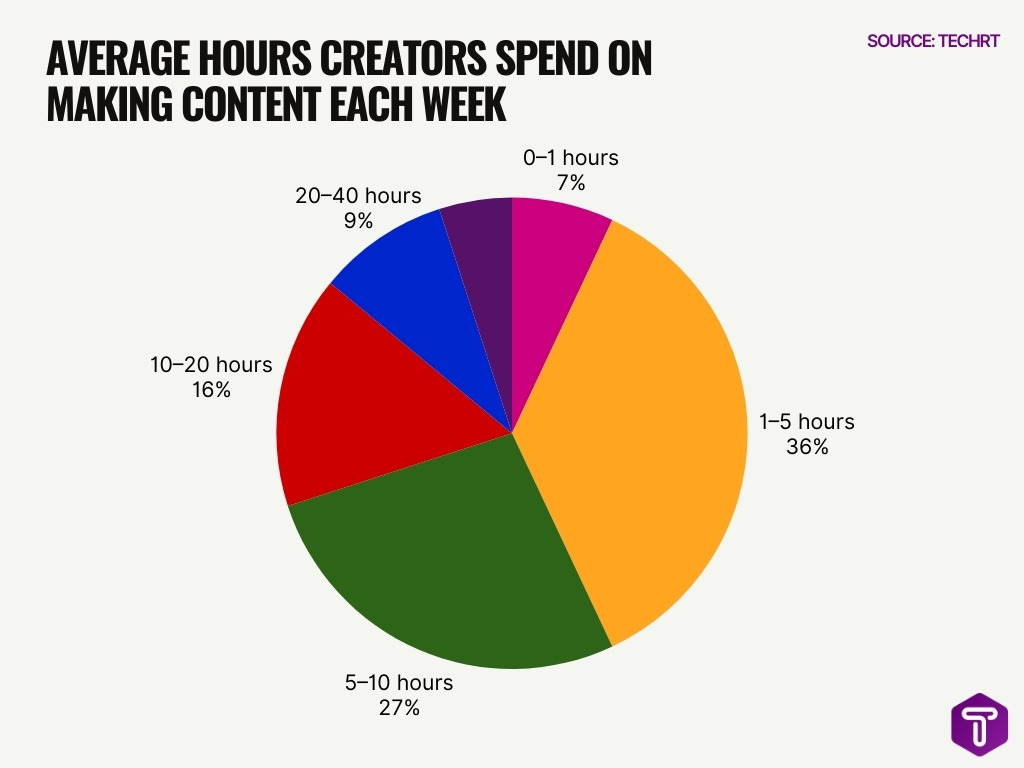
Average Weekly Time Spent by Creators on Content Creation
- The largest group of creators, 36%, spends 1–5 hours per week on making content, indicating a strong presence of part-time or casual creators.
- About 27% of creators dedicate 5–10 hours weekly, showing a significant shift toward more consistent content production.
- Nearly 16% of creators invest 10–20 hours per week, reflecting a semi-professional approach to content creation.
- Only 9% of creators spend 20–40 hours weekly, highlighting that full-time-level commitment remains relatively limited.
- A small segment, just 5%, works 40+ hours per week, representing highly dedicated or professional creators.
- Around 7% of creators spend only 0–1 hour per week, suggesting minimal engagement or early-stage participation.
- Overall, more than 63% of creators spend under 10 hours per week, emphasizing that most creators balance content creation with other responsibilities.
Brand Deals and Sponsorships
- Influencer marketing spending reached approximately $24 billion globally and continues rising.
- US influencer ad spending is projected to exceed $7 billion in 2026.
- Micro-influencers deliver engagement rates up to 60% higher than macro influencers.
- Nearly 80% of marketers report positive ROI from influencer campaigns.
- Long-term brand partnerships increased by over 40% year over year.
- Short-form video campaigns frequently exceed 5% average engagement rates.
- Most major brands now allocate dedicated creator marketing budgets.
- AI-based creator discovery tools reduce campaign planning time and costs.
Subscription and Membership Revenue
- Patreon creators collectively earn billions annually through recurring subscriptions.
- Substack’s top creators generate over $20 million annually in subscription revenue.
- YouTube channel memberships and Super Chats contribute recurring income.
- Membership-based communities report steady user growth among educators and coaches.
- Subscription pricing typically ranges between $5 and $15 per month.
- Recurring revenue provides more predictable income compared to ad-only models.
- Podcast subscription adoption continues growing among business and news creators.
- Superfans often generate the majority of recurring income within creator communities.
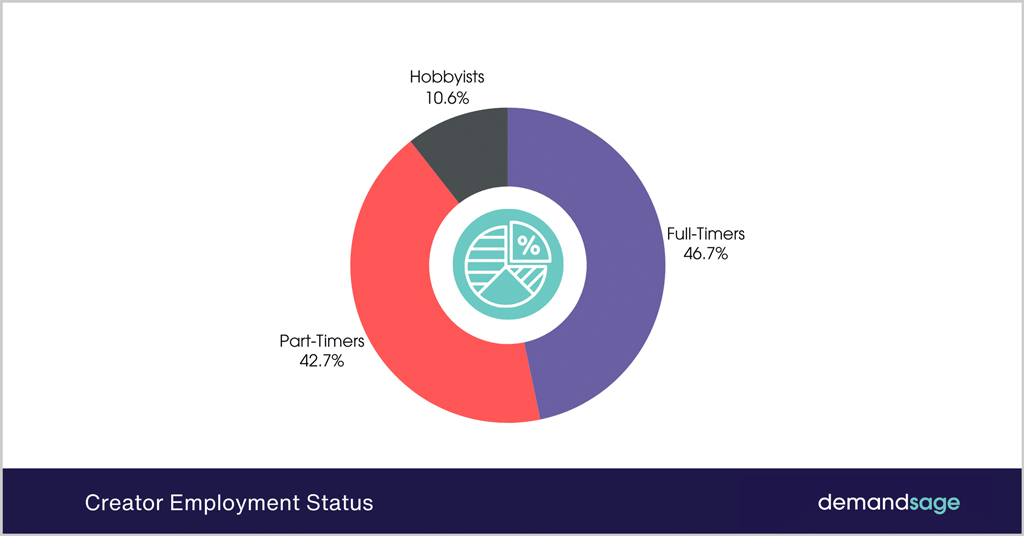
Creator Employment Status: Key Insights
- Full-time creators dominate the market, with 46.7% of respondents relying on content creation as their primary income source, highlighting the growing professionalism of the creator economy.
- Part-time creators account for 42.7%, showing that nearly half of all creators balance content creation alongside other jobs or businesses.
- Hobbyist creators represent only 10.6%, indicating that a small minority engage in content creation mainly for personal interest rather than income.
- Over 89% of creators (46.7% + 42.7%) are either full-time or part-time professionals, emphasizing that the creator economy is now largely income-driven and career-focused.
- The narrow gap between Full-Timers (46.7%) and Part-Timers (42.7%) suggests a high potential for part-time creators to transition into full-time roles.
- The relatively low 10.6% hobbyist share reflects increasing monetization opportunities, encouraging more creators to pursue content creation as a serious profession.
Digital Products and Courses
- The global e-learning market hit $342.4 billion in 2024.
- Digital downloads boast 80-95% profit margins.
- Creator-led courses grow at 25% annually.
- 70% of creators earn the most from online courses.
- The US e-learning market is at $35 billion with 12% CAGR.
- North America claims 37% of the global e-learning share.
- Course enrollments jumped 425% post-pandemic.
- Premium courses are priced at $300-$2,000, typically.
- Webinar launches yield 20-40% lead conversion.
Monetization Trends 2026
- Influencer marketing spending exceeds $24 billion globally.
- US influencer ad spending surpasses $7 billion.
- Affiliate marketing remains a $17 billion plus industry.
- Over 60% of marketers increased short-form video budgets.
- US social commerce sales are projected to exceed $100 billion by 2026.
- Subscription models continue growing faster than ad-supported revenue.
- Live shopping adoption continues to expand.
- Creator-owned brands are increasing across ecommerce platforms.
- Long-term ambassador contracts are replacing one-off sponsorships.
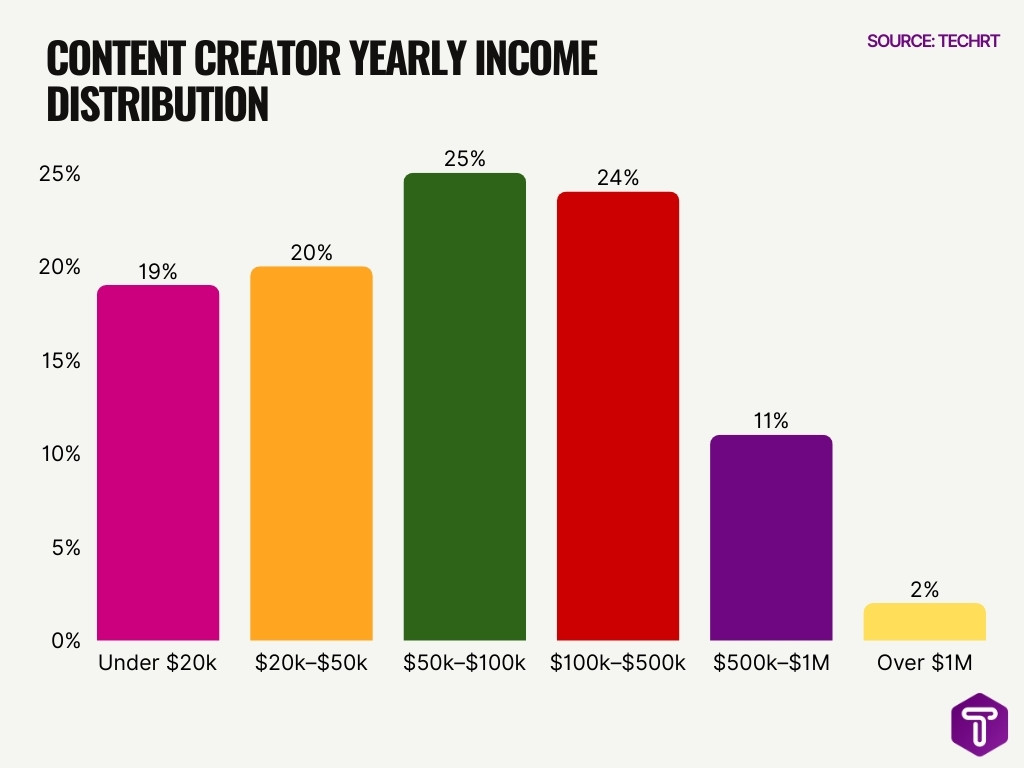
Content Creator Income Distribution Insights
- Nearly two-thirds of content creators earn under $100,000 annually, with 19% making under $20,000, 20% earning $20k–$50k, and the largest share, 25%, falling in the $50k–$100k income bracket.
- The mid-to-upper income segment ($100k–$500k) accounts for a significant 24% of creators, highlighting a growing group achieving sustainable full-time earnings.
- Only 11% of content creators earn between $500,000 and $1 million per year, showing that high-six-figure incomes remain relatively uncommon.
- An elite 2% of creators earn over $1 million annually, underscoring how top-tier success is highly concentrated among a small fraction of creators.
- Overall, the data confirms that while the creator economy offers strong upside, income distribution remains heavily skewed toward lower and mid-level earners, with fewer creators breaking into high-income tiers.
AI in the Creator Economy
- Over 90% of creators report using AI tools.
- More than 80% of marketers adopted generative AI in 2025.
- AI tools reduce production time by 30% to 50%.
- Recommendation algorithms drive the majority of content discovery.
- Over 60% of consumers express concern about AI misinformation.
- AI voice and avatar tools enable multilingual scaling.
- Automation tools improve productivity for solo creators.
- Regulatory scrutiny around AI-generated content continues to increase.
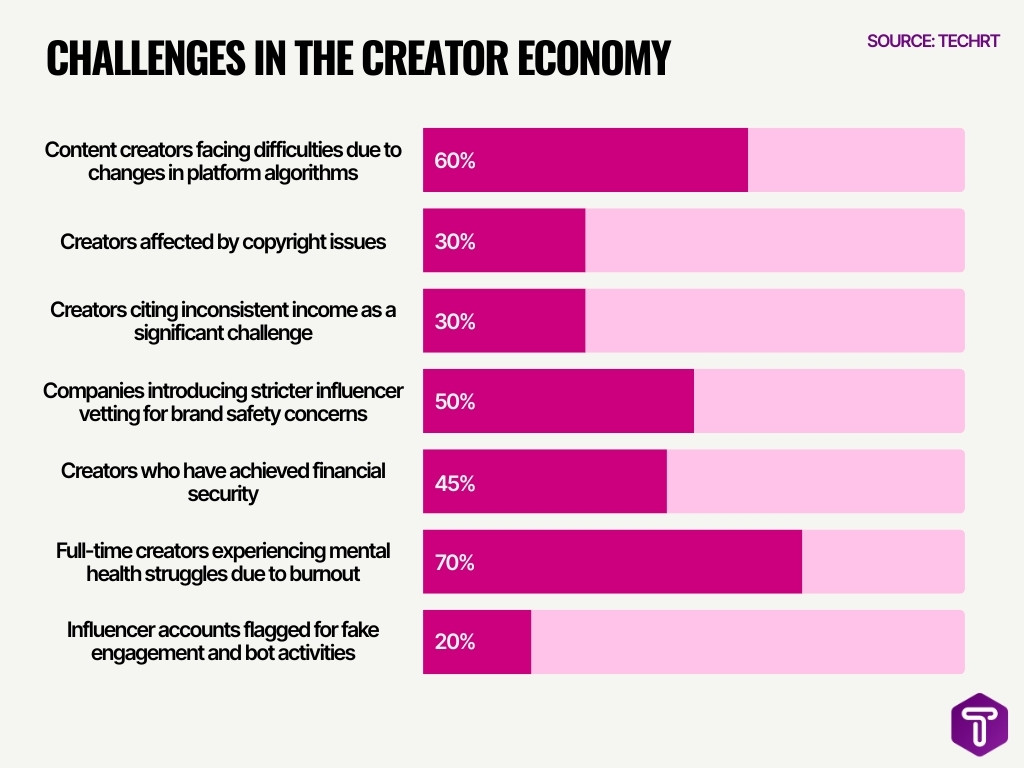
Key Challenges in the Creator Economy
- Mental health struggles are the most widespread issue, with 70% of full-time creators experiencing burnout and emotional stress.
- Platform algorithm changes significantly impact visibility and income, affecting 60% of content creators worldwide.
- Brand safety concerns are rising, as 50% of companies now apply stricter influencer vetting processes.
- Despite growth opportunities, only 45% of creators report achieving long-term financial security.
- Income instability remains a major concern, with 30% of creators citing inconsistent earnings as a serious challenge.
- Copyright-related issues continue to limit monetization, impacting 30% of digital creators across platforms.
- Fake engagement and bot activity are under scrutiny, with 20% of influencer accounts flagged for suspicious behavior.
Community-Led Models
- Patreon supports 250,000-plus active creators.
- Substack hosts over 2 million paid subscriptions.
- Discord surpassed 150 million monthly active users.
- Membership pricing typically ranges between $5 and $25 per month.
- Recurring revenue reduces income volatility.
- Top 10% of fans often generate the majority of income.
- Community-first creators report higher lifetime customer value.
- Education-focused creators increasingly rely on private communities.
Frequently Asked Questions (FAQs)
What was the global creator economy market size in 2025?
The global creator economy market size was valued at around $254.4 billion in 2025, according to recent forecasts.
At what growth rate is the creator economy expected to expand through the next decade?
The creator economy market is projected to grow at a 23.41% compound annual growth rate (CAGR) from 2026 to 2035.
How large could the global creator economy market be by 2035?
By 2035, the global creator economy is expected to reach an estimated $2,084.57 billion.
How big is the creator economy in the United States, specifically?
The U.S. creator economy market was valued at $66.78 billion in 2025 and could grow to nearly $558.72 billion by 2035 at a strong growth rate.
What percentage of revenue in 2026 do creators earn from sponsored content?
In 2026, creators are expected to earn 59% of their revenue from sponsored content, according to industry forecasts.
Conclusion
The creator economy stands at a defining moment. It has grown into a $200 billion plus global market, supported by hundreds of millions of creators and fueled by brand partnerships, digital products, and subscription models. Growth continues at double-digit rates, yet income inequality, algorithm dependency, and platform volatility create ongoing challenges.
For US creators and brands, the opportunity remains substantial. Businesses continue shifting advertising budgets toward creator partnerships, while creators diversify income streams to build resilience. Those who prioritize community ownership, recurring revenue, and multi-platform distribution remain best positioned for long-term sustainability.
The creator economy is no longer experimental. It is a measurable, expanding sector reshaping media, marketing, and entrepreneurship worldwide.

Leave a comment
Have something to say about this article? Add your comment and start the discussion.