




Customer relationship management (CRM) systems have become essential tools for businesses aiming to manage customers, streamline sales processes, and gain a competitive edge. Today’s CRM software integrates AI, mobile access, and cloud scalability, driving efficiency and personalized engagement across sectors such as retail and healthcare. In practical scenarios, a mid‑sized e‑commerce firm can automate customer follow‑ups to boost repeat purchases, while a regional healthcare provider uses CRM analytics to improve patient outcomes. Below, we break down the most important CRM statistics that every marketer, CIO, and sales leader should know.
Editor’s Choice
- The global CRM market was valued at approximately $112.91 billion in 2025.
- North America accounted for about 31.7% of global CRM revenue in 2025.
- 91% of companies with 10+ employees now use CRM systems.
- Around 87% of CRM deployments are cloud‑based.
- 70% of businesses use mobile CRM to stay connected on the go.
- CRM platforms deliver an average ROI of $8.71 per dollar spent.
- 65% of businesses view AI as a critical CRM capability by 2026.
Recent Developments
- CRM adoption continues to rise, with more than 90% of mid‑size and large organizations using CRM tools by 2026.
- AI enhancements such as predictive analytics and chatbots are now integral to CRM platforms, improving forecasting accuracy and engagement.
- Generative AI integration in CRM is identified by 65% of businesses as a top trend through 2026.
- CRM systems with AI boost organizations’ likelihood of exceeding sales goals by ~83%.
- Cross‑platform access is growing, with 81% of users accessing CRM on multiple devices.
- Automated workflows and real‑time data are driving CRM use in customer service and marketing functions.
- Cloud migration remains a priority as businesses seek scalability and cost savings.
- Vendors continue to expand capabilities through acquisitions and partnerships, particularly in AI and data analytics.
CRM Market Growth Outlook
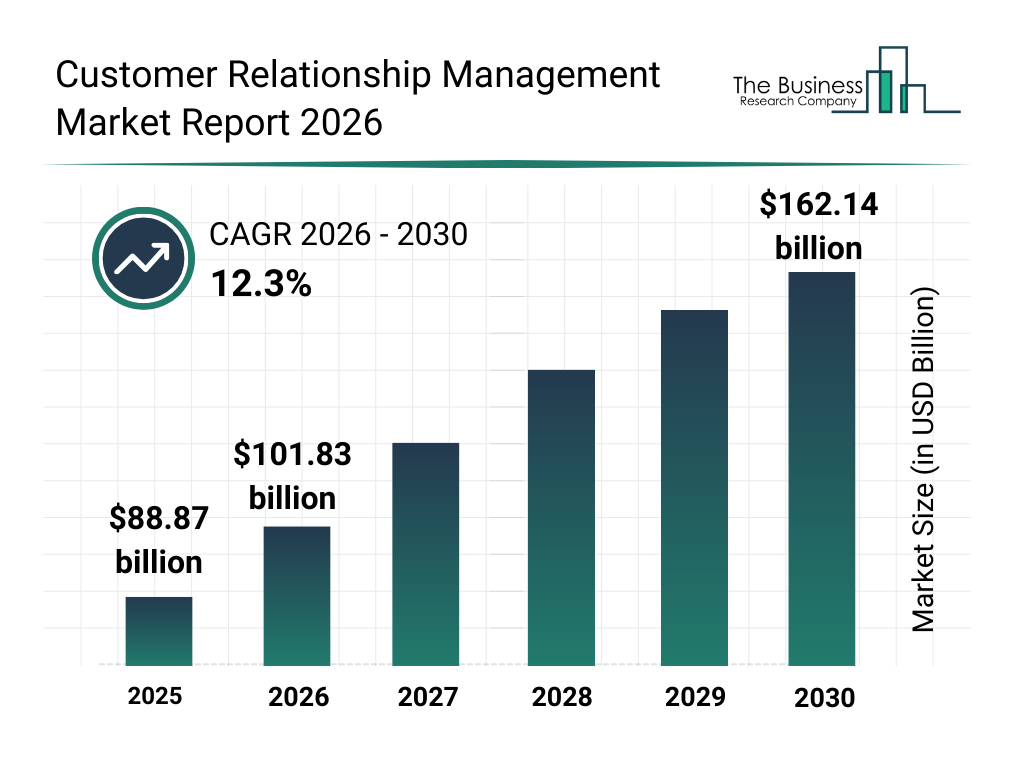
- The global CRM market was valued at $88.87 billion in 2025, reflecting strong enterprise adoption of customer management platforms.
- Market size increased to $101.83 billion in 2026, indicating rapid year-over-year expansion driven by digital transformation.
- The industry is projected to grow at a CAGR of 12.3% from 2026 to 2030, highlighting sustained long-term momentum.
- By 2030, the CRM market is expected to reach $162.14 billion, demonstrating robust demand across sales, marketing, and support functions.
- The consistent upward trend from 2025 to 2030 shows rising investments in cloud-based, AI-powered, and data-driven CRM solutions.
- Growth between 2026 and 2030 is supported by increasing focus on customer experience, automation, and analytics integration.
- The expansion from $88.87 billion in 2025 to $162.14 billion in 2030 represents nearly a 1.8× market increase within five years.
- Enterprises are increasingly adopting CRM platforms to improve lead management, customer retention, and revenue optimization, fueling market growth.
CRM Market CAGR
- The CRM market is projected to grow at a CAGR of ~12.4% from 2026 to 2034.
- Growth forecasts vary by source, with 9.38% CAGR through 2033 also cited.
- SaaS CRM alone shows an estimated 13.43% CAGR from 2024 to 2027.
- Cloud CRM market growth is estimated at 10.53% CAGR to 2032.
- Mobile and AI integrations are significant growth accelerators.
- Regional tech investments in North America and Europe push CAGR upward.
- Emerging markets in the Asia Pacific are expected to outperform due to digital initiatives.
- CRM adoption in SMEs contributes to sustained compound growth.
Regional CRM Market Share
- North America dominated with 52% market growth share in CRM.
- The North America CRM market is valued at $27.16 billion in 2024, growing to $72.06 billion by 2033.
- The U.S. CRM market reached $25.2 billion in 2025, leading globally.
- Europe cloud CRM market is sized at $13.54 billion in 2025.
- Asia Pacific CRM grows at 13.90% CAGR through 2032, the fastest regionally.
- Asia Pacific expected at 8.86% CAGR to 2031, driven by 50,000+ SMEs.
- Cloud holds 80.16% global CRM share in 2025.
- U.S. CRM providers’ industry revenue hit $45.3 billion in 2025.
- European enterprises show 25.8% CRM adoption rate.
- Latin America CRM leads SaaS with 30% revenue share in 2025.
Key Qualities Businesses Look for in CRM Software
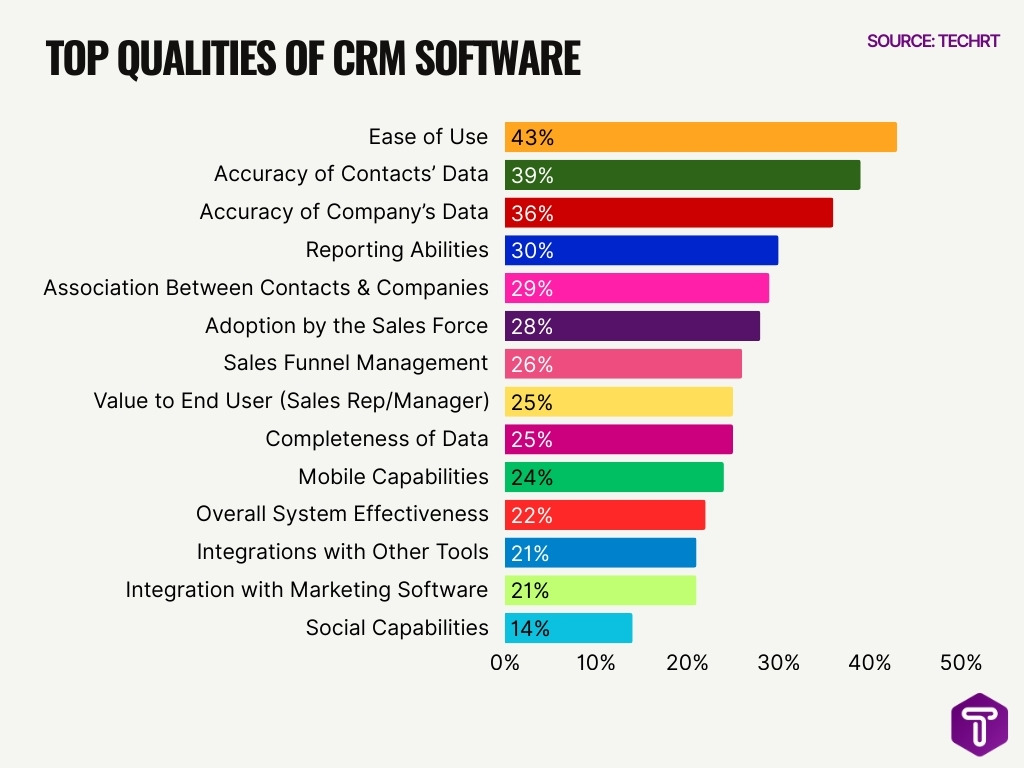
- Ease of use is the most important factor, with 43% of users prioritizing simple and intuitive CRM interfaces for daily operations.
- Accuracy of contacts’ data ranks second, as 39% of respondents emphasize the need for reliable and up-to-date customer information.
- Accuracy of company data remains critical for 36% of users, supporting better segmentation, targeting, and reporting.
- Reporting abilities are valued by 30% of organizations, enabling performance tracking and data-driven decision-making.
- Strong association between contacts and companies matters to 29% of users, improving relationship mapping and account management.
- Sales force adoption is a priority for 28% of businesses, highlighting the importance of user-friendly onboarding and engagement.
- Sales funnel management is essential for 26% of companies, helping optimize lead progression and conversion rates.
- Value to end users, such as sales representatives and managers, influences 25% of buyers, focusing on productivity and usability benefits.
- Completeness of data is important to 25% of respondents, ensuring minimal gaps in customer and prospect records.
- Mobile capabilities are considered vital by 24% of users, supporting remote work and on-the-go sales activities.
- Overall system effectiveness impacts 22% of organizations, reflecting the need for reliable and high-performing CRM platforms.
- Integrations with other tools are required by 21% of users, enabling seamless workflows across business software.
- Integration with marketing software is valued by 21%, supporting lead nurturing and campaign performance tracking.
- Social capabilities rank lowest, with only 14% of respondents considering social media features a key CRM requirement.
CRM Adoption Rates
- ~91% of companies with 10 or more employees use CRM systems, showing broad adoption across business sizes.
- Around 65% of businesses implement a CRM within their first five years of operations, underscoring early reliance on customer data tools.
- 87% of CRMs are now cloud‑based, reflecting the wide preference for SaaS deployment over legacy solutions.
- Adoption continues growing as remote and hybrid work models boost demand for connected customer systems.
- CRM adoption is accelerating across sectors such as e‑commerce, retail, and banking, where customer experience is a competitive differentiator.
- Cloud CRM use elevates participation among SMEs, with 53% of CRM installs in SMEs in recent cloud market analysis.
- AI‑enabled CRM features are now fundamental elements in adoption decisions, with about 33% of vendors adding generative AI tools to their suites.
- CRM adoption also rises with compliance needs and data security investments, especially in regulated industries.
Cloud vs On‑Premise CRM
- The cloud CRM segment is projected to hold a dominant ~34.7% market share in 2026, continuing to outpace on‑premise systems.
- Cloud CRM offers predictable subscription costs versus high upfront investments in on‑premise infrastructure.
- 87% of CRMs are cloud‑based today, reflecting the broad shift away from legacy on‑site installations.
- Cloud deployments support hybrid workforces with remote access and automatic updates.
- On‑premise CRM persists in industries with strict data residency or custom integration requirements.
- Cloud CRM market growth is strong, with the global cloud CRM market expected to rise from $53.74 B in 2025 to $59.28 B in 2026.
- Enhanced scalability and reduced IT maintenance make cloud CRM particularly attractive to growing SMEs.
- Omnichannel and AI‑ready features are now standard in cloud CRM offerings, widening adoption across digital engagement use cases.
CRM Usage by Industry
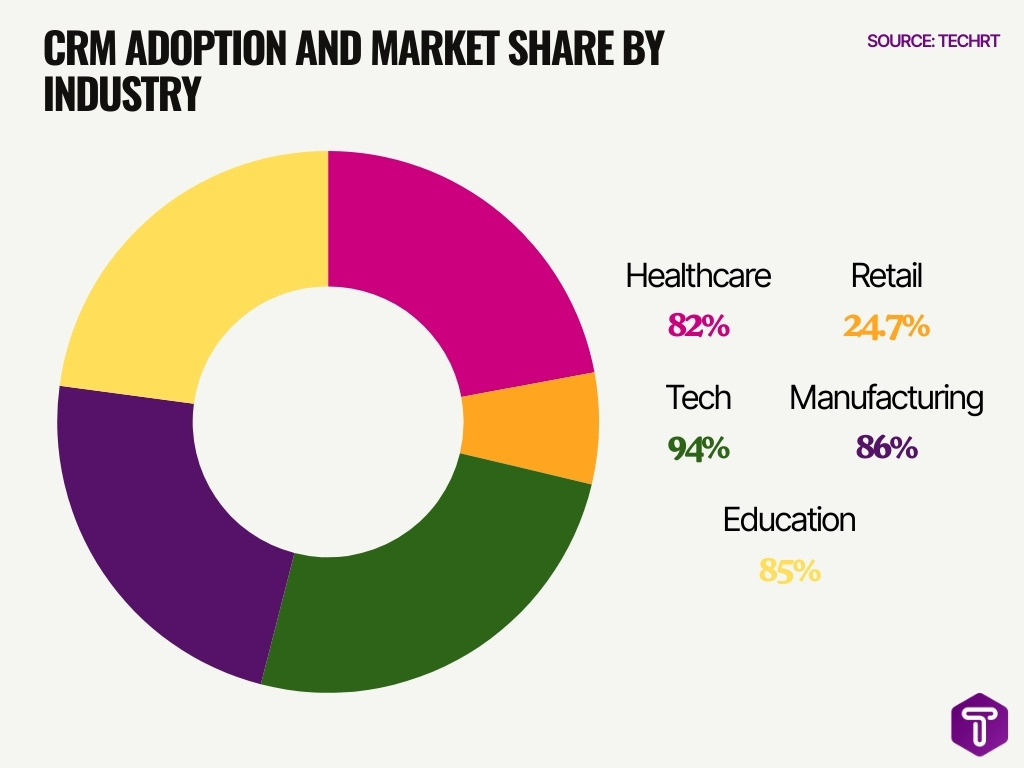
- Healthcare sees 82% CRM adoption rate for patient management and personalized care.
- BFSI leads the CRM market share, focusing on personalized services and compliance.
- Retail holds 24.7% CRM market share, driving customer engagement and sales.
- Telecommunications uses CRM for churn prediction, reducing customer loss significantly.
- Tech companies have the highest 94% CRM adoption for data-driven operations.
- Manufacturing reports 86% CRM usage for dealer networks and success tracking.
- Education achieves 85% CRM adoption for student and alumni engagement.
- 91% of companies with 10+ employees use CRM systems across industries.
Mobile CRM Adoption
- ~70% of businesses use mobile CRM tools to support sales teams in the field and improve responsiveness.
- Companies deploying mobile CRM are ~150% more likely to exceed sales targets due to real‑time access.
- Cloud‑based CRM adoption has expanded mobile CRM usage by 45%, enabling collaboration on the go.
- Mobile CRM enables remote customer service via mobile dashboards and integrated chat tools.
- Real‑time access to analytics and notifications increases sales efficiency and reduces response delays.
- Small businesses leverage mobile CRM for quick lead updates and follow‑up task automation.
- Integration with mobile productivity suites improves unified sales and marketing workflows.
- Mobile accessibility is cited as a key requirement for CRM upgrades in 2026 planning cycles.
CRM ROI Statistics
- A significant majority of companies view CRM as necessary for revenue growth and operational alignment.
- CRM investments deliver measurable ROI by improving sales pipeline visibility and customer insights.
- Companies often assess CRM value through metrics such as lead conversion, retention, and automation gains.
- Cloud CRM’s subscription model reduces TCO and accelerates net benefit realization.
- Firms with mature CRM analytics report improved forecasting and customer lifetime value (CLV) tracking.
- Many small businesses achieve value early through CRM‑enabled marketing automation.
- ROI increases as CRM integrates AI features like predictive lead scoring and churn alerts.
- CRMs that centralize multi‑channel engagement improve cross‑sell and up‑sell opportunities.
Leading CRM Vendors
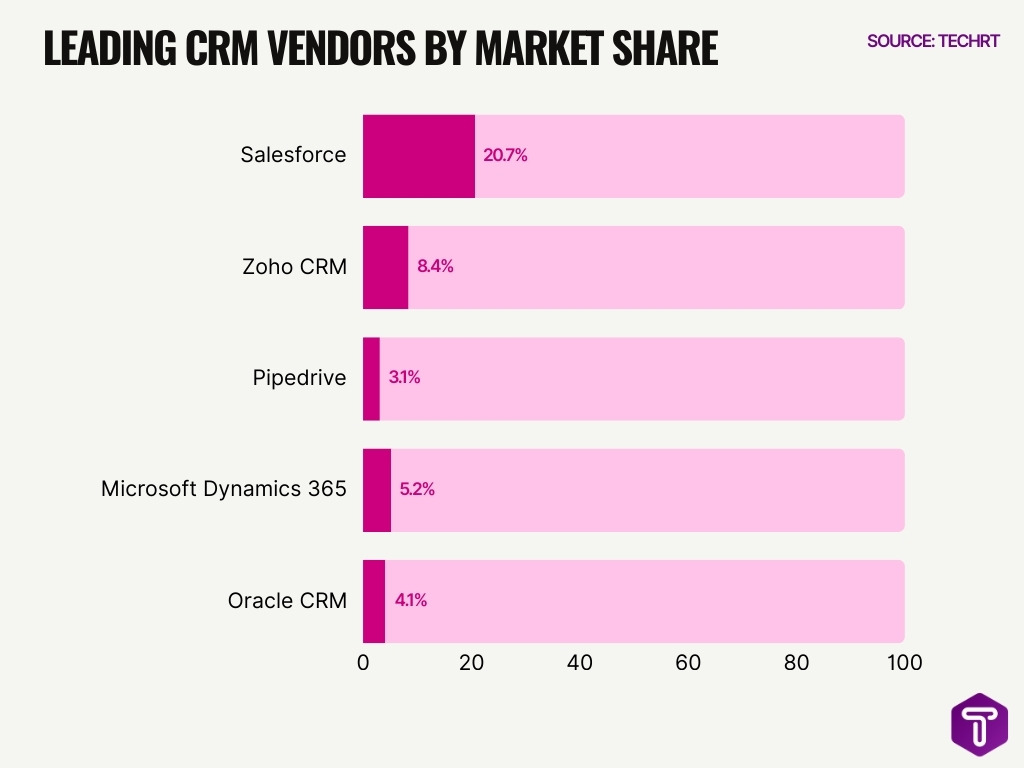
- Salesforce holds 20.7% global CRM market share in 2024, leading all vendors.
- Salesforce generated $37.9 billion in total revenue in fiscal year 2025.
- HubSpot serves ~248,000 paying customers as of Q4 2024.
- Zoho CRM commands 8.4% global CRM market share.
- Zoho CRM added 250,000+ businesses in 2024, with 30% YoY growth.
- Pipedrive holds 3.1% CRM market share and serves 100,000+ companies.
- Microsoft Dynamics 365 has 5.2% market share with 23% revenue growth in FY25 Q4.
- Oracle CRM possesses 4.1% market share, strong in enterprise integration.
- Freshworks (Freshsales) reached 73,300 customers in Q1 2025, up 9% YoY.
Sales Revenue Impact
- 92% of businesses report CRM as critical for meeting revenue goals.
- CRM implementations boost sales revenue by 21-30%.
- Businesses using CRM are 86% more likely to exceed sales goals.
- Every $1 spent on CRM yields $8.71 in ROI.
- CRM shortens sales cycles by 8-14 days.
- Mobile CRM increases sales productivity by 14.6%.
- AI-driven CRM boosts sales revenue by 25%.
- CRM improves customer retention rates by 10-29%, driving repeat sales.
- CRM enables cross-selling revenue growth by 39%.
Lead Conversion Rates
- CRM users report an average 17% increase in lead conversion rates after implementation, helping sales teams turn more prospects into customers.
- Companies using advanced CRM features see up to a 32% higher conversion rate compared with legacy systems.
- In 2026, lead quality and lead‑to‑customer conversion metrics rank among the top 5 priorities for marketers.
- About 80% of new leads never convert to sales, underscoring the need for effective CRM nurture workflows.
- Using CRM for segmentation and scoring helps prioritize high‑intent prospects.
- Integrating CRM with automation can shorten time to contact, boosting conversion.
- Data‑driven CRM decisions reduce churn in funnel stages, driving stronger lead progression.
CRM Buyers by Company Size: Key Market Insights
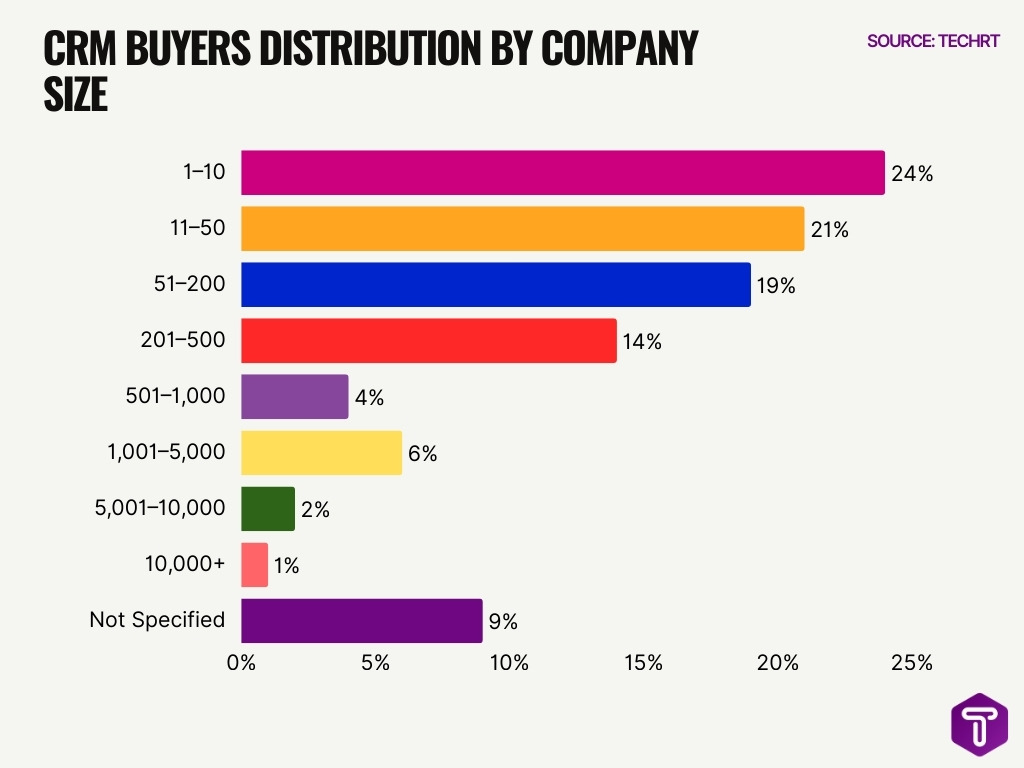
- Small businesses (1–10 employees) lead CRM adoption, representing 24% of all respondents, making them the largest buyer segment.
- Micro and small firms (11–50 employees) account for 21%, highlighting strong CRM demand among early-stage and growing companies.
- Mid-sized companies (51–200 employees) contribute 19%, showing steady CRM investment in scaling organizations.
- Upper mid-market businesses (201–500 employees) make up 14%, reflecting increased focus on customer management systems.
- Lower enterprise firms (501–1,000 employees) represent only 4%, indicating limited adoption in this segment.
- Large enterprises (1,001–5,000 employees) hold 6%, suggesting selective and specialized CRM usage.
- Very large organizations (5,001–10,000 employees) account for just 2%, showing low participation rates.
- Global corporations (10,000+ employees) form the smallest group at 1%, reflecting reliance on custom or legacy systems.
- Unspecified company sizes represent 9%, pointing to data reporting gaps in CRM market surveys.
Sales Productivity Boost
- CRM adoption correlates with improved sales productivity, with some platforms reporting up to a 34% increase in productivity metrics.
- AI‑enabled CRM use has helped 63% of sales teams increase productivity by 10–15%.
- Companies leveraging CRM analytics gain clearer pipeline insight and reduce non‑selling time.
- Sales reps spend less time on manual tasks as CRM automation frees time for selling.
- Mobile CRM access supports field teams, speeding real‑time interaction and follow‑ups, expanding productivity.
- CRM dashboards help sales managers track performance, uncover bottlenecks, and coach reps more efficiently.
- Integrated CRM and marketing automation support cross‑department alignment, improving output quality.
Sales Cycle Reduction
- CRM systems cut sales cycles by 8-14% through automation and tracking.
- Companies using CRM see 29% sales increase and 34% productivity boost, shortening cycles.
- Salesforce-driven CRM reduces the sales cycle from 90 to 63 days, a 30% drop.
- AI-powered CRM boosts sales productivity by 27% and revenue by 30%.
- Clean CRM data drives 30% higher sales revenue by enabling faster closes.
- Conversational CRM compresses sales cycles by 30-40% with automation.
- Poor CRM data causes 44% companies to lose over 10% revenue, extending cycles.
- AI CRM analytics increase forecast accuracy by 42%, speeding decisions.
- CRM automation cuts manual admin by 60-80%, accelerating deal progression.
CRM Automation Impact on Sales & Marketing Performance
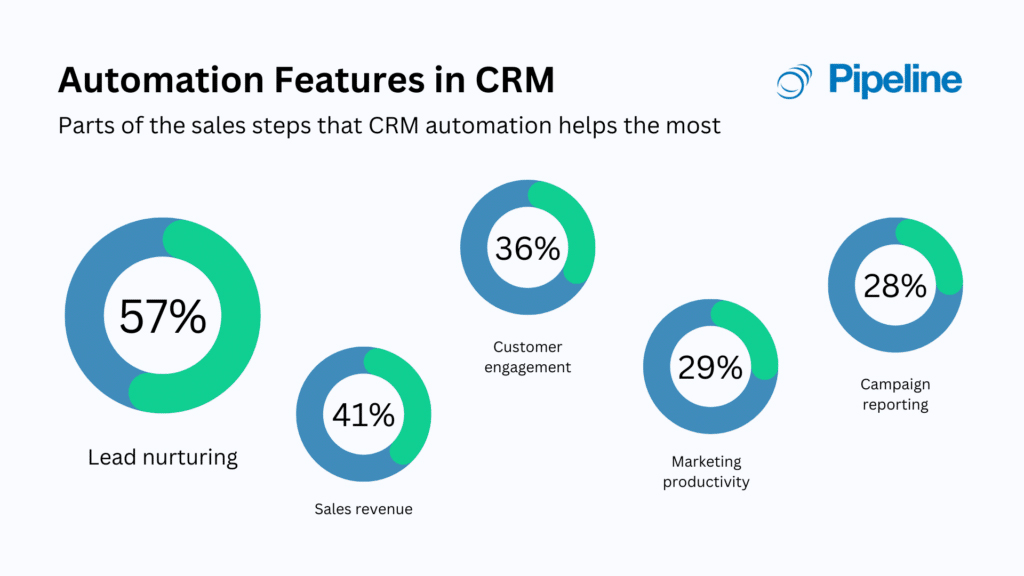
- Lead nurturing dominates CRM automation benefits, with 57% of businesses reporting improved lead engagement, follow-ups, and conversion readiness through automated workflows.
- Sales revenue optimization ranks second, as 41% of organizations use CRM automation to accelerate deal closures, reduce sales cycle time, and increase revenue predictability.
- Customer engagement sees major enhancement, with 36% of companies leveraging automation to deliver personalized interactions, timely responses, and consistent communication.
- Marketing productivity improves significantly, with 29% of teams reporting better campaign execution, task automation, and resource utilization through CRM systems.
- Campaign reporting benefits from automation tools, as 28% of marketers rely on CRM platforms for real-time analytics, performance tracking, and ROI measurement.
Customer Retention Rates
- CRM adopters report up to a 27% improvement in customer retention compared with companies using older systems.
- A 16% boost in customer retention is observed among CRM users year‑over‑year.
- CRM platforms enable personalized service, which increases loyalty and repeat business.
- Timely automated communication through CRM helps prevent churn.
- Tracking customer satisfaction and response history deepens engagement and trust.
- CRM segmentation supports targeted retention campaigns by customer segment.
- Retention‑focused metrics (churn rates, renewal likelihood) improve with CRM analytics.
Leading CRM Risk Factors Impacting Implementation Success
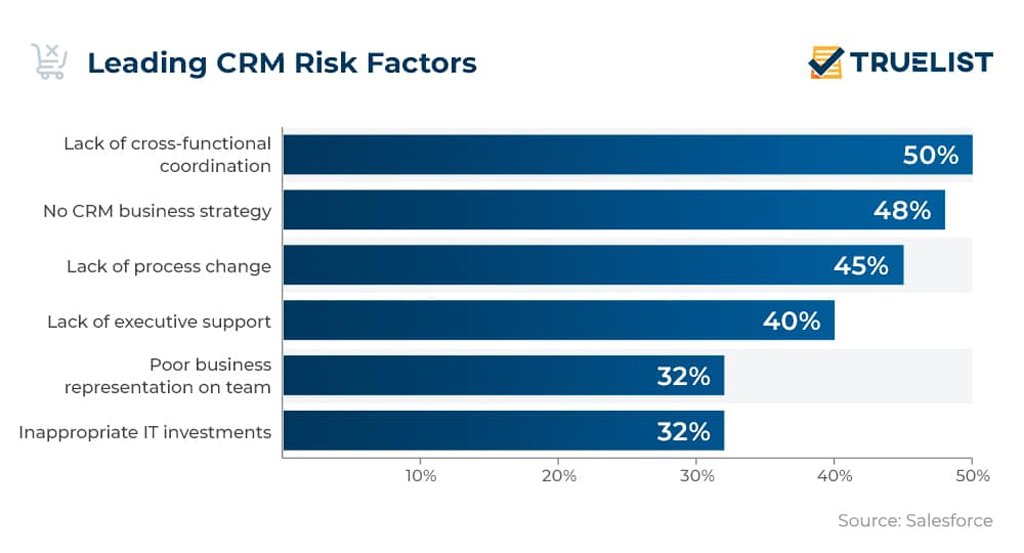
- Lack of cross-functional coordination is the top CRM risk, affecting 50% of organizations, highlighting major gaps in internal collaboration.
- No clear CRM business strategy impacts 48% of companies, showing that nearly half implement CRM without defined goals or direction.
- Lack of process change hinders adoption for 45% of businesses, indicating resistance to operational transformation.
- Insufficient executive support affects 40% of CRM projects, limiting funding, leadership, and long-term commitment.
- Poor business representation on CRM teams impacts 32% of organizations, reducing alignment between technology and business needs.
- Inappropriate IT investments also affect 32% of companies, leading to inefficient systems and wasted resources.
AI in the CRM Market
- Global AI in CRM market reaches $11.04 billion in 2025, projected to hit $48.4 billion by 2033.
- 81% of organizations are expected to adopt AI-powered CRM systems by 2025.
- 87% of businesses prioritize AI in their CRM strategy.
- AI lead scoring achieves up to 90% accuracy, vs 30-40% for manual methods.
- AI-driven lead scoring boosts conversion rates by 20-30%.
- AI sales forecasting improves accuracy by up to 30%, reaching 79% overall.
- Predictive analytics in CRM enhances forecasting accuracy by 30%.
- AI integration with CRM reduces churn rates by up to 15%.
- Automated AI duplicate detection removes 12% of duplicate contacts in CRM databases.
- AI data enrichment improves data accuracy by 61% and customer profiling by 47%.
AI Impact on Sales
- CRM systems using AI boost sales forecasting accuracy by over 40%.
- AI automation reduces missed follow-ups, increasing conversion rates by 25-30%.
- Teams with AI CRM insights see 20% higher conversion rates through tailored engagements.
- Chatbots in CRM free reps, improving lead qualification by up to 40%.
- AI real-time coaching raises sales close rates by 7%.
- Predictive AI analytics cut churn by 13-31%, enhancing retention.
- AI CRM segmentation boosts marketing conversions by 9-20%.
- AI-powered CRM increases sales productivity by 27% and revenue by 30%.
- Businesses using AI CRM are 83% more likely to exceed sales goals.
Frequently Asked Questions (FAQs)
What is the projected global CRM market size by 2030?
The global CRM market is expected to grow from about $73.40 billion in 2024 to $163.16 billion by 2030 at a 14.6% CAGR.
What percentage of businesses now use cloud‑based CRM platforms?
Approximately 89% of companies use cloud‑based CRM platforms, with over 72% preferring cloud deployment over on‑premise solutions.
How many organizations are expected to adopt AI‑powered CRM systems by 2025?
About 81% of organizations are projected to use AI‑powered CRM systems by 2025.
What is the forecasted compound annual growth rate (CAGR) of the CRM market from 2025 to 2034?
The CRM market is projected to grow at an 11.5% CAGR from 2025 to 2034, reaching $198.10 billion by 2034.
What share of CRM software spending comes from large enterprises?
Approximately 73.8% of total CRM software spending comes from companies with more than 1,000 employees.
Conclusion
CRM systems are not just tools; they’re strategic engines that fuel conversion, productivity, and retention in business environments. From lead conversion lifts to retention improvements, these platforms help align teams around customer intent and streamline sales outcomes. CRM adoption continues alongside AI and automation innovations that unlock deeper analytics, real‑time decision‑making, and workflow efficiency.
However, data quality remains a persistent challenge that can restrain full CRM value if not addressed through governance and intelligent tooling. Whether a small business or enterprise, integrating CRM thoughtfully continues to produce measurable business benefits across revenue and customer lifecycles.

Leave a comment
Have something to say about this article? Add your comment and start the discussion.