



Customer loyalty plays a critical role in how modern businesses sustain growth, improve profitability, and differentiate themselves in highly competitive markets. Whether it’s retail brands using mobile rewards apps or subscription platforms reducing churn through personalized offers, loyalty directly influences repeat purchases, customer lifetime value, and brand advocacy. Moreover, with rising acquisition costs and increasing consumer expectations, companies now rely on loyalty strategies to maintain stable revenue streams and long-term engagement.
As digital experiences evolve and personalization becomes the norm, understanding the data behind customer loyalty is more important than ever. Let’s explore the latest statistics and uncover how loyalty trends are shaping business strategies.
Editor’s Choice
- 65% of a company’s revenue comes from repeat customers, highlighting the value of retention-driven strategies.
- It is 5–25x more expensive to acquire a new customer than to retain an existing one.
- 91% of companies globally now run loyalty programs as a core retention strategy.
- Loyalty program members generate 12–18% more revenue than non-members.
- 77% of consumers report staying loyal to a brand for 10+ years.
- Nearly 93% of loyalty members earned or redeemed rewards in the past 6 months.
- Increasing retention by just 5% can boost profits by 25%–95%.
Recent Developments
- 83% of marketers report satisfaction with loyalty programs in 2026, signaling strong adoption.
- Loyalty programs are now considered strategic assets, not just marketing tools.
- AI-driven personalization is becoming central to loyalty strategies in 2026.
- 45% of US adults use a loyalty app with their primary grocery store.
- Loyalty programs now influence real-time customer engagement across channels.
- 89% of users are willing to share personal data for rewards and perks.
- 70% of consumers participate in paid loyalty programs or would consider joining.
- Major brands now design loyalty programs to drive habitual purchasing behavior, not just rewards.
Consumer Purchase Behavior and Brand Loyalty Insights
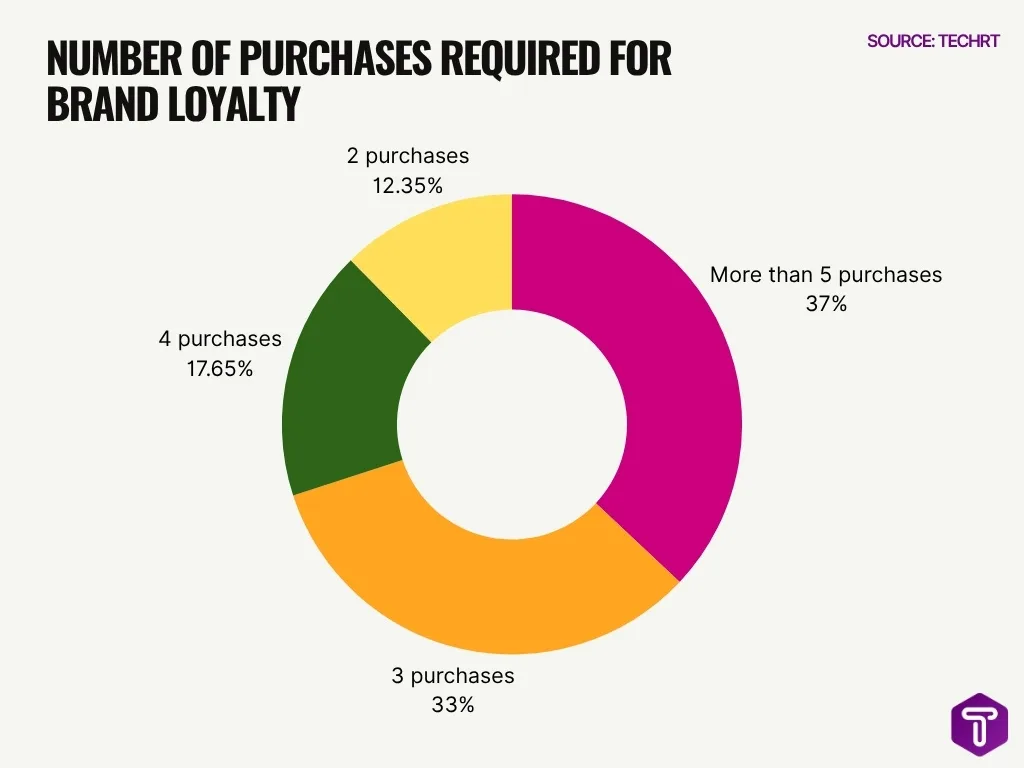
- The majority require multiple purchases: A combined 54.65% of consumers need 4 or more purchases before becoming loyal, indicating loyalty is built over time rather than instantly.
- High threshold for loyalty: The largest segment, 37% of consumers, requires more than 5 purchases, showing that sustained engagement is critical for strong brand loyalty.
- Moderate loyalty formation: Around 33% of consumers become loyal after 3 purchases, suggesting this is a key conversion milestone for many brands.
- Lower purchase threshold segment: Only 12.35% of consumers develop loyalty after just 2 purchases, highlighting that early loyalty is relatively rare.
- Gradual loyalty curve: The data reflects a progressive loyalty-building process, where the likelihood of loyalty increases with repeated interactions and consistent brand experience.
- Strategic takeaway: Brands should focus on retention strategies beyond the first 3–5 purchases, as this is the critical window where most consumers transition into loyal customers.
Global Customer Loyalty Program Statistics
- The global customer loyalty management industry is valued at over $5.5 billion.
- The market is projected to grow significantly, reaching $41.21 billion by 2032.
- 91% of companies worldwide now operate loyalty programs.
- Loyalty programs span 19+ industries and 17 countries in global reports.
- Over 10,000 consumers globally were surveyed in the 2026 loyalty research.
- Loyalty programs influence multiple sectors, including retail, airlines, and hospitality.
- In China, one loyalty ecosystem reached 590 million members, showing massive scale adoption.
- Loyalty-driven sales can account for over 50% of transactions in some markets.
Customer Loyalty Trends
- 68% of consumers report being loyal to specific brands in 2026.
- However, “true loyalty” dropped to 29%, indicating a gap between intent and behavior.
- 70% of consumers now participate in loyalty programs.
- 65% of consumers prefer signing up for loyalty programs to show brand preference.
- 75% of consumers buy more from brands they are loyal to.
- Nearly half of non-members would join a loyalty program for the right benefits.
- 24% of consumers show higher loyalty when offered personalized deals.
- Loyalty is increasingly influenced by experience and personalization, not just rewards.
Customer Loyalty Drivers
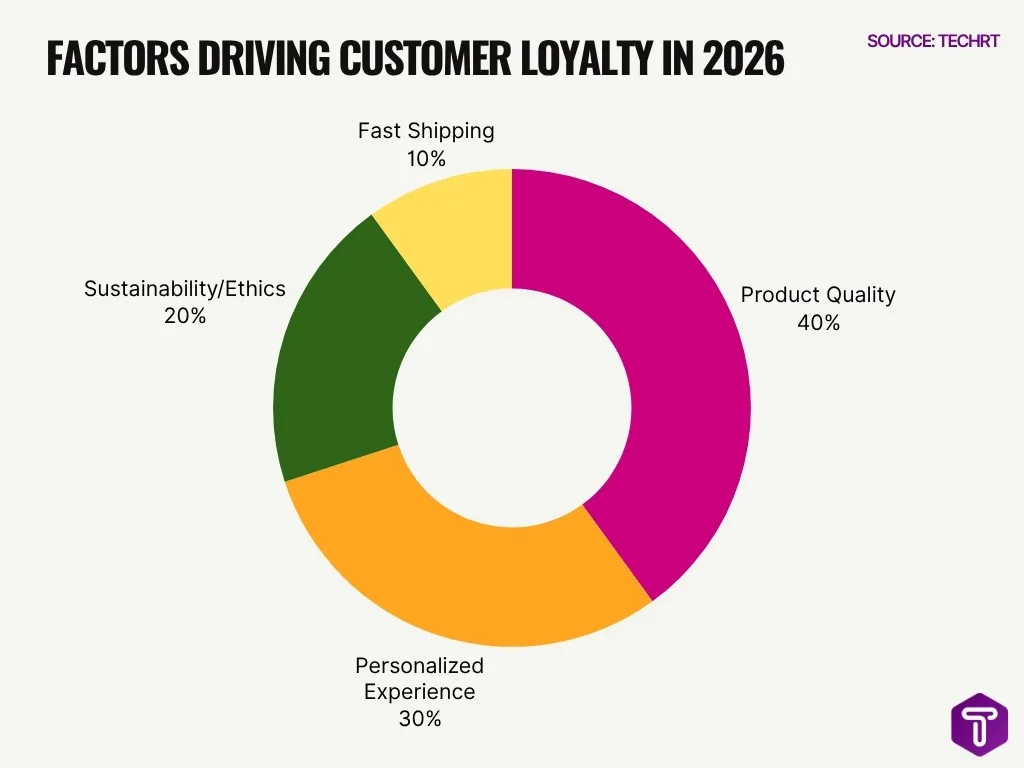
- Product Quality dominates at 40%, making it the most critical factor influencing customer loyalty, highlighting that customers prioritize reliability and value above all else.
- Personalized Experience accounts for 30%, showing that nearly one-third of customers expect tailored interactions, recommendations, and services from brands.
- Sustainability/Ethics contributes 20%, indicating a growing segment of consumers who value eco-friendly practices and ethical business behavior when choosing brands.
- Fast Shipping represents 10%, making it the least influential factor, though still important for enhancing overall customer satisfaction and convenience.
- The data reveals a clear hierarchy: Core product value (40%) + Experience (30%) = 70%, meaning the majority of loyalty is driven by what customers get and how they feel, rather than logistics alone.
- Emerging trend: Values-driven loyalty (20%) is becoming a key differentiator, especially among younger and more conscious consumers.
- Strategic takeaway: Brands should prioritize product excellence and personalization (70% combined impact) while integrating ethical practices to stay competitive in 2026.
Brand Loyalty Statistics
- 77% of consumers stay loyal to brands for over a decade.
- 96% of consumers say customer service impacts brand loyalty.
- Loyal customers are 5x more likely to repurchase.
- They are also 4x more likely to refer a brand to others.
- Returning customers spend 67% more than new customers.
- 50% of existing customers are more likely to try new products from brands they trust.
- Loyalty leaders grow 2.5x faster than competitors.
- 86% of CX professionals say loyalty is becoming more important as a metric.
Customer Retention Metrics
- Businesses have a 60–70% chance of selling to existing customers vs 5–20% for new prospects.
- 65% of revenue typically comes from repeat buyers.
- Retention improvements of 5% can increase profits by up to 95%.
- Loyal customers are 5x more likely to purchase again.
- They are 7x more likely to try new offerings.
- Loyalty programs can boost annual revenue by 15%–25%.
- Customers with personalized experiences are 60% more likely to become repeat buyers.
- 38% of companies actively focus on reducing churn through loyalty initiatives.
Loyalty Program Adoption and Usage
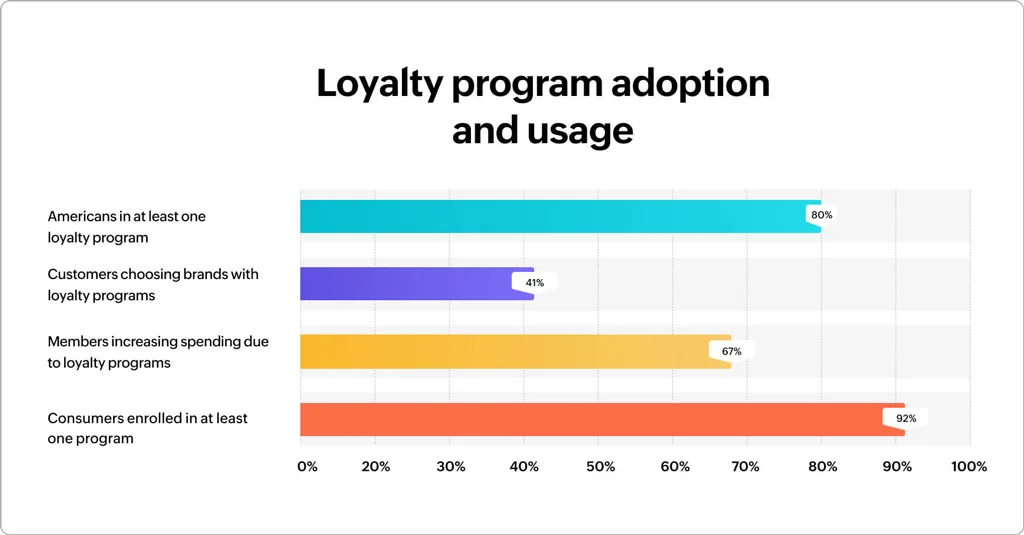
- Massive adoption rate: A striking 92% of consumers are enrolled in at least one loyalty program, highlighting near-universal penetration.
- Strong participation among Americans: Around 80% of Americans actively participate in loyalty programs, showing widespread engagement across the market.
- Direct impact on spending behavior: Approximately 67% of members report increased spending due to loyalty programs, proving their effectiveness in driving revenue.
- Moderate influence on brand choice: Only 41% of customers choose brands specifically because of loyalty programs, indicating room for differentiation and stronger value propositions.
- Engagement vs. influence gap: While adoption (92%) and participation (80%) are high, the lower brand influence (41%) suggests many programs fail to strongly impact decision-making.
- Revenue growth opportunity: With two-thirds of users (67%) spending more, loyalty programs remain a key lever for customer lifetime value (CLV) growth.
- Competitive necessity: Given that 4 out of 5 Americans (80%) are already in loyalty programs, brands without one risk losing relevance and retention potential.
- Optimization potential: The gap between enrollment (92%) and brand preference (41%) signals an opportunity to improve personalization, rewards, and customer experience.
Loyalty Program Impact
- Loyalty program members generate 12%–18% more annual revenue than non-members.
- Companies with loyalty programs report increased purchase frequency by 20%.
- 75% of consumers say they favor companies that offer rewards.
- Loyalty programs increase customer lifetime value by up to 306%.
- Members spend 13% more per transaction compared to non-members.
- 84% of consumers are more likely to stick with a brand offering a loyalty program.
- Loyalty-driven engagement can boost repeat purchases by up to 60%.
- Brands with strong loyalty programs experience lower churn rates by 5%–10%.
Customer Retention vs Acquisition Statistics
- Acquiring a new customer costs 5 to 7 times more than retaining an existing one.
- Businesses increase profits by 25% to 95% when retention improves by just 5%.
- The probability of selling to an existing customer is 60–70%, compared to 5–20% for new prospects.
- Repeat customers contribute up to 40% of total revenue despite being a smaller segment.
- Companies that prioritize retention see 2x higher ROI than those focused mainly on acquisition.
- Increasing customer retention by 10% can raise company value by 30% or more.
- 44% of companies still focus more on acquisition than retention, showing a strategic gap.
- Returning customers are 50% more likely to try new products compared to new buyers.
Customer Loyalty Trends by Brand Category
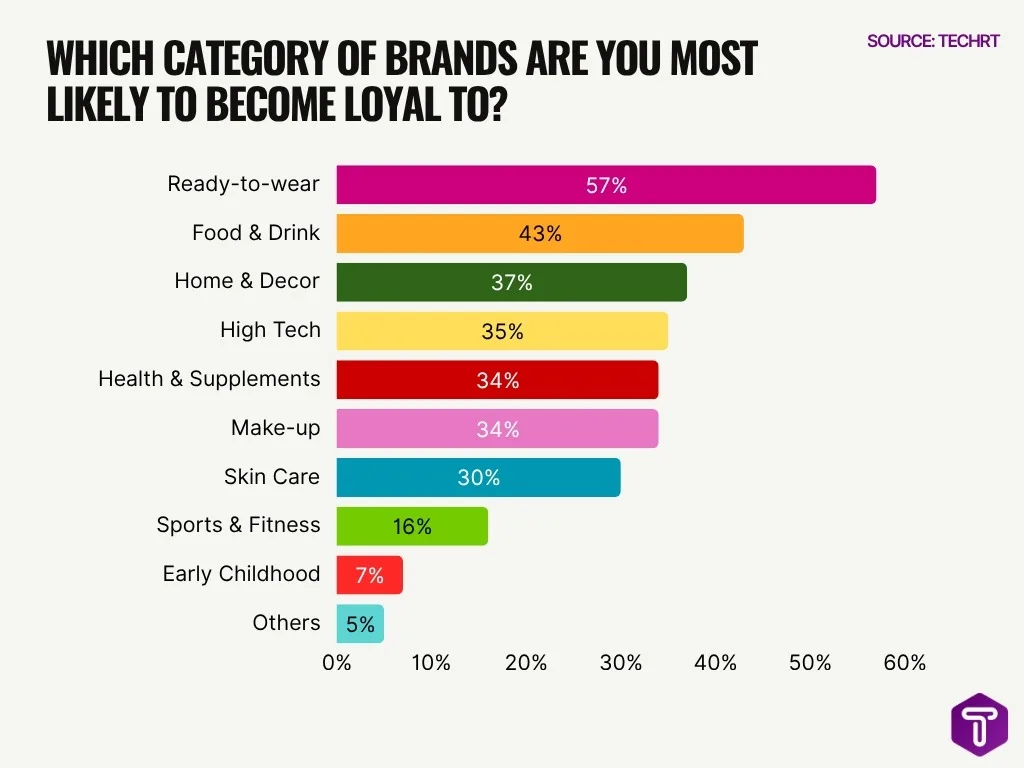
- Ready-to-wear leads significantly with 57%, making it the most loyalty-driven category, indicating strong emotional and repeat purchase behavior in fashion.
- Food & Drink ranks second at 43%, showing that daily consumption products naturally build habit-based loyalty among consumers.
- Home & Decor (37%) and High Tech (35%) are closely grouped, suggesting moderate loyalty levels driven by functionality, lifestyle alignment, and product longevity.
- Health & Supplements (34%) and Make-up (34%) share equal loyalty rates, highlighting the importance of personal care, trust, and brand consistency in these segments.
- Skin Care stands at 30%, indicating that while loyalty exists, consumers may still experiment with brands based on results and ingredient preferences.
- Sports & Fitness drops sharply to 16%, suggesting lower brand attachment and higher sensitivity to price, trends, or alternatives.
- Early Childhood products record just 7%, reflecting limited brand stickiness, possibly due to changing needs as children grow.
- The other category is the lowest at 5%, showing minimal loyalty concentration outside major consumer verticals.
- There is a clear loyalty gap of 52 percentage points between the top (57%) and bottom (5%) categories, emphasizing how industry type strongly influences customer loyalty behavior.
- Overall, essential, lifestyle, and identity-driven categories (fashion, food, and personal care) outperform functional or niche segments in building long-term brand loyalty.
Loyalty Program ROI
- The average ROI of loyalty programs ranges from 2x to 4x investment.
- Companies using advanced loyalty strategies report ROI increases of up to 5.2x.
- Loyalty programs can drive incremental revenue growth of 15%–25% annually.
- 73% of companies report positive ROI within the first 2 years of implementation.
- Personalized loyalty programs improve ROI by 20%–30%.
- Paid loyalty programs deliver 2x higher ROI than free-tier programs.
- Brands with mature loyalty programs see customer lifetime value increase by 25%.
- Data-driven loyalty campaigns improve marketing efficiency by 15%–20%.
Consumer Behavior and Loyalty Trends
- 66% of consumers say they are willing to switch brands if they feel undervalued.
- 80% of customers say experience is as important as products when choosing brands.
- 73% of consumers expect companies to understand their needs and expectations.
- 62% of consumers feel emotionally connected to brands they are loyal to.
- 88% of customers say trust is a key factor in loyalty decisions.
- 72% of consumers expect immediate service responses.
- Consumers who feel valued are 3x more likely to recommend a brand.
- 54% of consumers say companies need to transform how they engage with customers.
Consumer Trust and Spending Behavior
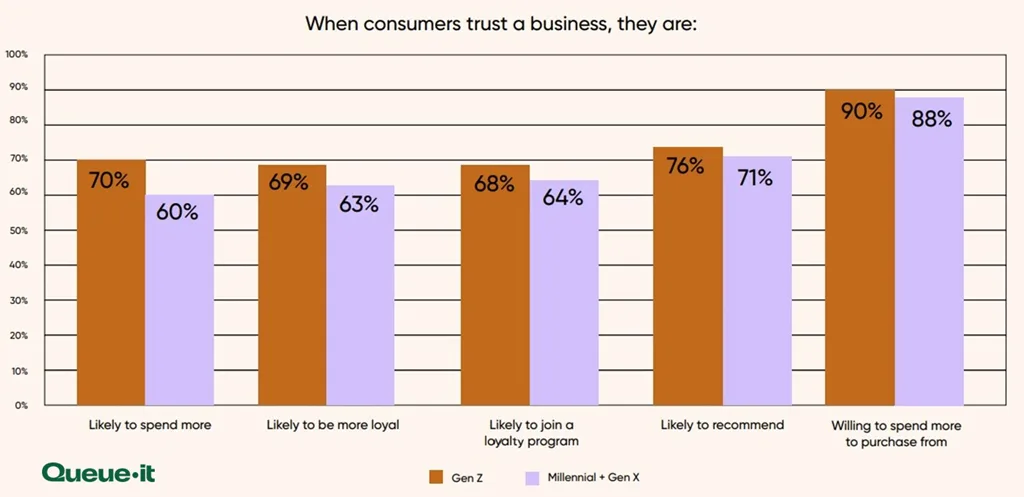
- Trust directly drives higher spending, with 70% of Gen Z consumers saying they are likely to spend more, compared to 60% of Millennials and Gen X.
- Customer loyalty strengthens significantly with trust, as 69% of Gen Z report being more loyal, versus 63% of older generations.
- Loyalty program participation increases with trust, with 68% of Gen Z and 64% of Millennials + Gen X willing to join loyalty programs.
- Word-of-mouth impact is strong, with 76% of Gen Z and 71% of Millennials + Gen X being likely to recommend a trusted brand.
- Premium spending behavior is highly influenced by trust, as a striking 90% of Gen Z and 88% of Millennials + Gen X are willing to spend more to purchase from trusted businesses.
- Gen Z consistently shows higher trust-driven behaviors across all metrics, outperforming older generations by 4–10 percentage points.
- The biggest behavioral gap appears in spending uplift, where Gen Z exceeds older generations by 10 percentage points (70% vs 60%), highlighting stronger emotional-brand alignment.
- Even among older consumers, trust remains a major conversion driver, with all metrics exceeding 60%, reinforcing trust as a universal growth lever.
Personalization in Loyalty
- 71% of consumers expect personalized interactions from brands in 2026.
- Companies that excel at personalization generate 40% more revenue than average performers.
- 76% of customers feel frustrated when personalization is missing.
- Personalized experiences increase purchase likelihood by 80%.
- 63% of consumers are willing to share data for more relevant experiences.
- Brands using AI-driven personalization see 20% higher customer satisfaction scores.
- 44% of consumers become repeat buyers after a personalized shopping experience.
- Personalized loyalty rewards improve engagement rates by 25%–30%.
Omnichannel Loyalty Strategies
- 73% of consumers use multiple channels during their shopping journey.
- Omnichannel customers have a 30% higher lifetime value than single-channel users.
- 90% of customers expect consistent experiences across channels.
- Brands with strong omnichannel strategies retain 89% of customers, compared to 33% for weak strategies.
- 67% of consumers use both online and offline touchpoints before purchasing.
- Companies using omnichannel engagement see 9.5% annual revenue growth, vs 3.4% for others.
- Mobile plays a key role, with 58% of loyalty interactions happening via smartphones.
- 80% of retail leaders say omnichannel loyalty is critical for future growth.
Key Customer Loyalty Marketing Trends Shaping the Next 2–3 Years
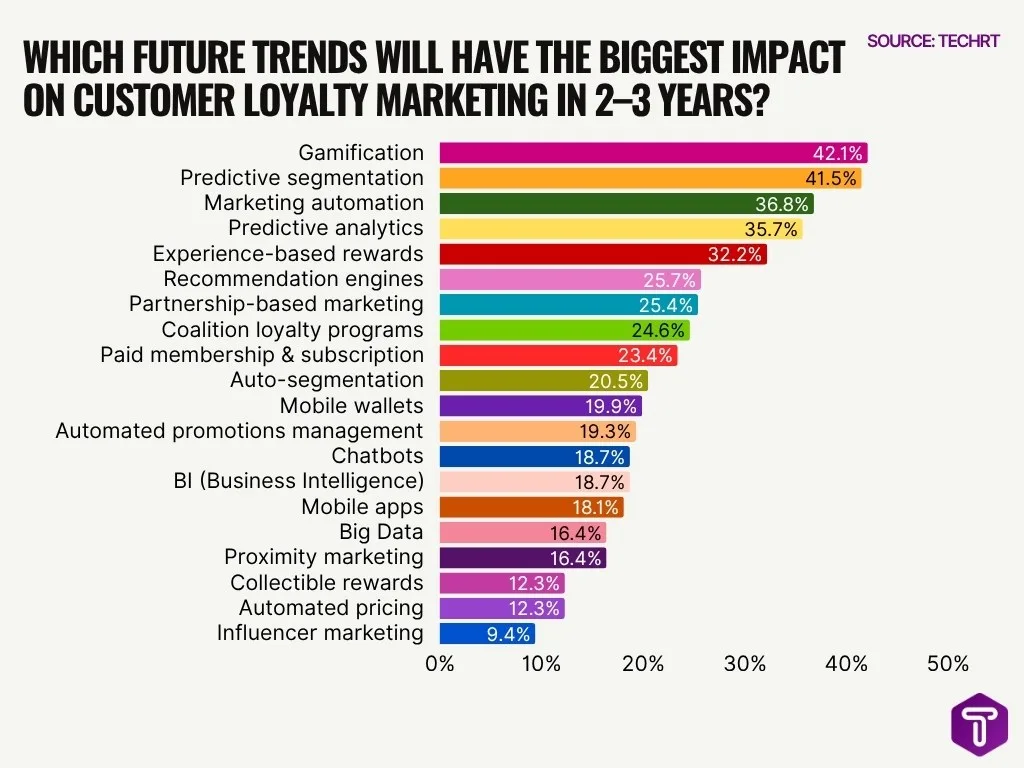
- Gamification leads the future with 42.1%, making it the most impactful trend, highlighting a shift toward interactive and engaging loyalty experiences.
- Predictive segmentation (41.5%) closely follows, emphasizing the growing importance of AI-driven customer targeting and personalized engagement strategies.
- Marketing automation (36.8%) and predictive analytics (35.7%) rank among the top trends, indicating that data-driven decision-making is becoming central to loyalty program success.
- Experience-based rewards (32.2%) outperform traditional incentives, signaling a strong move toward experiential and value-driven loyalty programs over simple point systems.
- Mid-tier trends like recommendation engines (25.7%), partnership-based marketing (25.4%), and coalition loyalty programs (24.6%) show the rise of ecosystem-based and cross-brand collaborations.
- Paid memberships & subscriptions (23.4%) are gaining traction, reflecting the success of premium loyalty models that deliver exclusive benefits.
- Emerging automation tools such as auto-segmentation (20.5%) and automated promotions management (19.3%) indicate a shift toward scalable and real-time personalization.
- Mobile wallets (19.9%) and mobile apps (18.1%) reinforce the importance of mobile-first loyalty experiences in driving customer engagement.
- Technologies like chatbots (18.7%) and BI tools (18.7%) highlight the role of real-time interaction and actionable insights in enhancing loyalty strategies.
- Lower-ranked but notable trends include Big Data (16.4%) and proximity marketing (16.4%), which support contextual and location-based engagement.
- Collectible rewards (12.3%) and automated pricing (12.3%) represent niche but growing areas focused on gamified ownership and dynamic pricing strategies.
- Influencer marketing (9.4%) ranks lowest, suggesting it plays a supporting role rather than a core driver in loyalty program innovation.
Ethical and Value-Based Loyalty
- 64% of consumers choose brands based on shared values.
- 62% of Gen Z prefer brands that align with social or environmental causes.
- 83% of global consumers believe companies should actively shape societal issues.
- 48% of US consumers have stopped buying from brands due to ethical concerns.
- Brands with strong sustainability messaging see 20% higher customer loyalty rates.
- 73% of millennials are willing to pay more for sustainable products.
- Transparency increases trust, with 86% of consumers expecting honesty from brands.
- Ethical business practices improve retention rates by up to 25%.
Disruptors of Customer Loyalty
- 74% of consumers switched brands at least once in the past year.
- Poor customer service drives 65% of customers to abandon brands.
- 60% of consumers stop buying after multiple bad experiences.
- Rising prices influence 58% of customers to explore alternatives.
- 49% of consumers switch due to a lack of personalization.
- Data privacy concerns affect 52% of customer trust levels.
- Competitor promotions influence 45% of switching behavior.
- Slow delivery or fulfillment issues cause 42% of churn in eCommerce.
Frequently Asked Questions (FAQs)
How much revenue comes from repeat customers?
How much more expensive is customer acquisition compared to retention?
What percentage of companies use loyalty programs?
How much can loyalty programs increase revenue annually?
What share of consumers participate in loyalty programs?
Conclusion
Customer loyalty reflects a clear shift from transactional relationships to deeper, experience-driven connections. Today’s consumers expect more than discounts; they value personalization, seamless omnichannel interactions, transparency, and alignment with their personal values. At the same time, the data shows that loyal customers drive higher revenue, make more frequent purchases, and actively promote brands through word-of-mouth. However, loyalty is becoming harder to earn as competition increases and switching barriers decline.
As a result, businesses that invest in data-driven personalization, consistent customer experiences, and ethical practices are better positioned to retain customers and maximize lifetime value. Use the insights and statistics in this guide to refine your retention strategy, strengthen customer relationships, and stay competitive in an evolving marketplace.

Leave a comment
Have something to say about this article? Add your comment and start the discussion.