




Digital nomadism has evolved from a niche lifestyle into a global workforce phenomenon, fueled by remote work adoption and changing career expectations. Millions of professionals worldwide work from anywhere, cafés, beaches, and coworking spaces, while contributing significant economic value. Industries such as tech recruitment and travel hospitality have adapted business strategies around this trend, reflecting its growing economic relevance. Global brands now tailor services for nomads, ranging from coworking passes to insurance plans specifically for location-independent workers. Explore how this movement reshapes work, travel, and life.
Editor’s Choice
- ~43 million people globally identify as digital nomads in 2026.
- 18.5 million of those nomads are from the United States, about 43% of the total.
- Digital nomads contribute roughly $940 billion yearly to the global economy.
- The average nomad age is about 38 years old in 2026.
- 58% of nomads are between 25 and 44 years old.
- 61% are employed, while 39% are self-employed.
- At least 41 countries offer digital nomad or remote work visas.
Recent Developments
- Remote work policies continued expanding into 2026, allowing more flexible work-from-anywhere arrangements.
- AI-related freelance roles are becoming prevalent among nomads, especially in automation and content services.
- Female and Gen Z nomad participation is rising and projected to grow this year.
- Travel tech platforms increasingly integrate long-stay options tailored for nomads.
- Decentralized offices and remote hubs gained ground as hybrid spaces for nomads and local workers.
- Employers emphasize mental health and cybersecurity as key remote work priorities.
- Policy momentum for digital nomad visas continues, with many launched after 2020.
- Remote work is now widely recognized as mainstream workforce infrastructure.
Global Digital Nomads Numbers
- 43 million digital nomads existed worldwide in 2026.
- This represents steady growth compared with estimates of 40 to 50 million in 2025.
- The total global population of remote-capable workers, those who could become nomads, is even higher.
- If treated as a country, the global nomad cohort would rank about 38th in population size.
- Nomads’ collective economic output is estimated at $940 billion annually.
- Between 2019 and 2026, nomad numbers have roughly doubled or more.
- Global digital nomadism remains highest in regions with strong internet infrastructure and visa access.
- Growth patterns point to continued increases through 2027 and beyond.
Growth of Digital Nomads in the U.S.
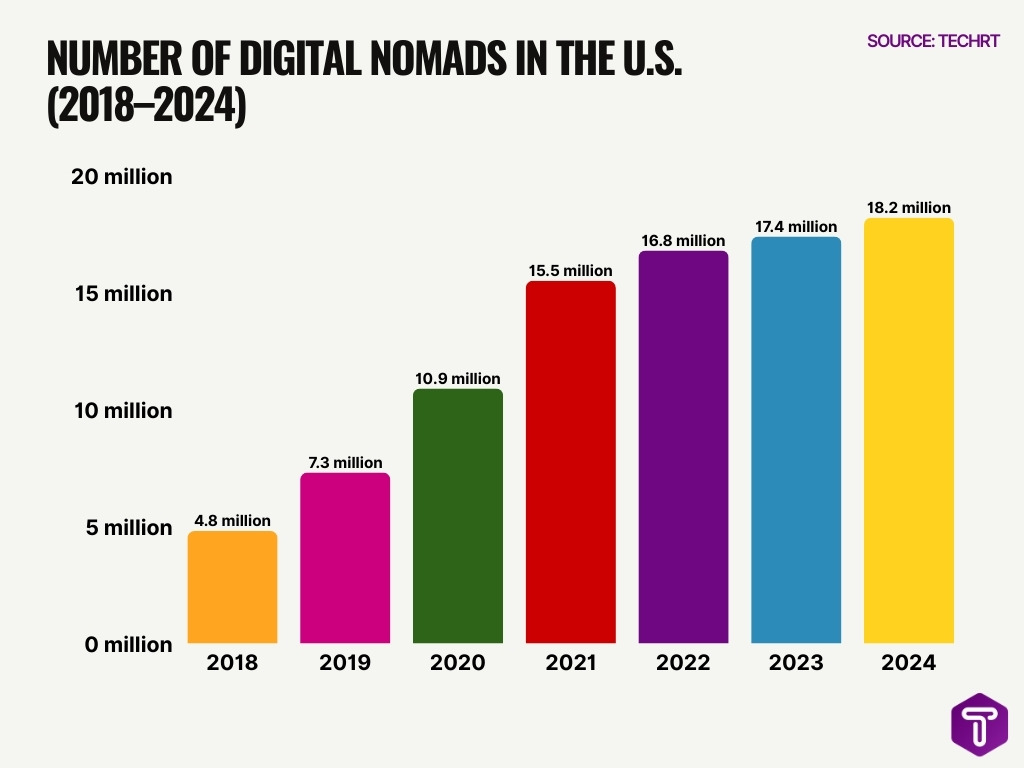
- The number of digital nomads in the U.S. grew from 4.8 million in 2018 to 18.2 million in 2024, showing a massive long-term expansion.
- Between 2018 and 2019, the population increased by nearly 2.5 million, reaching 7.3 million, marking the start of rapid adoption.
- In 2020, digital nomads crossed 10.9 million, driven by the rise of remote work during the COVID-19 pandemic.
- The year 2021 saw a major jump to 15.5 million, reflecting widespread acceptance of work-from-anywhere models.
- Growth remained strong in 2022, with figures rising to 16.8 million, indicating sustained post-pandemic momentum.
- In 2023, the digital nomad population climbed further to 17.4 million, showing continued lifestyle normalization.
- By 2024, the U.S. recorded a peak of 18.2 million digital nomads, the highest level ever observed.
- Overall, the market expanded by nearly 280% from 2018 to 2024, highlighting a long-term structural shift in employment.
- The fastest growth period occurred between 2020 and 2021, with an increase of about 4.6 million users in a single year.
- The consistent upward trend confirms that digital nomadism is becoming a mainstream work model, not a temporary trend.
Demographics Overview
- Digital nomads average 37 years old, with 49% aged 30-39.
- 90% hold postsecondary degrees, 52% have bachelor’s.
- Demographic mix favors remote-savvy paths like IT (19%) and marketing (9%).
- Higher education links to remote work: only 10% lack tertiary degrees.
- 64% worked remotely before extensive traveling.
- Lifestyles vary: 79% earn $50,000+, 46% over $75,000.
- Gender balance improving: 58% male, 40-46% female.
- Gen Z (17%) and Millennials (47-56%) now lead the movement.
Gender Breakdown
- 56% of U.S. digital nomads are men, while 44% are women.
- Female participation has increased steadily since 2020, when women represented about 42% of U.S. nomads.
- Globally, gender distribution trends closer to parity, with several surveys showing women accounting for 45% to 48% of nomads.
- Gen Z female participation grew faster than male participation between 2022 and 2024, driven by freelance and creator economy roles.
- In Europe, digital nomad visa applicants show a near-even gender split in countries like Portugal and Spain.
- Women nomads are more likely to work in marketing, content creation, and consulting, while men dominate in software development and IT roles.
- Safety remains a key gender specific concern, with over 60% of female nomads citing safety as a major factor in destination choice.
- Surveys show women digital nomads are more likely to prioritize healthcare access and stable infrastructure when selecting countries.
Age Distribution
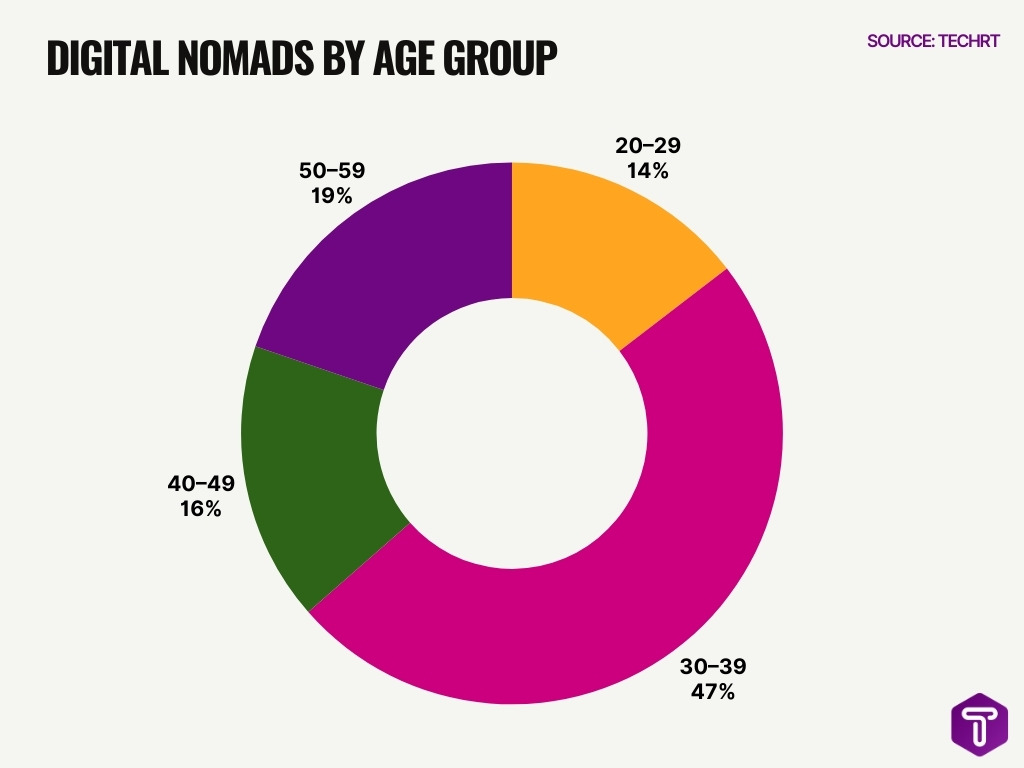
- The average age of digital nomads in 2026 is about 38 years old.
- 58% of nomads fall in the 25 to 44 age range.
- Reports from earlier years show 30 to 39 as the largest group, about 47%.
- Ages 20 to 29 represent around 14% in broader surveys.
- Individuals 40 to 49 make up roughly 16%.
- 50 to 59 nomads appear in higher proportions in recent surveys, about 19%.
- Seniors, 60+, remain a small but notable group.
- Younger professionals increasingly adopt nomadic lifestyles as digital careers grow.
Education Levels
- Over 90% of digital nomads hold at least some college education.
- Approximately 54% possess a bachelor’s degree, while nearly 30% hold a master’s or higher degree.
- Only about 10% report a high school diploma as their highest level of education.
- Nomads working in tech roles are significantly more likely to have STEM degrees.
- English proficiency correlates strongly with participation in global freelance platforms.
- More than 70% of digital nomads report engaging in ongoing skills training or online certifications.
- Remote work flexibility increases among workers with higher education levels compared to those without degrees.
- Coding bootcamps and digital marketing certifications contributed to rising first-time nomad participation between 2023 and 2025.
Occupations and Professions
- Software development and IT comprise 27% of digital nomads’ professions.
- Marketing, SEO, and content roles account for 16% of nomad occupations.
- Consulting and coaching represent 9% of digital nomad professions.
- Marketing, IT, design, writing, and eCommerce together make up 51% of nomad jobs.
- Finance and accounting hold 9% share among digital nomads’ occupations.
- 83% of digital nomads are self-employed in various remote professions.
- IT services lead nomadic fields at 19%, with creative services at 14%.
- Project management features among 14% unconventional nomad careers.
Digital Nomads Annual Income Breakdown
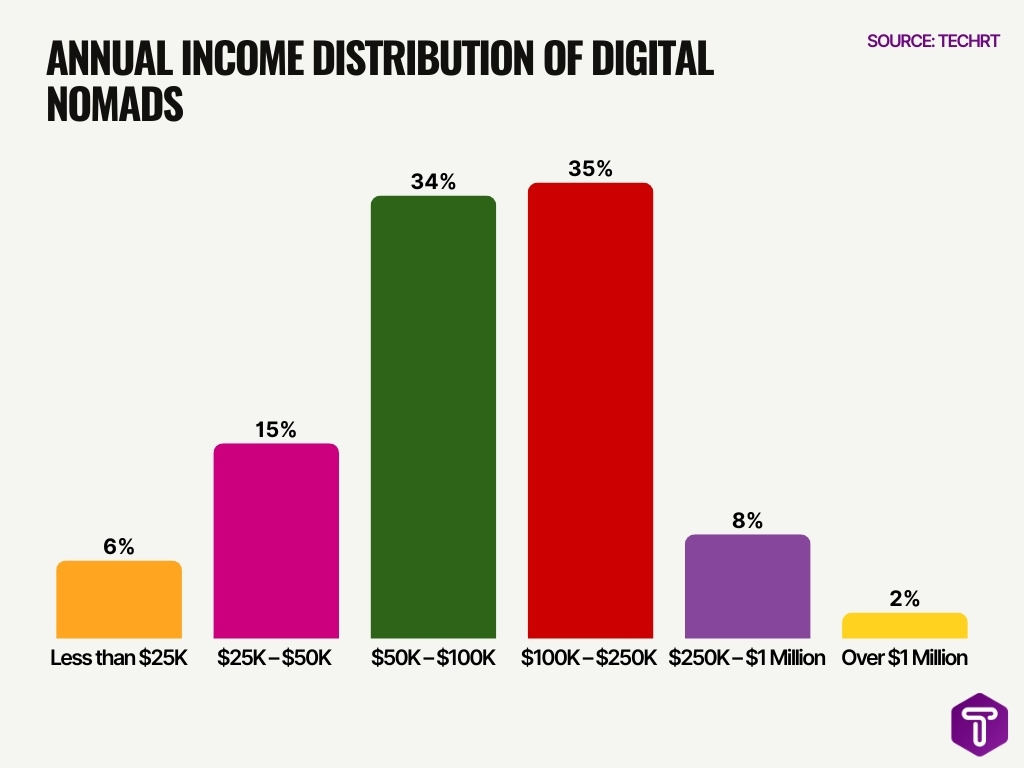
- The largest income group among digital nomads earns $100K to $250K annually, accounting for 35% of the total population.
- Close behind, 34% of digital nomads make between $50K and $100K, showing that the majority operate in solid upper-middle income brackets.
- Combined, 69% of digital nomads earn between $50K and $250K per year, highlighting strong earning potential within the remote workforce.
- A notable 10% earn more than $250K annually, including 2% who make over $1 million, reflecting a growing segment of high-income remote entrepreneurs and executives.
- Only 6% earn less than $25K, suggesting that very few digital nomads fall into low-income brackets.
- About 15% earn between $25K and $50K, representing early-stage freelancers, part-time nomads, or those based in lower-cost regions.
- The data clearly indicates that higher income brackets dominate the digital nomad ecosystem, with more than one-third surpassing the six-figure income mark.
Work Hours Patterns
- The average digital nomad works approximately 35 to 45 hours per week, similar to traditional employees.
- Around 22% report working more than 50 hours weekly, particularly freelancers managing multiple clients.
- Time zone differences require flexible scheduling; over 60% adjust working hours to accommodate client locations.
- Nomads are more likely to work weekends occasionally compared to office-based employees.
- Nearly 40% prefer asynchronous communication tools to manage remote workflows.
- Coworking space usage remains popular, with over 70% reporting occasional use during travel.
- Short-term travel stays average 1 to 3 months per location, balancing productivity and exploration.
- Many nomads cluster workdays mid-week and reserve extended weekends for travel.
Job Satisfaction Rates
- 79% of digital nomads report being satisfied or very satisfied with their work arrangement.
- Over 85% state they feel happier compared to traditional office roles.
- Flexibility ranks as the top reason for satisfaction among 70% of respondents.
- Nearly 68% say location freedom improves their mental well-being.
- Income stability concerns reduce satisfaction among freelance nomads more than salaried ones.
- About 74% plan to continue nomadic work for at least the next two years.
- Only 10% express a desire to return to full-time office environments.
- Burnout risk appears among those frequently changing time zones, particularly in global consulting roles.
General Digital Nomad Work Distribution by Industry
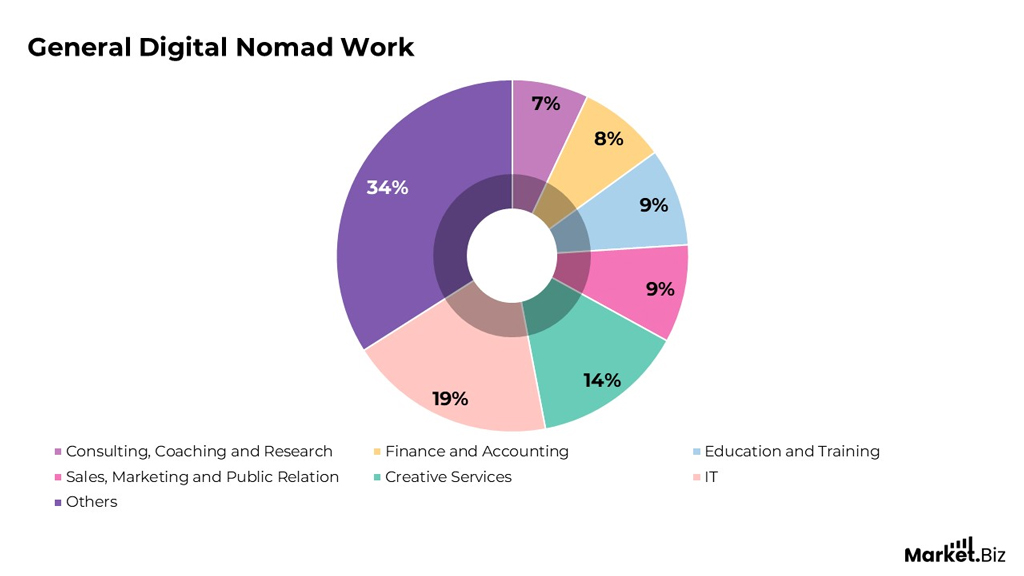
- Consulting, Coaching, and Research dominate digital nomad work, accounting for 34%, making it the largest professional segment in the remote workforce.
- Sales, Marketing, and Public Relations represents 19%, showing that nearly 1 in 5 digital nomads work in growth-driven and customer-facing roles.
- Creative Services contributes 14%, highlighting the strong presence of designers, writers, and content creators in the nomad economy.
- IT roles make up 9%, reflecting steady demand for developers, engineers, and technical specialists in location-independent work.
- Education and Training also account for 9%, indicating rising opportunities in online teaching, coaching, and skill-based learning.
- Finance and Accounting professionals represent 8%, showing that compliance-focused and analytical roles are increasingly adapting to remote models.
- The Other category (7%) includes emerging and niche professions, underscoring the diversifying nature of digital nomad careers.
Popular Destinations
- Portugal granted 2,600 digital nomad visas since 2022.
- Spain approved 27,875 digital nomad visas by the end of 2024.
- Thailand’s DTV visa attracted over 35,000 applicants in its first year.
- Estonia issued 535 digital nomad visas since its launch in 2020.
- Indonesia’s E33G visa saw 77% of applicants choose Bali.
- UAE ranks 2nd globally for digital nomads in 2025.
- Spain achieved 94% digital nomad visa approval rate in 2024.
- Portugal issued 386,463 residency permits by Oct 2025, up 60%.
Digital Nomad Visas
- As of 2026, more than 50 countries offer dedicated digital nomad or remote worker visas.
- Portugal’s digital nomad visa requires proof of monthly income roughly four times the national minimum wage.
- Spain’s visa requires proof of income of around €2,500 per month.
- Estonia was the first EU country to introduce a digital nomad visa in 2020.
- Costa Rica’s visa program requires proof of at least $3,000 monthly income for individuals.
- The UAE’s virtual working program requires proof of a $5,000 monthly income.
- Croatia’s nomad visa allows stays up to 12 months, tax-free on foreign income.
- Barbados’ Welcome Stamp program requires proof of a $50,000 annual income.
- Visa processing times vary widely, ranging from 2 weeks to 3 months, depending on the country.
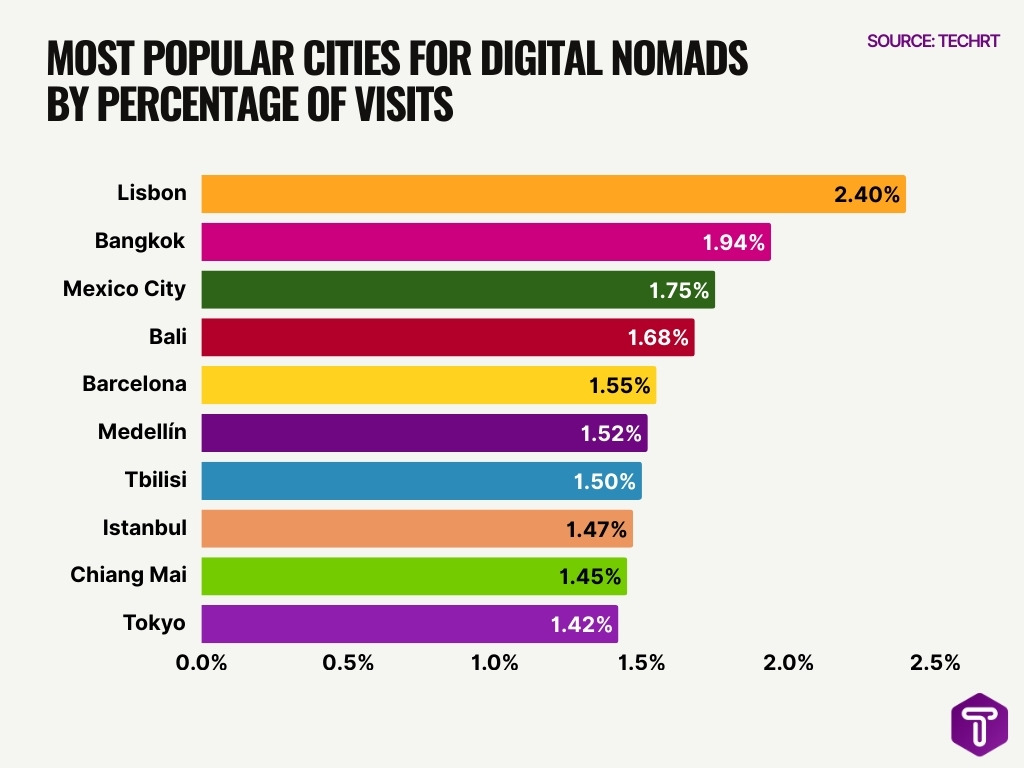
Digital Nomad City Popularity: Key Visit Share Insights
- Lisbon leads globally with the highest share of digital nomad visits at 2.40%, making it the most preferred destination among remote workers.
- Bangkok ranks second with 1.94%, highlighting Southeast Asia’s continued appeal due to affordable living and strong digital infrastructure.
- Mexico City secures third place at 1.75%, reflecting rising interest in Latin American hubs for location-independent professionals.
- Bali attracts 1.68% of visits, reinforcing its reputation as a top lifestyle and wellness destination for digital nomads.
- Barcelona records 1.55%, showing that European cultural capitals remain competitive in the remote work ecosystem.
- Medellín follows closely with 1.52%, driven by improving connectivity, cost advantages, and a growing nomad community.
- Tbilisi captures 1.50%, demonstrating increasing popularity due to visa-friendly policies and low living expenses.
- Istanbul accounts for 1.47%, benefiting from its strategic location between Europe and Asia and rich cultural offerings.
- Chiang Mai posts 1.45%, continuing its long-standing status as a budget-friendly hub for freelancers and remote workers.
- Tokyo rounds out the top ten with 1.42%, indicating strong interest in high-tech urban environments despite higher costs.
- European and Asian cities dominate the list, with 6 out of 10 destinations located in these regions.
- All top cities exceed 1.4%, showing that digital nomad traffic is relatively concentrated among leading global hubs.
- The gap between first and tenth place is just 0.98 percentage points (2.40% vs. 1.42%), reflecting intense competition among popular locations.
- Lifestyle, affordability, and connectivity remain the main drivers behind city selection for digital nomads.
- Emerging destinations like Tbilisi and Medellín suggest a shift toward more cost-efficient and flexible visa locations.
Major Challenges Faced
- Internet reliability ranks as the top concern for 52% of digital nomads.
- Time zone differences challenge 20% of remote workers in productivity.
- Visa restrictions hinder long-term stays for many digital nomads, lacking clear policies.
- Healthcare access worries remote workers due to varying global system quality.
- Currency fluctuations create budgeting issues for nomads earning in one currency and spending in another.
- Language barriers pose no major issue for many nomads using translation tools.
- Tax compliance confuses nomads with 183-day residency rules, triggering liabilities.
- Political instability drives migration alongside economic factors for digital nomads.
- Overworking affects 37% of remote workers due to blurred boundaries.
- Loneliness impacts 36.7% of remote professionals missing interactions.
Financial Concerns
- Approximately 36% of digital nomads report inconsistent monthly income streams.
- Around 25% maintain emergency savings covering six months or less of expenses.
- Healthcare insurance for international nomads averages between $40 and $200 per month, depending on coverage.
- U.S. citizens remain liable for federal taxes regardless of residence, though the Foreign Earned Income Exclusion applies up to $120,000+.
- Exchange rate volatility can increase living expenses by 5% to 15% annually in certain emerging markets.
- Nearly 18% of nomads maintain multiple revenue streams to stabilize income.
- Retirement savings participation drops among freelance nomads compared to traditional employees.
- Coworking memberships typically cost between $100 and $300 monthly, depending on the city.
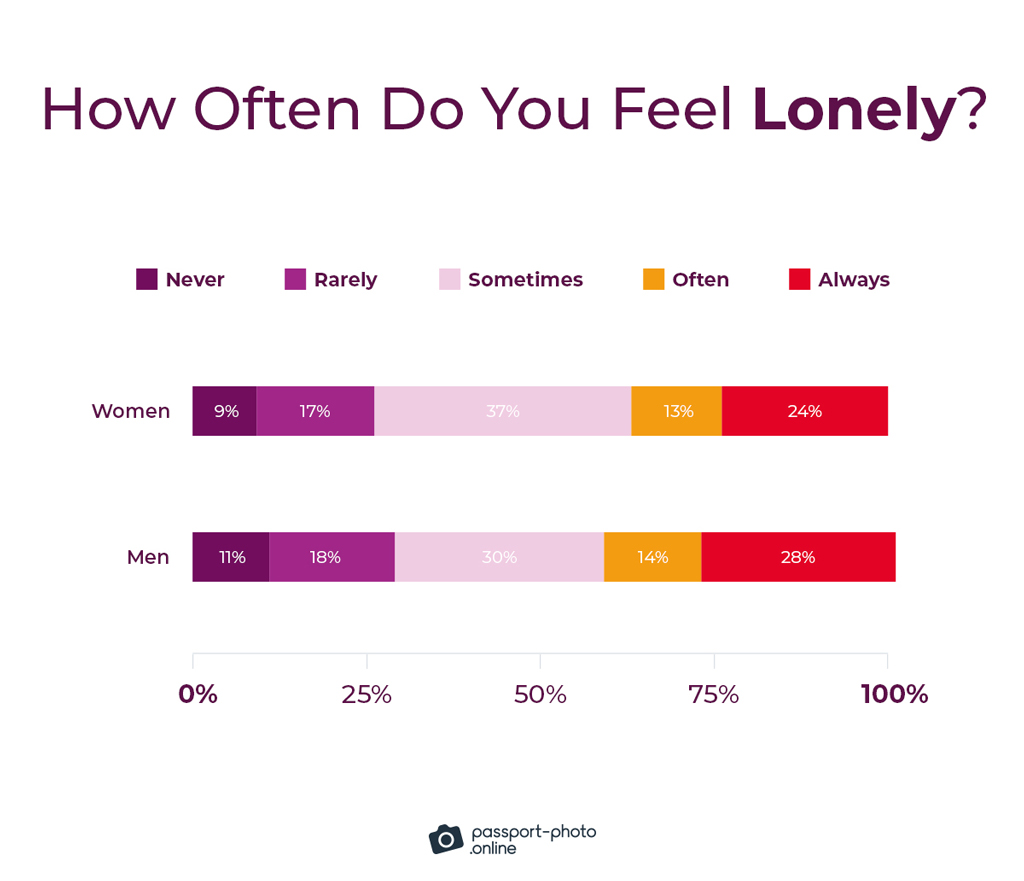
Loneliness Frequency by Gender
- Nearly half of women (47%) report feeling lonely sometimes, making it the most common response among female respondents.
- Among men, 37% say they feel lonely sometimes, showing a lower but still significant emotional impact.
- 23% of men report feeling lonely always, which is 9 percentage points higher than women (14%).
- Women are more likely to experience occasional loneliness, with 17% rarely and 12% often feeling lonely.
- Men show higher intensity in persistent loneliness, with 14% often and 23% always feeling lonely.
- Only a small share of respondents say they never feel lonely, including 9% of women and 8% of men.
- Combined, 26% of men feel lonely often or always, compared to 26% of women, indicating similar overall high-risk levels but different patterns.
- Women are more concentrated in the moderate loneliness range (47% sometimes), while men are more polarized toward chronic loneliness (23% always).
- The data highlights a clear gender gap in emotional experience, with men showing higher long-term loneliness risk.
- These findings suggest the need for targeted mental health support, especially for men experiencing persistent isolation.
Loneliness and Isolation
- 67% of remote workers report loneliness as a challenge at least occasionally.
- 45% of digital nomads cite missing family as their biggest emotional challenge.
- Nomads staying longer than three months per location report lower isolation levels.
- Coworking participation reduces reported loneliness by nearly 30%.
- 83% of coworking members feel less lonely than solo workers.
- Digital communities provide major support for remote professionals combating isolation.
- Time zone differences reduce real-time social connections with home networks by up to 50%.
- Married or partnered nomads report 20% higher satisfaction than solo nomads.
- Nearly 70% of nomads say building local friendships improves lifestyle sustainability.
- 40% of digital nomads feel lonely often or always.
Future Projections
- Analysts project the global digital nomad population could surpass 60 million by 2030 if remote work adoption continues.
- Hybrid work policies in U.S. corporations remain above 25% of workforce participation, sustaining remote pipelines.
- AI-driven remote job categories are expected to expand significantly through 2027.
- International remote hiring increased by over 40% between 2020 and 2024, reshaping cross-border employment norms.
- More countries are expected to launch competitive digital nomad visas to stimulate tourism revenue.
- High-speed satellite internet access is expanding rural and island based nomad destinations.
- Tax treaties and remote compliance frameworks are likely to evolve to accommodate cross-border digital labor.
- Younger generations show a stronger preference for location independence, signaling continued growth.
Frequently Asked Questions (FAQs)
How many digital nomads are there worldwide in 2026?
There are an estimated 43 million digital nomads globally as of 2026.
How many digital nomads come from the United States?
About 18.1 to 18.5 million U.S. digital nomads were reported in recent data, marking a significant increase from earlier years.
What percentage of digital nomads earn more than $50,000 per year?
Approximately 79% of digital nomads earn over $50,000 annually, according to recent income data.
What share of digital nomad visas were introduced after 2020?
About 91% of tracked digital nomad or remote-worker visas were launched after 2020, showing rapid policy growth.
What proportion of digital nomads are men versus women?
Data indicates 56% of digital nomads are men, while around 44% are women in recent surveys.
Conclusion
Digital nomadism represents more than a lifestyle trend. It reflects a structural shift in how professionals define work, income, and mobility. With 43 million global nomads and nearly 18.5 million Americans participating, the movement now influences visa policies, real estate markets, and corporate workforce strategies.
At the same time, financial planning, tax compliance, and mental well-being remain central challenges. As governments refine remote work regulations and companies expand distributed teams, digital nomadism will likely become an established segment of the global labor market rather than a temporary wave.

Leave a comment
Have something to say about this article? Add your comment and start the discussion.