




Entrepreneurship remains a key driver of economic growth, shaping markets, jobs, and innovation in the US and across the globe. New business creation and startup momentum continue to defy traditional downturns, underscoring the resilience of founders and innovators. From small business job creation to cutting-edge tech startups, entrepreneurship fuels diverse sectors. This article unpacks the latest data, trends, and patterns defining entrepreneurship and invites you to explore how founders are reshaping the economic landscape.
Editor’s Choice
- Approximately 665 million people worldwide are actively engaged in entrepreneurial activities.
- An estimated 19% of adults in the US were involved in entrepreneurial activity in 2024–2025.
- 5.2 million new business applications were filed in the US in 2024, up sharply from prior years.
- Nearly half of all new small businesses survive at least five years.
- 66.3% of entrepreneurs self-fund their ventures.
- Roughly 80% of entrepreneurs prioritize digital tools to enhance customer engagement and growth.
- Global startup annual growth averaged about 21% by 2025.
Recent Developments
- In late 2025 and early 2026, trends show rapid AI adoption shaping new business models across sectors.
- Invisible entrepreneurship, where individuals generate income without formal business registration, jumped 94% YOY in the US in 2026 surveys.
- TIME launched its first ranking of top incubators and accelerators in the US for 2026, spotlighting support ecosystems for founders.
- In Latin America, startup investments rose 26% in 2024, with continued growth expectations into 2025.
- Developers and policymakers increasingly emphasize AI tools as co-founders, lowering barriers to firm formation.
- Global entrepreneurial fear of failure remains notable, with roughly half of potential founders citing it as a barrier.
- Surveyed US business leaders project 73% expect revenue growth in 2026, and 48% plan workforce expansion.
- Green startups and climate tech continue climbing as priority innovation areas for founders.
Global Entrepreneurship Overview
- 20% of adults globally engaged in entrepreneurial activity, equating to roughly 580–665 million people by 2026.
- Entrepreneurship growth remains strongest in Asia-Pacific, up ~27% YoY.
- 51% of economies saw increases in early-stage entrepreneurship over two decades.
- High-income economies typically saw ~7.3 new firms per 1,000 adults, compared with 0.4 per 1,000 in low-income countries.
- The Global Startup Ecosystem Index 2025 tracks over 1,400 cities and 110 countries on startup activity and environment.
- London, New York City, Boston, and Paris rank among the top global startup ecosystems.
- Emerging ecosystems like Bengaluru and Hong Kong climbed rankings in 2025.
- Entrepreneurial activity continues rising across regions despite economic uncertainty.
Number of Entrepreneurs Worldwide
- The total global entrepreneur population reached approximately 665 million people in 2026.
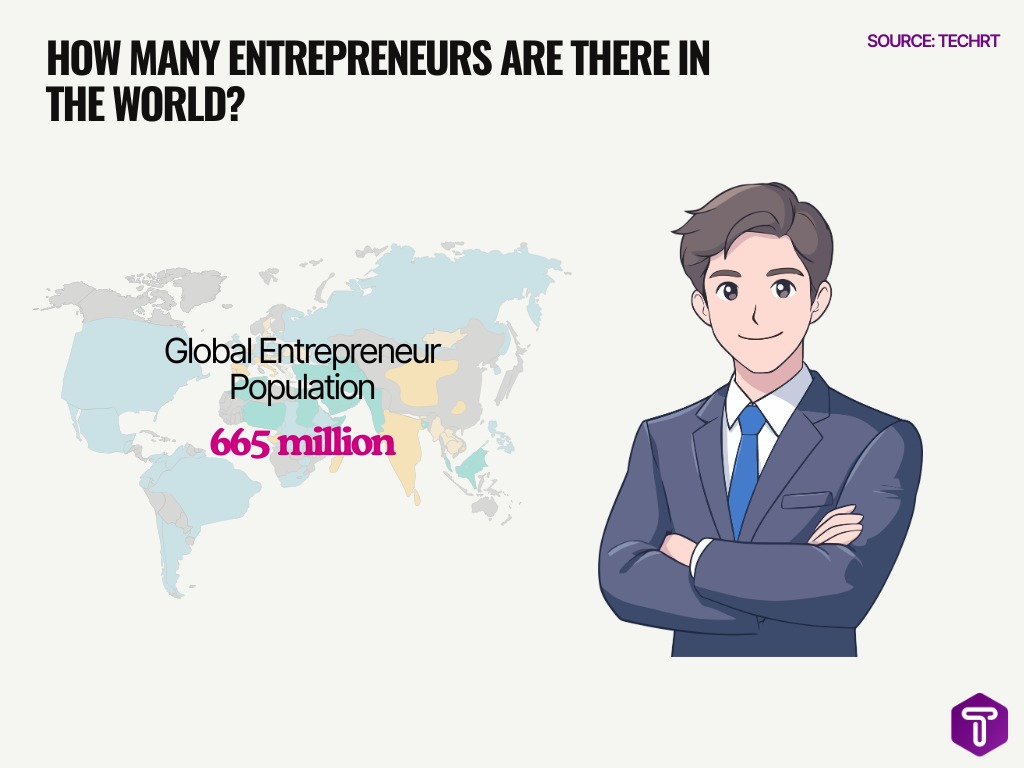
- About 20% of working-age adults globally participate in entrepreneurial activities.
- One in eight working-age adults worldwide is running or starting a business.
- Entrepreneurship growth rates hovered around a 21% annual increase by 2025.
- 51% of participating economies in the GEM data saw entrepreneurship rise between 2001 and 2023.
- Early-stage entrepreneurial activity jumped substantially in Africa and Latin America.
- Countries with supportive regulatory frameworks saw higher rates of business formation.
- Digital infrastructure access is strongly correlated with higher entrepreneur numbers.
New Business Formation and Startup Rates
- The US recorded 5.2 million new business applications in 2024.
- That figure marked a ~48.6% increase since 2019.
- US new business applications equated to about 16.3 per 1,000 residents in 2023.
- Annual startup formation in high-income countries remains multiple times higher than in low-income nations.
- Global startup markets grew ~21% per year through 2025.
- Early-stage entrepreneurial engagement in the US was at near-historic highs in 2024–2025.
- Startup ecosystem data show significant regional variances in entry rates.
- Digital-first businesses continue to dominate new business creation.
Entrepreneurial Ambition Is Rising Across Major Economies
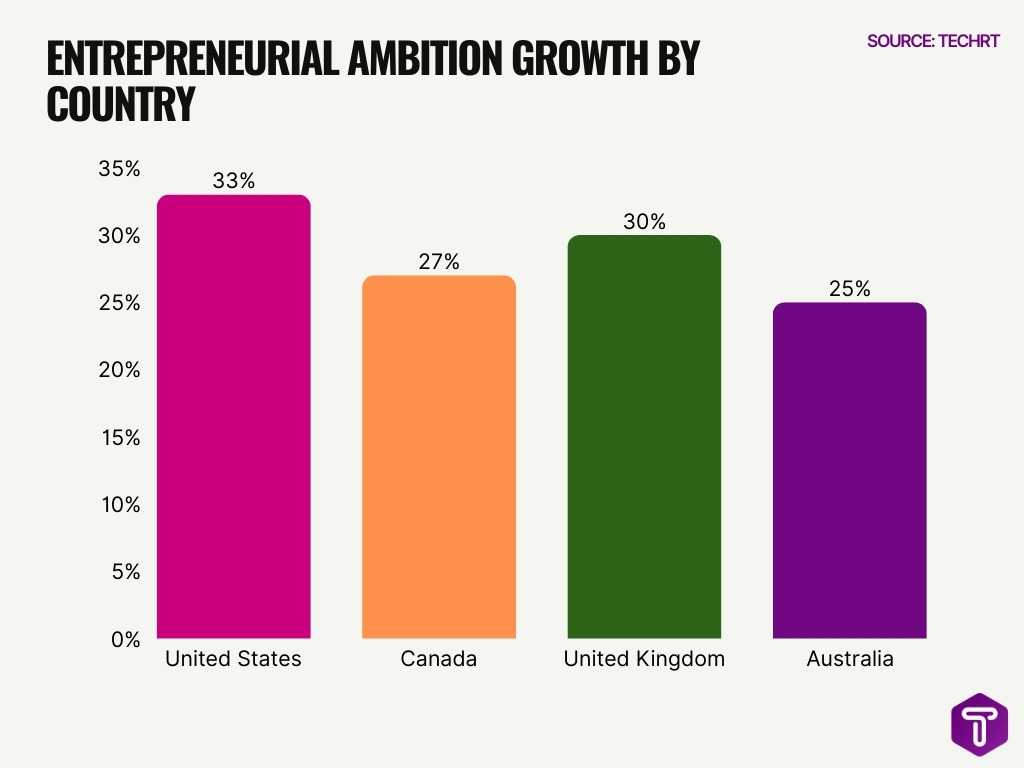
- The United States leads with a 33% increase in entrepreneurial ambition, the highest among all four countries surveyed.
- The United Kingdom follows at 30%, showing strong momentum in new business intent.
- Canada reports a 27% rise, reflecting steady growth in entrepreneurial aspirations.
- Australia records 25% growth, the lowest among the four, but still demonstrates meaningful upward acceleration.
- The gap between the U.S. (33%) and Australia (25%) is 8 percentage points, highlighting stronger entrepreneurial momentum in the U.S. market.
- The survey sample included 3,000 respondents in the U.S. and 1,500 respondents each in Canada, the UK, and Australia, ensuring statistically robust cross-country comparisons.
- Overall, entrepreneurial ambition is accelerating in all four countries, with every market reporting a 25%+ increase in intent to start or grow a business.
Entrepreneurship by Industry and Sector
- The technology sector captured roughly 35% of global startup funding in 2024, led by AI, fintech, and SaaS ventures.
- Global investment in AI startups surpassed $50 billion in 2024, rebounding after a 2023 slowdown.
- Health tech startups secured over $15 billion in funding in 2024, driven by telehealth and biotech innovation.
- The global fintech market is projected to reach $340 billion by 2028, fueling sustained startup formation in digital payments and lending.
- E-commerce startups continue to expand, with US retail e-commerce sales reaching $1.1 trillion in 2024, encouraging new digital-first ventures.
- Climate tech startups attracted over $70 billion globally in 2024, highlighting rising interest in sustainability-focused entrepreneurship.
- The global creator economy surpassed $250 billion in 2024, creating new solo entrepreneurship opportunities.
- Professional services and consulting remain dominant in small business formation, accounting for nearly 15% of new US businesses.
Entrepreneur Demographics (Age, Gender, Education)
- The average age of a successful startup founder in the US is 42 years old, according to MIT research.
- Nearly 50% of US entrepreneurs are between the ages of 30 and 49.
- Approximately 64% of entrepreneurs globally are men, while women account for about 36%.
- Over 60% of startup founders in high-income economies hold a bachelor’s degree or higher.
- Immigrants founded 55% of US unicorn startups valued at $1 billion or more.
- Around 31% of US entrepreneurs identify as minorities, reflecting growing diversity in business ownership.
- College-educated founders are 1.7 times more likely to scale beyond 10 employees compared to non-degree founders.
- First-time founders represent nearly 62% of new business owners in 2025, signaling strong entry rates.
Entrepreneurs by Education Level in the United States
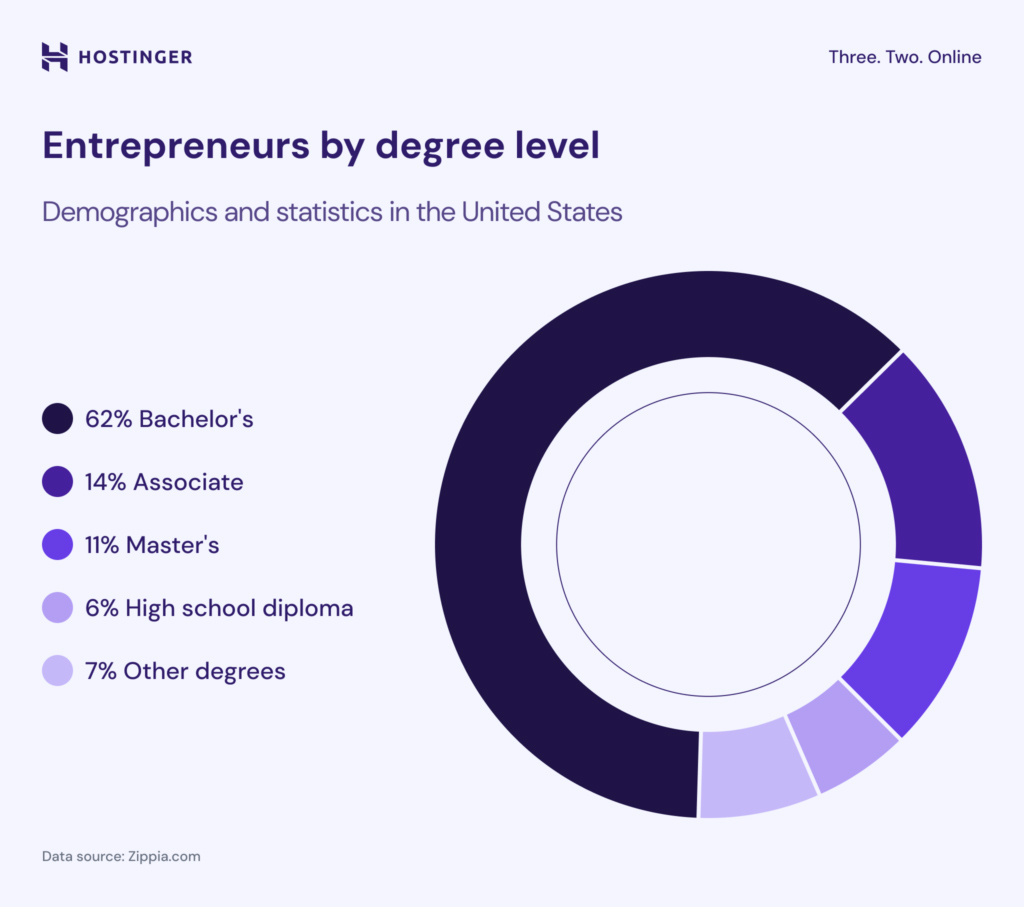
- 62% of entrepreneurs hold a Bachelor’s degree, making it the most common education level among U.S. business owners.
- 14% have an Associate degree, indicating that nearly 1 in 7 entrepreneurs enter business with a two-year college qualification.
- 11% possess a Master’s degree, highlighting a significant share of founders with advanced academic credentials.
- Only 6% of entrepreneurs have a High School diploma as their highest qualification, suggesting that higher education is strongly correlated with entrepreneurial participation.
- 7% fall under “Other degrees”, which may include professional certifications or alternative educational pathways.
- Overall, 87% of entrepreneurs have at least an Associate degree, demonstrating a clear trend toward post-secondary education among U.S. founders.
Women in Entrepreneurship
- Women own 42% of US businesses, representing over 14 million firms.
- Women-led businesses generated $2.7 trillion in revenue in 2024 in the US alone.
- Globally, women’s early-stage entrepreneurial activity reached 11.8% participation in 2024.
- Venture capital funding to women-only founding teams accounted for only 2% of total VC funding in 2024.
- Mixed-gender founding teams secured approximately 20% of total VC investment.
- Women entrepreneurs are more likely to start businesses in healthcare, education, and consumer services.
- Women-owned employer firms grew at a rate of +13% between 2019 and 2024, outpacing male-owned firm growth.
- Access to capital remains a barrier, with 70% of women entrepreneurs reporting funding challenges.
Youth and Student Entrepreneurship
- Globally, about 20% of entrepreneurs are under age 30, reflecting rising youth engagement.
- In the US, nearly 1 in 5 Gen Z adults reports running a side business or startup.
- College entrepreneurship programs increased by +40% since 2015, expanding campus startup ecosystems.
- Youth unemployment rates above 13% globally continue to push necessity entrepreneurship in emerging markets.
- Student-founded startups account for roughly 15% of US tech incubator entries.
- Over 60% of Gen Z founders prioritize mission-driven or sustainability-focused ventures.
- Digital platforms such as Etsy and Shopify lowered entry barriers, with millions of young sellers worldwide.
- Youth-led startups are more likely to operate remotely, with 70% adopting hybrid or fully remote models.
Happiness Levels of Entrepreneurs in the United States
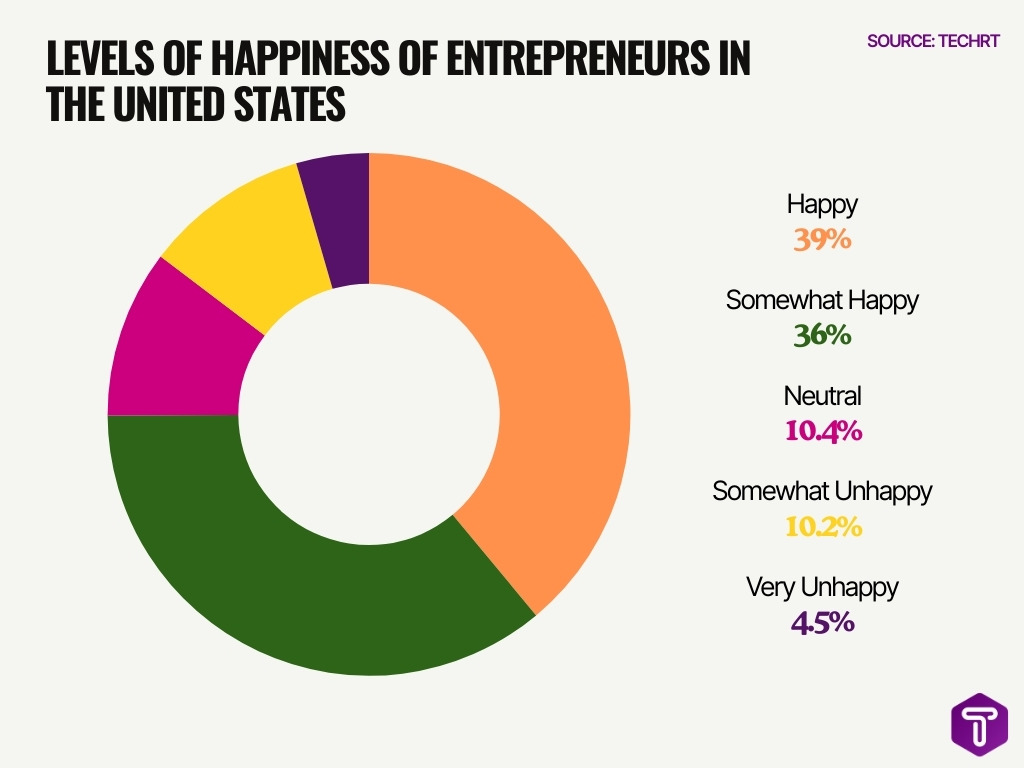
- A combined 75% of U.S. entrepreneurs report being happy, with 39% saying they are “Happy” and 36% “Somewhat Happy.”
- Only 14.7% of entrepreneurs express dissatisfaction, including 10.2% who are “Somewhat Unhappy” and 4.5% who are “Very Unhappy.”
- Approximately 10.4% of entrepreneurs feel neutral, indicating neither satisfaction nor dissatisfaction with their entrepreneurial journey.
- The data shows that entrepreneurs are over 5 times more likely to be happy (75%) than very unhappy (4.5%), highlighting overall positive sentiment within the ecosystem.
- With nearly 4 in 10 entrepreneurs (39%) identifying as fully happy, strong optimism remains a defining characteristic of U.S. business founders.
Startup Funding and Capital Sources
- Global venture funding totaled approximately $285 billion in 2024, recovering from 2023 lows.
- US startups raised over $170 billion in 2024, maintaining global leadership.
- Around 66% of entrepreneurs rely primarily on personal savings to launch ventures.
- Angel investment in the US reached $25 billion annually, supporting early-stage companies.
- Bank loans remain a key source, with 34% of small firms applying for financing in 2024.
- Corporate venture capital accounted for roughly 20% of global VC deals in 2024.
- Government grants and SBA-backed loans distributed over $30 billion in small business funding in 2024.
- Revenue-based financing models grew by +18% year over year, offering non-dilutive capital alternatives.
Venture Capital and Angel Investment in Startups
- The US remained the largest VC market, accounting for nearly 55% of global venture funding in 2024.
- AI startups attracted over 25% of total VC investment globally in 2024.
- Median US seed round sizes rose to approximately $3 million in 2024.
- Angel groups fund over 70,000 startups annually in North America.
- The average Series A valuation in the US hovered around $45 million in 2024.
- Exit activity increased in late 2024, with IPO filings rebounding by +30% compared to 2023.
- Corporate venture arms participated in roughly 1 in 5 venture deals globally.
- VC-backed startups create disproportionate economic value, representing less than 1% of firms but driving outsized innovation impact.
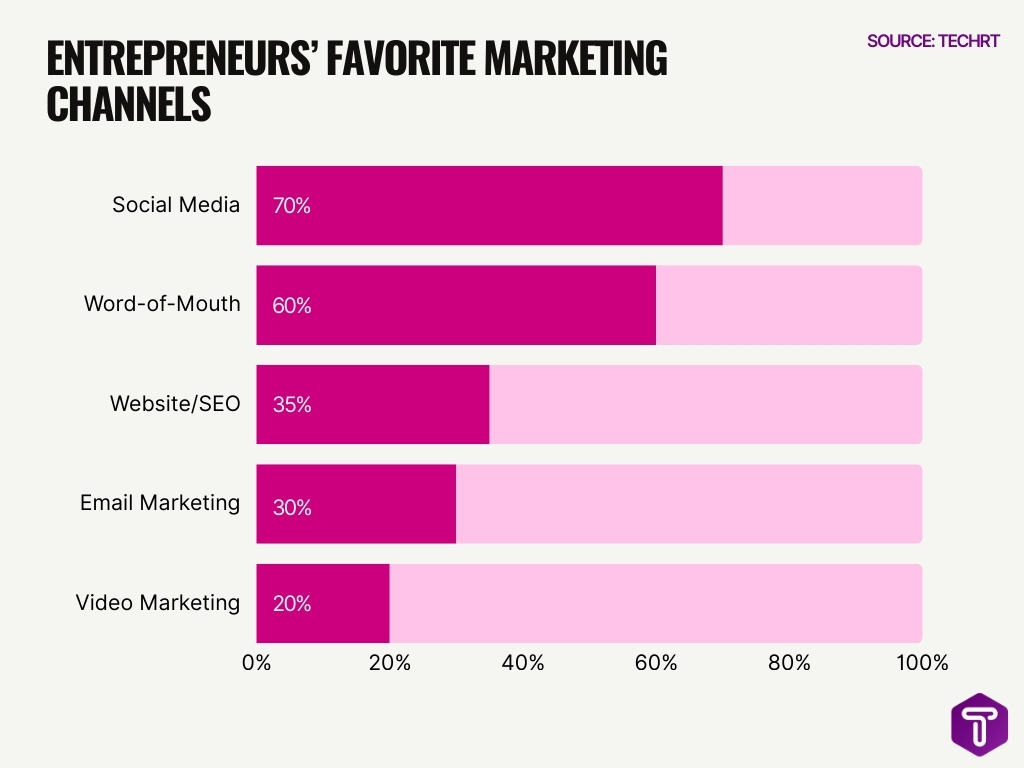
Entrepreneurs’ Favorite Marketing Channels
- Social Media dominates as the top choice, with 70% of entrepreneurs relying on it for marketing and customer acquisition.
- Word-of-Mouth marketing ranks second, used by 60% of entrepreneurs, highlighting the power of referrals and organic advocacy.
- Website/SEO is leveraged by 35%, showing that over one-third prioritize search visibility and owned digital assets.
- Email Marketing accounts for 30%, reinforcing its continued relevance for direct audience engagement and retention.
- Video Marketing is utilized by 20%, indicating growing but still comparatively lower adoption among entrepreneurs.
Crowdfunding and Alternative Financing
- The global crowdfunding market reached approximately $17 billion in 2024, with continued expansion projected.
- The US accounts for nearly 40% of global crowdfunding volume.
- Kickstarter has raised over $8 billion cumulatively since launch.
- Equity crowdfunding participation increased by +16% year over year in 2024.
- Peer-to-peer lending platforms facilitated billions in small business loans globally.
- Revenue-based financing firms reported 18% annual growth in deal volume.
- Crypto-based fundraising and tokenization models gained traction among Web3 startups in 2024.
- Alternative lenders now account for roughly 15% of small business financing in the US.
Revenue, Profitability, and Owner Income
- The average annual revenue for US small businesses is approximately $1.2 million, though most generate under $500,000.
- About 65% of small businesses report profitability in 2024–2025.
- The median income for self-employed business owners in the US is roughly $60,000–$70,000 annually.
- Nearly 30% of startups reach profitability within their first two years.
- Small businesses with employees report average revenues nearly 4x higher than nonemployer firms.
- E-commerce businesses saw average profit margins between 10% and 20% in 2024.
- SaaS startups typically target gross margins of 70% or higher, making them attractive to investors.
- Roughly 82% of business failures stem from cash flow issues, underscoring profitability challenges.
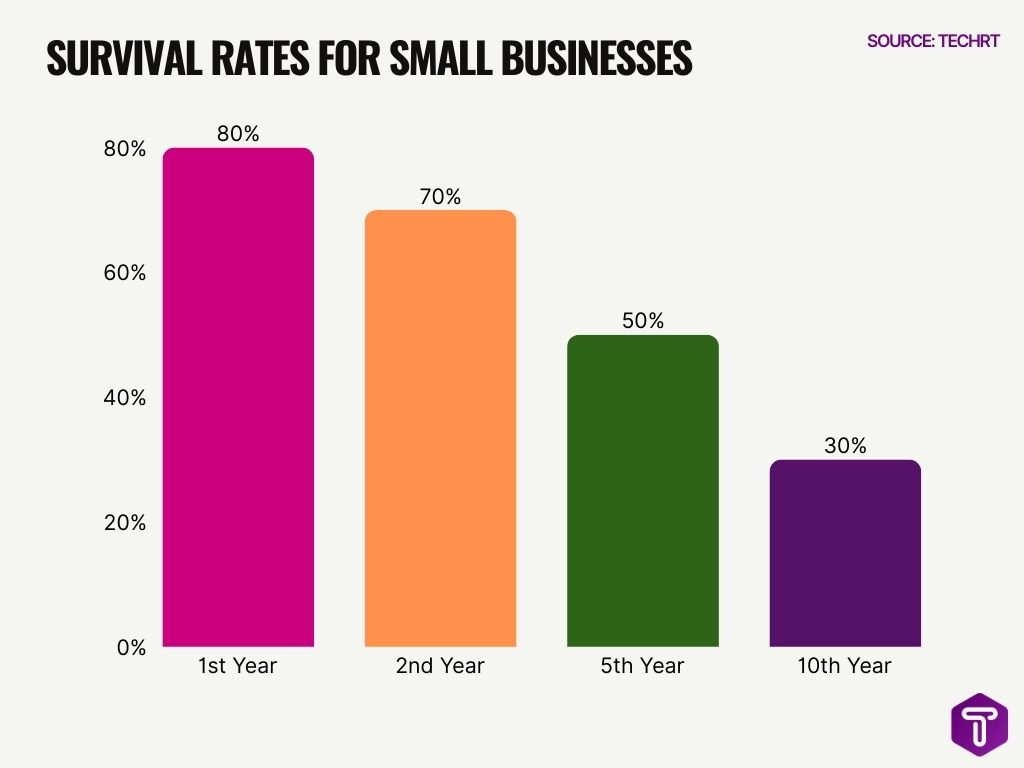
Business Survival and Failure Rates
- 80% of small businesses with employees survive their first year, indicating relatively strong short-term sustainability.
- Survival drops to 70% by the second year, meaning 3 out of 10 businesses fail within the first two years.
- By the fifth year, only 50% of businesses remain operational, highlighting a critical mid-term survival milestone.
- Long-term sustainability becomes more challenging, with just 30% of businesses surviving to their tenth year.
- The data shows a 50 percentage-point decline in survival from Year 1 (80%) to Year 10 (30%), underscoring the increasing risks over time.
- The sharpest cumulative decline occurs within the first five years, where survival falls from 80% to 50%.
Employment and Job Creation by Entrepreneurs
- Small businesses account for 99.9% of all US businesses.
- They employ nearly 46% of the US private workforce, representing over 61 million workers.
- Small firms created over 60% of net new jobs in recent decades.
- In 2023 alone, small businesses generated approximately 1.6 million net new jobs.
- High-growth startups, though less than 5% of firms, account for a disproportionate share of employment expansion.
- Immigrant-founded companies employ an average of 11% more workers than native-founded firms in tech sectors.
- Minority-owned employer firms support over 8 million jobs in the US.
- Remote-first startups increasingly hire across borders, with over 30% of startups maintaining distributed teams.
Contribution of Entrepreneurship to GDP and Economy
- Small businesses contribute approximately 43% of the US GDP.
- Globally, SMEs account for roughly 90% of businesses and 50% of employment.
- In emerging markets, SMEs contribute up to 40% of national GDP.
- Innovation-driven startups significantly boost productivity growth in OECD economies.
- High-tech entrepreneurship correlates strongly with regional GDP expansion.
- US venture-backed companies generate an estimated $3 trillion in annual revenue, contributing significantly to economic output.
- Entrepreneurial ecosystems drive foreign direct investment inflows, particularly in Asia-Pacific markets.
- Research shows that regions with strong startup density experience higher wage growth over time.
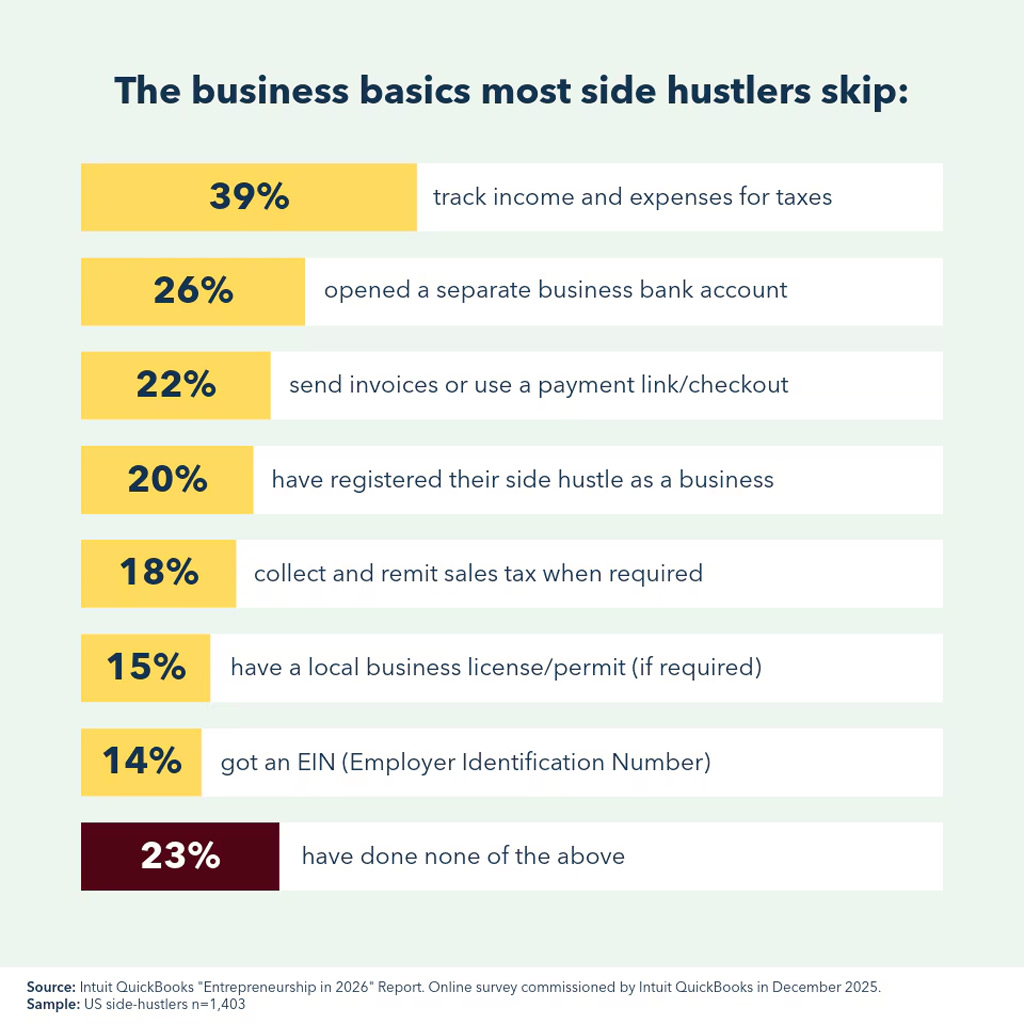
Key Business Basics Most Side Hustlers Overlook
- 39% of side hustlers do not track income and expenses for taxes, increasing their risk of tax errors and missed deductions.
- 26% have not opened a separate business bank account, mixing personal and business finances.
- 22% do not send invoices or use a payment link/checkout system, limiting professional payment processes.
- 20% have not registered their side hustle as a formal business, potentially missing legal and financial protections.
- 18% fail to collect and remit sales tax when required, exposing themselves to compliance risks.
- 15% do not have a local business license or permit (if required).
- Only 14% have obtained an EIN (Employer Identification Number), a key step for business taxation and credibility.
- Notably, 23% of side hustlers have done none of the above, highlighting a significant gap in basic business compliance and financial setup.
Future Trends in Entrepreneurship (2025–2030)
- AI-enabled startups are projected to grow at a compound annual growth rate (CAGR) above 25% through 2030.
- Climate tech investment is expected to surpass $1 trillion cumulatively by 2030.
- The global gig economy is projected to reach $455 billion by 2030, supporting independent entrepreneurship.
- Remote and hybrid startups are forecast to remain dominant, with over 70% of founders planning flexible work models long term.
- Digital payments and embedded finance markets are projected to grow at 20%+ CAGR through 2030.
- Women’s entrepreneurial participation is expected to rise steadily, narrowing the global gender gap by 2030.
- Blockchain-based startups continue expanding in fintech and supply chain use cases.
- Governments worldwide are increasing startup visa programs and founder incentives to attract global talent.
Frequently Asked Questions (FAQs)
How many new business applications were filed in the US in 2024?
5.2 million new business applications were filed in the US in 2024, representing sustained high entrepreneurial activity.
What proportion of businesses fail within the first year?
About 20% of businesses fail within their first year of operation, based on recent failure rate data.
How many entrepreneurs are there globally?
There are approximately 665 million entrepreneurs worldwide, meaning one in eight working-age people is actively engaged in entrepreneurial pursuits.
How many new startups are established each year globally?
Around 50 million new startups are established each year globally, contributing to a worldwide total of more than 150 million startups.
What was the percentage increase in US business applications in January 2026 compared to December 2025?
Business applications in January 2026 increased by 7.2% compared to December 2025, while projected new business formations rose by 4.5%.
Conclusion
Entrepreneurship reflects resilience, innovation, and rapid transformation. Founders across the US and globally continue launching businesses at historically high rates, even amid economic shifts. Small businesses remain central to job creation, GDP growth, and technological progress, while emerging sectors such as AI, climate tech, and digital finance redefine opportunity.
At the same time, data shows persistent funding gaps, survival challenges, and capital access barriers. However, with strong ecosystems, expanding alternative financing options, and increasing diversity among founders, entrepreneurship remains one of the most powerful economic forces shaping the decade ahead.

Leave a comment
Have something to say about this article? Add your comment and start the discussion.