




Gmail remains one of the most widely used email services in the world, shaping how individuals, businesses, and organizations communicate daily. From billions of active users to its central role in digital workflows, Gmail influences communication traffic, productivity, and even marketing strategies. In industries from customer support to remote workforce collaboration, Gmail’s reach continues to expand, underscoring its relevance in professional and personal settings. Read on to explore the latest data and trends defining Gmail.
Editor’s Choice
- ~1.8 billion people use Gmail actively as of 2026.
- Gmail accounts for about 25–30% of the global email client market share.
- The U.S. accounts for roughly 75% of Gmail usage among surveyed respondents.
- 121 billion+ emails are sent daily via Gmail.
- Over 82% Gmail penetration in Indonesia and India.
- Mobile access represents a dominant portion of Gmail usage.
- Gmail integrates new AI‑powered features as of 2026.
Recent Developments
- Google rolled out AI‑driven inbox features in early 2026 to help users compose, summarize, and prioritize emails.
- “Help Me Write” AI tool tailors email drafting based on user style.
- Early tests of AI Inbox automate message prioritization.
- Features are initially available primarily in English in the U.S. before global rollout.
- Expanded search and overview capabilities assist users in navigating large inboxes.
- AI integrations aim to reduce inbox stress and increase productivity.
- New tools underline Google’s push to make Gmail more than just an email platform.
- These changes reflect a broader trend toward AI‑assisted communication tools across the industry.
What is Gmail?
- Gmail is a free and paid email service provided by Google.
- First launched on April 1, 2004, Gmail revolutionized email storage and usability.
- It supports access via webmail, mobile apps, and third‑party email clients.
- Offers integrated storage shared with Google Drive and Photos.
- Gmail is available in 130+ languages, expanding global usability.
- The service includes spam filtering and security scanning.
- It’s a core part of Google’s productivity ecosystem alongside Workspace tools.
- Gmail’s architecture supports Google’s broader digital services strategy.
User Growth Trends Over Time for Gmail
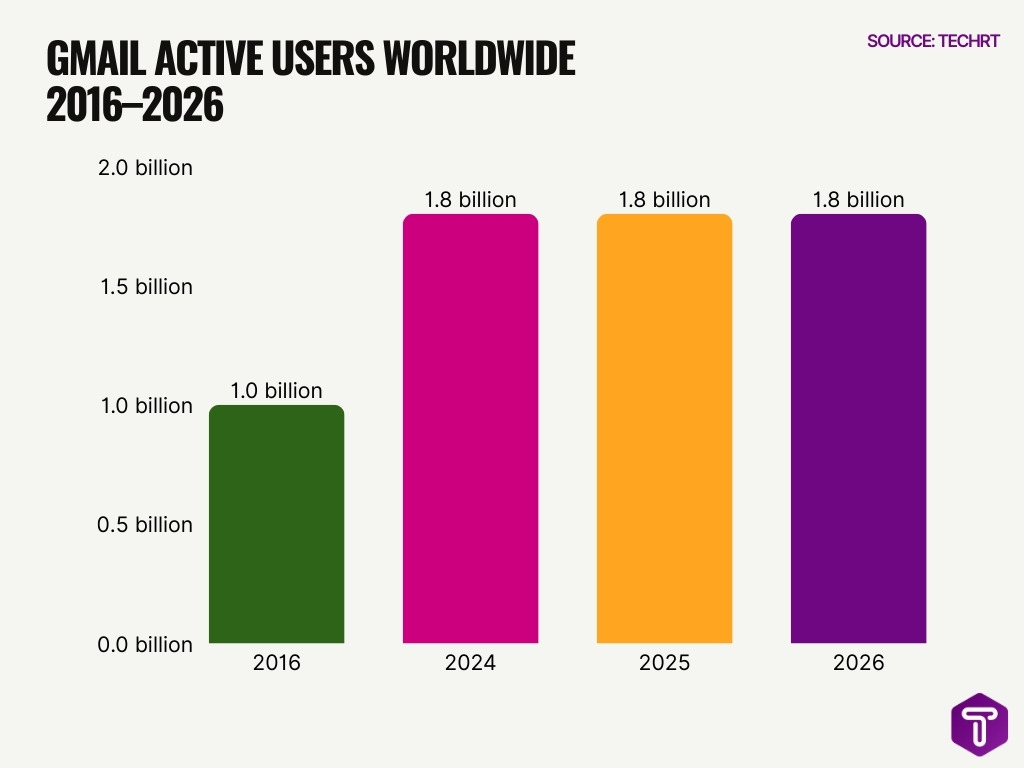
- Gmail’s active user count has hovered around 1.8 billion worldwide in 2025 and 2026, showing both scale and maturity in its adoption.
- From 2016 to 2024, Gmail grew from 1 billion to 1.8 billion users, with most of that growth happening before 2020.
- Growth plateau suggests Gmail has reached global digital communication saturation in many markets.
- Average Gmail accounts per active user remain around 1.7 to 1.9, indicating multi‑account use (personal + work).
- Monthly visits consistently exceed 8 billion, reflecting heavy engagement.
- Although 1.8 billion active users is stable, total associated accounts (individual logins) approach 3 billion when counting multi‑account users.
- Gmail’s ongoing growth in emerging markets contributes to new users despite slower expansion in saturated regions.
- The plateau in high‑income markets contrasts with strong rises in Asia and Africa, underpinning future growth potential.
- The consistency of Gmail’s user figures reflects its entrenchment across personal, educational, and business contexts.
Total Number of Users on Gmail
- Gmail has approximately 1.8 billion active users worldwide in 2026.
- This reflects consistent long‑term growth over the past decade.
- The number includes users across personal and organizational accounts.
- Gmail has more users than many other standalone email services.
- Monthly Gmail session counts exceed those of major standalone competitors.
- Growth has eased compared to the explosive early decade trends.
- Gmail’s user base continues to scale with global internet adoption.
- Adoption remains high among business and educational email accounts.
Market Share Held by Gmail Globally
- Gmail holds roughly 25–30% of the global email client market share as of 2025 to 2026.
- Some reports show Gmail as second only to Apple Mail in market share.
- Gmail’s market share varies by measurement methodology and region.
- Apple Mail often leads due to the default device settings on iOS hardware.
- Outlook and Yahoo! Mail trail far behind in opens and usage.
- Gmail’s share reflects combined web and mobile app use.
- Competing platforms gain or lose share based on regional trends.
- Inclusion in Workspace enhances Gmail’s presence in business segments.
Usage Distribution of Gmail by Country and Region
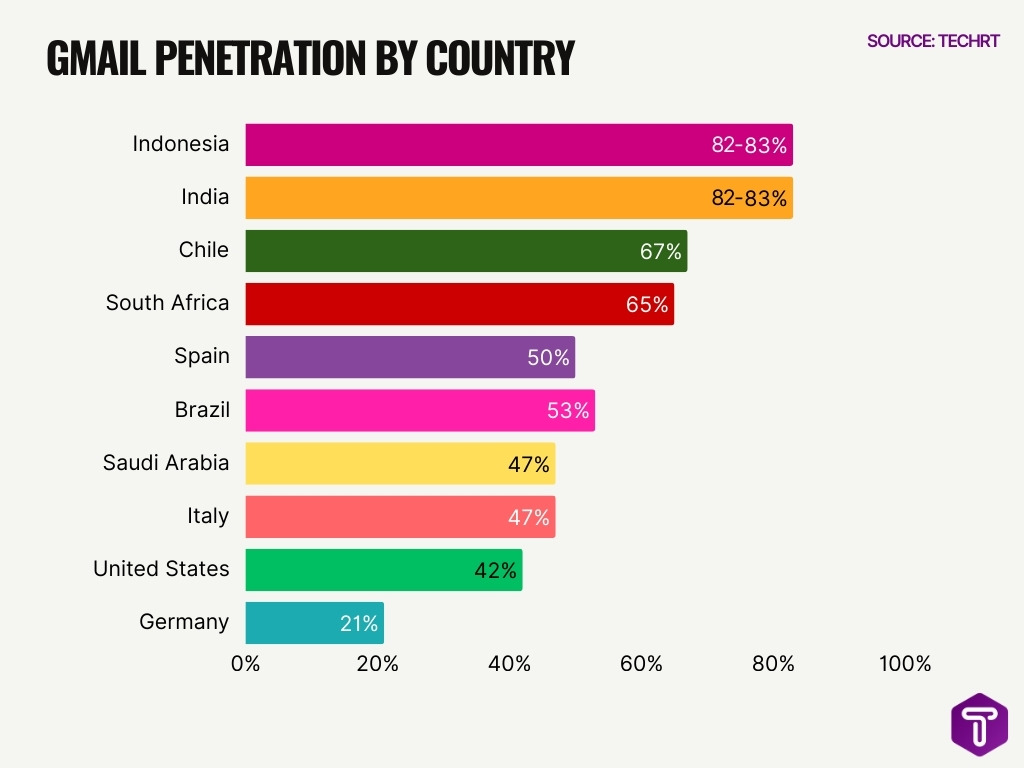
- Indonesia and India lead in Gmail penetration, with ~82‑83% of residents using the platform.
- Chile (~67%) and South Africa (~65%) rank next in regional adoption share.
- Brazil also shows high Gmail use (~53%), demonstrating strong Latin American engagement.
- The United States has approximately 41.9% of its population using Gmail.
- Other high‑usage countries include Spain (~50%), Saudi Arabia (~47%), and Italy (~47%).
- Some European countries, like Germany, show lower Gmail uptake (~21%).
- Regional trends highlight Gmail dominance in Asia, parts of Africa, and the Americas.
- Despite varied regional penetration, Gmail maintains a significant global reach due to integration with Android devices and Google services.
Mobile vs Desktop Access Patterns for Gmail
- Approximately 75–85% of Gmail users access their email via mobile devices (smartphones or tablets).
- Only about 15–25% access Gmail primarily on desktop clients.
- Mobile usage reflects broader email trends, where mobile opens account for 40–60% of all email interactions.
- Mobile access includes both the Gmail app and mobile web interfaces.
- Desktop access remains more common for business and corporate Gmail accounts.
- The rise of mobile‑first communication habits drives frequent short sessions on Gmail.
- Responsive design updates in Gmail aim to enhance mobile user experience.
- Mobile engagement is boosted by push notifications for new emails and real‑time alerts.
App Downloads and Install Metrics for Gmail
- Gmail app surpasses 10 billion downloads on Google Play.
- The iOS version of Gmail has over 2 million ratings on the App Store.
- Global Gmail active users exceed 1.8 billion monthly.
- 75% of Gmail traffic comes from mobile devices.
- Google Play lists Gmail in the 10+ billion install bracket.
- Asia accounts for 45% of Gmail app downloads.
- The Americas contribute 30% of total Gmail installs.
- Daily downloads average 5 million for the Gmail app.
- Workspace integration drives 20% business user installs.
Gmail Users by Age Group: Key Demographic Insights
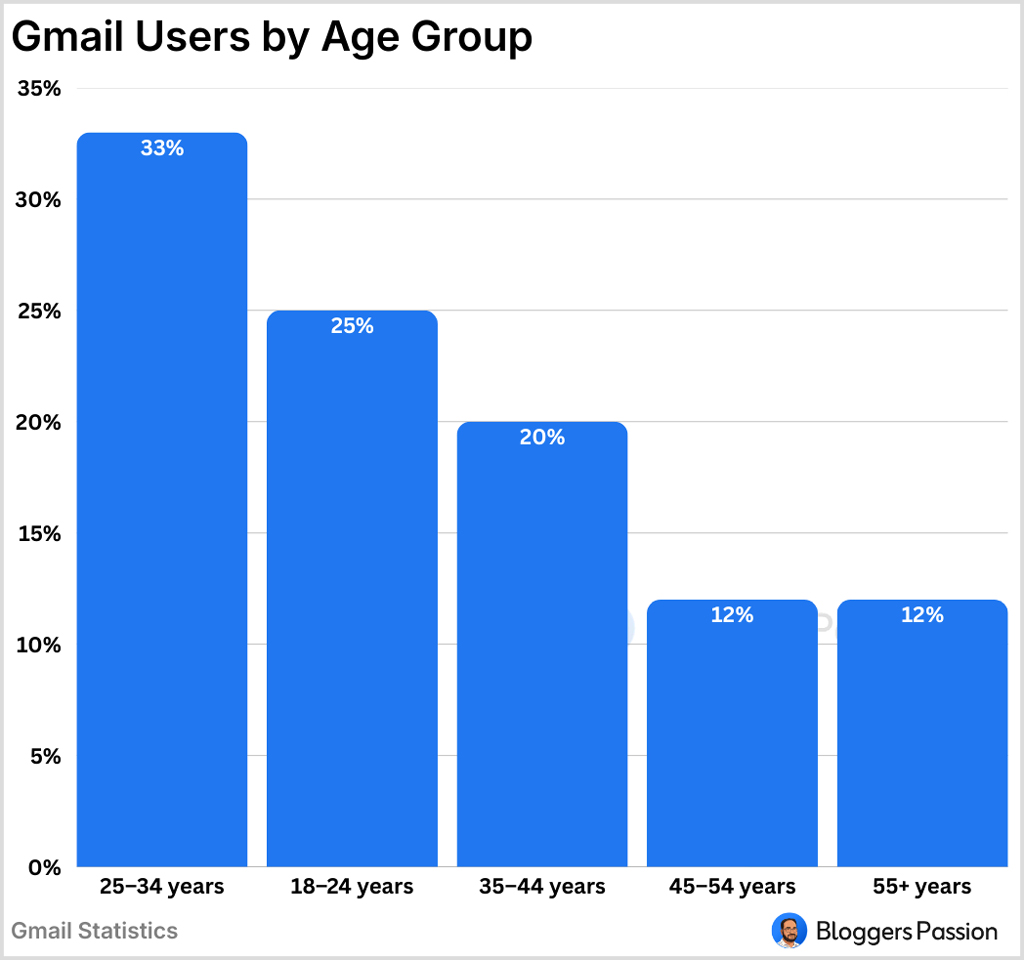
- The 25–34-year age group represents the largest share, accounting for 33% of total Gmail users, showing strong adoption among young professionals.
- Users aged 18–24 years make up 25%, highlighting Gmail’s high popularity among students and early-career individuals.
- The 35–44 years segment contributes 20%, reflecting steady usage among mid-career professionals and families.
- Adults in the 45–54 years category account for 12%, indicating moderate engagement among mature users.
- The 55+ years age group also represents 12%, showing that Gmail maintains a solid presence among senior users.
- Combined, users aged 18–34 years contribute 58%, demonstrating that younger demographics dominate Gmail’s user base.
- More than 78% of users are under 45 years, emphasizing Gmail’s strong appeal to digitally active and working-age populations.
- The relatively lower share among users 45+ (24%) suggests opportunities for growth and targeted outreach in older age segments.
Volume of Emails Sent Through Gmail Daily
- Gmail handles an estimated 121 billion emails sent per day, a substantial share of global email traffic.
- That daily volume reflects messages across personal, business, marketing, and transactional types.
- Projections suggest Gmail’s daily volume could reach 131 billion by 2025 with market share increases.
- As part of the overall email traffic, Gmail contributes significantly to the hundreds of billions of daily messages worldwide.
- Daily email load is driven by business automation, newsletters, and user‑to‑user communication.
- Heavy daily volume underlines the platform’s central role in enterprise workflow and marketing campaigns.
- Spam and filter activity also scales with daily traffic, requiring robust protections.
- Gmail’s infrastructure is optimized to route massive volumes with minimal downtime.
Business Adoption Trends of Gmail
- Over 6 million businesses use Google Workspace, which includes Gmail as the primary email service.
- About 90% of U.S. startups choose Gmail for business email communications.
- Roughly 40% of Fortune 500 companies rely on Gmail and Google Workspace for corporate email and collaboration.
- Mid‑sized companies show ~60% Gmail adoption within their email systems.
- In higher education and research institutions, Gmail adoption reaches around 80% for official email use.
- Gmail’s business use spans core functions like shared calendars, Drive file storage, and team collaboration tools in Workspace.
- Google Workspace’s integrated admin controls and custom domain email remain major drivers of enterprise adoption.
- Monthly business signups for Workspace (which includes Gmail) add approximately 250,000 new customers.
Gmail.com Marketing Channel Distribution
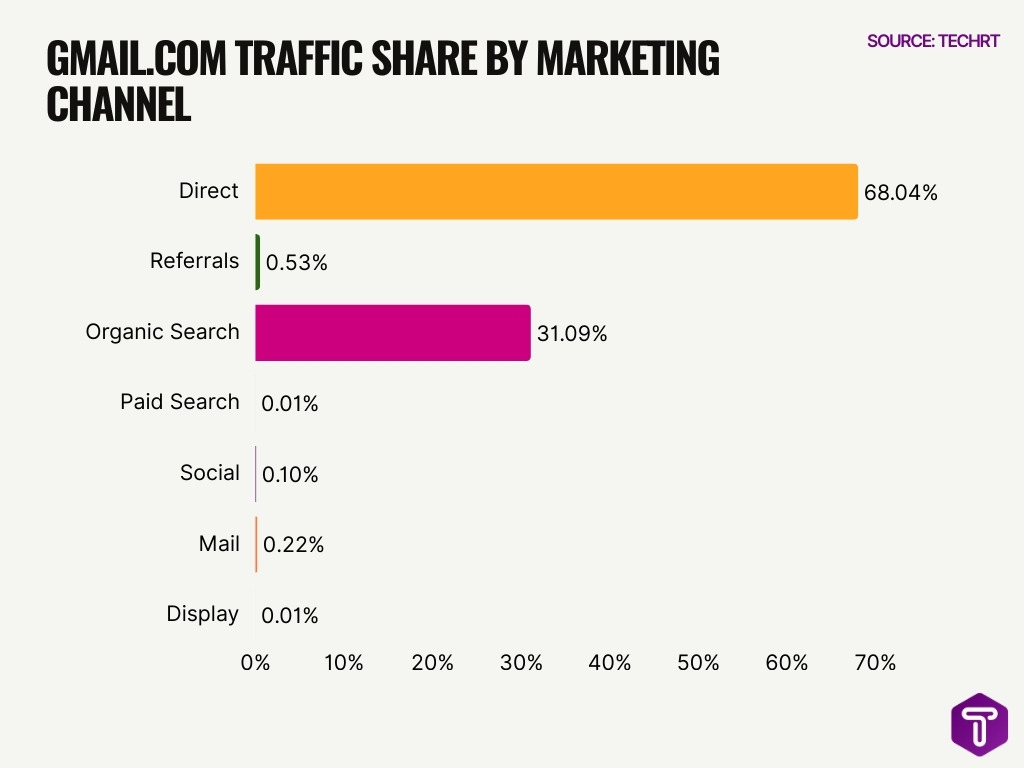
- Direct traffic dominates, accounting for 68.04% of total visits, showing strong brand recognition and repeat usage.
- Organic Search is the second-largest source at 31.09%, highlighting the importance of SEO and search visibility for Gmail.
- Combined, Direct and Organic Search contribute over 99% of total traffic, indicating high user loyalty and discoverability.
- Referrals remain minimal at just 0.53%, suggesting limited dependence on external websites.
- Paid Search contributes only 0.01%, reflecting Gmail’s negligible reliance on paid advertising.
- Social media traffic is extremely low at 0.10%, showing minimal impact from social platforms.
- Email (Mail) marketing drives only 0.22% of visits, indicating limited cross-email promotion.
- Display advertising impact is almost zero at 0.01%, reinforcing Gmail’s organic-first growth model.
Usage of Gmail in Education and Nonprofit Sectors
- Google Workspace for Education serves over 150 million students and educators worldwide.
- Over 170 million students and teachers actively use Google Workspace globally.
- Google Classroom, integrated with Gmail, reaches 120 million academic users.
- 80% of top U.S. higher education institutions adopt Google Workspace for Education.
- 300,000 nonprofits worldwide use Google for Nonprofits products, including Gmail.
- Google Workspace for Nonprofits supports up to 2,000 users per organization at no cost.
- Over 30 million students, faculty, and staff utilize Gmail in academic settings.
- Educational institutions in more than 180 countries leverage Google Workspace for Education.
- Google Classroom holds 9.36% global LMS market share with 29,161 organizations.
Revenue and Monetization Figures for Gmail
- Google Workspace revenue reached $15.1 billion in 2024, fueling Gmail‘s enterprise monetization.
- Google Cloud, encompassing Workspace, achieved a $68 billion annual run rate by late 2025.
- Q4 2025 Google Cloud revenue jumped 48% to $17.7 billion, boosting productivity tools.
- Google One hit 150 million paid subscribers in 2025, expanding Gmail storage beyond 15 GB.
- Alphabet ad revenue, including free Gmail ads, totaled $350 billion in 2025.
- Workspace powers 9 million business customers and 3 billion free Gmail users.
- Google Cloud backlog surged to $240 billion in Q4 2025, driven by Workspace demand.
- Paid Workspace plans generate recurring revenue from 70% enterprise upgrades.
- Gmail ads contribute $10-15 billion annually to Google’s $400 billion total revenue.
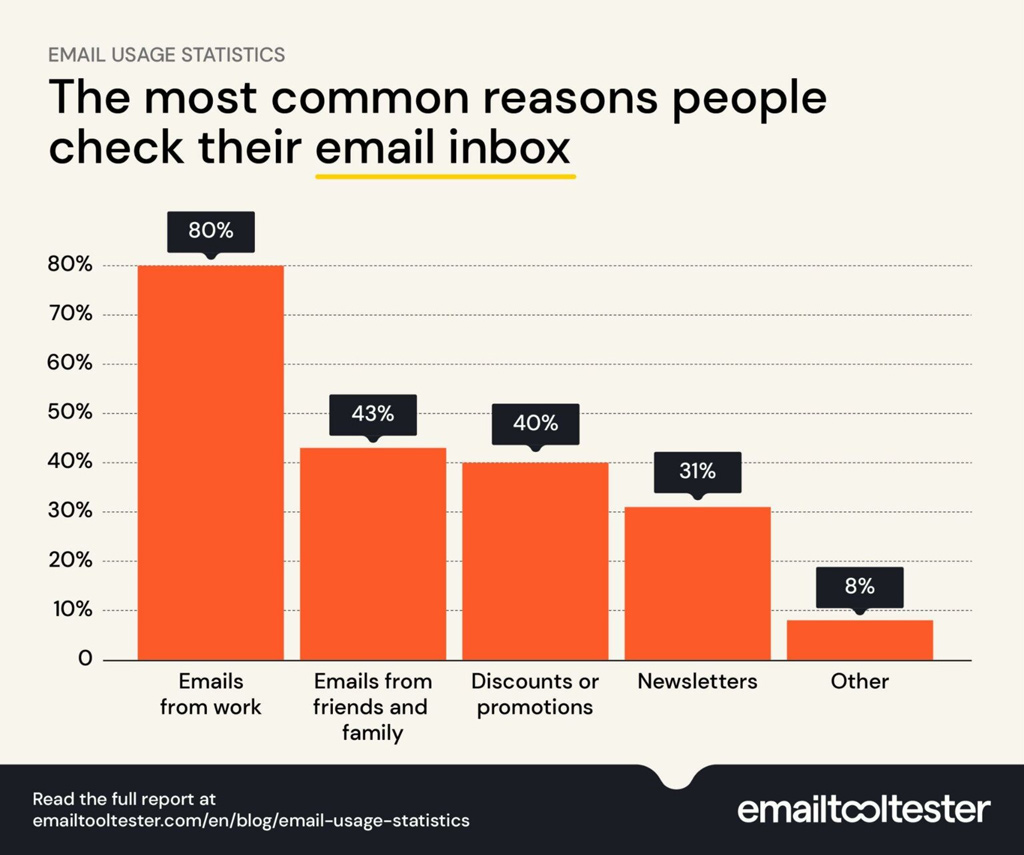
Top Reasons People Check Their Email Inboxes
- Work-related emails dominate usage, with 80% of users checking their inbox mainly for professional communication and job-related updates.
- Personal connections remain important, as 43% of people regularly check emails from friends and family.
- Promotional content strongly influences engagement, with 40% of users opening emails for discounts and special offers.
- Newsletters continue to attract readers, with 31% of users checking their inbox for subscriptions, updates, and curated content.
- Other reasons account for minimal usage, representing just 8%, showing limited interest in non-standard email purposes.
Security and Privacy Performance of Gmail
- Gmail blocks over 99.9% of spam, phishing, and malware before users see it.
- Nearly 100 million spam emails are filtered out every single minute across Gmail’s global infrastructure.
- Advanced AI filters have improved detection, reducing false positive spam flags by ~19%.
- Gmail employs multilayered threat detection combining sender reputation, content inspection, and behavioral signals.
- Two‑factor authentication (2FA) and security alerts help protect accounts from unauthorized access.
- Encryption in transit and at rest is standard for Gmail traffic.
- Gmail’s security approach continually updates to mitigate evolving threats such as spoofing.
- Users can review and manage connected devices and access permissions to enhance account privacy.
AI and Automation Features Used in Gmail
- Gmail serves 1.8 billion active users worldwide in 2026.
- Smart Reply accounts for 10% of all Gmail emails sent daily.
- Over 80% of users opt for Smart Reply suggestions instead of typing replies.
- Enterprise users accept 70% of Gemini Help Me Write suggestions.
- By 2025, 70% of Gmail users regularly use at least one AI feature.
- Gmail blocks 99.9% of spam and phishing messages using machine learning.
- TensorFlow blocks an additional 100 million spam messages daily in Gmail.
- Gmail processes 121 billion emails daily, powering AI prioritization.
- AI-driven search in Gmail prioritizes relevance based on user habits and context.
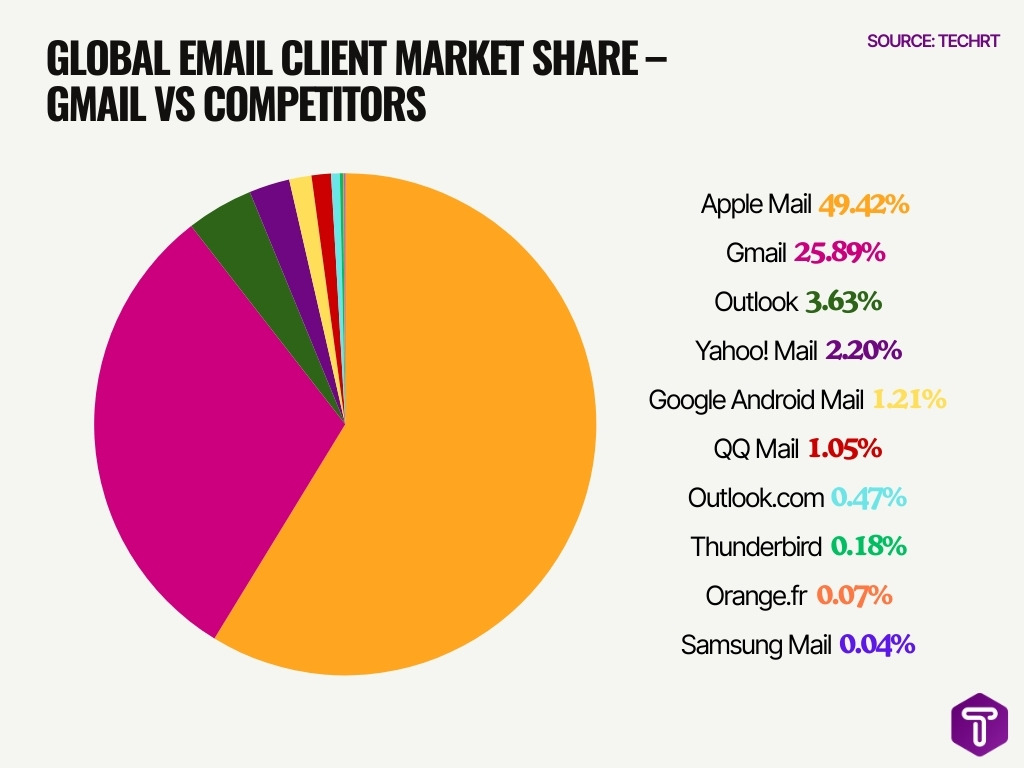
Email Client Market Share: Gmail vs Competitors
- Apple Mail dominates the market with a commanding 49.42% share, making it the most widely used email client globally.
- Gmail holds the second position with 25.89%, showing strong adoption across personal and professional users.
- Outlook maintains a modest presence at 3.63%, reflecting its niche usage compared to leading platforms.
- Yahoo! Mail accounts for 2.20%, indicating declining popularity in the modern email ecosystem.
- Google Android Mail captures 1.21%, highlighting limited standalone usage beyond integrated Gmail services.
- QQ Mail secures 1.05%, driven mainly by its strong user base in Asian markets.
- Outlook.com registers just 0.47%, showing minimal impact as a separate web-based client.
- Thunderbird’s market share remains low at 0.18%, reflecting its use among technical and open-source-focused users.
- Orange.fr records only 0.07%, suggesting very limited regional adoption.
- Samsung Mail ranks last with 0.04%, indicating marginal global usage.
- Apple Mail and Gmail together control over 75% of the market, with a combined share of 75.31%, reinforcing their market dominance.
- All other competitors combined account for less than 25%, showing high market concentration among top providers.
Device and Platform Trends Related to Gmail Access
- Mobile devices dominate Gmail access at 75–80% of opens, up from 60% in 2020.
- Smartphones account for 75% of Gmail user access globally.
- Desktop usage accounts for roughly 20–25% of Gmail opens, remaining vital for professional tasks.
- Android Gmail app exceeds 10 billion downloads, often pre-installed.
- iOS Gmail downloads surpass 500 million on App Store.
- Web access draws 95% mobile and 5% desktop traffic to gmail.com.
- Gmail app saw 990K installs in 2025 alone on Android.
- Businesses favor desktop Gmail, with 60% mid-sized US firms using it.
- Cross-platform engagement rises, with users averaging 28 minutes daily.
- Responsive design supports seamless shifts, 70% users are primarily mobile.
Frequently Asked Questions (FAQs)
How many active users does Gmail have worldwide in 2026?
Gmail has over 1.8 billion active users globally as of the latest reports in 2026.
What percentage of the global population uses Gmail?
An estimated about 22–23% of the world’s population actively uses Gmail.
What share of the email client market does Gmail hold?
Gmail holds around 29–31% of the global email client market share, making it one of the top email platforms.
How many emails does Gmail send every day?
Gmail handles an estimated around 121 billion emails per day.
What percentage of Gmail users access it on mobile devices?
Approximately 75–80% of Gmail users access their accounts via mobile devices.
Conclusion
Gmail remains a dominant force in email, with massive global reach, strong business and educational adoption, and increasingly sophisticated security and AI features. Its integration within Google Workspace fuels enterprise collaboration, while mobile‑first access keeps personal use robust. Compared with competitors, Gmail holds a leading position in user engagement and platform versatility. As email usage evolves, Gmail’s role in both professional communication and everyday connectivity continues to expand, driven by automation, security enhancements, and broad platform support.

Leave a comment
Have something to say about this article? Add your comment and start the discussion.