


Google Search remains the backbone of the modern internet. From researching products before buying on Amazon to finding nearby restaurants or troubleshooting software issues, billions of people rely on Google every day. Businesses also depend on search visibility to drive traffic, generate leads, and inform digital marketing strategies. Understanding Google Search statistics helps marketers, publishers, and companies make better SEO and advertising decisions, so let’s explore the data shaping search.
Editor’s Choice
- Google processes more than 13.6 billion searches per day globally as of 2025, reflecting massive growth in digital information demand.
- Annual Google searches have surpassed nearly 5 trillion queries worldwide, making it the largest information retrieval system in history.
- Google handles roughly 9.5 million searches every minute, which translates into massive real-time user activity across devices.
- Google receives approximately 16.4 billion searches per day in recent estimates, highlighting continued usage growth in 2025 and 2026.
- Google maintains about 89.98% global search engine market share in 2026, far ahead of competitors like Bing and Yahoo.
- Roughly 5.9 million Google searches occur every minute, showing how quickly users seek information online.
- The average internet user performs about 2–4 searches per day, depending on region and usage habits.
Recent Developments
- Google now handles more than five trillion searches annually, according to company statements shared in recent industry discussions.
- The rollout of AI-powered search features such as Gemini and AI Overviews is changing how people formulate queries and explore results.
- Exposure to AI-generated answers in search results expanded from 7 to 229 countries between 2024 and 2025, reflecting rapid global deployment.
- AI-generated search responses answered over 66% of COVID-related queries in 2025, compared with only 1% in 2024.
- Some users increasingly explore alternatives like Bing and DuckDuckGo due to concerns about AI-generated results, though Google still dominates search traffic.
- AI-driven summaries have increased “zero-click” search behavior, reducing traffic to some publisher websites.
- Google’s evolving search experience now prioritizes context-rich queries and conversational search patterns, particularly on mobile devices.
- New AI-powered competitors and tools, such as conversational search platforms, are emerging, but they still handle far fewer queries than Google.
Overview of Google Search in 2026
- Google processes more than 5 trillion searches per year, highlighting its enormous scale in the digital ecosystem.
- The search engine averages over 16 billion daily queries based on recent global estimates.
- Google Search generates millions of results across hundreds of billions of indexed web pages stored in its massive search index.
- The platform handles nearly 190,000 searches per second based on recent daily query estimates.
- Google Search continues to attract billions of active users worldwide, reflecting the widespread adoption of internet access and mobile devices.
- The search index contains more than 100 million gigabytes of data, including billions of web pages updated constantly by crawlers.
- Google remains the primary discovery platform for websites, with most users starting their online journeys through a search query.
- The average user conducts several searches daily for information, shopping, and navigation, demonstrating search’s role in daily decision-making.
How Many Google Searches Happen Every Day?
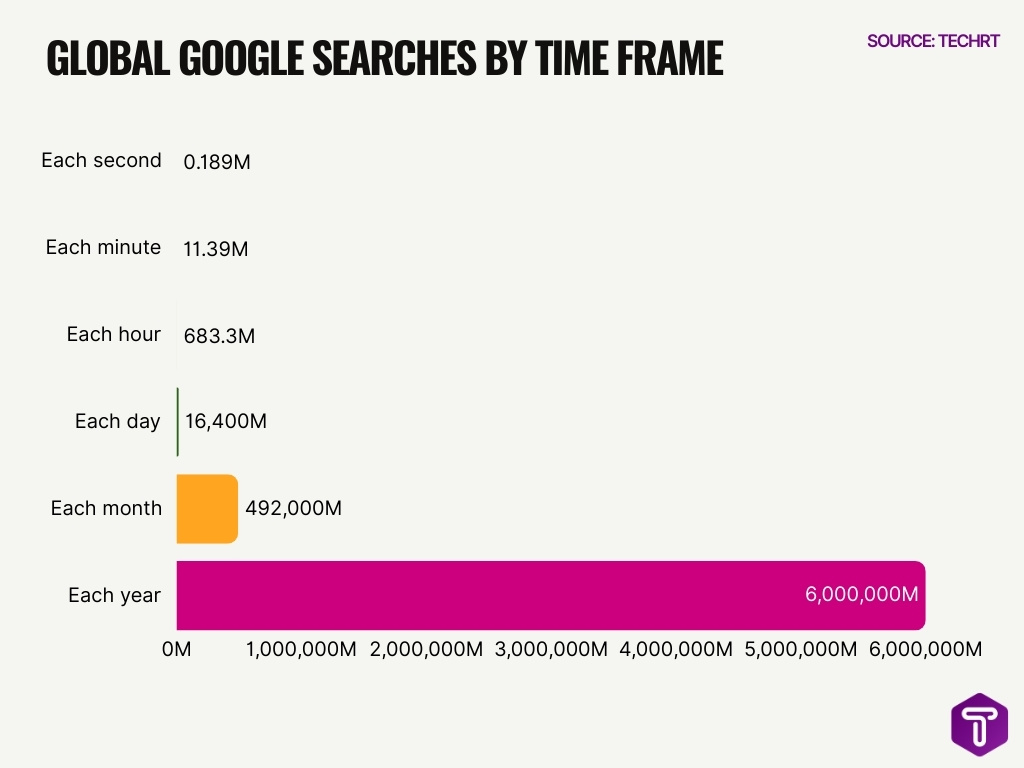
- Google processes about 189,815 searches every second, showing how constantly users rely on the platform for information and answers.
- This activity quickly scales to 11.39 million searches every minute, reflecting the massive global demand for real-time information.
- Over the course of an hour, Google handles roughly 683.3 million searches, demonstrating the platform’s enormous search processing capacity.
- On a daily basis, Google records approximately 16.4 billion searches worldwide, making it the most widely used search engine globally.
- The volume grows to around 492 billion searches per month, highlighting the consistent and heavy use of Google across different devices and regions.
- Over a full year, Google processes an estimated 6 trillion searches, illustrating the platform’s unmatched dominance in global online search activity.
Google Search Usage and Growth
- Google processed only around 10,000 searches per day in 1998, showing how dramatically the platform has expanded.
- By 2012, daily searches had reached roughly 3.3 billion, marking the rapid adoption of internet search tools.
- By 2024, Google handled about 8.3–8.5 billion searches per day, nearly tripling usage compared with a decade earlier.
- In 2025, daily searches increased to over 13.6 billion, reflecting rising internet penetration and mobile adoption.
- Global internet users now exceed 6 billion people, which contributes significantly to search growth worldwide.
- The typical U.S. desktop user performs about 126 searches per month, or roughly four per day.
- Google’s rapid growth coincided with the rise of smartphones and voice assistants, which expanded the contexts in which people search.
- Global search volume continues to increase as businesses rely more heavily on SEO, paid search advertising, and digital commerce.
Desktop vs Mobile Google Searches
- Mobile devices generate approximately 63%–65% of all Google searches worldwide, highlighting the shift toward smartphone browsing.
- Desktop searches account for roughly 35%–37% of total Google queries, primarily from workplace and research activities.
- Google holds over 93% of the mobile search market, making it the dominant mobile search platform globally.
- In contrast, Google’s desktop search share sits around 81%–83%, leaving slightly more room for competitors such as Bing.
- More than 70% of online consumers start their shopping journey on mobile search, demonstrating the importance of mobile SEO.
- About 76% of smartphone users search for something nearby, which strongly influences local business discovery.
- Mobile-first indexing now powers the majority of Google’s search rankings, reflecting the company’s mobile-focused algorithm strategy.
- Research shows users are more likely to perform quick informational queries on mobile, while longer research queries often occur on desktop.
- The average mobile search session tends to be shorter but more frequent, contributing to the surge in daily search volume.
Google Search Market Share
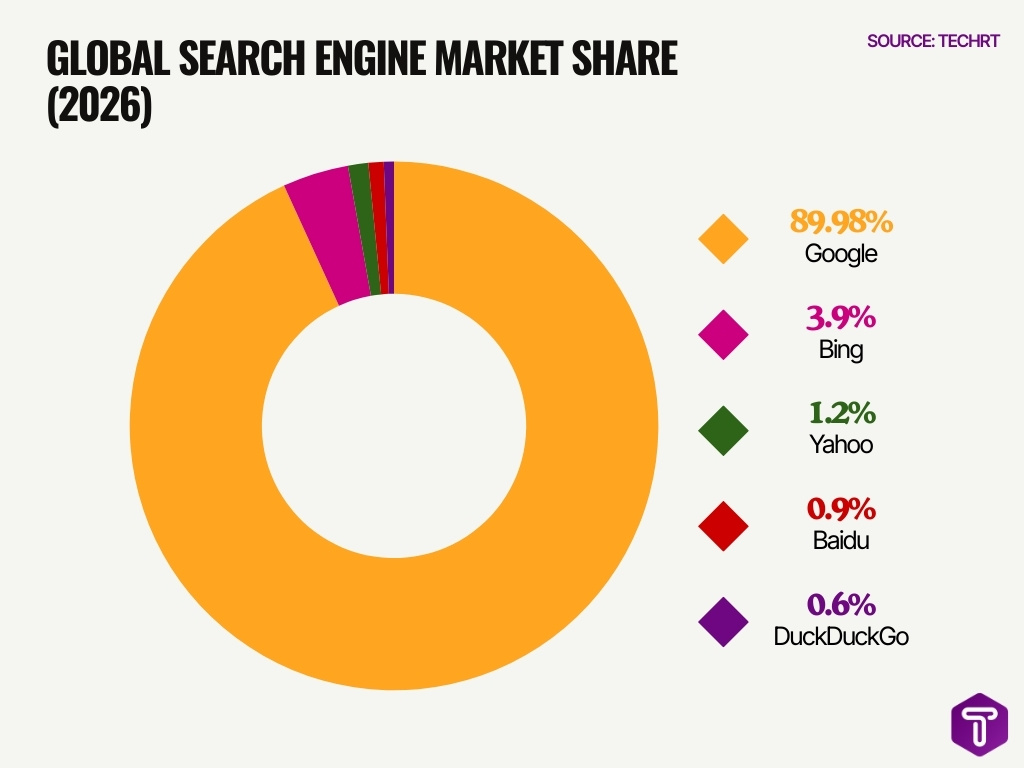
- Google holds roughly 89.98% of the global search engine market share as of 2026, maintaining a dominant lead over competitors like Bing and Yahoo.
- Microsoft Bing accounts for about 3.9% of worldwide search traffic, making it the second-largest search engine but still far behind Google.
- Yahoo Search captures approximately 1.2% of global market share, continuing its gradual decline over the past decade.
- Baidu controls roughly 0.9% of global search share, though it dominates within China’s domestic internet ecosystem.
- Google’s search share in the United States stands at around 86%–88%, reflecting strong domestic adoption.
- Across Europe, Google’s market share exceeds 90% in many countries, including Germany, France, and the U.K.
- On mobile devices, Google’s dominance is even stronger, with over 93% market share globally.
- In comparison, DuckDuckGo holds about 0.6% of the global search market, attracting users focused on privacy.
- Despite the emergence of AI-driven search tools, Google continues to process the overwhelming majority of global search queries.
Voice Search on Google
- Around 20% of mobile searches globally are voice-based, reflecting the growing use of digital assistants.
- Approximately 41% of adults use voice search at least once per day, showing strong adoption across devices.
- Nearly 27% of the global online population uses voice search on mobile devices, according to recent industry reports.
- Smart speaker adoption continues to grow, with over 200 million smart speakers in U.S. households supporting voice queries.
- About 58% of consumers use voice search to find local businesses, especially restaurants and service providers.
- Voice searches often contain longer, conversational queries, typically averaging 4–6 words more than typed searches.
- Google Assistant processes hundreds of millions of voice interactions daily across smartphones and smart home devices.
- Approximately 50% of voice searches relate to local information, such as nearby stores, directions, or operating hours.
- Voice search queries increasingly include natural language phrases like “how,” “what,” or “best,” reflecting conversational search behavior.
Image and Visual Search on Google
- Google Images accounts for more than 20% of all web searches globally, making visual search a major discovery channel.
- Google Lens now processes over 20 billion visual searches per month, highlighting rapid growth in visual discovery.
- Users conduct more than 12 billion Google Lens searches every month, especially for shopping and product discovery.
- Nearly 62% of Gen Z users prefer visual search over traditional text search when exploring products online.
- Google Lens helps identify over 15 billion products in its visual shopping index, improving visual commerce experiences.
- Around 36% of consumers have used visual search to discover products online, according to e-commerce research.
- Visual search adoption increased sharply after smartphone camera improvements and AI-powered object recognition.
- Image searches play a major role in e-commerce discovery, travel planning, and fashion browsing, where visuals provide faster context.
- Businesses increasingly optimize images for SEO because Google Images can drive significant organic traffic to websites.
Most Searched Questions on Google Worldwide
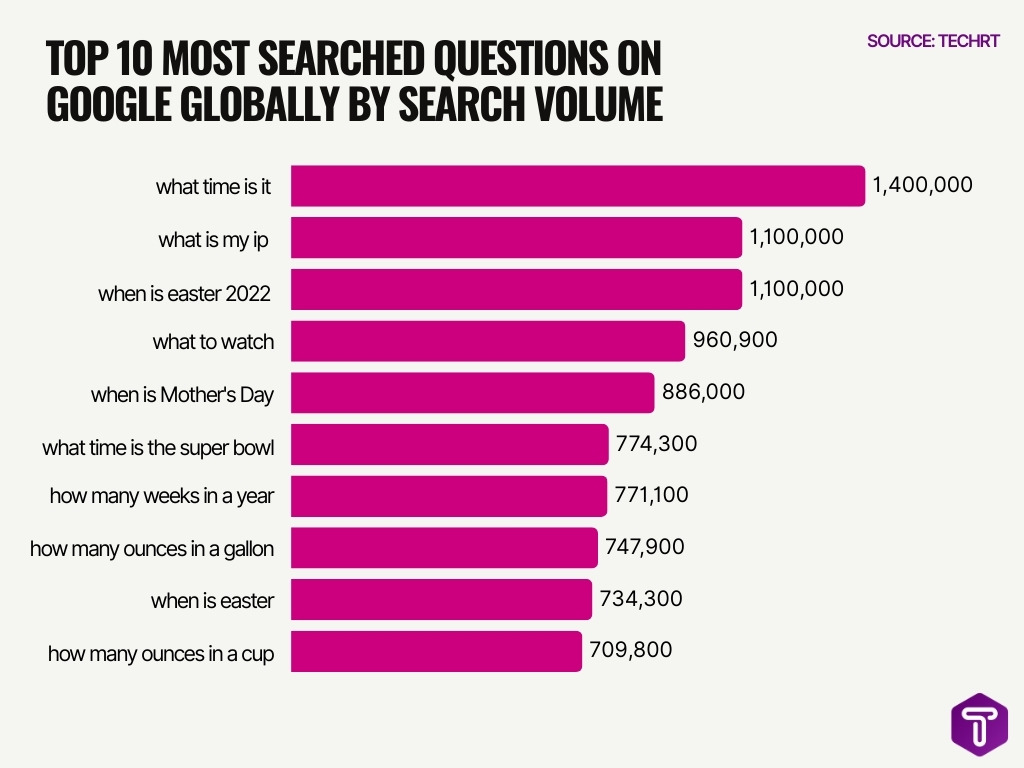
- The most searched question globally on Google is “what time is it”, generating around 1.4 million monthly searches, showing that users frequently rely on Google for quick time checks.
- The query “what is my IP” receives approximately 1.1 million searches, highlighting how many users use Google to quickly find their public IP address for network troubleshooting or privacy checks.
- Another high-volume search is “when is Easter 2022”, also with about 1.1 million searches, demonstrating how holiday-related questions often drive massive search demand.
- Entertainment discovery is another major search category, with “what to watch” attracting nearly 960,900 searches, reflecting how people turn to Google to find movies, shows, and streaming recommendations.
- Seasonal and celebration-related queries are common, with “when is Mother’s Day” generating around 886,000 searches globally.
- Sports-related searches also rank highly, as “what time is the Super Bowl” receives approximately 774,300 searches, especially during the NFL championship season.
- Educational or informational queries remain popular, such as “how many weeks in a year”, which receives about 771,100 searches.
- Measurement conversions are frequently searched as well, including “how many ounces in a gallon”, with roughly 747,900 searches.
- The general query “when is Easter” attracts around 734,300 searches, reflecting ongoing interest in religious and cultural holiday dates.
- Another common conversion query is “how many ounces in a cup”, which receives about 709,800 searches, often related to cooking and recipe measurements.
- Overall, the data shows that utility-based questions, holiday dates, measurement conversions, and entertainment recommendations dominate the most searched questions on Google worldwide.
Local and “Near Me” Search Statistics
- Searches containing “near me” have grown more than 500% over the past few years, reflecting increased demand for local results.
- Around 76% of people who search for something nearby on their smartphone visit a business within 24 hours.
- Approximately 28% of local searches result in a purchase, making them highly valuable for businesses.
- Nearly 46% of all Google searches have local intent, according to SEO research.
- Around 88% of consumers who perform a local search on mobile contact or visit a store within a week.
- Google Business Profile listings influence over 70% of local consumer decisions when choosing nearby services.
- The number of “open now near me” searches has increased significantly as users rely on Google for real-time local information.
- Mobile searches for phrases like “best restaurant near me” or “coffee near me” have become one of the fastest-growing query types.
- Local search optimization plays a critical role for small businesses because most local queries occur on mobile devices.
Zero-Click and No-Click Google Searches
- Around 58%–60% of Google searches now end without a click, meaning users find answers directly on the results page.
- Zero-click searches occur when Google displays information such as featured snippets, knowledge panels, or instant answers.
- On mobile devices, over 65% of searches may result in zero clicks, reflecting the growth of quick-answer features.
- Knowledge panels, weather results, and sports scores are among the most common zero-click search formats.
- Google’s AI-generated answers and summaries are increasing the number of queries answered without leaving the search page.
- Local searches frequently produce zero-click outcomes when users get directions, phone numbers, or hours directly in Google Maps results.
- Featured snippets appear in about 19% of search results, contributing significantly to zero-click behavior.
- Despite rising zero-click trends, Google still drives billions of daily visits to websites worldwide.
- Businesses increasingly optimize content to appear in featured snippets and SERP features to capture visibility even without traditional clicks.
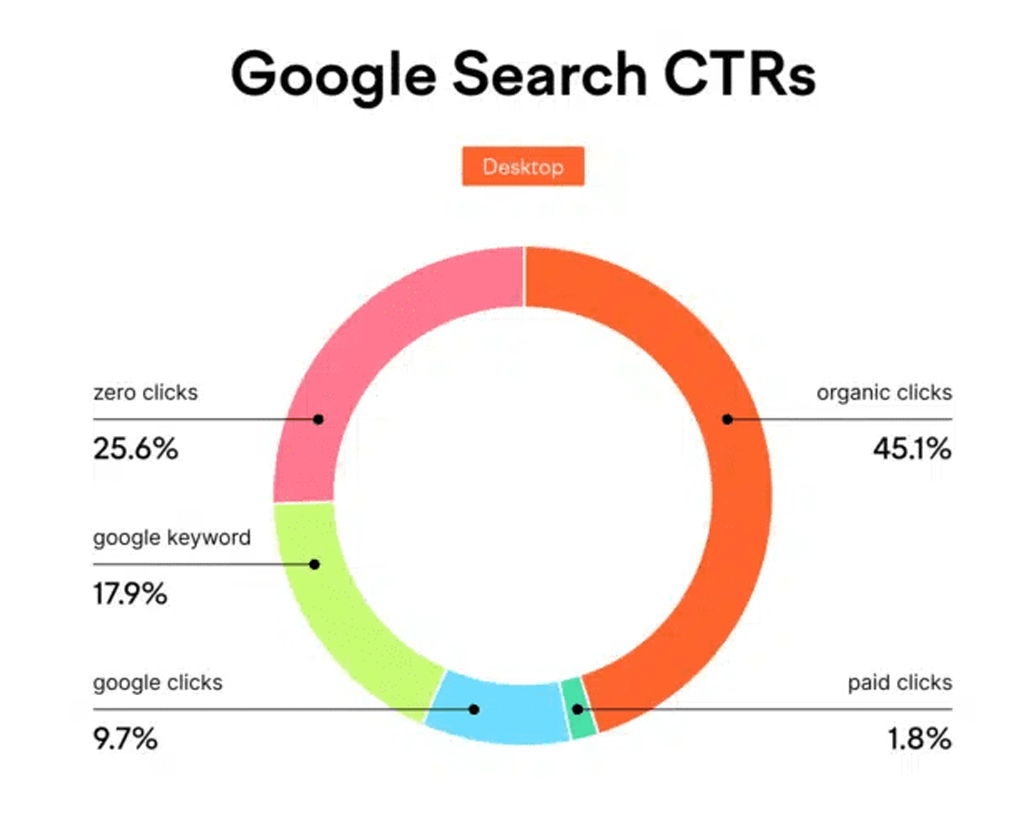
Google Search Desktop CTR Breakdown
- Organic results dominate Google clicks, accounting for 45.1% of all desktop search clicks, making them the largest traffic source in Google’s search ecosystem.
- Zero-click searches represent 25.6% of queries, meaning more than one in four searches end without a click, as users get answers directly from the search results page.
- Google-owned properties capture 9.7% of clicks, showing that Google services such as Maps, YouTube, and other Google platforms attract a noticeable share of user interactions.
- Keyword-related Google features account for 17.9% of clicks, highlighting how search features like knowledge panels, featured snippets, and related search results influence user behavior.
- Paid search ads generate only 1.8% of desktop clicks, indicating that organic results significantly outperform paid ads in click-through rates on desktop searches.
- Overall, nearly half of all clicks (45.1%) go to organic listings, while a combined 27.6% go to Google-controlled results and features, reshaping how traffic is distributed on the search engine results page (SERP).
Google Search Demographics and User Behavior
- Google has over 4.3 billion users worldwide, making it the most widely used search platform.
- In the United States, approximately 92% of adults use Google as their primary search engine.
- Younger users tend to search more frequently, with Gen Z performing more daily searches than older age groups.
- Roughly 84% of people use Google three or more times per day, demonstrating its role in everyday decision-making.
- Around 60% of searches originate from mobile devices, shaping user behavior around quick answers and micro-moments.
- The average Google search query contains 3–4 words, though conversational queries are growing longer.
- Users typically click on one of the first five search results, emphasizing the importance of high rankings.
- Consumers frequently use Google for product research before purchasing, especially in e-commerce and electronics.
- Google search behavior increasingly blends with other platforms such as YouTube, Google Maps, and Google Shopping.
Google Search by Geography and Region
- The United States accounts for 20.98% of global Google traffic with 21.3 billion monthly users.
- India holds 97.17% Google market share and ranks second globally with 5.7 billion monthly users.
- Europe sees Google with 91.38% average market share across devices.
- Brazil contributes 4.48% of worldwide Google traffic, ranking fourth with 4.5 billion users.
- Japan has Google at 75-82% search market share despite Yahoo Japan competition.
- China limits Google to under 3-6% market share, with Baidu dominating at 63%.
- Africa experienced 23% year-over-year Google usage growth fueled by mobile access.
- Southeast Asia shows Google dominance at 80-97% market share in key countries.
- India leads globally in Google Lens usage, with visual searches up 70% annually.
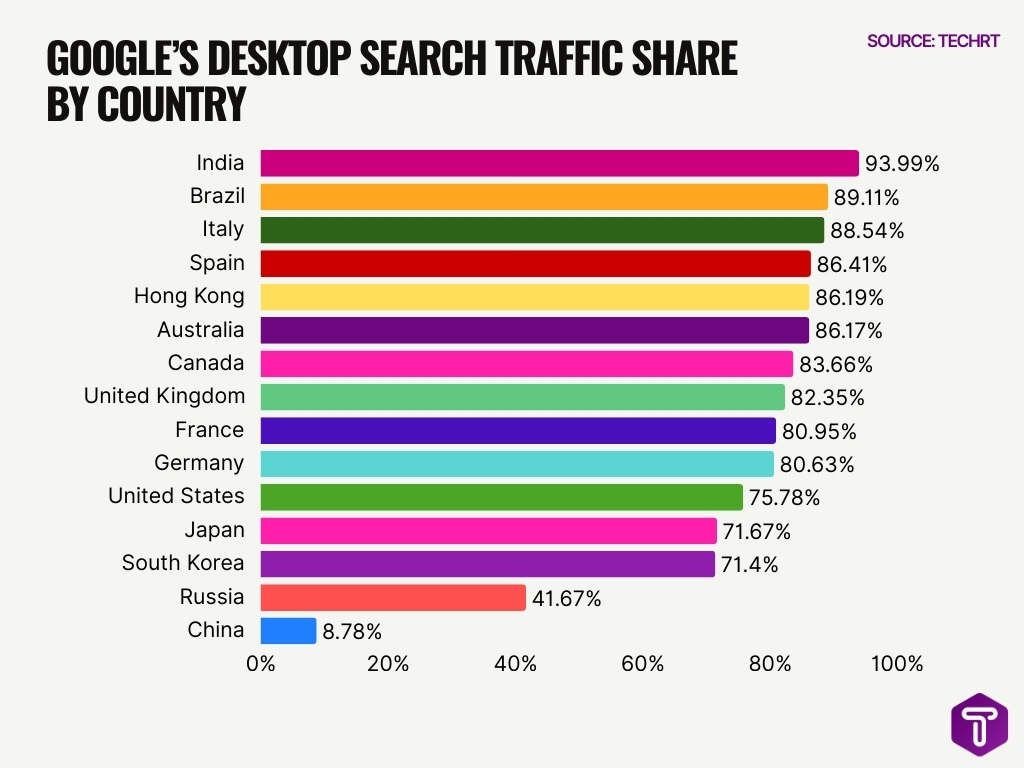
Google Desktop Search Traffic Share by Country
- India leads globally, with 93.99% of desktop search traffic going through Google, making it the most dominant Google market among the listed countries.
- Brazil (89.11%) and Italy (88.54%) also show extremely high dependence on Google, with nearly 9 out of 10 desktop searches happening on the platform.
- In Spain (86.41%), Hong Kong (86.19%), and Australia (86.17%), Google captures over 86% of desktop search traffic, reinforcing its strong global search dominance.
- Canada (83.66%) and the United Kingdom (82.35%) maintain above 80% Google search share, highlighting the platform’s strong presence across major Western markets.
- France (80.95%) and Germany (80.63%) also report over four-fifths of desktop search traffic on Google.
- In the United States, Google holds 75.78% of desktop search traffic, still dominant but lower compared to many international markets due to stronger competition from other search engines.
- Japan (71.67%) and South Korea (71.4%) have relatively lower Google shares, influenced by the presence of strong local search engines.
- Russia stands out with only 41.67%, reflecting the significant popularity of regional search alternatives.
- China shows the lowest Google share at just 8.78%, primarily due to government restrictions and the dominance of domestic search engines.
- Overall, the data shows that Google controls over 80% of desktop search traffic in most countries, demonstrating its near-monopoly position in global search markets.
Google Search Query Types and Intent
- Informational queries account for more than 60% of all Google searches, including questions and research topics.
- Navigational searches, where users look for a specific website or brand, represent roughly 10–15% of queries.
- Transactional searches such as “buy,” “discount,” or “order online” make up around 10%–12% of search traffic.
- Long-tail keywords, phrases with three or more words, generate over 70% of total search queries.
- Google reports that 15% of searches each day are completely new, meaning they have never been searched before.
- Question-based queries containing “how,” “what,” or “why” have grown significantly due to voice search adoption.
- Search intent increasingly drives SEO strategies, with businesses optimizing content around informational, navigational, commercial, and transactional intent.
- Local intent queries like “near me” have increased dramatically as users search for nearby services and stores.
- AI-powered search experiences encourage longer, conversational queries, especially on mobile devices.
Google Search Ads and Paid Search Performance
- Google Ads remains the largest digital advertising platform, generating over $237 billion in advertising revenue in 2023.
- Paid search ads appear in about 40%–50% of commercial search results, particularly for high-value keywords.
- Businesses earn an average of $2 in revenue for every $1 spent on Google Ads, demonstrating a strong return on investment.
- The average Google Ads click-through rate across industries is about 6.11% for search campaigns.
- The average cost-per-click, CPC, for Google Search ads across industries ranges from $2 to $4 in the U.S.
- Retail and e-commerce companies spend billions annually on search advertising to capture high-intent buyer traffic.
- Paid search advertising accounts for over 40% of global digital advertising revenue, reflecting its importance in online marketing.
- Google Ads reaches over 90% of internet users worldwide, providing massive targeting capabilities.
- Search ads often deliver higher conversion rates compared to display advertising because they capture users with clear purchase intent.
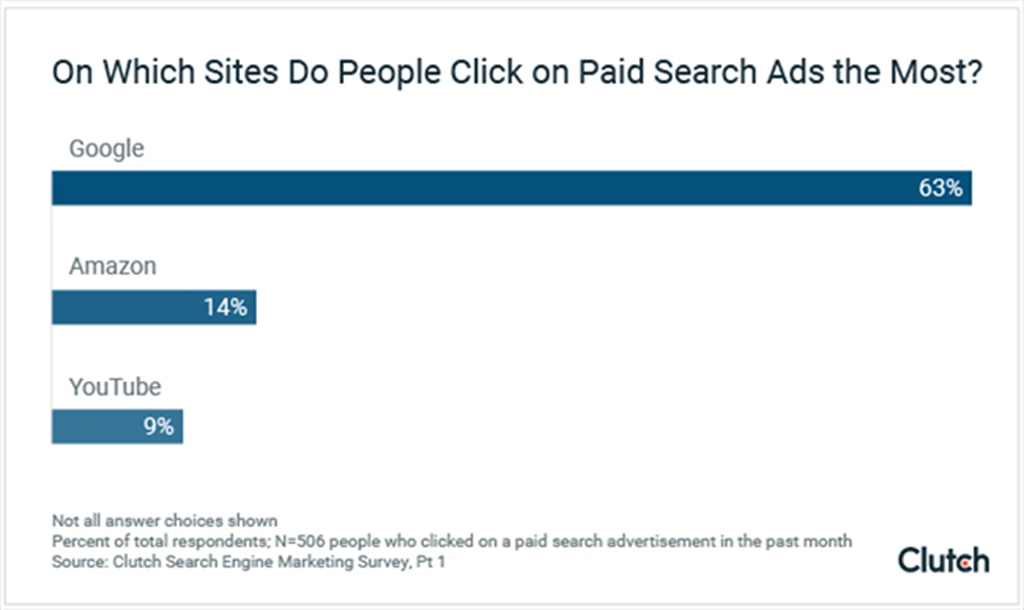
Where People Click Paid Search Ads the Most
- Google dominates paid search ad clicks, capturing 63% of all clicks, making it by far the most effective platform for paid search advertising.
- Amazon ranks second, accounting for 14% of paid ad clicks, highlighting its growing importance as a product discovery and advertising platform.
- YouTube comes third with 9% of paid search ad clicks, showing the increasing role of video platforms in digital advertising engagement.
- The gap between the first and second platform is significant: Google leads Amazon by 49 percentage points, demonstrating its dominant position in search advertising.
- Together, Amazon and YouTube capture 23% of paid search ad clicks, which is still far behind Google’s overwhelming share of 63%.
- The data suggests that search-driven intent remains strongest on Google, while commerce-based searches on Amazon and video discovery on YouTube also attract a notable portion of ad interactions.
Google Search Revenue and Advertising Share
- Google’s parent company, Alphabet, generated over $307 billion in revenue in 2023, with the majority coming from advertising.
- Google Search advertising alone accounted for more than $175 billion of Alphabet’s total revenue, making it the company’s largest revenue stream.
- Advertising contributes more than 75% of Alphabet’s overall revenue, demonstrating the financial importance of search ads.
- Google Ads revenue grew approximately 10% year-over-year in 2024, reflecting continued demand from advertisers.
- Search advertising remains the largest segment of digital ad spending globally, surpassing social media advertising.
- U.S. companies alone spend tens of billions annually on Google Search advertising to capture online consumers.
- Small businesses increasingly rely on Google Ads because it provides measurable performance data and precise targeting.
- AI-driven bidding strategies now power a growing share of Google Ads campaigns, improving campaign optimization.
- Paid search marketing continues to expand as e-commerce and digital services grow worldwide.
Impact of AI and Generative Search on Google Usage
- As of early 2025, Google processes over 5 trillion searches per year, up from 2 trillion in 2016, highlighting how AI features are driving higher overall usage.
- AI Overviews now appear on over 11% of Google queries globally, with their presence growing 22% since launch as generative answers become a default part of search.
- BrightEdge reports impressions on content have risen by over 49% since AI Overviews launched, while average click-throughs have fallen by nearly 30%, signaling more zero-click behavior.
- A Pew-style study shows queries with AI summaries see CTR drop from 15% to 8%, a 46.7% relative reduction, directly impacting informational publishers.
- Authority data finds publishers lose 47.5% of click-through rate on desktop and 37.7% on mobile when an AI Overview is present on the results page.
- Longer, complex queries within AI Overview results have grown by 49% since May 2024, while ranking-style and comparison queries are down 60% and 14%, reflecting more conversational searches.
- BrightEdge notes Google still holds over 90% search market share even as AI search tools like ChatGPT, Perplexity, and Gemini grow, keeping Google the dominant discovery hub.
- In one dataset, AI Overviews penetration for some keyword sets surged nearly 475% year over year, showing rapid scaling of generative results in mainstream SERPs.
- Surveys show 58% of users have already encountered at least one AI summary in results, and searches starting with “who/when/why” or full-sentence prompts generate summaries in about 60% of cases.
- After the rollout of AI Overviews, Google reports that the volume of commercial queries has increased, aligning with AI-powered journeys that surface products and shopping journeys more prominently.
Frequently Asked Questions (FAQs)
How many searches does Google process each day?
Google processes about 16.4 billion searches per day, which equals roughly 189,800 searches per second worldwide.
What percentage of the global search engine market does Google control?
Google holds around 89.98% of the worldwide search engine market share, far ahead of competitors like Bing and Yahoo.
How many searches occur on Google every minute?
Google receives approximately 9.5 to 11.4 million searches per minute, reflecting its massive global usage.
What percentage of clicks go to the top Google search results?
The top three Google search results capture roughly 68.7% of all organic clicks, highlighting the importance of ranking on the first page.
How many searches does Google process annually?
Google handles over 5 trillion searches per year, making it the largest information discovery platform on the internet.
Conclusion
Google Search remains one of the most influential technologies shaping the modern internet. With trillions of queries processed annually, it continues to guide how people discover information, research products, and connect with businesses. At the same time, trends like mobile search, visual search, and AI-powered results are rapidly changing how users interact with search engines.
For marketers, publishers, and companies, understanding Google Search statistics helps guide SEO strategies, advertising investments, and digital growth initiatives. As AI continues to reshape search behavior and information discovery, staying informed about these trends will remain essential for anyone competing in the online marketplace.

Leave a comment
Have something to say about this article? Add your comment and start the discussion.