




Identity theft continues to scale alongside digital adoption, affecting everything from online banking systems to e-commerce platforms like Amazon and Walmart. As more consumers rely on digital payments, cloud-based services, and mobile apps, cybercriminals gain more entry points to exploit personal data. Businesses now face rising fraud losses, operational disruptions, and reputational damage, while individuals deal with compromised identities, credit score impacts, and long recovery timelines.
At the same time, fraud tactics are evolving quickly, with attackers using AI-driven phishing, synthetic identities, and large-scale data breaches to stay ahead of security systems. This makes identity theft not just a consumer issue but a broader economic and cybersecurity challenge. Understanding the numbers behind identity theft helps organizations strengthen defenses and enables individuals to make informed decisions. Let’s explore the latest data shaping this growing threat.
Editor’s Choice
- 1.1 million+ identity theft reports were filed in the U.S. in 2024 via FTC systems.
- Total fraud and identity-related losses reached $12.5 billion in 2024, up 25% YoY.
- Identity theft accounted for 17% of all consumer reports in 2024.
- Over 1.15 million identity theft cases were already reported by Q3 2025.
- Financial losses from identity-related crimes exceeded $11 billion in 2024, doubling since 2021.
- Nearly 31% of Americans report experiencing identity theft at some point.
- Credit card fraud remains the most common type of identity theft, with hundreds of thousands of cases annually.
Recent Developments
- Consumer reports rose to 6.5 million total complaints in 2024, up from 5.4 million in 2023.
- Identity theft reports grew 9.5% year-over-year between 2023 and 2024.
- Fraud losses jumped from $10.4 billion (2023) to $12.7 billion (2024).
- Synthetic identity fraud increased by 153% between late 2023 and early 2024.
- Reports of high-loss scams ($100K+) among older adults rose 8x from 2020 to 2024.
- Financial institutions report 60% increase in fraud attempts affecting accounts in 2025.
- Email became the most common contact method for fraud attempts, surpassing phone calls.
- Identity theft tied to student loans surged 195% YoY in 2025.
- Investment and impersonation scams remain the top loss-driving fraud categories.
Global Identity Theft Statistics
- Global fraud losses exceed $12 billion annually, with identity theft forming a major share.
- Over 57% of banks and fintech firms reported losses above $500,000 due to fraud in 2023.
- More than 25% of financial institutions lost over $1 million to fraud-related activities.
- Identity fraud incidents increased globally due to AI-driven scams and deepfake technologies.
- Fraud reports worldwide continue to grow, with millions of cases logged annually across regions.
- Global cybercrime losses, including identity theft, are estimated to reach trillions annually by 2026.
- Cross-border fraud schemes have increased with digital payment adoption and crypto usage.
- Identity theft now impacts both consumers and enterprise systems, including banking APIs and fintech apps.
Identity Theft Cases by Year
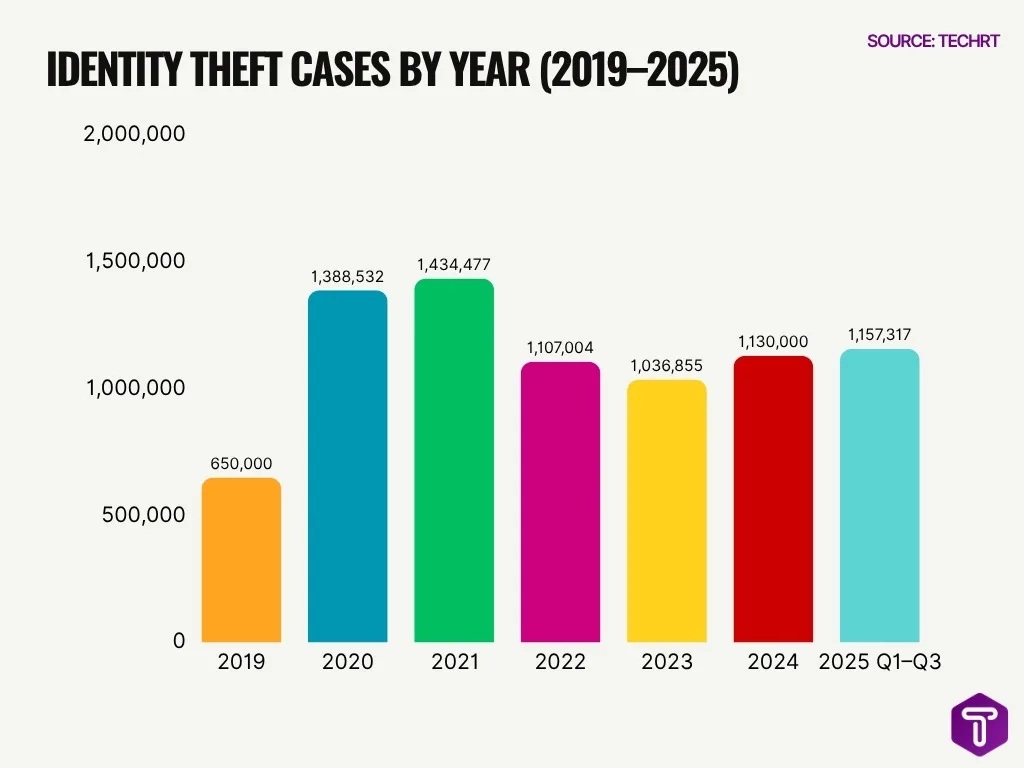
- 2019: 650,000 reported identity theft cases.
- 2020: 1,388,532 cases, driven by pandemic fraud.
- 2021: 1,434,477 cases, peak reporting year.
- 2022: 1,107,004 cases, slight decline but still elevated.
- 2023: 1,036,855 cases, continued high baseline.
- 2024: ~1.13 million cases reported.
- 2025 (Q1–Q3): 1,157,317 cases, already exceeding 2024 totals.
- 2025 is projected to be a record-breaking year for identity theft.
Identity Theft Trends Over Time
- Identity theft reports surged from 650,000 in 2019 to over 1.4 million in 2021.
- Cases declined slightly post-2021 but remained above 1 million annually through 2024.
- Reports rose again in 2025, exceeding all 2024 totals by Q3 alone.
- Fraud losses increased by 558% over five years, reflecting growing sophistication.
- Identity theft became the second-largest complaint category after fraud overall.
- Pandemic-era spikes (2020–2021) were driven by government benefits fraud schemes.
- Post-pandemic trends show a shift toward digital accounts and financial fraud.
- Synthetic identity fraud is among the fastest-growing financial crimes globally.
- Losses have steadily increased from $5.38B (2021) to $11B+ (2024).
Identity Theft Losses and Financial Impact
- Total fraud losses reached $12.5 billion in 2024.
- Losses increased by 23% year-over-year from 2023 to 2024.
- Identity-related losses doubled from $5.38B (2021) to $11B+ (2024).
- 2025 (Q1–Q3) losses already hit $10.91 billion, nearing full-year 2024 totals.
- Average reported scam loss per victim ranges from $730 to $5,256 lifetime.
- FBI estimates total cybercrime losses at $16.6 billion in 2024.
- Only 2%–6.7% of fraud cases are reported, suggesting actual losses are far higher.
- Estimated real losses (including unreported cases) may reach $196 billion annually in the U.S..
- Median loss per fraud case stood at $499 in 2024.
Most Common Types of Identity Theft
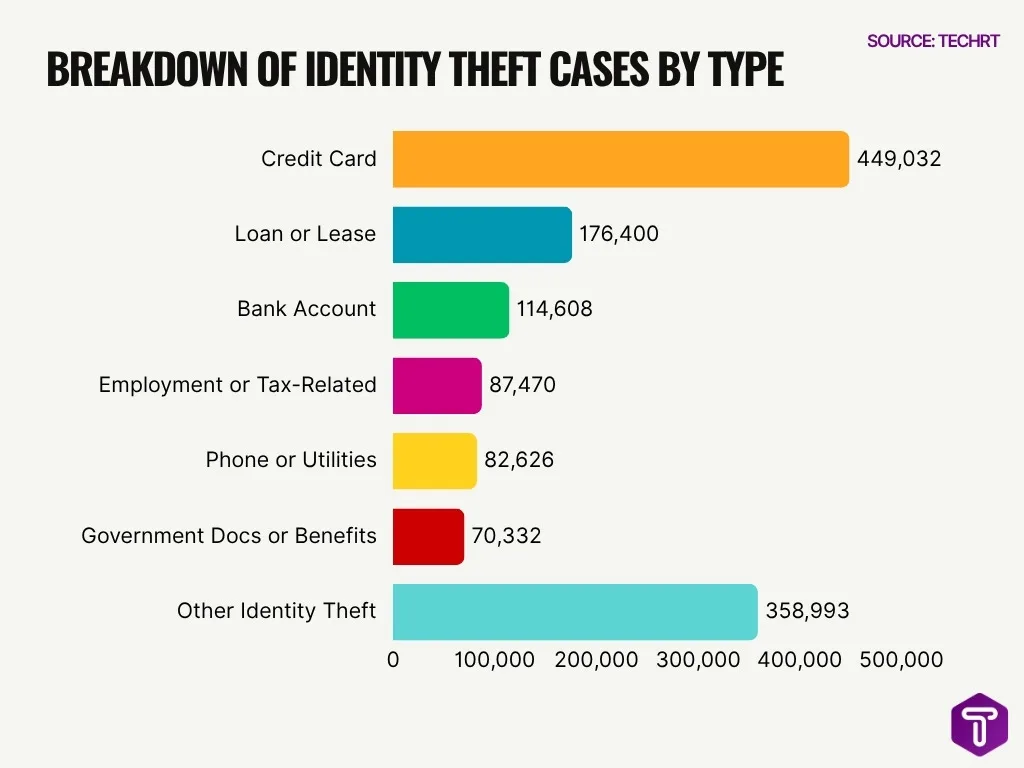
- Credit card fraud dominates identity theft cases with 449,032 reports, making it the most reported category by a wide margin.
- “Other identity theft” ranks second, accounting for a significant 358,993 cases, highlighting the diverse and evolving nature of fraud methods.
- Loan or lease fraud recorded 176,400 reports, indicating a high risk in lending and financing sectors.
- Bank account-related theft reached 114,608 cases, showing that direct financial account access remains a major threat.
- Employment or tax-related identity theft totaled 87,470 reports, reflecting ongoing issues with fraudulent tax filings and job scams.
- Phone or utilities fraud accounted for 82,626 cases, pointing to identity misuse in telecom and service accounts.
- Government documents or benefits fraud had the lowest reported cases at 70,332, but still represents a critical area of concern due to potential large-scale abuse.
- The gap between credit card fraud (449K) and the next category (loan fraud at 176K) shows a massive concentration of fraud in card-based transactions.
- Combined, the top three categories (credit card, other, and loan fraud) account for the majority of identity theft reports, emphasizing where consumers are most vulnerable.
- Overall, the data highlights that financial-based identity theft (cards, loans, bank accounts) continues to dominate, making financial security the primary risk area for individuals.
Identity Theft by Victim Demographics
- Urban residents face 24.5 violent victimizations per 1,000, over double the rural 11.1 rate, extending to higher identity theft exposure.
- Florida reports the highest 528 identity theft complaints per 100,000 residents, with California and Texas ranking high in total cases.
- Black communities show 45% recent identity theft victimization, often with greater financial losses than the general population.
- Households earning over $75,000 have 20% victimization rate, reporting mean losses of $3,945 compared to $1,742 for lower incomes.
- Lower-income victims suffer compounded harm, with 62% facing direct losses and jeopardy to essential benefits like housing.
- Post-graduate educated individuals report 22% identity theft rates, twice that of high school graduates at 12%, and are prone to phishing.
- Military consumers filed nearly 50,000 identity theft reports in 2021, with losses exceeding $584 million in 2024.
- Small business owners see over 80% hit by cyberattacks, with financial losses over $500,000 doubling yearly.
- Gig workers encounter rampant identity fraud via fake profiles and payment redirection on platforms.
Identity Theft by Gender
- Women comprise 54% of identity theft victims compared to 46% for men.
- Women are more likely victims than men, according to the FTC’s demographic analysis.
- 23% of men reported identity theft vs. 11% of women in the UK survey.
- 30-39 year olds, often women, represent 29.8% of US identity theft reports.
- 17% of women lost $1,000+ in identity fraud vs. 10% of men.
- Men are twice as likely to be targeted by identity theft as cautious women.
- 63% of women protect social media accounts vs. 50% of men.
- 44% of women suffer ongoing stress from fraud vs. 35% of men.
- Women are more likely to report identity theft incidents than men.
Identity Theft Trends by Age Group
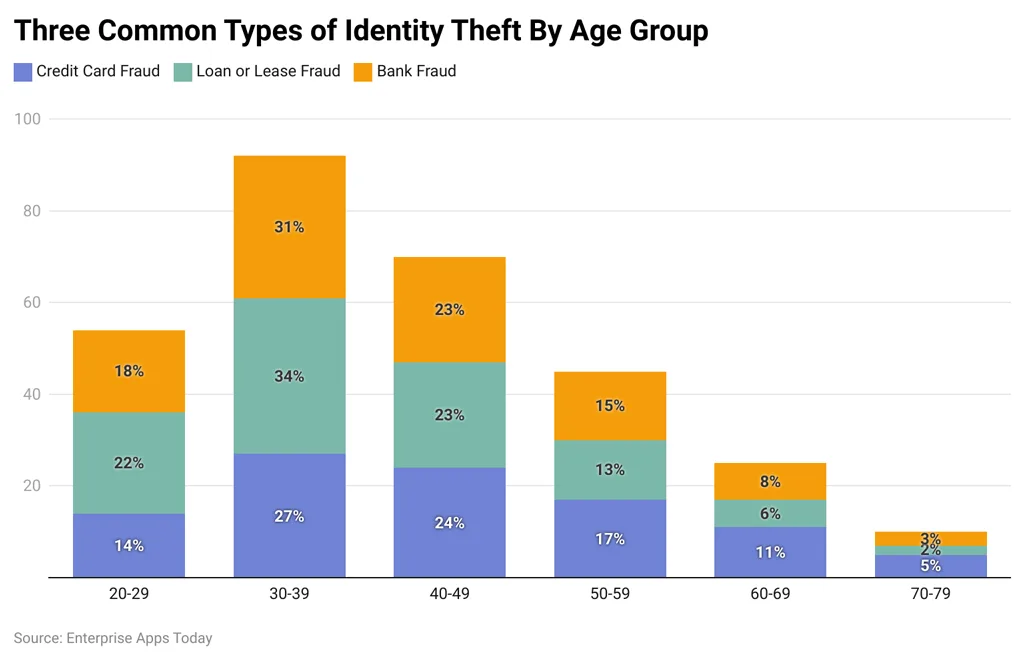
- Peak vulnerability occurs in the 30–39 age group, with the highest rates across all fraud types: 27% credit card fraud, 34% loan/lease fraud, and 31% bank fraud.
- Loan or lease fraud is the most dominant type overall, especially among younger adults, reaching a peak of 34% in the 30–39 segment.
- In the 20–29 age group, identity theft is already significant, with 22% loan fraud, 18% bank fraud, and 14% credit card fraud, indicating early exposure to financial fraud risks.
- The 40–49 group shows a balanced distribution, with 24% credit card fraud and 23% each for loan and bank fraud, suggesting diversified fraud targeting.
- Fraud rates decline steadily after age 50, with the 50–59 group reporting 17% credit card fraud, 13% loan fraud, and 15% bank fraud.
- Among 60–69-year-olds, all fraud types drop further, with credit card fraud at 11%, bank fraud at 8%, and loan fraud at just 6%.
- The 70–79 age group has the lowest exposure, with minimal levels across categories: 5% credit card fraud, 3% bank fraud, and 2% loan fraud.
- Credit card fraud remains relatively consistent across all age groups, but still peaks at 27% in the 30–39 segment, making it the most common fraud type overall.
- Younger and middle-aged adults (20–49) are the primary targets, showing significantly higher fraud rates compared to older demographics.
- Overall, the data highlights a clear age-based decline in identity theft risk, with fraud activity concentrated heavily in individuals under 50.
Identity Theft by Fraud Category
- Impersonation scams caused $2.7 billion in losses in 2024, topping all fraud categories.
- Investment fraud losses reached $4.6 billion in 2024, the highest-cost identity theft type.
- Online shopping fraud using stolen identities led to over $400 million in losses annually.
- Phishing attacks affect millions yearly, acting as the primary entry for identity theft.
- Account takeover fraud surged by 24% year-over-year in 2024.
- Loan fraud on digital platforms grew 30% amid rising online lending in 2025.
- Cryptocurrency identity theft losses spiked 20% with deepfakes in 2024.
- Employment scams rose sharply, impacting remote job seekers with 129 crore INR losses in 2024.
- Tech support scams resulted in hundreds of millions in annual U.S. losses.
Identity Theft and Digital Account Takeovers
- Account takeover (ATO) attacks increased by over 60% in financial services in 2025.
- More than 29% of consumers experienced account takeover attempts in 2024.
- Password reuse contributes to over 80% of successful account breaches.
- Credential stuffing attacks grew significantly, targeting streaming, banking, and e-commerce accounts.
- Nearly 1 in 3 identity theft cases now involve account takeovers.
- Multi-factor authentication (MFA) adoption reduced ATO success rates by up to 99%.
- Social engineering tactics account for over 70% of successful ATO incidents.
- Financial institutions report millions of attempted logins using stolen credentials daily.
- Mobile account takeovers increased with mobile banking adoption surpassing 70% of users.
Global Attitudes Toward Identity Theft
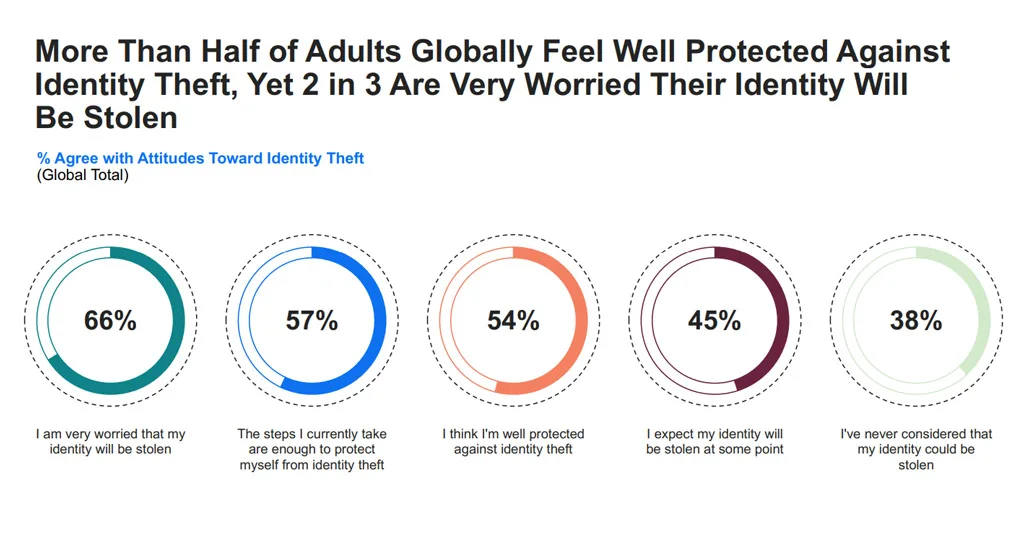
- A significant 66% of adults globally say they are very worried their identity will be stolen, highlighting widespread anxiety around identity theft.
- Despite this concern, 57% believe the current steps they take are sufficient to protect themselves, indicating a potential gap between perceived and actual security.
- Only 54% feel well protected, suggesting that nearly half of the population lacks confidence in their identity protection measures.
- Around 45% expect their identity to be stolen at some point, reflecting a strong sense of inevitability and rising cyber risk awareness.
- Interestingly, 38% have never considered that their identity could be stolen, showing a significant awareness gap among a large segment of users.
- The data reveals a clear contradiction: while over half feel protected, an even higher 66% remain worried, indicating low trust in protection methods.
- The coexistence of high concern (66%) and low preparedness awareness (38%) suggests a need for better education and proactive security measures.
- Overall, the findings point to a global mindset shaped by fear, partial confidence, and limited awareness, making identity theft a major consumer concern in the digital age.
Identity Theft in Credit Card Fraud
- Credit card fraud remains the top identity theft category, with over 440,000 reports in 2024.
- Card-not-present (CNP) fraud accounts for over 70% of credit card fraud cases globally.
- U.S. credit card fraud losses reached $9.5 billion in 2024.
- Contactless payment fraud is rising with tap-to-pay adoption growing rapidly.
- Fraudulent new credit card accounts made up over 60% of credit card identity theft cases.
- Existing account fraud cases remain significant, especially through account takeover attacks.
- E-commerce drives most credit card fraud, with online transactions accounting for the majority of cases.
- Real-time fraud detection tools have reduced unauthorized transactions by over 20% in recent years.
- Chargeback fraud and friendly fraud continue to impact merchants, costing billions annually.
Identity Theft in Government Benefits Fraud
- FTC received 70,332 reports of government document or benefits identity theft in 2024.
- Government benefits fraud cases reached 937 in fiscal year 2024, up 242% since 2020.
- Pandemic unemployment insurance fraud caused $191 billion in losses across states.
- U.S. Department of Education blocked over $1 billion in student aid fraud in 2025.
- Stolen SSNs enable fraudsters to divert Social Security and Medicare benefits repeatedly.
- CMS handles about 800 identity theft calls monthly related to Medicare misuse.
- Government document fraud hit 102,000 cases in 2023, surging 68% year-over-year.
- Fraud recovery in benefits programs is low, with analytics potentially saving $80 billion if implemented earlier.
- Organized fraud rings contributed to $32.6 billion in California‘s UI fraud losses alone.
Economic Impact of Identity Fraud
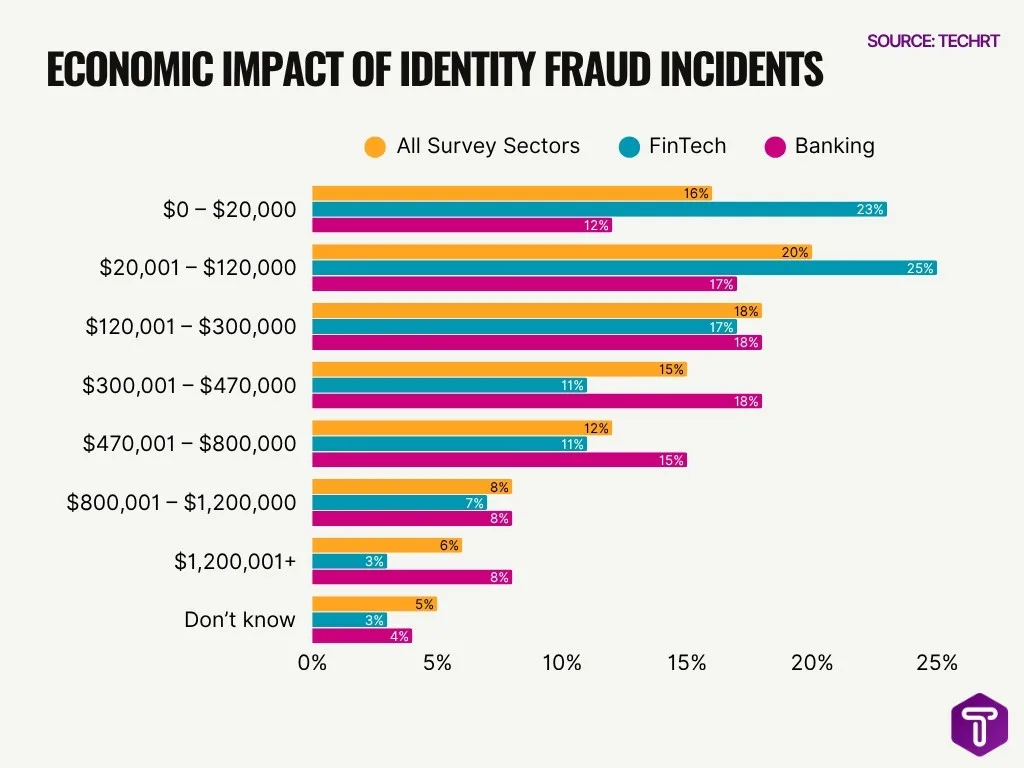
- The most common loss range from identity fraud incidents is $20,001–$120,000, accounting for 25% in FinTech, 17% in Banking, and 20% overall.
- A significant portion of fraud cases still falls in the lower loss bracket ($0–$20,000), with 23% in FinTech, compared to only 12% in Banking, indicating a higher frequency of smaller losses in FinTech.
- Mid-range losses between $120,001–$300,000 are consistently high across sectors, with 17% (FinTech) and 18% (Banking & overall), showing a balanced distribution of moderate fraud impact.
- Banking experiences a notable spike in higher mid-tier losses ($300,001–$470,000) at 18%, significantly higher than 11% in FinTech, suggesting larger individual fraud incidents in traditional banking.
- Losses in the $470,001–$800,000 range remain substantial, especially in Banking (15%), compared to 11% in FinTech, reinforcing the trend of higher-value fraud cases in banks.
- High-value fraud incidents above $800,000 are relatively rare but still impactful:
- $800K–$1.2M: 7% (FinTech) vs 8% (Banking & overall)
- $1.2M+: Peaks at 8% in Banking, compared to only 3% in FinTech
- The Banking sector shows a higher concentration of large-scale fraud losses, particularly in ranges above $300,000, highlighting greater financial exposure per incident.
- In contrast, FinTech is more prone to smaller but frequent fraud incidents, with higher percentages in lower loss brackets under $120,000.
- Across all survey sectors, the distribution is relatively evenly spread, but peaks at 20% in the $20,001–$120,000 range, making it the industry-wide dominant loss category.
- A small percentage of respondents (3%–5%) reported “Don’t know”, indicating limited visibility or tracking gaps in fraud loss reporting.
Identity Theft in Online Shopping Fraud
- E-commerce fraud losses surpassed $48 billion globally in 2023, with identity theft playing a key role.
- Online shopping fraud cases continue to rise alongside global e-commerce growth exceeding 10% annually.
- Card-not-present fraud accounts for over 70% of online payment fraud incidents.
- Nearly 1 in 4 consumers reported fraudulent online transactions in the past year.
- Fraudulent purchases using stolen identities spike during holiday shopping seasons, especially Q4.
- Buy now, pay later (BNPL) fraud is increasing, with identity theft used to open fake accounts.
- Mobile commerce contributes to rising fraud, as mobile transactions exceed 60% of e-commerce traffic.
- Merchants lose billions annually due to chargebacks and identity-based purchase fraud.
- Fraud detection tools using AI have reduced online fraud attempts by over 15% in recent years.
Identity Theft in Medical Fraud
- Medical identity theft affects roughly 2.3 million Americans annually.
- Healthcare fraud losses in the U.S. exceed $80 billion per year.
- Victims spend an average of 200+ hours resolving medical identity theft cases.
- Fraudsters use stolen identities to obtain medical services, prescriptions, and insurance benefits.
- Medical identity theft can corrupt patient records, leading to serious treatment risks.
- Nearly 50% of victims report inaccurate medical records due to identity misuse.
- Healthcare data breaches exposed over 133 million records in 2023 alone.
- Stolen medical credentials sell for higher prices on the dark web than credit card data.
- Hospitals and insurers continue investing in cybersecurity as healthcare remains a top‑targeted industry.
- The average cost per victim of medical identity theft reaches about $13,500 in out‑of‑pocket expenses.
Consumer Cybersecurity Habits
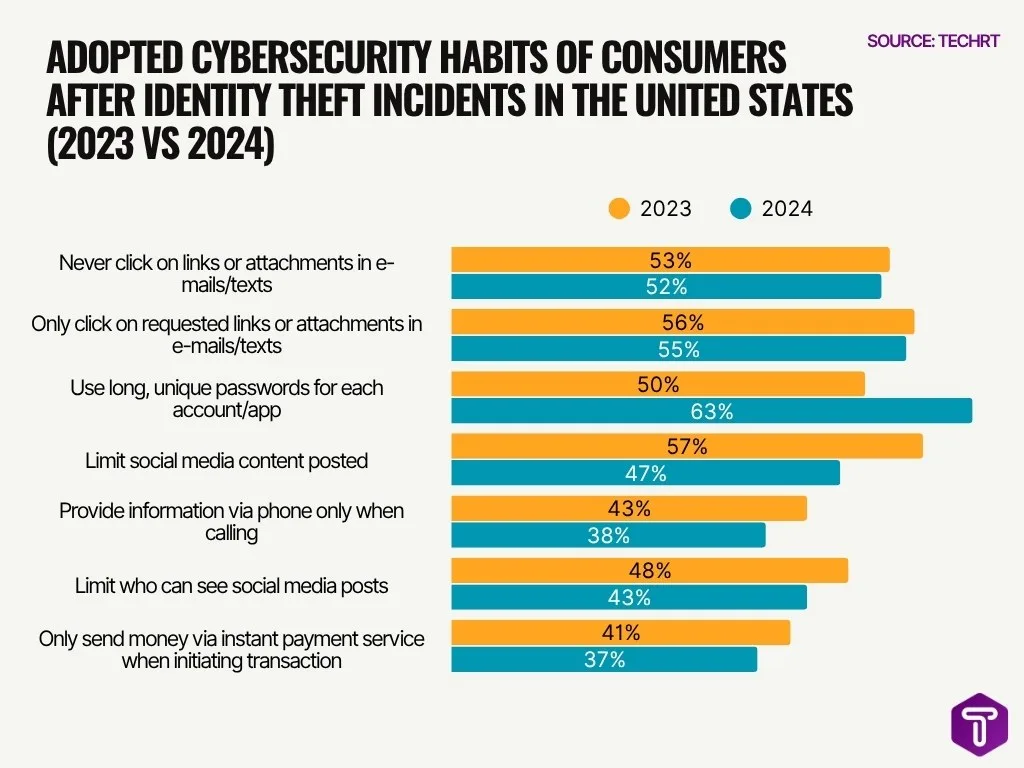
- Strongest growth was seen in password security, with 63% of consumers in 2024 using long, unique passwords, up from 50% in 2023, a +13 percentage point increase, indicating rising awareness of credential-based attacks.
- The habit of avoiding suspicious links remained high but slightly declined, with 52% in 2024 vs 53% in 2023, suggesting a plateau in phishing awareness behavior.
- Similarly, only clicking on requested links saw a marginal dip from 56% (2023) to 55% (2024), indicating stable but not improving caution levels.
- A notable decline occurred in limiting social media content posted, dropping from 57% in 2023 to 47% in 2024 (-10 percentage points), signaling reduced caution in online sharing.
- Privacy control behaviors also weakened, with those limiting who can see social media posts falling from 48% to 43%, highlighting a drop in proactive privacy management.
- Phone-based verification practices decreased from 43% in 2023 to 38% in 2024, suggesting less reliance on safer communication channels.
- Caution in instant payment transactions declined as well, with only 37% in 2024 restricting payments to self-initiated actions, down from 41% in 2023, increasing financial fraud vulnerability risks.
- Overall, while password hygiene improved significantly, most behavioral cybersecurity practices declined, indicating a shift toward reactive rather than preventive security habits.
- The data reflects a mixed trend, where users are strengthening account-level security but becoming less vigilant in daily online behaviors, which could expose them to social engineering and phishing threats.
Identity Theft Complaints to the FTC
- The Federal Trade Commission received over 1.1 million identity theft reports in 2024.
- Total consumer complaints reached 6.5 million in 2024, including fraud and identity theft.
- Identity theft ranked among the top three complaint categories nationwide.
- Credit card fraud complaints made up the largest share of identity theft reports.
- States like Georgia, Florida, and Nevada reported the highest per-capita complaint rates.
- Online reporting through IdentityTheft.gov increased accessibility, leading to higher reporting volumes.
- Younger consumers are more likely to report fraud digitally, while older adults rely on phone reporting.
- Complaint data shows a steady upward trend since 2020, despite fluctuations.
- FTC data helps law enforcement identify emerging fraud patterns and organized crime networks.
Identity Theft Prevention and Protection Trends
- Over 60% of consumers now use identity monitoring services to protect personal data.
- 87% of technology organizations adopted MFA, leading with the highest rate across industries.
- Global cybersecurity spending rose by over 12% to $212 billion in 2025.
- 90% of financial institutions deploy AI for real-time fraud detection.
- The passwordless authentication market is valued at $22.15 billion in 2025.
- 81% of CISOs link breaches to credentials, boosting passwordless plans.
- AI fraud systems prevented $4 billion in U.S. Treasury fraud in 2024.
- 85% of organizations plan to increase cybersecurity budgets amid rising threats.
Frequently Asked Questions (FAQs)
How many identity theft cases were reported in the U.S. in 2025?
What percentage of total consumer reports were identity theft cases in 2024?
How much money did consumers lose to fraud and identity theft in 2024?
What share of identity theft victims are Millennials?
What is the estimated total fraud loss in the U.S. including unreported cases?
Conclusion
Identity theft continues to evolve as digital systems expand and fraud tactics grow more sophisticated. The data shows a clear upward trend in both reported cases and financial losses, signaling that this issue is far from contained. At the same time, the nature of identity theft is shifting, with more attacks targeting digital accounts, financial platforms, and emerging technologies like crypto and AI-driven systems.
However, the statistics also highlight progress. Businesses are investing more in advanced fraud detection, and consumers are becoming more aware of risks and prevention strategies. Tools like multi-factor authentication, identity monitoring, and real-time transaction analysis are helping reduce exposure, even as threats increase.
For organizations, this means prioritizing layered security, employee training, and proactive monitoring. For individuals, it means staying vigilant across accounts, devices, and online interactions. As identity fraud grows more complex, understanding these statistics equips readers to make smarter, safer decisions in an increasingly connected world.

Leave a comment
Have something to say about this article? Add your comment and start the discussion.