




Pinterest has evolved from a niche visual search engine to a major social discovery platform with global presence. The platform’s monthly active users have climbed sharply, and its revenue continues to grow, driven by engagement and shopping-inspired browsing behaviors. Industries like ecommerce and lifestyle media increasingly rely on Pinterest data to forecast trends, from fashion to home décor, making it a powerful tool for marketers and creators alike. Explore the latest statistics to understand how Pinterest is reshaping digital discovery and consumer interaction.
Editor’s Choice
- Pinterest reached around 578 million monthly active users (MAUs) globally in 2025, marking strong year-over-year growth.
- In 2024, Pinterest generated $3.6 billion in revenue, up more than 20% from the prior year.
- Approximately 70% of Pinterest’s users are women, influencing categories like fashion, home, and lifestyle.
- U.S. users alone number around 96–97 million, making North America the largest national audience.
- Pinterest’s advertising reach topped 340 million users by early 2025, up year-over-year.
- Around 96% of searches on Pinterest are unbranded, highlighting its role in product discovery.
- Pinterest continues investing in AI for discovery and shopping experiences.
Recent Developments
- Pinterest announced a workforce reduction of ~15% in early 2026 as it reallocates resources toward AI development.
- The company released an AI-powered shopping assistant to enhance commerce-focused user experiences.
- Pinterest agreed to acquire TVScientific, expanding into connected TV (CTV) advertising tech.
- Executives emphasized AI-driven ad features in 2025 revenue calls, aligning with evolving marketing needs.
- Pinterest’s market strategies now prioritize data-driven ad optimization tools for marketers.
- Expansion of trend prediction reports like Pinterest Predicts supports creators and brands.
- AI integration and content moderation have increased to address user experience concerns.
- Continued development of features aimed at shopping discovery pathways frames Pinterest as more than a discovery engine.
Top Statistics of Pinterest
- 578 million global monthly active users as of mid-2025, up from 522 million the year before.
- Q4 2024 marked Pinterest’s first billion-dollar revenue quarter with approximately $1.15 billion.
- Pinterest’s revenue in 2024 was $3.6 billion, reflecting 20%+ annual growth.
- As many as 340 million users were reachable by ads in January 2025.
- Pinterest attracts roughly 1.1–1.3 billion monthly web visits, showcasing its web traffic strength.
- Pinterest ranks around the 15th most used social platform worldwide by MAU count.
- 96%+ of top searches are unbranded, meaning discovery often starts upstream of specific products.
- The majority of users engage through mobile devices, reflecting modern content consumption.
Pinterest User Demographics by Age and Gender
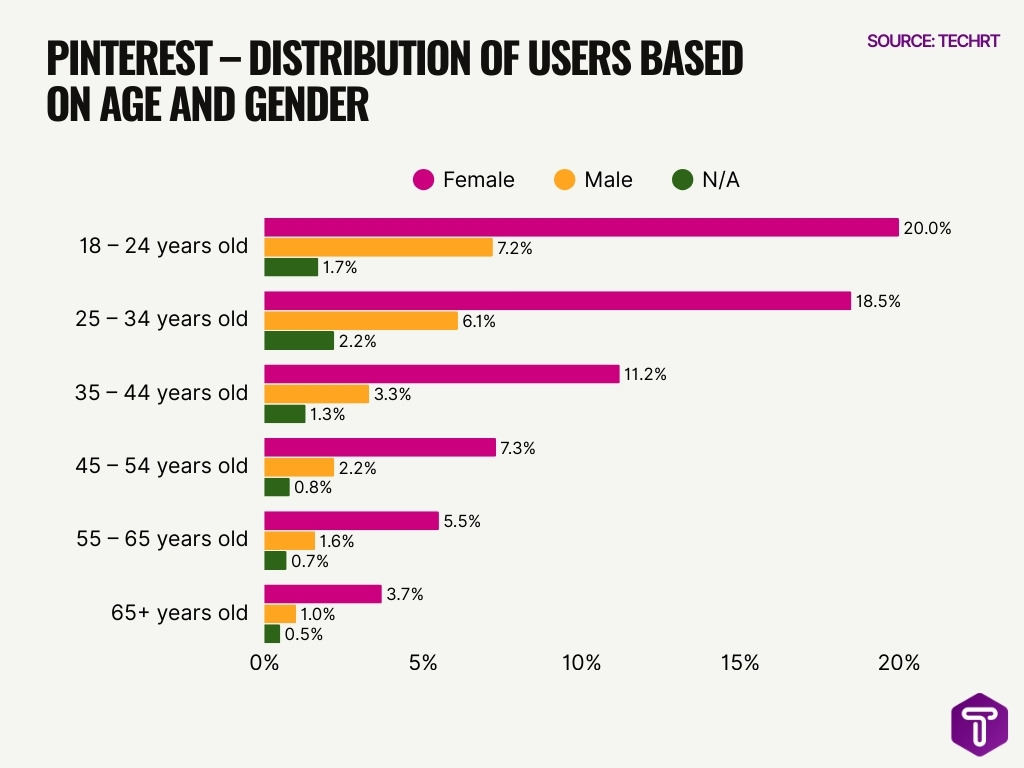
- Pinterest has a strong female majority across all age groups, with women making up the largest share in every segment.
- The 18–24 age group is the largest audience segment, with 20.0% female users and 7.2% male users, making it the most dominant demographic overall.
- The 25–34 age group follows closely, accounting for 18.5% female users and 6.1% male users, showing Pinterest’s strong appeal among young adults.
- Among users aged 35–44, Pinterest maintains solid engagement, with 11.2% female users and 3.3% male users.
- Usage gradually declines with age, but remains significant:
- 45–54 years: 7.3% female, 2.2% male
- 55–65 years: 5.5% female, 1.6% male
- 65+ years: 3.7% female, 1.0% male
- The gender gap is most pronounced in younger age groups, particularly 18–24 and 25–34, where female users significantly outnumber male users.
- Users who did not specify gender (N/A) remain a small portion across all segments, peaking at 2.2% in the 25–34 age group.
- Overall, Pinterest’s core audience is clearly young women aged 18–34, making it highly attractive for brands targeting Gen Z and Millennials.
User Statistics of Pinterest
- Around 70% of users are women, a consistent trend for Pinterest’s core audience.
- Women dominate key categories like fashion, beauty, and home décor.
- Pinterest’s user base grew by tens of millions year-over-year, indicating continued adoption.
- Gen Z comprises a rapidly growing share of users, with estimates above 40% of the global base.
- Millennial users, ages 25-34, are a major cohort in the 2025 data.
- The platform shows strong engagement rates among diverse demographic segments.
- Pinterest users tend to engage longer with browsing and saving content than many competitors.
- Pinterest’s audience has high purchase intent, with a large share researching before buying.
Usage Statistics of Pinterest
- Pinterest users spend an average of 14–15 minutes per session, reflecting focused browsing behavior.
- The average user visits Pinterest around 8–9 times per month on mobile devices.
- More than 85% of Pinterest usage occurs on mobile, underscoring its mobile-first experience.
- Over 1 billion videos are watched daily on Pinterest, signaling growth in video content.
- Approximately 40% of users log in weekly to discover new ideas and products.
- Pinterest hosts over 240 billion saved Pins, demonstrating long-term content retention.
- Around 80% of weekly Pinners say they’ve discovered a new brand or product on the platform.
- Idea Pins and short-form video formats have increased time spent per session year over year.
Geography and Country Statistics of Pinterest
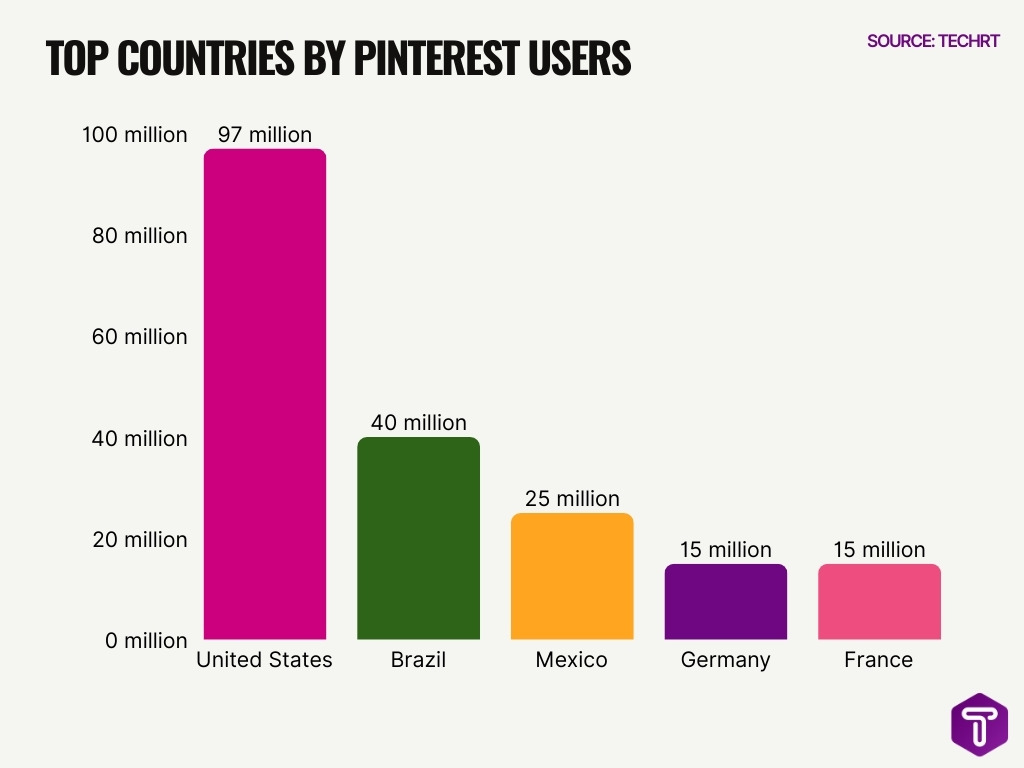
- Pinterest had approximately 96–97 million monthly active users in the United States in 2025, making it the platform’s largest national market.
- The U.S. accounts for roughly 17% of Pinterest’s global user base, highlighting its strong domestic footprint compared to other social platforms.
- Brazil ranks among the top international markets with over 40 million users, reflecting Pinterest’s growing presence in Latin America.
- Mexico has surpassed 25 million users, driven by mobile-first adoption and ecommerce growth.
- Germany and France each report over 15 million users, signaling steady growth across Western Europe.
- Pinterest’s international users now represent more than 80% of total MAUs, showing that growth increasingly comes from outside the U.S.
- In 2024, international revenue grew at a faster rate than U.S. revenue, with double-digit growth reported in Europe.
- Canada maintains a penetration rate above 35% of internet users, making it one of the platform’s strongest per-capita markets.
- India has seen year-over-year audience growth exceeding 20%, driven by Gen Z adoption.
Engagement and Traffic Statistics on Pinterest
- Pinterest receives roughly 1.1–1.3 billion monthly web visits.
- Organic search accounts for more than 30% of Pinterest’s desktop traffic, showing strong SEO visibility.
- Pinterest drives more referral traffic to ecommerce sites than many other social platforms, particularly in lifestyle categories.
- Pins with high-quality images generate up to 3x more engagement than low-resolution images.
- Video Pins receive 2x higher engagement rates compared to static Pins.
- Rich Pins increase click-through rates by approximately 20%.
- The average engagement rate on Pinterest ranges between 0.5% and 1.5%, depending on industry.
- Saves and repins remain a key engagement metric, with millions recorded daily across categories.
Search Statistics on Pinterest
- Pinterest processes billions of searches every month, reinforcing its identity as a visual search engine.
- Around 96% of top searches are unbranded, which supports discovery-based browsing.
- More than 500 million visual searches occur each month through Pinterest Lens.
- Search queries related to shopping increased by over 20% year over year in 2024.
- Seasonal searches spike significantly during Q4, especially in gift and home décor categories.
- Pinterest Predicts reports have maintained an 80%+ accuracy rate in forecasting emerging trends.
- Long-tail keyword searches dominate Pinterest’s ecosystem, aligning with planning and inspiration intent.
- Users are more likely to search for “ideas” and “inspiration” than specific product names, reinforcing upper-funnel discovery.
Top Referral Sources Driving Desktop Traffic to Pinterest.com
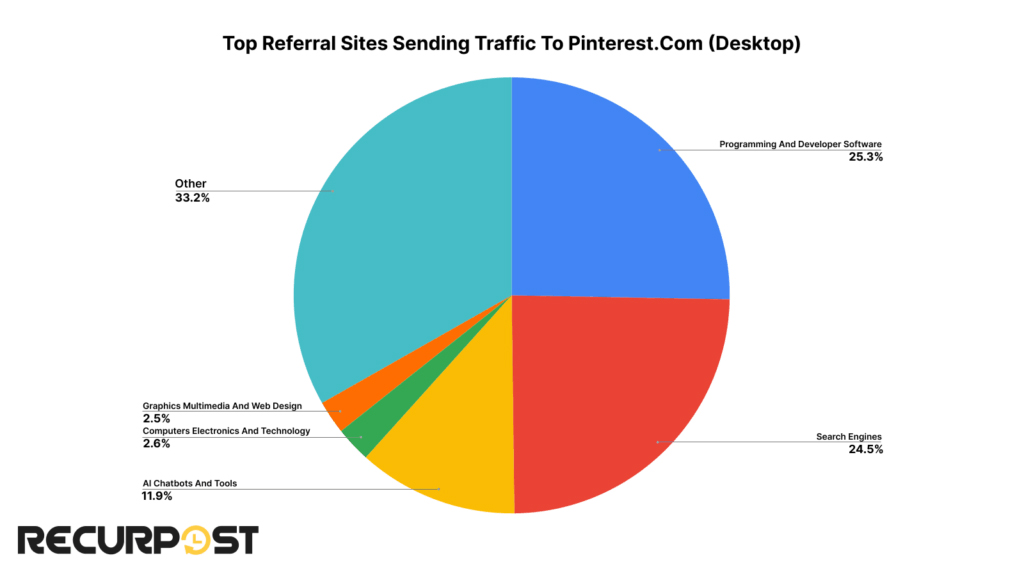
- Programming and Developer Software accounts for 25.3% of Pinterest’s desktop referral traffic, making it the largest single identifiable source category.
- Search Engines contribute 24.5%, indicating that nearly one-quarter of desktop referrals originate from organic and search-driven discovery.
- AI Chatbots and Tools generate 11.9% of referral traffic, highlighting the growing influence of AI-driven platforms in content discovery and traffic distribution.
- The “Other” category dominates with 33.2%, representing the largest overall traffic share, suggesting a highly diversified long-tail referral ecosystem.
- Smaller but notable contributors include:
- Computers, Electronics, and Technology at 2.6%
- Graphics, Multimedia, and Web Design at 2.5%
- Combined, tech-oriented categories (Programming, AI Tools, Computers, and Graphics) account for 42.3% of total desktop referral traffic, underscoring Pinterest’s strong connection to the technology and digital tools ecosystem.
- The close split between Programming (25.3%) and Search Engines (24.5%) suggests Pinterest benefits from both direct tech-platform referrals and traditional search-based discovery channels.
Device and Platform Statistics of Pinterest
- Over 85% of Pinterest’s global traffic comes from mobile devices.
- The Pinterest mobile app ranks among the top lifestyle apps in both major app stores.
- iOS users account for a higher share of ad revenue per user compared to Android users.
- Desktop usage remains relevant for planning-intensive activities like weddings and home renovations, representing around 15% of total traffic.
- Pinterest’s app downloads surpassed 500 million globally across platforms.
- The Pinterest Chrome extension continues to support desktop saves, with millions of active users.
- Tablet usage represents a smaller but stable segment of traffic, typically under 5%.
- In-app shopping features have increased session duration compared to standard browsing sessions.
Content and Category Statistics on Pinterest
- Home décor boasts over 23 billion Pins and 682 million boards, Pinterest’s largest category.
- Users save more than 1.5 billion Pins weekly, many in home décor and fashion.
- Gen Z comprises 42% of Pinterest’s global users and saves more Pins than other generations.
- Fashion category features 13+ billion Pins for women’s outfits and styles.
- Food and recipes hold 18+ billion Pins, among top global searches like “dinner recipes”.
- DIY and crafts drive high engagement with popular sub-niches like Cricut projects, outperforming others.
- Travel searches for nature getaways rose 72%, with mountains up 221% for Kilimanjaro.
- Wellness searches like “art journal therapy” surged 3,755% from 2020-2022.
- Video content in beauty and fashion boosts engagement with 86% purchase intent.
- Sustainable living searches increased 69% since 2018, with “for beginners” up 265%.
Best Times to Post on Pinterest: Key Insights
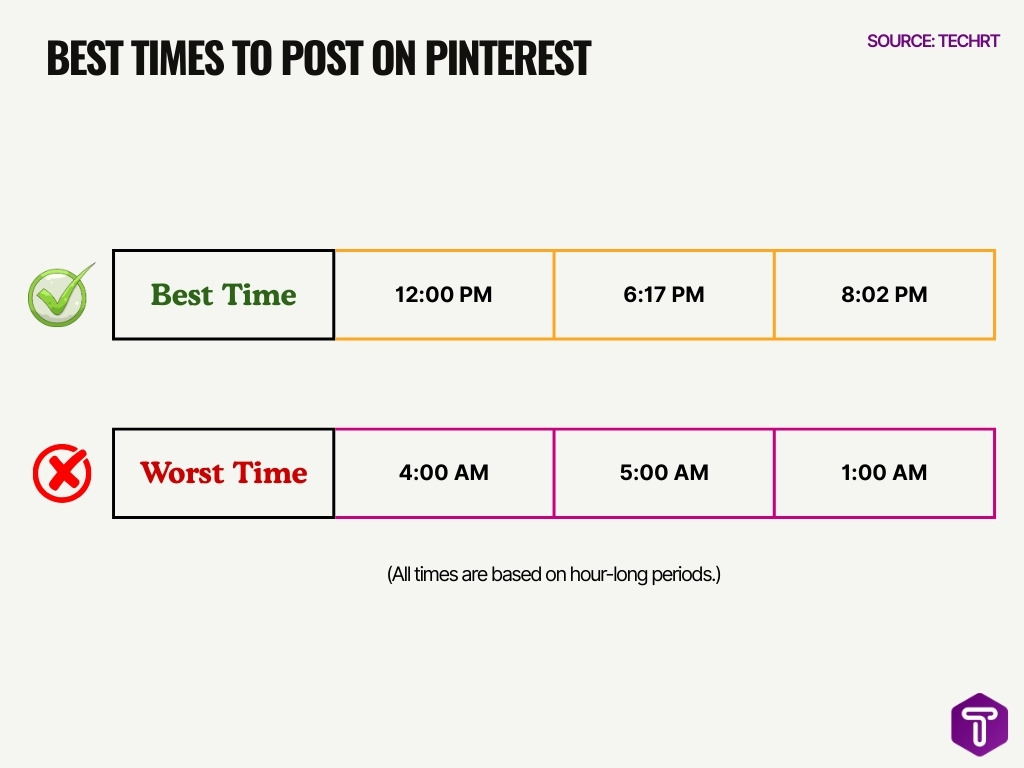
- The top-performing posting times on Pinterest are 12:00 PM, 6:17 PM, and 8:02 PM.
- Midday (12:00 PM) stands out as a strong engagement window, likely capturing users during lunch breaks and mid-day browsing sessions.
- Evening hours dominate performance, with 6:17 PM and 8:02 PM showing high engagement potential as users browse after work or school.
- The worst-performing times to post are 1:00 AM, 4:00 AM, and 5:00 AM, indicating minimal user activity during early morning hours.
- Posting during early morning (1 AM – 5 AM) may significantly reduce reach and engagement due to low platform traffic.
- All time slots are measured in hour-long periods, suggesting that even small timing adjustments within peak windows can impact visibility.
- For optimal performance, brands and creators should prioritize midday and evening publishing schedules while avoiding late-night posting windows.
Trends and Pinterest Predicts Statistics
- Pinterest Predicts has maintained an 80% accuracy rate in forecasting emerging trends since its launch.
- In 2025, searches related to “dopamine décor” increased by over 120% year over year, reflecting vibrant interior design trends.
- “Eclectic grandpa” fashion searches grew by more than 65%, highlighting Pinterest’s influence on niche style movements.
- Wellness-related searches, including “nervous system regulation,” rose over 70% in 2024, indicating growing mental health awareness.
- Sustainable fashion searches increased by approximately 40% year over year, driven by Gen Z users.
- Travel trend searches such as “slow travel” climbed by over 50% in 2024 compared to 2023.
- Pinterest reports that 8 out of 10 weekly Pinners say the platform feels positive, reinforcing its brand-safe and trend-driven positioning.
- Seasonal trend searches begin 2–3 months earlier on Pinterest than on other platforms, giving marketers early forecasting signals.
Shopping and Ecommerce Statistics on Pinterest
- Pinterest shoppers spend 2× more per month than on other platforms.
- 85% of weekly Pinners have purchased based on a brand Pin.
- 55% of Pinners use the platform specifically as a place to shop.
- 80% of weekly Pinners feel inspired by the shopping experience.
- Pinterest ads deliver 32% higher ROAS than other digital platforms.
- 50% year-over-year increase in shoppable Pins saved to boards.
- 84% of weekly Gen Z Pinners discover products fitting their style.
- Gen Z weekly Pinners are 1.3× more likely to shop online.
- Retailers uploading catalogs see 30% more checkouts.
- Pinterest ads generate 11.4× more prospects than other social platforms.
Pinterest Ad Revenue Growth Statistics
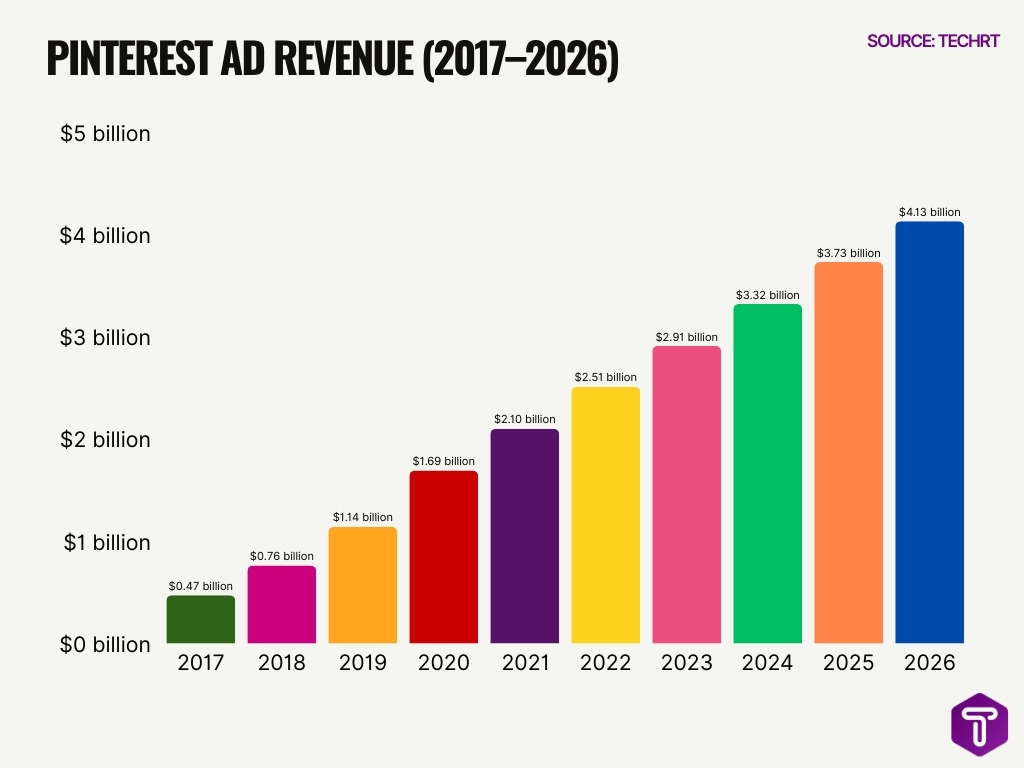
- Pinterest’s ad revenue increased from $470 million in 2017 to a projected $4.13 billion in 2026, representing nearly a 9x growth in under a decade.
- The platform crossed the $1 billion milestone in 2019, reaching $1.14 billion, signaling its rapid monetization phase.
- Between 2017 and 2020, ad revenue surged from $470 million to $1.69 billion, marking an explosive ~260% increase in just three years.
- In 2021, Pinterest generated $2.1 billion in ad revenue, surpassing the $2 billion threshold for the first time.
- Revenue continued to grow steadily to $2.51 billion in 2022, showing resilience amid broader digital ad market volatility.
- Forecasts indicate Pinterest will reach $2.91 billion in 2023 and $3.32 billion in 2024, maintaining strong double-digit expansion.
- By 2025, ad revenue is projected to hit $3.73 billion, before climbing to $4.13 billion in 2026.
- Although early years saw aggressive growth (above 48–60% YoY), projections show a gradual normalization to around 10–16% annual growth by 2026.
- Overall, Pinterest’s ad revenue trajectory reflects a transition from a high-growth social platform to a maturing, scalable digital advertising business with consistent multi-billion-dollar annual revenues.
Revenue and Financial Statistics of Pinterest
- Full-year 2024 revenue reached approximately $3.6 billion, up over 20% from 2023.
- Pinterest reported net income improvement in 2024 compared to prior losses in earlier years.
- Adjusted EBITDA margin expanded to around 30%+ in 2024, signaling operational efficiency.
- International revenue represented over 20% of total revenue, continuing to rise annually.
- Research and development expenses remain a significant investment area, particularly in AI-driven discovery.
- Pinterest maintains strong liquidity, with billions in cash and marketable securities reported in 2024 filings.
- Advertising accounts for over 95% of total revenue, underscoring reliance on ad monetization.
- The company’s stock valuation fluctuated in 2025 amid broader tech market adjustments.
Statistics on Pinterest for Brands and ROI
- Pinterest campaigns deliver a 32% higher ROAS than other digital platforms, per Nielsen analysis.
- 96–97% of top Pinterest searches are unbranded, enabling early brand discovery.
- 76% of Pinterest users are open to trying new brands, higher than the average U.S. adult.
- 83% of pinners have purchased based on branded content seen on Pinterest.
- Pinterest shopping ads provide 3x higher conversion and sales lift versus other platforms.
- Retail brands using Pinterest see 10–20% conversion lifts from shoppable Pins.
- Idea Pins and video Pins achieve 8–10% engagement rates, boosting dwell time.
- Pinterest users show 26% higher annual spending, driving elevated average order values in home décor.
- Performance+ tools reduce CPA by up to 52% and improve campaign efficiency.
- Brand lift studies reveal Pinterest ads increase purchase intent by 2.3+ points in key demos.
Average Daily Time Spent on Pinterest vs Other Social Platforms
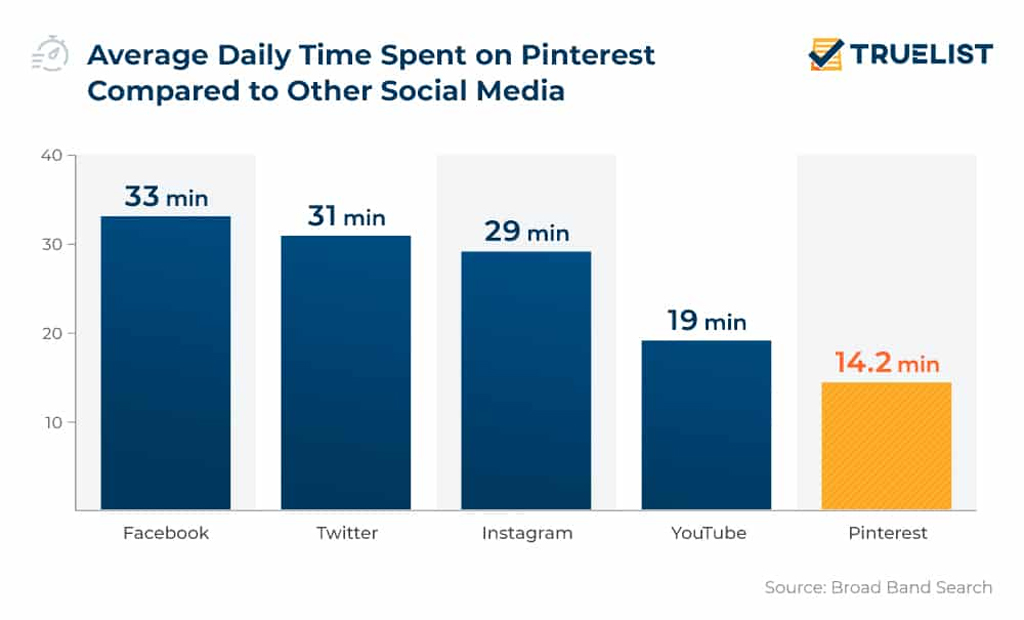
- Facebook leads in daily engagement with an average of 33 minutes per day, making it the most time-consuming platform among those compared.
- Twitter follows closely at 31 minutes daily, just 2 minutes behind Facebook, highlighting strong user stickiness.
- Instagram users spend 29 minutes per day, placing it third but still significantly ahead of video-first platforms like YouTube in this comparison.
- YouTube averages 19 minutes daily, which is 10 minutes less than Instagram and 14 minutes less than Facebook.
- Pinterest records the lowest daily usage at 14.2 minutes per day, spending 18.8 minutes less than Facebook and nearly half the time of Instagram.
- Compared to Twitter, Pinterest users spend 16.8 fewer minutes per day, indicating a substantial engagement gap.
- Overall, Pinterest’s daily engagement time is less than half of Facebook’s and approximately 49% of Instagram’s average daily time.
Future Outlook and Growth Projections for Pinterest
- Pinterest analysts forecast $4.75 billion in revenue for 2026, a 12% increase from 2025.
- Gen Z comprises over 42% of Pinterest’s MAUs, the fastest-growing segment driving trends.
- Europe revenue surged 31% to $775 million in 2025, accelerating international monetization.
- Rest of World revenue jumped 62% to $274 million in 2025, highlighting expansion potential.
- Global ARPU rose 4% to $7.21 in 2025, with international markets showing 21-40% gains.
- Q1 2026 revenue projected at $951-$971 million, implying 11-14% year-over-year growth.
- Global MAUs hit 619 million in 2025, up 12%, with the Rest of World at 16% growth.
- AI auto-collages deliver 2x the save rate of standard product Pins for advertisers.
- Performance+ campaigns yield 24% higher conversions for retail advertisers internationally.
Frequently Asked Questions (FAQs)
How many monthly active users does Pinterest have as of late 2025?
Pinterest reached 619 million monthly active users, growing 12% year-over-year.
What revenue did Pinterest report for the full year 2025?
Pinterest delivered $4.2 billion in revenue in 2025, an increase of 16% year-over-year.
What was Pinterest’s Q4 2025 revenue and year-over-year change?
In Q4 2025, Pinterest reported $1.319 billion in revenue, up 14% year-over-year.
What percentage of Pinterest users are in the United States, and how many are not?
Approximately 96.9 million users (the largest national audience) are in the U.S., making up a major portion of global usage.
What share of Pinterest’s revenue comes from the U.S.?
About 78% of Pinterest’s total revenue is generated in the United States.
Conclusion
Pinterest enters the year with strong momentum. The platform now serves hundreds of millions of global users, generates billions in annual revenue, and continues expanding its AI-powered shopping ecosystem. Moreover, its search-driven discovery model sets it apart from entertainment-first platforms, making it particularly valuable for brands seeking purchase intent.
As international monetization improves and ecommerce tools mature, Pinterest’s role in digital marketing and online shopping will likely expand further. For marketers, retailers, and creators, understanding these statistics provides a clear roadmap for leveraging Pinterest’s growth in the year ahead.

Leave a comment
Have something to say about this article? Add your comment and start the discussion.