



The digital landscape continues to evolve as users find information through both search engines and social media. Search remains a dominant entry point for discovering websites and structured answers, while social media increasingly fuels brand awareness and community engagement. Industries from e‑commerce to media publishing rely on both channels for traffic, conversions, and engagement, from leveraging search optimization for product queries to using social platforms for direct engagement and discovery. The numbers below set the stage for how brands and marketers balance search vs social to achieve visibility and growth.
Editor’s Choice
- Google holds roughly 90% of the global search market share, maintaining its dominance across search traffic sources.
- Organic search drives ~53.3% of website traffic, compared to just ~5% from organic social channels.
- Organic search generates 1000% more traffic than organic social on average.
- Over 5.4 billion people globally use social media, with users active on nearly 7 platforms per month.
- 58% of consumers discover new businesses via social media, often outperforming traditional search methods.
- Mobile accounts for ~62% of global web traffic, emphasizing mobile usage for both search and social consumption.
- Social ad spend is projected at ~$276.7B in 2025, highlighting investment momentum in social marketing.
Recent Developments
Understanding current movements in search and social helps frame how each channel is adapting:
- Traditional web search referrals to news publishers dropped by ~33% in one year, partly due to AI summaries on search results.
- AI tools integrated into search are increasing “zero‑click” outcomes, where users get answers without clicking through.
- AI‑driven search traffic saw dramatic growth, and search sessions from AI sources increased by ~527% YoY.
- AI‑supported search platforms are beginning to divert desktop search traffic, climbing from about 1.3% to 5.6% over the year.
- Media executives expect a further 43% decline in organic search referrals to news sites over the next three years.
- Younger audiences now turn to social platforms first to explore local businesses and brands, surpassing search in some categories.
- Social platforms are increasingly used for real‑time discovery, engagement, and content consumption.
- AI and cross‑platform interaction patterns are reshaping how user attention shifts between search and social environments.
Overview of the Search vs Social Traffic Ecosystem
Search and social channels funnel users in fundamentally different ways:
- Search queries initiate ~68% of all online experiences, making it the primary gateway to web content.
- Organic search traffic remains the largest single source for website visits, often 10x or more than organic social traffic.
- 29% of website traffic comes from organic search, followed by direct at ~58% and organic social at ~2%.
- Search engines handle more than 9.5 million queries per minute globally, illustrating scale.
- Social platforms contribute heavily to brand visibility and user engagement, particularly for first contact and discovery.
- Worldwide, social platforms have over 5.4 billion users, expanding potential reach beyond traditional search audiences.
- Social content consumption continues on mobile devices, aligning with global mobile web traffic patterns.
- Social feeds and communities foster impulse discovery, while search queries signal intent and information need.
Search vs Social Media: Core Data Insights for Marketers
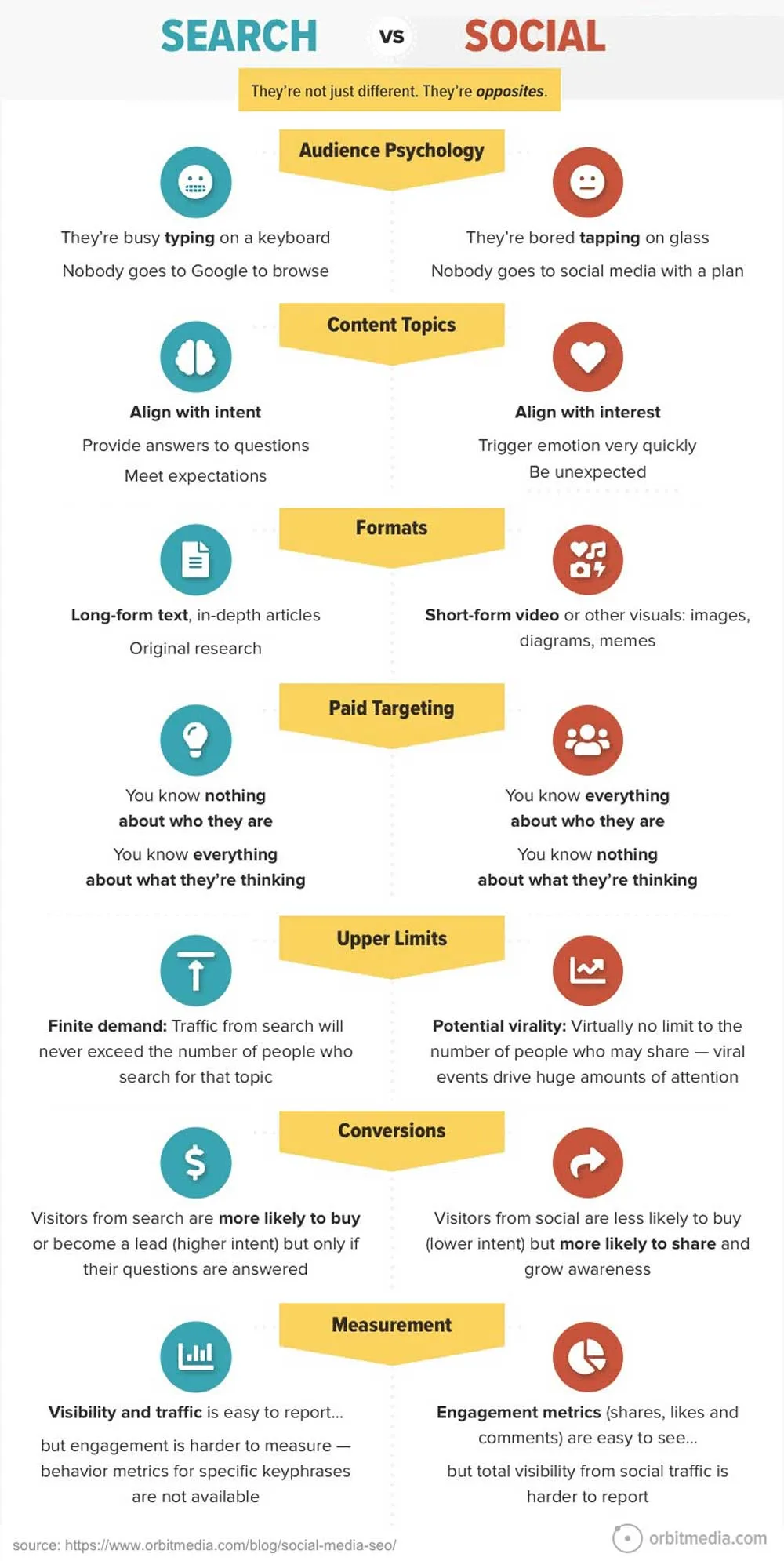
- Search audiences are actively typing with intent, as users visit search engines to find answers, not to browse content.
- Social media audiences are passively tapping and scrolling, with users arriving without a predefined goal or plan.
- Search content strategy must align with user intent, focus on answering questions, and meet explicit expectations.
- Social content strategy should align with interests, trigger emotion quickly, and aim to capture attention through surprise.
- Search platforms favor long-form content, including in-depth articles and original research pieces.
- Social platforms favor short-form videos and visual formats such as images, diagrams, and memes.
- In search advertising, marketers know nothing about who users are, but everything about what they are thinking.
- In social advertising, marketers know everything about who users are, but nothing about what they are thinking.
- Search traffic demand is finite, as traffic volume is limited to the number of people actively searching for a topic.
- Social traffic has viral potential, with virtually no upper limit due to sharing and algorithm-driven amplification.
- Search visitors are more likely to convert, driven by higher purchase or lead intent, when their queries are fully answered.
- Social visitors are less likely to convert, but are more likely to share content and increase brand awareness.
- Search performance measurement makes visibility and traffic easy to report, while engagement metrics are harder to capture.
- Social media measurement makes engagement metrics like likes, shares, and comments easy to track, but overall traffic visibility is harder to quantify.
Website Traffic Share from Search vs Social Platforms
Traffic distribution varies by channel, with search historically outperforming social:
- ~53.3% of site traffic comes from organic search, dwarfing social’s ~5% share.
- Organic search outperforms organic social by 10x or more in generating visits.
- Direct traffic leads overall at ~58%, followed by organic search and then social channels.
- Search engines, especially Google, capture the majority of global web queries.
- Mobile search accounts for over 62% of global web sessions, closely matching mobile social usage trends.
- Social content often drives engagement and repeat visits, even if it doesn’t equal search volume.
- Younger demographics skew more social for exploration, impacting traffic proportions.
- Paid social and search also feed traffic funnels differently, with paid search generating intent‑based visits and social emphasizing reach first.
How Search vs Social Drives Brand Discovery
Both channels contribute to how users first encounter brands:
- 38% of consumers discover brands via social media, slightly ahead of search engines at 37%.
- 58% of consumers find it more engaging to connect with brands on social media than in stores.
- 29.7% of users discover brands through social media, ranking it among the top sources after search at 32.8%.
- Gen Z is 25% less likely to use Google search for brand discovery compared to Gen X.
- 67% of Gen Z use Instagram for searching brands, with 62% turning to TikTok.
- 69% of Gen Z discovered new products or brands through social media influencers in 2024.
- 44% of Google searches are branded, showing search’s role in intent-driven discovery.
- 76% of consumers say social content influenced a purchase in the past six months.
- Brand searches convert 3–5x better than generic searches due to established trust.
Product Research Behavior across Search vs Social
Users research products differently depending on the channel and intent:
- Search queries often reflect specific intent, like “best running shoes 2026”.
- Social browsing supports inspiration and trend discovery before intent forms.
- Visual social platforms like Instagram and TikTok significantly influence product perception.
- Users may see product ads in social feeds before searching for details.
- Search provides detail-rich comparisons and review access.
- Social signals like likes and comments impact confidence in new products.
- Search terms with “near me” or purchase intent queries have grown significantly.
- Both channels together shape the overall research path, from awareness to evaluation.
Search Channel Share Breakdown
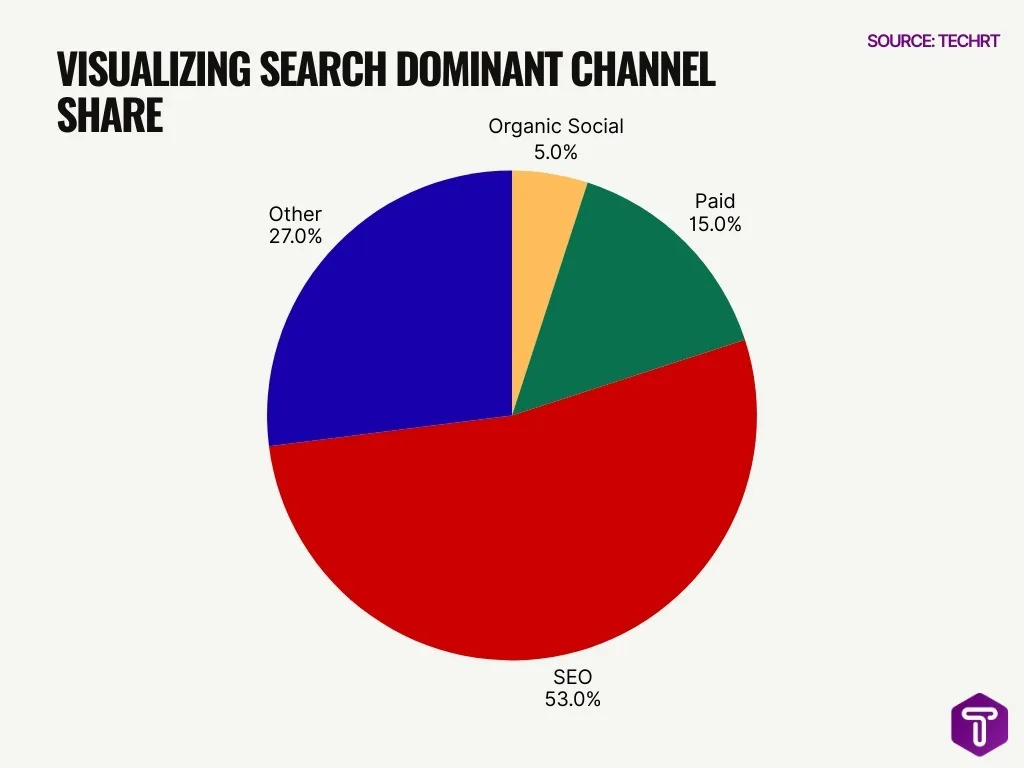
- SEO dominates search-driven traffic, accounting for 53.0% of the total channel share, making it the most influential acquisition source.
- Other traffic sources contribute a sizable 27.0%, highlighting the role of alternative and mixed channels beyond core search strategies.
- Paid search captures 15.0% of the overall share, reinforcing its importance as a scalable but secondary traffic driver.
- Organic social delivers just 5.0%, indicating a relatively limited impact compared to search-focused channels.
Demographic Differences in Search vs Social Usage
Understanding who uses search and social differently reveals how channels shape behaviors:
- Around 78% of internet users use social platforms for product and brand research, showing social’s high reach for discovery.
- About 24% of users say they use social media as their primary search engine, especially for lifestyle and trend queries.
- ~66.6% of U.S. consumers used “social search” in early 2025.
- Among younger groups, ~46% of Gen Z prefer social platforms over traditional search for discovery, versus ~35% of Millennials.
- 63% of Instagram users are aged 18–34, highlighting social’s strong appeal among younger demographics.
- YouTube is used for brand engagement by ~66% of Gen Z, with Instagram close behind at ~63%, showing social media’s deep role in brand discovery.
- Younger users are more likely to explore local businesses via social platforms than older adults.
- Males lead slightly in overall social media use, while younger adults skew more heavily toward TikTok and Instagram.
- Global daily social media use averages ~2h20m–2h21m, reflecting broad demographic adoption across age groups.
Device-Based Usage Trends: Search vs Social on Mobile vs Desktop
How users access search and social reveals usage patterns by device:
- Over 60% of Google searches occur on mobile devices in the U.S., highlighting mobile dominance.
- Social media use is even more mobile‑centric, with ~91% of social engagement happening via mobile devices.
- Search on mobile grows with voice and visual search adoption, though desktop remains strong for complex tasks.
- Social apps are optimized for mobile scrolling and engagement touchpoints, reinforcing their mobile advantage.
- Cross‑device behavior shows users often discover products on mobile social and then switch to desktop for a detailed search.
- Search tasks requiring detailed comparisons still favor desktop when available.
- Social content consumption spikes on weekends and evenings, while search maintains steadier usage throughout the week.
- App‑based search features blur typical device divides between channels.
Understanding User Intent in Search vs Social Journeys
Intent drives how and why users engage with each channel:
- Approximately 31% of consumers use social media to find answers to their questions.
- Nearly one in three consumers skip Google, starting searches on TikTok, Instagram, or YouTube.
- 46% of Gen Z rely on social media as their primary search tool, outpacing Google.
- 78% of internet users use social platforms for product and brand research.
- 92.5% of respondents use social media to research products before buying.
- Organic search from search engines has a 2.1-2.6% conversion rate, higher than social traffic.
- Search leads convert at higher rates with less nurturing than social discovery leads.
- 29% of Gen Z and millennials prefer social media over traditional search engines.
- 58% of consumers discover new businesses via social media, outperforming search.
Industry and Niche Impact on Search vs Social Performance
Different sectors see unique outcomes from search and social engagement:
- Retail sees 82% of consumers using social media for product discovery before search.
- News publishers report Google search referrals dropping from 51% to 27% in two years.
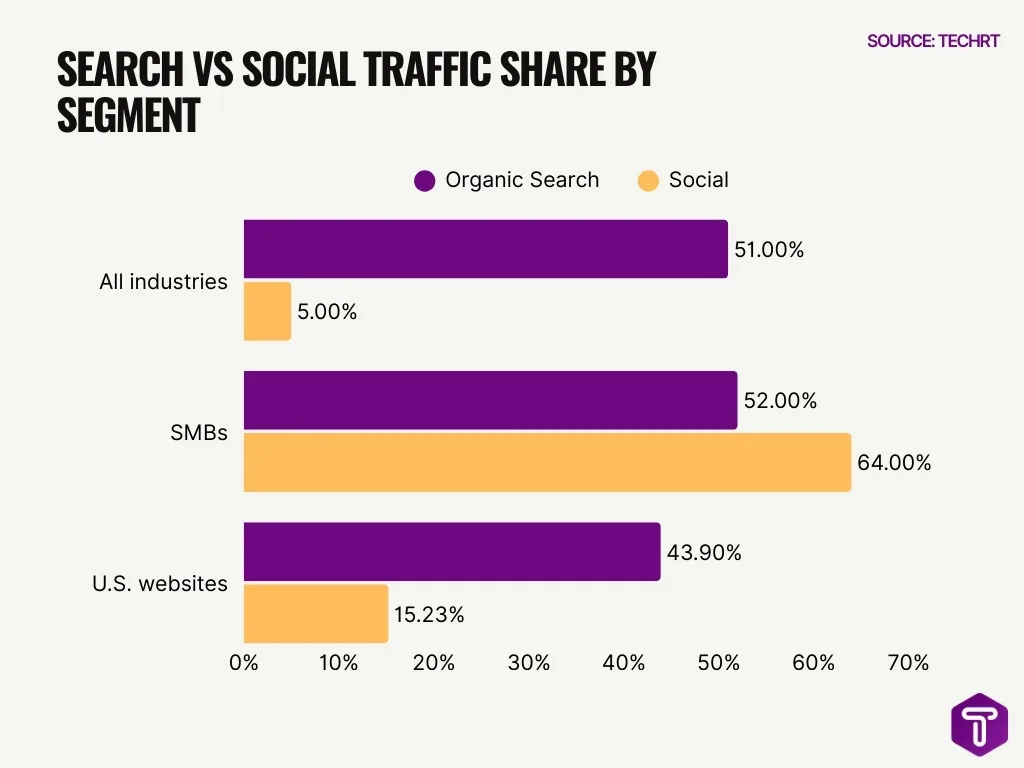
- Organic search drives 51% of traffic across industries vs 5% from social.
- SMBs get 64% traffic from social, surpassing 52% from organic search.
- B2B buyers rely on the internet search for 66% of product exploration.
- Social media ad spend projected to rise 83% by 2030, mobile-dominant.
- 64% of global shoppers use social as the top channel for product discovery.
- US websites derive 15.23% traffic from social vs 43.9% organic search.
Click‑Through Rate Comparison between Search vs Social
Click‑through rates (CTR) illustrate how often users click after seeing content:
- Search campaigns traditionally see higher CTRs, with averages around ~6.64% for search results.
- Display and social media CTRs are lower, with ~0.90% average on social campaigns across industries.
- Social CTRs vary widely by platform, format, and audience targeting.
- Search CTRs typically peak on top organic results pages, with most clicks going to the first few listings.
- Paid search ads have different CTR benchmarks than organic listings.
- CTR performance also depends on creative messaging and keyword matching.
- Social CTRs tend to improve when native content aligns with user interests.
- Search CTRs remain a strong proxy for intent and relevance to query topics.
Conversion Rate Insights for Search vs Social Campaigns
Conversion rates show how often engagement leads to desired actions:
- Search campaigns average 3.2% conversion rate across industries, outperforming social’s 1.5%.
- Paid search delivers 7.52% average CVR in Google Ads for 2025.
- Facebook ads average 8.95% conversion rate in 2025, down from 9.21% in 2024.
- Organic search yields 2.7% average conversion, strong for high-intent queries.
- Retargeting boosts conversions by up to 150% on search and social visitors.
- Social proof, like testimonials, increases conversions by 34% in social campaigns.
- Paid social visitors are 41% more likely to bounce than search traffic.
- Instagram leads paid social at 17.9% CVR, followed by Facebook at 13%.
- Landing page optimization lifts search conversions via higher Quality Scores.
Web Content, Search & Social Media Market Growth Statistics
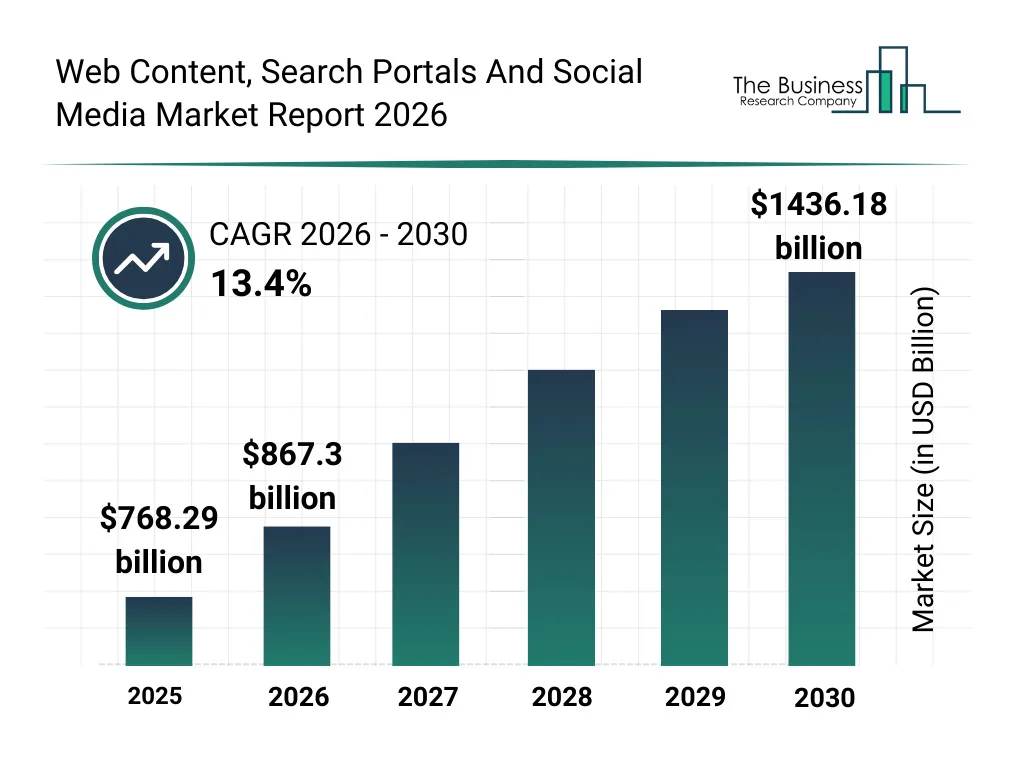
- The global web content, search portals, and social media market was valued at $768.29 billion in 2025, reflecting the strong foundation of the digital content economy.
- Market size increased to $867.3 billion in 2026, driven by higher digital ad spending and expanding social platform usage.
- The market is projected to grow at a robust 13.4% CAGR from 2026 to 2030, signaling sustained long-term expansion.
- By 2028, the market is expected to surpass $1 trillion, marking a major milestone for search and social ecosystems.
- Market value is estimated to reach around $1.27 trillion in 2029, supported by monetization of short-form content and AI-driven discovery.
- By 2030, the global market is forecast to hit $1,436.18 billion, nearly doubling its 2025 value.
- Between 2025 and 2030, the market is expected to add approximately $668 billion in total value, highlighting the accelerating role of digital platforms in the global economy.
Revenue and ROI Benchmarks from Search vs Social Channels
Comparing revenue generation and return on investment (ROI) across search and social helps marketers allocate resources effectively:
- Search engine optimization and content channels rank among the top marketing channels driving ROI for B2B brands, together with paid social efforts and social commerce tools.
- Search remains a major revenue driver for B2B brands, with 23% of B2B marketers citing organic search as the most effective revenue channel.
- 70% of B2B decision‑makers say SEO generates more sales than pay‑per‑click, underscoring search’s influence on revenue.
- Many marketers find that combining search and social tactics yields a higher overall ROI than investing in either channel alone.
- While exact ROI varies widely by campaign and industry, organic search and targeted paid search often deliver cost efficiencies for high‑intent traffic.
- Social marketing continues to grow as a revenue contributor, with survey data showing 53% of shoppers discover products on social platforms.
- ROI from social media increases when campaigns include social selling, engagement optimization, and retargeting.
- Social channels help shorten purchase decision times, increasing velocity to revenue for some brands.
- Larger deals in B2B contexts emerge from social selling strategies, with companies reporting up to 48% larger deal sizes attributed to social engagement tactics.
- In direct commerce contexts, social commerce integrations incrementally improve revenue performance relative to traditional web funnels.
Budget Allocation Trends for Search vs Social Marketing
How organizations plan and spend their marketing budgets reveals strategic priorities in 2026:
- The average company allocates about 7.7% of revenue to marketing, balancing investment across channels.
- B2B firms typically spend 2–5% of revenue on marketing, while consumer‑focused B2C companies invest 7–12%, with some high‑growth sectors pushing 15–20%.
- Allocation between search and social depends on goals; search is prioritized for intent capture, while social budgets emphasize reach, engagement, and community building.
- Marketers increasingly blend SEO budgets with content creation to support long‑term organic search performance.
- Social platforms account for a growing portion of digital ad budgets, particularly for reputation, brand awareness, and live commerce.
- Many organizations allocate 30–50% of their digital budget toward social and search combined, integrating performance outcomes across channels.
- AI tools are reshaping budget planning, with efficiencies from automation reducing cost per impression and increasing budget flexibility.
- Investments in social influencer partnerships and creator ecosystems remain prominent in social spend strategies.
- Brands that emphasize social data analytics find improved multi‑channel measurement and dynamic budget reallocations.
- PPC and paid search remain substantial line items, particularly in competitive verticals like retail and technology.
TikTok as a Search Engine: User Adoption by Generation
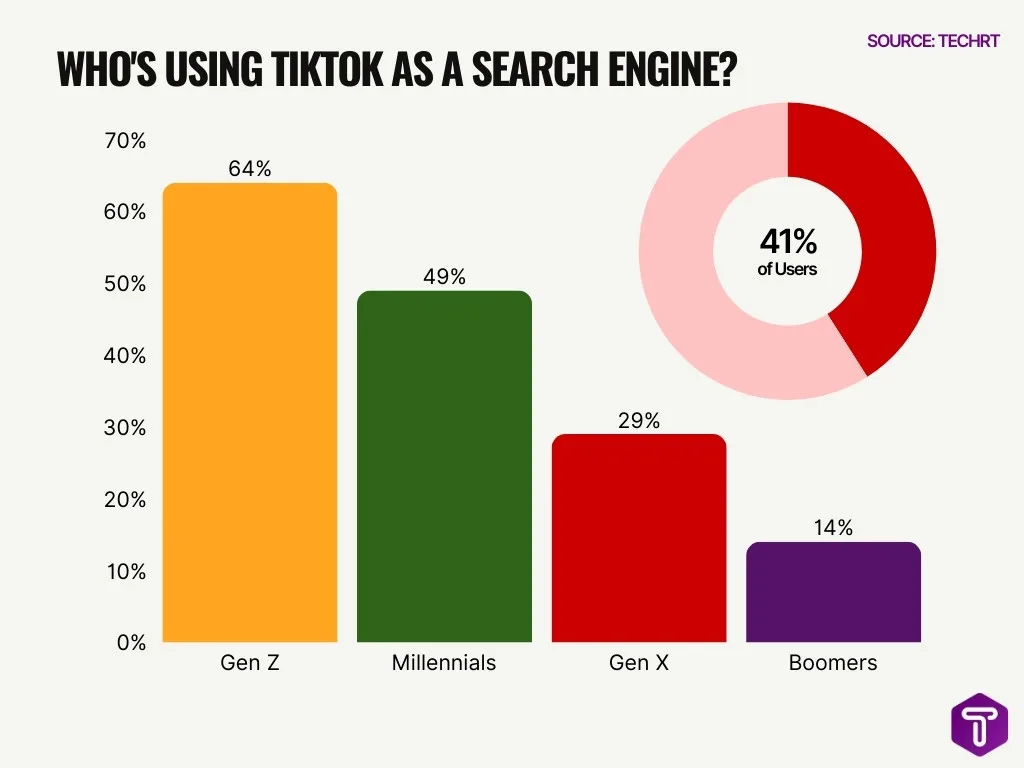
- 41% of TikTok users now use the platform as a search engine, highlighting a major shift in how people discover information.
- Gen Z leads TikTok search adoption at 64%, making it the most search-driven generation on the platform.
- 49% of Millennials rely on TikTok for search, showing strong adoption among digitally native adults.
- Gen X records 29% usage, indicating moderate but growing use of TikTok as a search tool.
- Only 14% of Boomers use TikTok for search, reflecting limited adoption among older users.
- Search usage declines steadily with age, positioning TikTok as a youth-centric discovery engine.
- The large gap between Gen Z (64%) and Boomers (14%) underscores a 50-percentage-point generational divide in search behavior.
- High adoption among Gen Z and Millennials signals TikTok’s rising importance for product discovery, local search, and how-to content.
Comparing B2B vs B2C Outcomes in Search vs Social
The role of search and social varies significantly between business types:
- 75% of B2B buyers use social media at some point in the purchase decision, reflecting social’s influence beyond purely B2C contexts.
- 54% of B2B marketers generate leads directly from social platforms, showing how social impacts pipeline development.
- In B2C environments, social channels often lead initial discovery, with 53% of shoppers finding products via social platforms.
- B2B marketers still rely heavily on search for detailed product research and competitive comparisons, often driven by SEO and PPC campaigns.
- LinkedIn remains the dominant social channel for B2B engagement, significantly outperforming other networks for professional lead generation.
- B2C brands increasingly tie search data insights into social creative strategies to amplify relevance and conversions.
- B2B sales cycles are typically longer, making search intent signals and nurture sequences crucial for conversion path optimization.
- In B2C contexts, social selling and content engagement yield faster purchase decisions for lower‑cost products.
- Brands that integrate search and social in unified funnel strategies report better alignment between brand awareness and purchase conversion metrics.
- Social platforms play a bigger role in relationship building and repeat engagement in B2C than in many traditional B2B funnels.
Performance Over Time: How Search vs Social Has Evolved
Historical trends show how both channels have shifted over recent years:
- Traditional search referrals to some industries, such as news publishers, have declined noticeably as alternative discovery methods evolve.
- AI‑enhanced search experiences (including summaries and conversational answers) are reshaping how users interact with search results.
- Social engagement patterns continue to grow as daily time spent on social platforms remains high, shaping discovery behaviors.
- Search has maintained its role in high‑intent, detail‑driven querying, even as social platforms compete for early‑stage attention.
- Social media’s impact on brand recall and network effects has increased with expanded audience sizes.
- Emerging generational habits, particularly among younger cohorts, show social as the starting point for exploration more often than in previous years.
- Multi‑platform strategies now outperform single‑channel approaches in driving consistent engagement across the customer lifecycle.
- Integration of social and search data sources enhances cross‑channel insights and campaign performance.
- Mobile optimization continues to influence evolution, as both search and social pivot to app‑first experiences.
How Often Users Use Search on Social Media Platforms
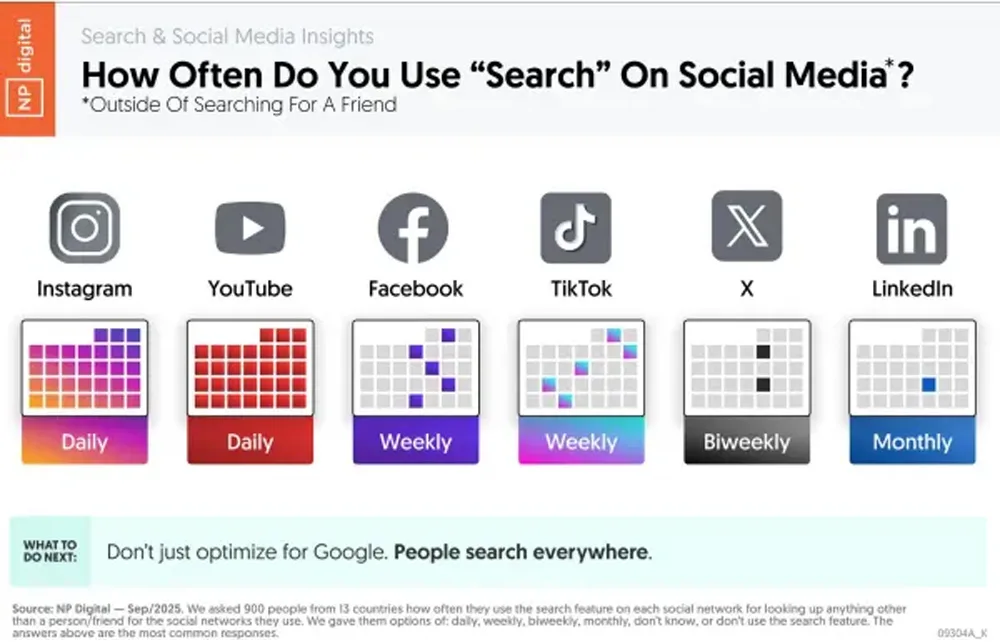
- Instagram users rely on the search feature daily, highlighting its role as a primary tool for content discovery beyond friends.
- YouTube search is used daily, reinforcing its position as a search-driven video platform rather than a passive social feed.
- Facebook sees search usage most commonly on a weekly basis, suggesting more occasional intent-based discovery.
- TikTok users typically use search weekly, reflecting growing use for trend, product, and topic exploration.
- X (Twitter) search is most often used biweekly, indicating lower reliance on search compared to real-time feed consumption.
- LinkedIn has the lowest search frequency, with most users searching only monthly, aligning with its professional and task-driven usage patterns.
- Overall, visual-first and video-centric platforms (Instagram and YouTube) show higher daily search dependence, while professional and text-heavy networks see less frequent search behavior.
Role of Search vs Social in Customer Acquisition and Loyalty
Search and social contribute differently to acquiring and retaining customers:
- Search captures 86% of businesses for customer acquisition via paid campaigns.
- Social media drives customer acquisition for 83% of marketers as a primary channel.
- 60% of marketing leaders credit social media with new customer acquisition.
- Retargeting via search ads boosts CTR by 180.6% over regular display.
- 58% of leaders say social media enhances customer loyalty through engagement.
- 62% of millennials grow more loyal to social brand interactions.
- 73% of social users switch brands if there is no timely response on social.
- Social CRM lifts customer satisfaction by 25% and retention by 15%.
Impact of Search vs Social on the Sales Funnel
Each channel plays a distinct role at funnel stages:
- Social media drives 68% of businesses prioritizing top-of-funnel awareness.
- Search content converts at 25x higher rates (4.78%) than social top-funnel (0.19%).
- 47% of buyers view 3–5 pieces of content before engaging sales.
- Personalization boosts conversions up to 60% over generic funnels.
- Cross-channel strategies increase sales by 14.6% using 3+ channels.
- Retargeting via social makes users 70% more likely to convert.
- Bottom-funnel search keywords yield 1–5% conversion rates.
- Social commerce averages 3% conversion, lower than search’s 5%.
Frequently Asked Questions (FAQs)
What percent of the global web search market share does Google hold?
How many people worldwide use social media as of 2025?
What percentage of people use social media instead of traditional search engines?
What share of internet users have used “social search” platforms like TikTok or Instagram?
How many different social networks does the average person use per month?
Conclusion
Both search and social channels are essential pillars of digital marketing, each contributing uniquely to traffic, revenue, and customer journey outcomes. Search maintains its strength in intent‑driven discovery and conversions, while social excels in brand visibility, engagement, and community growth. Leading marketers now blend these channels strategically to maximize reach, optimize ROI, and build long‑term customer relationships. Whether driving acquisition or nurturing loyalty, understanding the evolving metrics across search and social enables smarter data‑driven decisions and sustained business impact.

Leave a comment
Have something to say about this article? Add your comment and start the discussion.