




Shopify continues to shape the global ecommerce economy. From independent creators launching direct-to-consumer brands to enterprise retailers managing omnichannel operations, the platform powers millions of storefronts worldwide. Its impact stretches across payments, logistics, AI-driven personalization, and cross-border selling. The statistics below break down Shopify’s scale, growth trajectory, and geographic reach, giving you a clear view of where the platform stands today and where it’s heading next.
Editor’s Choice
- Shopify generated $7.06 billion in revenue in 2023, up from $5.6 billion in 2022.
- Shopify reported $235.9 billion in Gross Merchandise Volume (GMV) in 2023, a 20% year-over-year increase.
- More than 4.8 million live websites run on Shopify globally as of 2025.
- Shopify holds roughly 28% of the US ecommerce platform market share, making it the market leader.
- Shopify merchants operate in 175+ countries, highlighting global adoption.
- Over 875 million unique shoppers purchased from Shopify stores in 2023.
- Shopify Payments’ penetration exceeded 60% of GMV in 2023, showing strong in-house payment adoption.
Recent Developments
- Shopify’s 2024 earnings showed continued GMV growth exceeding $235 billion annually, maintaining double-digit expansion.
- The company expanded Shopify Magic AI tools in 2024 to assist merchants with product descriptions and marketing automation.
- Shopify completed the sale of its logistics arm in 2023, refocusing on core commerce software.
- Shop Pay Installments expanded further across the US in 2024, increasing BNPL accessibility for merchants.
- Shopify integrated more deeply with Google and Meta sales channels to support multichannel selling.
- Shopify reduced its workforce by approximately 20% in 2023 as part of restructuring efforts.
- Enterprise adoption through Shopify Plus continued to grow in 2024, contributing meaningfully to subscription revenue.
Key Shopify Facts
- Shopify was founded in 2006 and is headquartered in Ottawa, Canada.
- The company trades publicly on NASDAQ under the ticker SHOP.
- Shopify supports over 2 million active merchants globally.
- In 2023, Shopify processed more than $235.9 billion in merchant sales.
- Shopify’s ecosystem includes over 8,000 apps in the Shopify App Store.
- The platform supports omnichannel sales, including online, retail POS, and social commerce integrations.
- Shopify Plus serves enterprise brands, including global retailers and high-growth DTC companies.
- Shopify’s workforce exceeded 8,000 employees globally in 2024.
Top Countries by Number of Shopify Stores
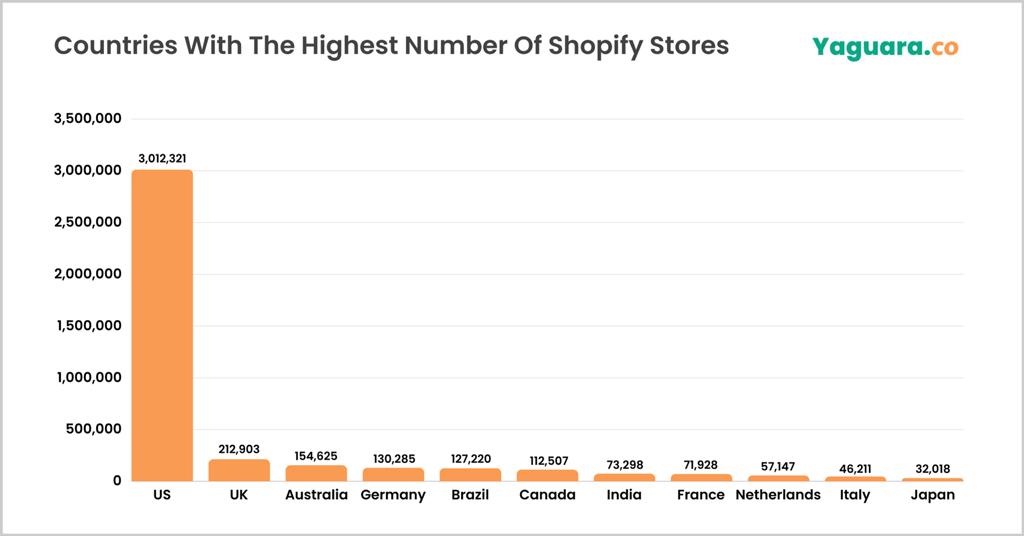
- The United States dominates the Shopify ecosystem with 3,012,321 stores, accounting for the overwhelming majority among listed countries.
- The United Kingdom ranks second with 212,903 stores, but the US has over 14× more stores than the UK.
- Australia (154,625 stores) and Germany (130,285 stores) hold strong positions in the top five, showing Shopify’s deep penetration in developed eCommerce markets.
- Brazil leads Latin America with 127,220 stores, highlighting Shopify’s growing presence in emerging markets.
- Canada records 112,507 stores, reinforcing North America’s strong Shopify adoption beyond the US.
- India (73,298 stores) and France (71,928 stores) show steady growth, both exceeding 70,000 active Shopify stores.
- The Netherlands (57,147) and Italy (46,211) represent mid-tier European adoption levels.
- Japan has 32,018 stores, making it the lowest among the top-listed countries, but still a significant Shopify market in Asia.
- The US alone has more Shopify stores than all other listed countries combined, underscoring its dominance in Shopify’s global merchant base.
Shopify Store Growth
- Shopify’s GMV grew 20% year over year in 2023, signaling merchant expansion.
- Revenue increased from $5.6B in 2022 to $7.06B in 2023, reflecting growth momentum.
- Live Shopify store counts surpassed 4 million in 2024, continuing upward growth.
- Shopify experienced accelerated growth during 2020–2022 and maintained sustained expansion afterward.
- Subscription Solutions revenue grew over 20% year over year in 2023.
- Merchant Solutions revenue represented the majority of Shopify’s revenue mix in 2023.
- Shopify Plus adoption increased among mid-market and enterprise brands in 2024.
- Growth in cross-border selling tools drove international store launches.
Shopify Revenue
- Shopify generated $7.06 billion in total revenue in 2023, up from $5.6 billion in 2022.
- Revenue growth in 2023 reached 26% year over year.
- In 2021, Shopify’s revenue peaked at $4.6 billion, reflecting pandemic-driven ecommerce acceleration.
- Merchant Solutions contributed the majority share of total revenue in 2023.
- Shopify returned to profitability in late 2023 after restructuring efforts.
- The company reported positive free cash flow during 2023, strengthening financial stability.
- Shopify’s subscription base expansion continues driving recurring revenue stability.
- Analysts forecast continued double-digit revenue growth into 2025.
E-Commerce Platform Market Share Breakdown
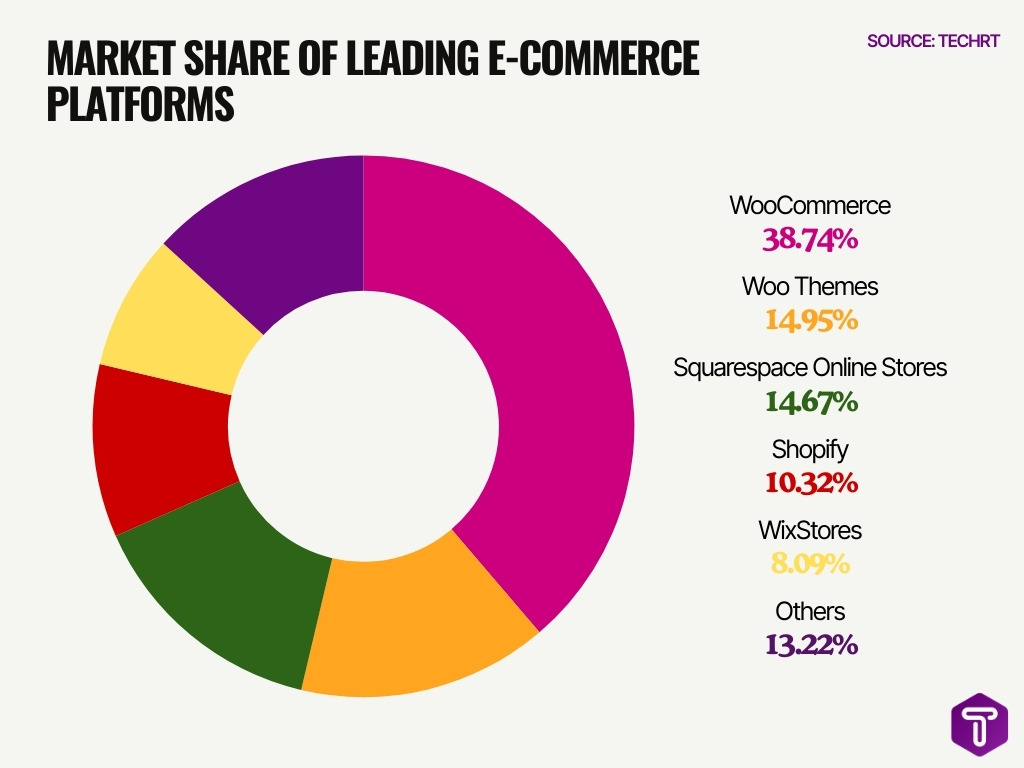
- WooCommerce dominates the market with a commanding 38.74% share, making it the clear leader among all e-commerce platforms.
- Woo Themes holds 14.95%, positioning itself as the second-largest player, though far behind WooCommerce.
- Squarespace Online Stores accounts for 14.67%, closely competing with Woo Themes and maintaining a strong mid-tier presence.
- Shopify captures 10.32% of the market, placing it in the fourth position among leading platforms in this dataset.
- WixStores represents 8.09%, reflecting a smaller but still notable share in the e-commerce ecosystem.
- The “Others” category makes up 13.22%, indicating that a significant portion of the market is distributed across smaller or niche platforms.
- The top three platforms (WooCommerce, Woo Themes, and Squarespace) together control 68.36% of the total market share, highlighting a highly concentrated competitive landscape.
- WooCommerce’s 38.74% share alone exceeds the combined share of Shopify and WixStores (18.41%), underscoring its dominant position in the industry.
Subscription Solutions Revenue
- Subscription Solutions revenue reached approximately $1.7 billion in 2023.
- Subscription revenue grew about 20% year over year in 2023.
- Shopify Plus accounts for a disproportionate share of subscription revenue despite lower merchant volume.
- Monthly subscription pricing ranges from under $50 to enterprise-level plans exceeding $2,000 per month.
- Shopify Plus revenue continues to expand as more enterprise merchants migrate from legacy platforms.
- Subscription Solutions represented roughly 25% of total revenue in 2023, with Merchant Solutions making up the remainder.
- Recurring subscription fees provide a predictable cash flow independent of GMV fluctuations.
- Annual plan adoption increased among established merchants seeking cost savings.
Merchant Solutions Revenue
- Merchant Solutions revenue reached approximately $5.3 billion in 2023, representing the majority of total revenue.
- Merchant Solutions grew over 30% year over year in 2023.
- Shopify Payments contributes the largest share within Merchant Solutions.
- Payment processing, shipping, capital lending, and POS hardware all fall under Merchant Solutions.
- Shopify Capital has provided billions in cumulative funding to merchants since launch.
- Payment penetration rates exceeded 60% of GMV, directly fueling Merchant Solutions revenue.
- Shop Pay adoption improved checkout conversion rates by up to 1.72x compared to standard checkouts.
- Merchant Solutions revenue scales directly with GMV growth, aligning Shopify’s success with merchant performance.
Shopify Gross Merchandise Volume (GMV)
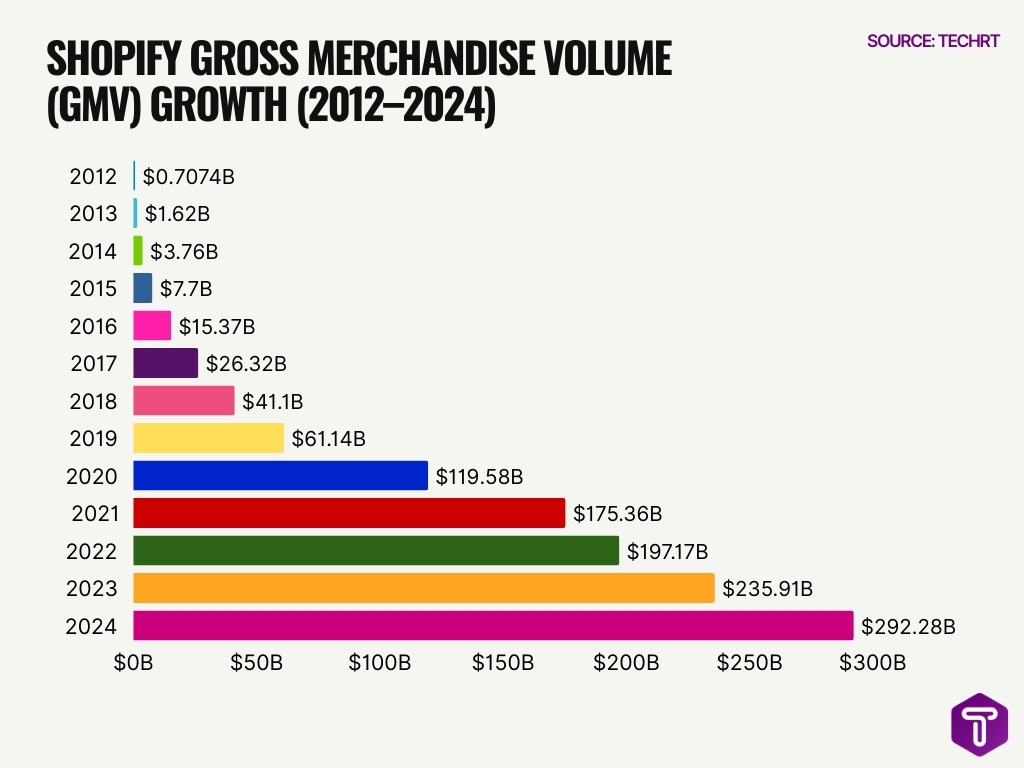
- Shopify’s Gross Merchandise Volume (GMV) surged from $707.4 million in 2012 to $292.28 billion in 2024, reflecting an extraordinary long-term expansion.
- The platform crossed the $1 billion milestone in 2013, reaching $1.62 billion, more than doubling from the previous year.
- Between 2014 and 2016, GMV scaled rapidly from $3.76 billion to $15.37 billion, marking a 4× increase in just two years.
- In 2018, Shopify surpassed $40 billion, reporting $41.1 billion in GMV.
- GMV nearly doubled from $61.14 billion in 2019 to $119.58 billion in 2020, driven by the global eCommerce acceleration.
- Shopify exceeded $175.36 billion in 2021, highlighting sustained post-pandemic growth momentum.
- The platform crossed the $200 billion mark in 2023, reaching $235.91 billion.
- In 2024, Shopify achieved a record $292.28 billion in GMV, adding over $56 billion in a single year.
- Overall, Shopify’s GMV expanded by more than 400× between 2012 and 2024, positioning it among the dominant global commerce infrastructure platforms.
Shopify Buyers and Customers
- More than 875 million unique shoppers purchased from Shopify stores in 2023.
- Shopify supports over 2 million active merchants globally.
- The United States accounts for the largest share of Shopify merchants.
- Mobile devices generate the majority of Shopify storefront traffic globally.
- Shop Pay has over 100 million stored user accounts, streamlining repeat purchases.
- Shopify merchants serve customers across 175+ countries, enabling global reach.
- Direct-to-consumer brands represent a significant portion of Shopify’s merchant base.
- Shopify POS enables unified customer data across online and offline channels.
Average Order Value (AOV)
- Average ecommerce order value in North America typically ranges between $85–$120, depending on the industry.
- Shopify merchants in fashion and apparel often report AOVs above $100 per order.
- Electronics and high-ticket categories frequently exceed $150 AOV.
- Shop Pay Installments increases AOV by enabling larger purchases through installment options.
- Mobile shoppers tend to have slightly lower AOV compared to desktop shoppers.
- Upsell and bundling apps within the Shopify App Store can increase AOV by 10–30%, depending on implementation.
- Subscription-based Shopify stores often report higher lifetime value despite moderate AOV.
- Cross-border purchases can increase AOV due to bundled shipping economics.
Shopify Conversion Rate Benchmarks by Store Tier
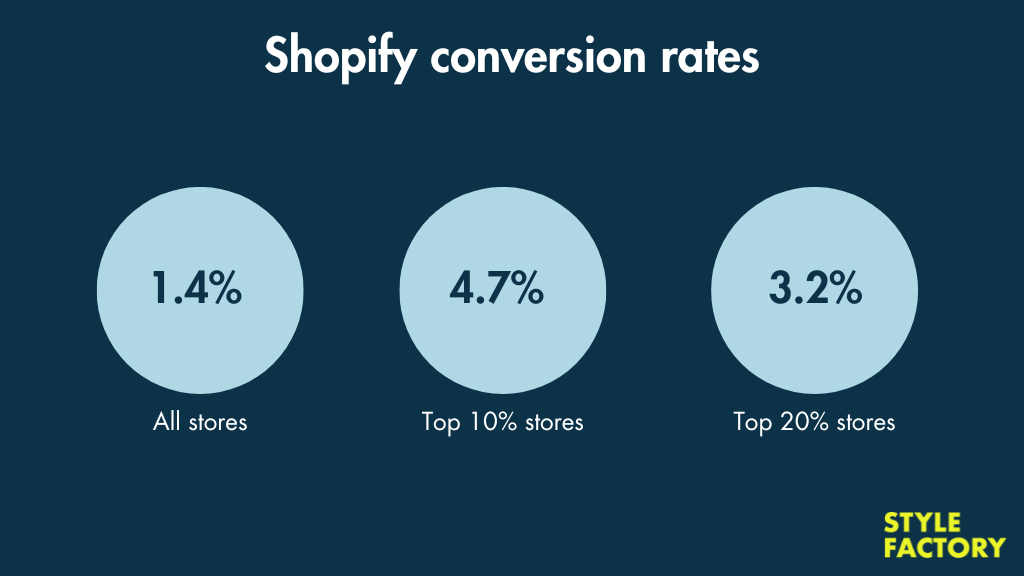
- The average Shopify conversion rate across all stores is 1.4%, establishing the baseline performance benchmark.
- Top 20% of Shopify stores achieve a 3.2% conversion rate, more than 2× higher than the platform-wide average.
- The top 10% of stores convert at 4.7%, which is over 3× higher than the overall average (1.4%).
- There is a 1.5 percentage point gap between the Top 10% (4.7%) and Top 20% (3.2%), highlighting significant performance differentiation within high-performing merchants.
- The performance spread from 1.4% to 4.7% demonstrates a 3.3 percentage point uplift potential, indicating strong upside for stores optimizing CRO (Conversion Rate Optimization).
- Merchants operating below the 1.4% benchmark are underperforming relative to the Shopify ecosystem average and may need improvements in UX, checkout flow, product pages, and traffic quality.
Conversion Rates
- The average ecommerce conversion rate across industries ranges between 2% and 3% in North America.
- Shopify reports that Shop Pay boosts checkout conversions by up to 1.72x compared to standard checkouts.
- Mobile ecommerce conversion rates typically average around 1.5–2%, lower than desktop.
- Desktop conversion rates often exceed 3% in optimized stores.
- Shopify Checkout is used by over 100 million buyers, improving repeat purchase conversion.
- Stores using accelerated checkout options such as Shop Pay and Apple Pay see measurable uplift in completed transactions.
- Shopify’s one-page checkout optimization launched platform-wide in 2023 to reduce friction and increase conversions.
- Conversion rate optimization apps in the Shopify App Store frequently report 10–30% improvements in conversion when implemented properly.
Shopify Plus Statistics
- Shopify Plus serves over 10,000 enterprise merchants globally.
- Shopify Plus merchants generate 3–5 times higher GMV per store than standard Shopify plans.
- Over 50% of Shopify Plus merchants operate in multiple countries with localized storefronts.
- Shopify Plus accounts for roughly 10–15% of Shopify’s total subscription revenue with a much smaller merchant share.
- The average contract value for Shopify Plus is estimated at above $2,000 per month, scaling with revenue volume.
- Enterprise brands such as Gymshark, Heinz, and Allbirds report over 30% YoY growth after moving to Shopify Plus.
- Nearly 70% of Shopify Plus merchants integrate with ERP or CRM systems like NetSuite and Salesforce.
- Shopify Plus supports over 135 currencies and 170+ countries, enabling global checkout for enterprise stores.
- Enterprise merchant onboarding to Shopify Plus grew by over 40% YoY post‑2022 as brands migrated from legacy platforms.
- Shopify Plus merchants report over 20% faster site load times versus legacy enterprise platforms.
Shopify Merchants by Region: Global Distribution Breakdown
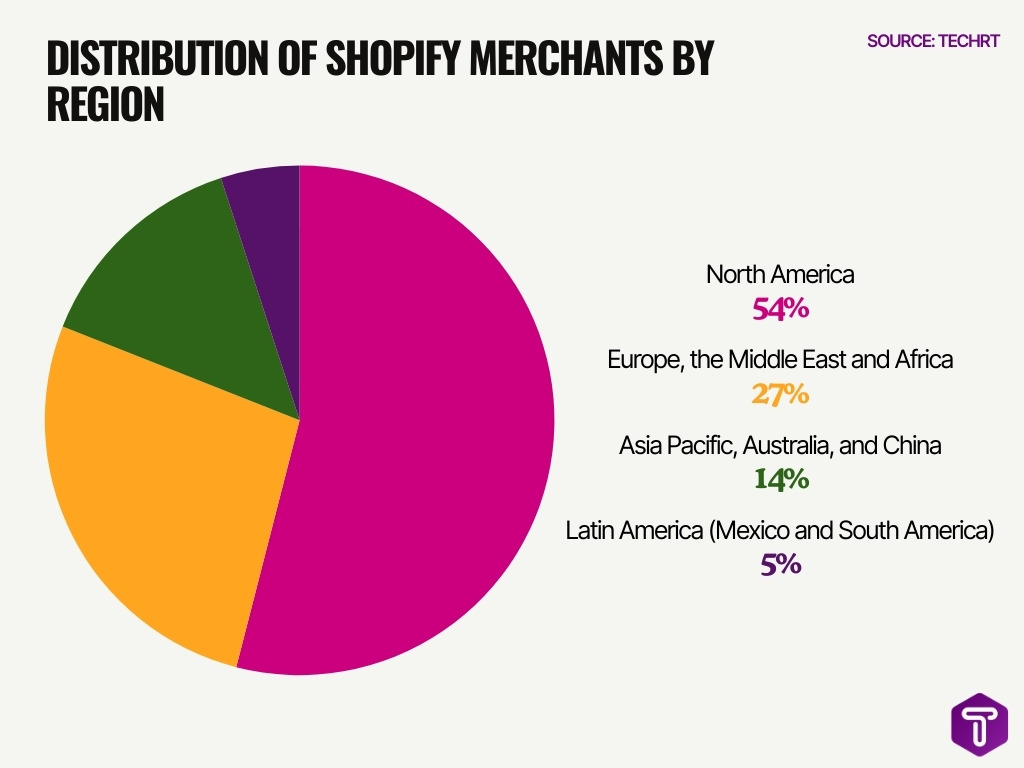
- North America dominates the Shopify ecosystem, accounting for 54% of all Shopify merchants, making it the platform’s largest regional market.
- The Europe, Middle East, and Africa (EMEA) region holds a significant 27% share, highlighting strong cross-border and multi-market adoption.
- Asia Pacific, Australia, and China collectively contribute 14% of Shopify merchants, indicating steady growth potential in emerging and developed APAC markets.
- Latin America (Mexico and South America) represents 5% of total merchants, showing a smaller but expanding footprint in the region.
- Overall, more than half of Shopify’s merchant base is concentrated in North America, while the remaining 46% is distributed globally, reinforcing Shopify’s strong international presence.
Shopify Payments Usage
- Shopify Payments’ penetration exceeded 60% of total GMV in 2023.
- Shopify Payments is available in over 20 countries, including the US, UK, Canada, and Australia.
- Shop Pay has over 100 million stored user accounts, driving faster checkout adoption.
- Shop Pay Installments expands buy-now-pay-later options across the US market.
- Payment processing revenue forms the largest share of Merchant Solutions revenue.
- Shopify Capital has provided billions in merchant funding since launch.
- Merchants using Shopify Payments avoid third-party transaction fees, improving margin efficiency.
- Accelerated checkouts reduce cart abandonment, which averages nearly 70% across ecommerce globally.
Shopify App Store Stats
- The Shopify App Store now lists around 13,000+ apps, up from about 5,600 in 2021, making it one of the largest ecommerce app ecosystems globally.
- Over 11,000 different vendors contribute apps to Shopify’s ecosystem, with thousands of partners publishing 1–5 apps each for global merchants.
- Shopify merchants install an average of 6–6.5 apps per store, with about 12% of stores running 10+ apps in more complex tech stacks.
- Roughly 87% of Shopify merchants rely on apps to enhance marketing, shipping, analytics, and other store functionality.
- Marketing and conversion-related apps exceed 1,500 listings, while orders and shipping apps surpass 3,000, reflecting strong demand for growth and logistics tools.
- Shopify app developers have collectively earned over $1.5 billion from the App Store, with many top developers generating six‑figure annual SaaS income.
- Under Shopify’s current revenue-share model, eligible developers pay 0% on their first $1 million in lifetime app revenue, then 15% on earnings above that threshold.
- Store analytics, conversion, and 3D product apps can boost conversion rates by up to 250%, delivering strong ROI for optimization-focused merchants.
- The Shopify app ecosystem spans about 2.5 million active stores, with more than 16.1 million total third‑party app installations recorded.
Social Media Traffic Distribution to Shopify’s Website
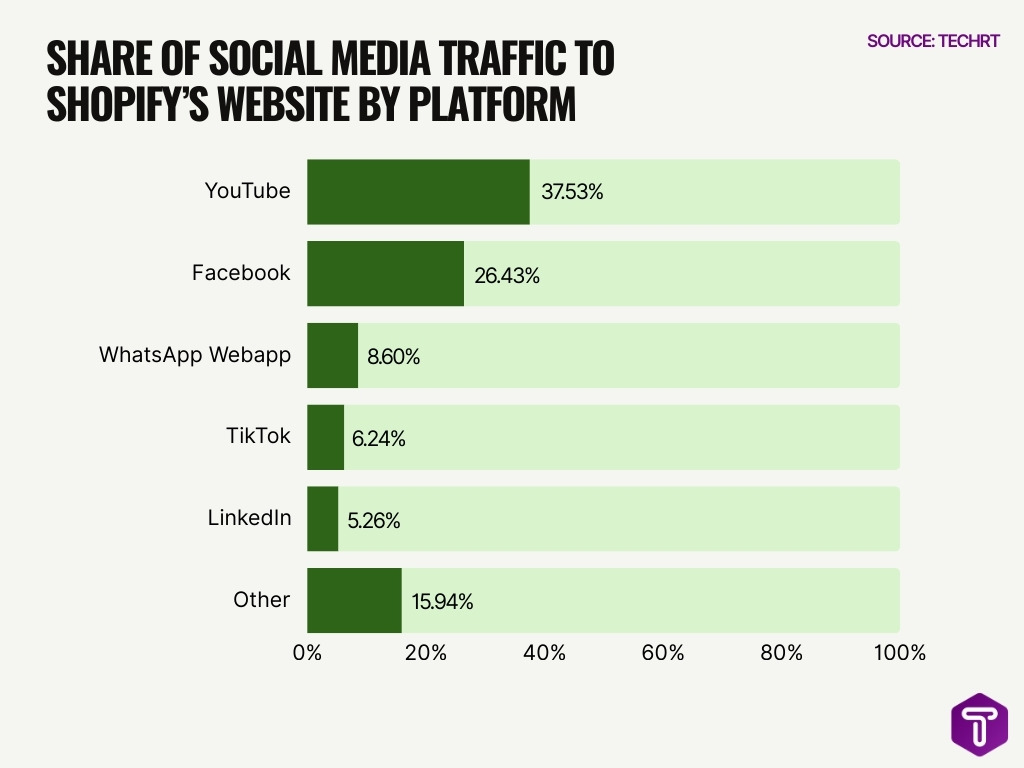
- YouTube dominates social referrals, driving 37.53% of Shopify’s total social media traffic, making it the largest single source.
- Facebook ranks second with 26.43%, contributing more than a quarter of total social traffic.
- WhatsApp Web accounts for 8.60%, highlighting the growing role of messaging platforms in referral traffic.
- TikTok generates 6.24%, showing the platform’s rising influence in short-form commerce discovery.
- LinkedIn contributes 5.26%, reflecting a steady stream of B2B and professional audience traffic.
- The “Other” category represents 15.94%, indicating a diversified mix of smaller platforms contributing nearly one-sixth of total social traffic.
- Combined, YouTube and Facebook drive 63.96% of Shopify’s social media traffic, demonstrating a strong concentration in video and social networking platforms.
Black Friday Cyber Monday Sales
- Shopify merchants generated $14.6 billion in BFCM 2025 sales, up 27% YoY.
- Peak sales hit $5.1 million per minute at 12:01 PM EST on Black Friday.
- 81+ million consumers bought from Shopify-powered stores during BFCM 2025.
- Average cart value reached $114.70, up 6% YoY.
- Cross-border orders made up 16% of all global BFCM transactions.
- Mobile devices accounted for 56.1% of BFCM sales and over 75% of orders.
- Shopify infrastructure handled 2.2 trillion edge requests and 90 petabytes of data.
- 94,900+ merchants hit their highest sales day ever during BFCM 2025.
- 15,800+ new entrepreneurs made their first sale on Shopify over BFCM.
- Shop Pay processed 32% of orders, with 39% YoY sales growth.
Shopify Stock Performance
- Shopify’s current market cap stands at $155.68 billion as of March 2026.
- SHOP stock peaked at $169.06 in November 2021 during ecommerce boom.
- Shares plunged 84.8% from the 2021 peak to $25.67 low in October 2022.
- SHOP stock surged approximately 119% throughout 2023 amid recovery.
- 2025 full-year revenue reached $11.6 billion, up 30% year-over-year.
- Q4 2025 GMV hit $124 billion, reflecting 31% year-over-year growth.
- Institutional investors own 69.27% of Shopify’s outstanding shares.
- Free cash flow generated $2.0 billion in 2025 with 17% margin.
- Current P/E ratio is 86.9 (TTM), indicating a premium valuation.
- Analyst average price target for SHOP is $184, suggesting 52% upside potential.
Frequently Asked Questions (FAQs)
How much did Shopify merchant sales total over Black Friday–Cyber Monday 2025?
Shopify merchants generated $14.6 billion in global sales over Black Friday–Cyber Monday 2025, up 27% from 2024.
What was Shopify’s revenue growth and total revenue in 2025?
In 2025, Shopify reported 30% revenue growth, with total revenue topping $11.5 billion.
How many active Shopify stores were there in 2025?
There were approximately 6,519,105 active Shopify stores worldwide as of late 2025.
What share of the US ecommerce market does Shopify hold?
Shopify captured approximately 30% of the US ecommerce businesses’ market share in 2025.
What was Shopify’s gross payment volume in Q4 2025?
In Q4 2025, Shopify’s gross payment volume (GPV) reached $84 billion, representing 68% of GMV.
Conclusion
Shopify’s position reflects resilience, scale, and strategic focus. The company processes over $235 billion in annual GMV, supports millions of merchants, and continues expanding enterprise and payments adoption. While ecommerce growth has normalized since the pandemic surge, Shopify’s ecosystem, from Shopify Pay to Shopify Plus, remains central to digital retail infrastructure in the US and globally.
For entrepreneurs, brands, and investors, these statistics reveal more than just platform size. They highlight sustained revenue expansion, strong merchant adoption, and a payments engine deeply integrated into ecommerce workflows. As omnichannel retail and AI-driven commerce accelerate, Shopify’s performance metrics suggest it will remain a foundational layer of online selling for years to come.

Leave a comment
Have something to say about this article? Add your comment and start the discussion.