



Synthetic media, AI-generated images, videos, audio, and text have rapidly evolved from experimental technology into a core component of modern digital ecosystems. Today, brands use it to localize advertising campaigns at scale, creating region-specific video content in minutes rather than weeks. At the same time, film studios and gaming companies rely on synthetic media to build immersive environments, recreate actors digitally, and streamline production workflows. This shift is not just about efficiency; it is redefining how content is produced, distributed, and consumed across industries.
As generative AI tools become more accessible and powerful, synthetic media is influencing everything from marketing personalization to cybersecurity risk management. Understanding the scale, growth, and implications of this technology is essential for businesses and consumers alike, so let’s explore the data shaping synthetic media.
Editor’s Choice
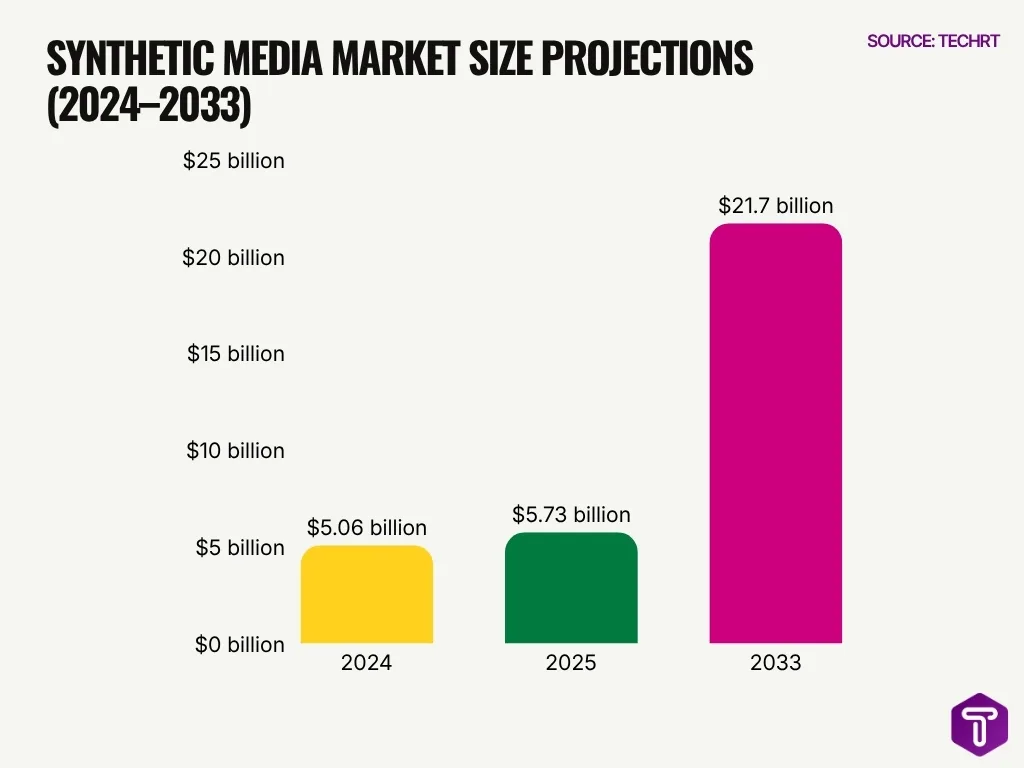
- The global synthetic media market reached $5.06 billion in 2024 and is projected to exceed $21.7 billion by 2033 (18.1% CAGR).
- The market is expected to hit $7.29 billion in 2025 and grow to $48.55 billion by 2033 (26.75% CAGR).
- Deepfake AI market size stood at $764.8 million in 2024, projected to reach $19.8 billion by 2033.
- The number of online deepfakes surged from 500,000 in 2023 to 8 million in 2025.
- The deepfake technology market is expected to grow from $11.18 billion in 2026 to $51.42 billion by 2034.
- The fake image detection market will reach $2.07 billion in 2026, growing to $28.01 billion by 2034.
- Generative AI is projected to grow from $16 billion in 2024 to $85 billion by 2029.
Recent Developments
- Synthetic media adoption accelerated due to generative AI breakthroughs, with multimodal AI tools enabling real-time content creation.
- Deepfake fraud attempts increased by 347% in 2024 compared to 2023, highlighting cybersecurity risks.
- Over 8 million deepfake videos circulated online by 2025, signaling rapid misuse growth.
- AI-generated media tools have reduced production costs by enabling automated video and voice generation workflows.
- Generative adversarial networks now dominate deepfake creation technologies, holding over 69% market share.
- North America accounted for over 34% of the synthetic media market share in 2024, leading adoption.
- Asia-Pacific is emerging as the fastest-growing region with a CAGR above 49% in deepfake AI adoption.
- Video-based synthetic media accounted for 36.89% of the total market share in 2024, dominating formats.
What Is Synthetic Media?
- Synthetic media refers to AI-generated or AI-altered content, including images, videos, audio, and text.
- Deepfake technology forms a major subset, enabling realistic face swaps and voice cloning.
- Generative AI models power synthetic media using deep learning and neural networks.
- Synthetic media includes fully artificial content and partially modified real content.
- The technology supports use cases like virtual avatars, automated dubbing, and AI-generated ads.
- Generative AI tools enable content creation at scale and near-zero marginal cost.
- Synthetic media is widely used in education, marketing, and entertainment industries.
- Ethical concerns include misinformation, identity fraud, and digital impersonation risks.
Synthetic Media Market Size Statistics
- Global market size reached $5.06 billion in 2024.
- The market is expected to grow to $5.73 billion in 2025.
- Forecasts suggest growth to $21.7 billion by 2033.
- Another estimate places the 2025 market size at $7.23 billion.
- The market could reach $15.01 billion by 2030.
- Alternative projections show $48.55 billion by 2033, indicating aggressive growth scenarios.
- The synthetic media software segment alone was valued at $2.5 billion in 2025.
- The U.S. market is projected to reach $4.55 billion by 2032.
Overview of Synthetic Media Adoption
- Media and entertainment accounted for 28.94% of synthetic media usage in 2024.
- Generative AI represented over 37.6% of the technology share in synthetic media platforms.
- Enterprise adoption is rising due to cost savings in content production workflows.
- Cloud-based deployment accounted for nearly 69.66% of deepfake AI usage in 2024.
- Synthetic media tools are widely adopted in advertising, e-learning, and virtual training.
- Banking and finance sectors are expected to grow adoption at 49.66% CAGR through 2030.
- The U.S. synthetic media market reached $1.36 billion in 2024, showing strong enterprise demand.
- Increasing AI accessibility has lowered barriers, enabling small businesses and creators to adopt synthetic media tools.
Synthetic Media Growth and CAGR Statistics
- The synthetic media market is growing at 18.1% CAGR (2025–2033).
- Another projection shows 26.75% CAGR through 2033, driven by generative AI.
- Conservative estimates place CAGR at 15.74% between 2025–2030.
- The synthetic media software segment is expanding at 25% CAGR.
- Deepfake AI market shows extreme growth at 44.3% CAGR.
- The fake image detection market is growing at 38.45% CAGR through 2034.
- The generative AI sector overall is expanding at ~40% CAGR.
- The deepfake technology market is expected to grow at 21% CAGR through 2034.
Synthetic Media Adoption by Region
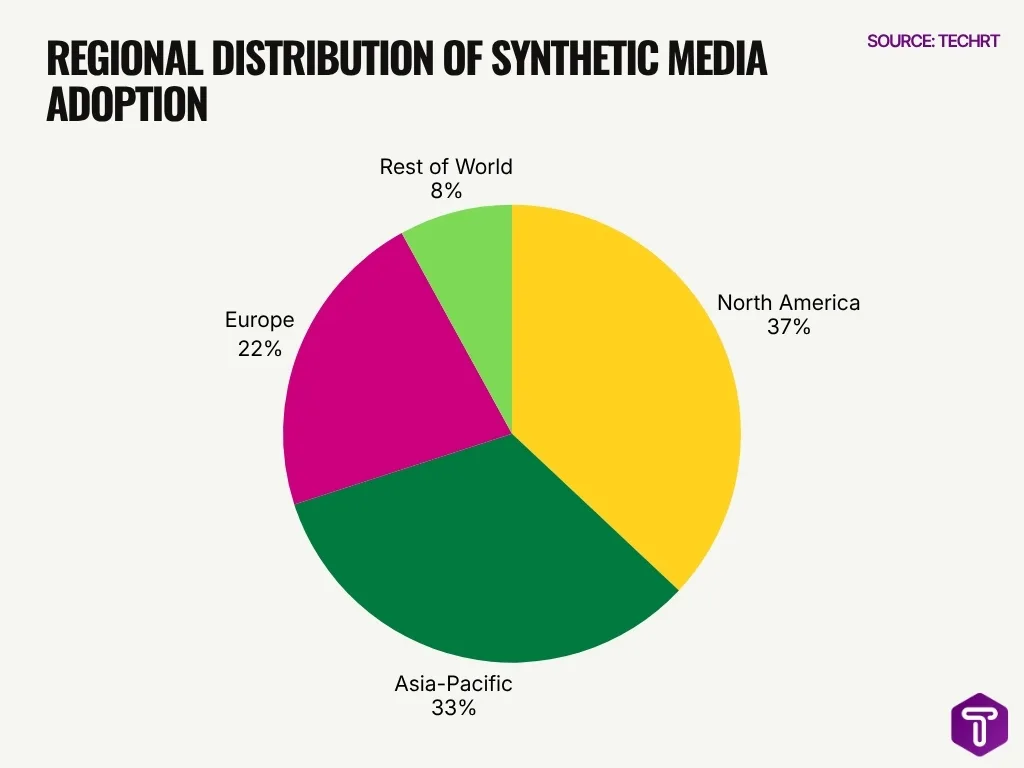
- North America has the largest share of synthetic media adoption at 37%, making it the leading region in the dataset.
- Asia-Pacific follows closely with 33%, only 4 percentage points behind North America.
- Together, North America and the Asia-Pacific account for 70% of total synthetic media adoption, showing strong concentration in these two regions.
- Europe represents 22% of adoption, placing it third among the listed regions.
- The Rest of World category accounts for 8%, indicating comparatively lower adoption outside the three major regions.
- The data suggests that synthetic media adoption is currently strongest in developed and fast-growing digital markets.
- The relatively high share in Asia-Pacific highlights the region’s growing role in synthetic media, likely driven by expanding digital infrastructure, content creation, and AI-related innovation.
- The gap between Europe and Asia-Pacific is 11 percentage points, showing that Asia-Pacific has a notably stronger adoption share than Europe.
- Overall, the chart shows a clear regional hierarchy: North America first, Asia-Pacific second, Europe third, and the Rest of the World fourth.
Synthetic Media Revenue and Investment Statistics
- Global investment in synthetic media startups exceeded $3.2 billion in 2024, reflecting growing venture capital interest.
- Generative AI companies raised over $25 billion in funding in 2023–2024 combined.
- The synthetic media software segment generated $2.5 billion in revenue in 2025, with SaaS tools leading adoption.
- Enterprise spending on AI-generated content tools is projected to grow by 32% year-over-year in 2026.
- The U.S. synthetic media market alone is expected to surpass $4.5 billion in annual revenue by 2032.
- Marketing and advertising account for over 40% of synthetic media revenue streams, driven by personalized content demand.
- Investment in deepfake detection technologies crossed $500 million globally in 2024.
- Cloud-based AI media platforms contribute to over 60% of recurring revenue models in this segment.
- Media companies are allocating 10–15% of production budgets to AI-assisted content workflows as of 2025.
Synthetic Video and Deepfake Statistics
- The number of deepfake videos online reached 8 million in 2025, up from 500,000 in 2023.
- The deepfake AI market size was valued at $764.8 million in 2024.
- The market is expected to grow at 44.3% CAGR, reaching nearly $20 billion by 2033.
- Video-based synthetic media accounts for 36.89% of the total market share, making it the dominant format.
- Over 90% of deepfake content online is non-consensual or harmful, highlighting ethical concerns.
- Deepfake fraud incidents increased by 347% in 2024, especially in financial services.
- AI-generated video ads can reduce production costs by up to 80% compared to traditional filming.
- Synthetic video tools allow real-time video generation, cutting production timelines from weeks to hours or minutes.
Synthetic Media by Type
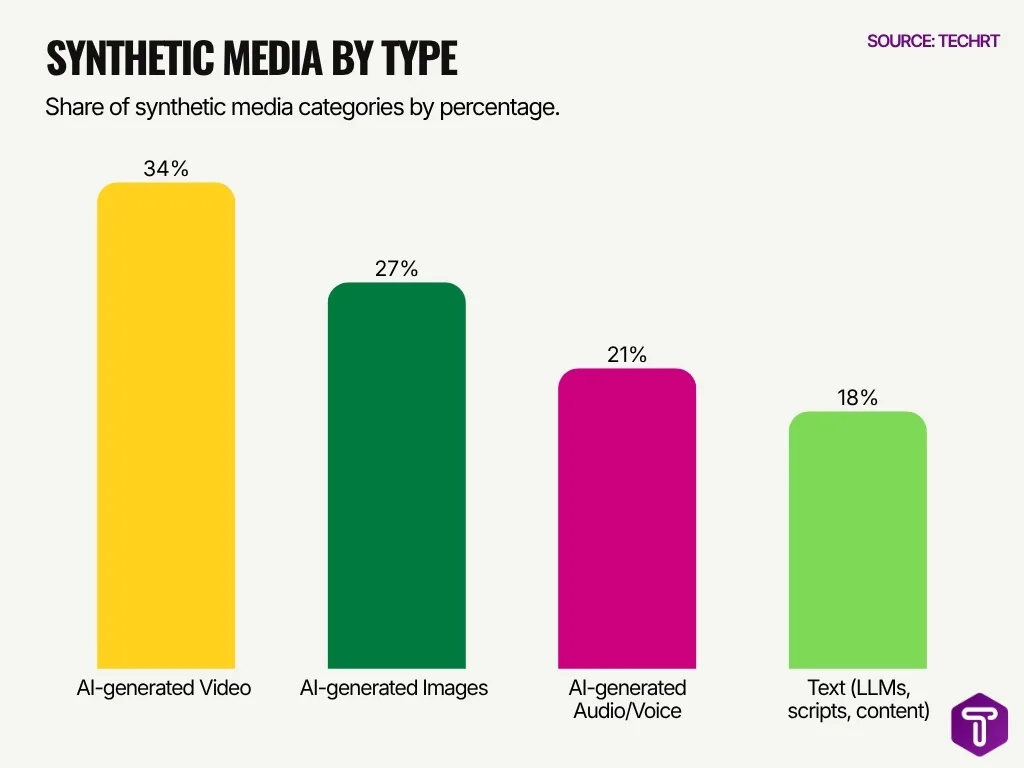
- AI-generated Video represents the largest share of synthetic media at 34%, making it the leading format in the dataset.
- AI-generated Images account for 27%, showing strong adoption of visual synthetic content beyond video.
- AI-generated Audio/Voice makes up 21%, indicating notable use of synthetic speech, voice cloning, and audio-based media.
- Text-based synthetic media, including LLMs, scripts, and generated content, hold the smallest share at 18%.
- Together, AI-generated videos and Images contribute 61% of the total, suggesting that visual formats dominate synthetic media usage.
- The combined share of Audio/Voice and Text is 39%, showing that non-visual synthetic media remains significant but less dominant.
- The data suggests a clear preference for rich media formats, especially video and images, in synthetic media production.
- Overall, synthetic media appears to be driven primarily by visual content, with AI-generated Video standing out as the most prominent category.
Synthetic Audio, Voice, and Music Statistics
- The AI voice generation market is expected to reach $26.8 billion by 2030.
- Voice cloning tools can replicate speech with over 95% accuracy in controlled environments.
- Synthetic voice adoption in customer service increased by over 40% in 2024.
- AI-generated music platforms are growing at over 30% CAGR globally.
- Over 60% of enterprises plan to adopt AI voice assistants by 2026.
- Podcast and audiobook industries use synthetic voices to reduce production costs by 50–70%.
- AI voice fraud cases increased significantly, with voice phishing attacks rising by 25% in 2024.
- Music labels are experimenting with synthetic vocals, with AI-assisted tracks accounting for 10% of new releases in 2025.
AI Avatars and Virtual Influencer Statistics
- The virtual influencer market is projected to reach $37.8 billion by 2030.
- Over 58% of Gen Z consumers follow at least one virtual influencer.
- Brands report 3x higher engagement rates with virtual influencers compared to human influencers.
- AI avatars are used in customer service, reducing operational costs by up to 30%.
- The number of virtual influencers has grown by over 200% between 2020 and 2025.
- Retail and fashion industries lead adoption, accounting for over 40% of virtual influencer campaigns.
- AI avatars are increasingly used in corporate training and onboarding, improving retention rates by 25%.
- Gaming platforms integrate AI avatars, with over 50% of multiplayer games using AI-generated characters.
Synthetic Media Adoption by Industry and Use Case
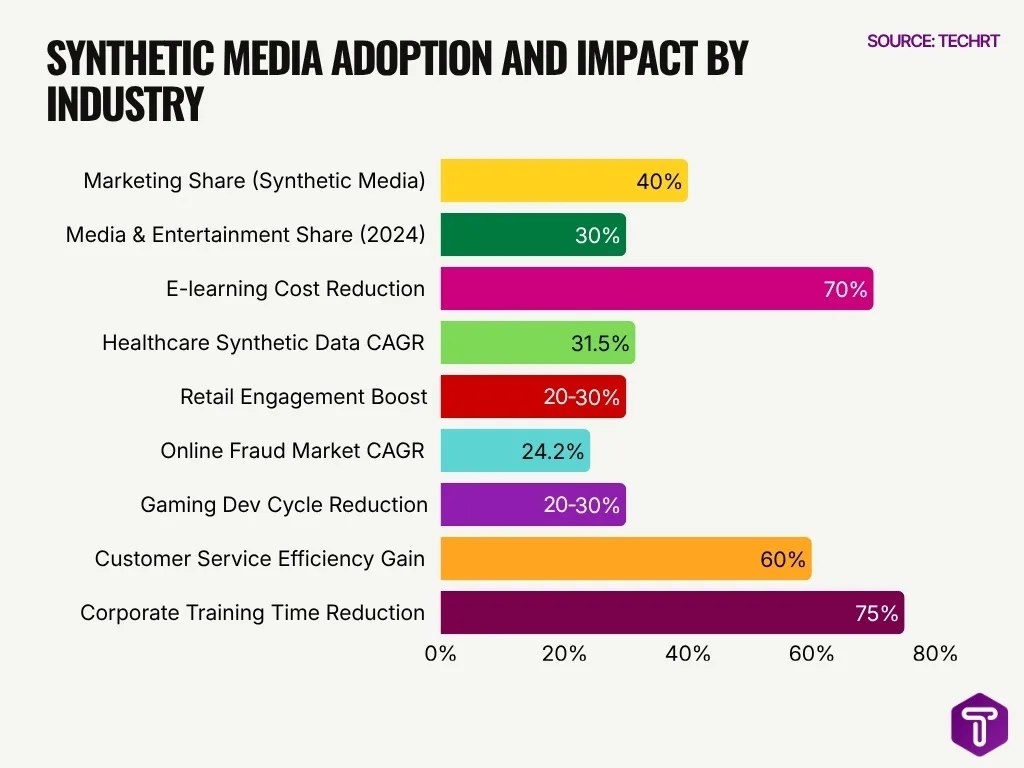
- Marketing and advertising lead synthetic media adoption with over 40% of total applications, driven by personalized campaigns.
- Media and entertainment holds 30% market share in 2024, using it for content localization and virtual production.
- E-learning reduces production costs by up to 70% via synthetic media for scalable content.
- Healthcare sees 31.5% CAGR in synthetic data adoption through 2025–2033 for training simulations.
- Retail boosts engagement by 20–30% with virtual try-ons and personalized demos.
- Financial institutions leverage it for fraud detection amid 24.2% CAGR in the online fraud market growth.
- Gaming cuts development cycles by 20–30% using AI-generated assets and environments.
- Customer service improves efficiency by up to 60% with AI avatars and voice bots.
- Corporate training slashes production time by 75% via synthetic media videos.
Synthetic Media in Social Media and User-Generated Content
- Over 50% of social media posts are expected to be AI‑generated or AI‑assisted by 2026.
- Global synthetic media spending is projected to reach over $11.98 billion in 2026, growing at roughly 18% CAGR through the early 2030s.
- More than 80% of user‑generated AI content on social platforms has increased year‑over‑year since 2023, driven by accessible generative tools.
- Creators using synthetic media tools can produce short‑form videos 5x faster on average than with traditional video workflows.
- Short‑form AI‑generated videos now account for over 60% of social media engagement on major platforms such as TikTok and Instagram Reels.
- Roughly over 30% of brands currently experiment with AI‑generated influencers or avatars in social media campaigns.
- Surveys show that over 70% of users report being worried about fake or synthetic content when browsing social feeds.
- AI‑assisted posts on social media reportedly achieve around 30% higher engagement rates than purely manually created posts.
- Around 40% of marketers now use generative AI for social‑media copy, and nearly 40% use it for image creation, indicating deep platform‑level integration.
- By 2033, the global synthetic media market is forecast to hit around 48.55 billion USD, reflecting a CAGR of about 26.75% from 2026.
Synthetic Media in Entertainment, Film, and Gaming
- Hollywood studios now allocate 15–20% of VFX budgets to AI-driven synthetic media workflows.
- AI-generated characters and environments reduce production timelines by 30–50% in gaming studios.
- Over 60% of film studios experimented with AI-assisted editing or CGI enhancement in 2025.
- Synthetic media enables digital resurrection and de-aging, used in over 25 major film productions annually.
- The global gaming industry uses AI-generated assets in more than 50% of new AAA titles.
- Streaming platforms leverage synthetic dubbing to localize content in 20+ languages simultaneously.
- Virtual production stages using AI have reduced filming costs by up to 35%.
- AI-generated scripts and storyboarding tools are used by over 40% of indie game developers.
Consumer Trust and Perception of Synthetic Content
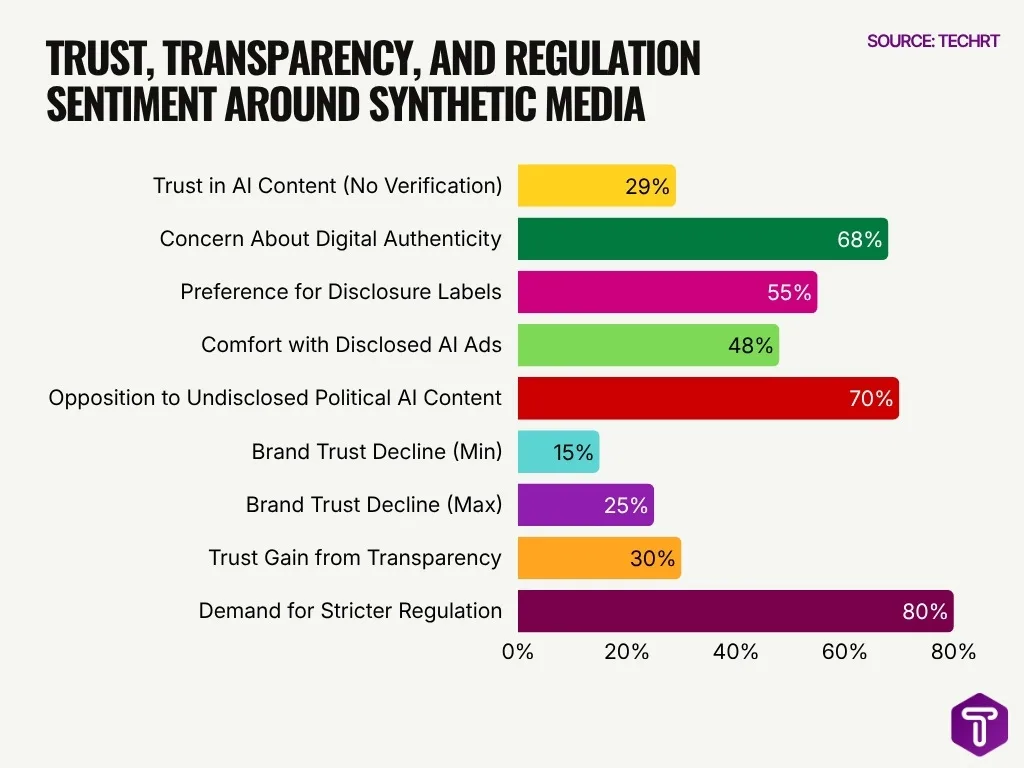
- Only 29% of consumers trust AI-generated content without verification.
- Around 68% of users express concern about authenticity in digital media.
- Trust in synthetic media increases when labeled, with over 55% of users preferring disclosure tags.
- In advertising, 48% of consumers are comfortable with AI-generated ads if clearly disclosed.
- However, over 70% oppose undisclosed AI-generated political content.
- Brand trust declines by 15–25% when synthetic content is perceived as deceptive.
- Transparency initiatives improve trust metrics by up to 30%.
- Ethical concerns remain widespread, with 80% of respondents calling for stricter regulation.
Synthetic Media in News, Politics, and Public Opinion
- Over 64% of Americans say deepfakes could significantly impact elections.
- Deepfake political content increased by over 300% during major global elections in 2024.
- News organizations are adopting AI tools, with over 45% using synthetic media for content production.
- Governments worldwide introduced 50+ AI and deepfake regulations by 2025.
- Synthetic media has been used in misinformation campaigns across at least 30 countries since 2023.
- Fact-checking organizations report a 70% increase in manipulated media cases year-over-year.
- AI-generated news anchors are already deployed in multiple countries, reaching millions of viewers daily.
- Public concern remains high, with 75% of global respondents worried about AI-driven misinformation.
Consumer Awareness of Synthetic Media
- Around 52% of global consumers can correctly identify deepfake content in tests.
- Awareness of AI-generated content increased from 32% in 2022 to over 60% in 2025.
- In the U.S., 65% of consumers report encountering synthetic media online.
- Younger audiences show the highest awareness, with over 70% recognizing AI-generated content.
- Only 38% of users feel confident in distinguishing real vs synthetic content.
- Educational campaigns improved awareness levels by 20% in regions with active digital literacy programs.
- Social media exposure remains the primary discovery channel, accounting for over 80% of first encounters.
- Businesses are investing in transparency tools, with over 45% implementing AI content labeling in 2025.
Top Synthetic Media Risks by Public Concern
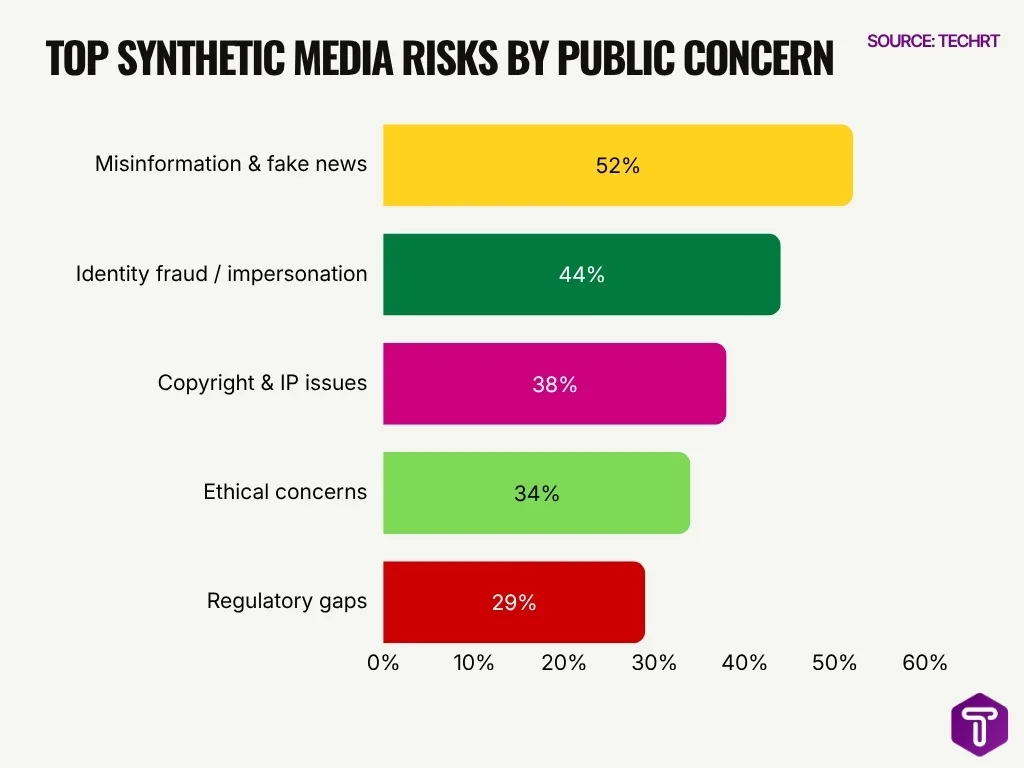
- Misinformation & fake news are the biggest public concern around synthetic media, cited by 52% of respondents.
- Identity fraud and impersonation rank second, with 44% public concern, showing strong anxiety around deepfakes and fake digital identities.
- Copyright and IP issues concern 38% of people, highlighting growing worries about AI-generated content using protected work.
- Ethical concerns are reported by 34%, suggesting that transparency, consent, and responsible AI use remain major discussion points.
- Regulatory gaps are the least-cited risk in this chart, but still concern 29% of respondents.
- The data shows that trust and authenticity risks are the dominant concerns, with misinformation and impersonation ranking above legal or regulatory issues.
- Overall, more than 1 in 2 people are concerned about misinformation and fake news linked to synthetic media.
Deepfake Fraud and Cybercrime Statistics
- Deepfake fraud caused over $200 million in global losses in 2024.
- Fraud attempts using synthetic identities rose by more than 300% from 2022 to 2024.
- Financial institutions reported a 245% year-over-year rise in deepfake detections globally from Q1 2023 to Q1 2024.
- In 2024, every second business globally reported at least one deepfake fraud incident.
- Businesses hit by deepfakes lost nearly $450,000 on average in 2024.
- Deepfake incidents grew 303% year over year in the U.S. in election-linked fraud tracking.
- AI voice cloning scams affected 1 in 4 adults in a global study, showing rapid mainstream spread.
- 85% of online attacks in one fraud analysis were tied to impersonation tactics.
- The global deepfake detection market is projected to keep expanding as threats scale faster than defenses.
Forecasts and Future Trends in Synthetic Media
- The synthetic media market is projected to exceed $48.5 billion by 2033, driven by enterprise adoption.
- Generative AI is expected to contribute up to $4.4 trillion annually to the global economy.
- Over 50% of digital content could be AI-generated by 2030.
- Synthetic media tools will become standard in marketing stacks, with over 75% of enterprises adopting them by 2027.
- AI-powered personalization is expected to increase marketing ROI by 20–30%.
- Regulation will expand, with over 100 countries expected to introduce AI governance laws by 2030.
- Real-time content generation will dominate workflows, reducing production cycles by up to 90%.
- Synthetic media in education is forecast to grow at over 35% CAGR, transforming digital learning experiences.
Frequently Asked Questions (FAQs)
What is the current size of the synthetic media market?
How fast is the synthetic media market growing globally?
How large is the deepfake AI market today and in the future?
How many deepfake files exist globally?
What is the projected value of the synthetic media market by 2033?
Conclusion
Synthetic media has moved far beyond its early-stage experimentation and now plays a central role in digital transformation across industries. It enables faster content production, reduces operational costs, and opens new creative possibilities in marketing, entertainment, and education. However, this rapid growth also introduces significant challenges, particularly around misinformation, fraud, and declining consumer trust. As organizations continue to adopt synthetic media at scale, the focus will increasingly shift toward ethical usage, transparency, and regulatory compliance.
Companies that invest in both innovation and responsible governance will be better positioned to leverage their full potential while minimizing risks. Looking ahead, synthetic media will not only reshape how content is created but also how audiences perceive authenticity, making it one of the most influential technologies of the decade.

Leave a comment
Have something to say about this article? Add your comment and start the discussion.