



Lead generation sits at the core of modern marketing, helping businesses turn attention into measurable revenue and sustainable growth. Whether it’s SaaS companies leveraging CRM platforms like HubSpot to track prospects or eCommerce brands capturing emails through optimized landing pages, effective lead generation directly shapes pipeline performance and revenue outcomes.
As customer journeys become longer and increasingly digital, marketers now rely on data, automation, and multi-channel strategies to attract and convert potential buyers. This shift has made lead generation more complex but also more measurable, allowing teams to refine targeting, improve conversion rates, and maximize ROI.
In a landscape where competition for attention continues to rise, understanding current benchmarks and trends is critical. The following statistics provide a clear, data-backed view of how lead generation is evolving and what strategies are driving results across industries.
Editor’s Choice
- 50% of marketers say lead generation is their top campaign priority, highlighting its central role in growth strategies.
- Businesses generate an average of 1,877 leads per month, showing the scale of modern demand generation efforts.
- The average cost per lead is $198.44 across industries, with wide variance depending on channel and niche.
- 76% of marketers use content marketing to generate leads, reinforcing its long-term value.
- Around 68% of marketers say social media helps generate leads effectively.
- 97% of people ignore cold calls, signaling a shift toward inbound and digital-first strategies.
- Companies using platforms like HubSpot report 129% more leads within one year of adoption.
Recent Developments
- 71% of marketers say AI has made content creation easier, accelerating lead generation campaigns.
- Short-form video delivers the highest ROI among content formats in 2025–2026 marketing trends.
- 87% of marketers believe AI tools are crucial for social media success.
- 71% of social marketers already use AI tools to improve campaign performance.
- 25% of consumers purchased products directly through social platforms in recent months.
- AI-generated content performs better for 71% of marketers compared to manual content.
- 22% of users now prefer social platforms over search engines for discovery, impacting lead channels.
- 80% of marketing automation users report increased lead generation efficiency.
- 34% of marketers say automation improves both lead generation and nurturing.
Key Lead Generation Statistics for 2026
- Organizations generate thousands of leads monthly, with 80% classified as marketing-qualified leads.
- 34% of marketers rank lead generation as their top priority over brand awareness or customer satisfaction.
- 44% of sales reps report being too busy to follow up on leads, indicating process inefficiencies.
- 63% of B2B leads take at least three months to convert, showing longer nurturing cycles.
- The average B2B buying cycle now spans 11.3 months, with most time spent in research.
- 58% of B2B companies report longer sales cycles compared to previous years.
- Accurate contact data can increase conversion rates by 66%, emphasizing data quality.
- 12% of marketers admit they don’t track how many leads they generate, revealing measurement gaps.
- Email marketing is used by 34.49% of companies for lead generation campaigns.
Top Lead Generation Channels Statistics
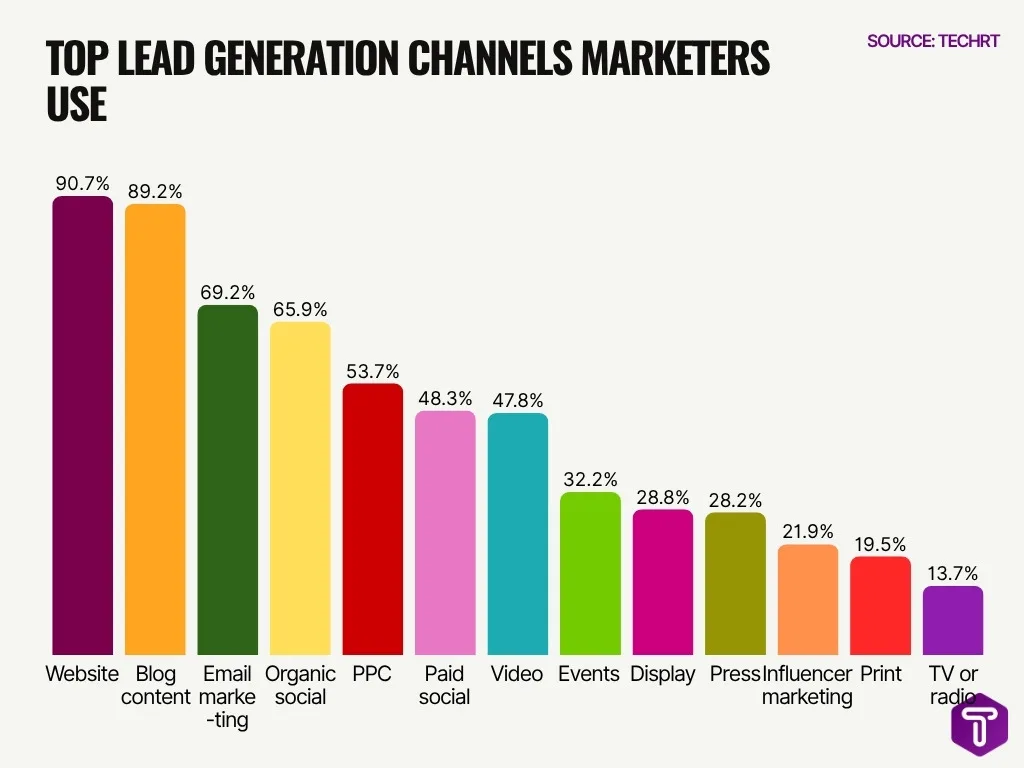
- Websites dominate lead generation, used by 90.7% of marketers, making them the #1 channel for capturing leads.
- Blog content follows closely at 89.2%, highlighting the critical role of content marketing and SEO-driven traffic.
- Email marketing remains highly effective, with 69.2% usage, proving its strong ROI and conversion potential.
- Organic social media contributes 65.9%, showing the importance of consistent, non-paid audience engagement.
- PPC (Pay-Per-Click) is utilized by 53.7%, indicating that paid search is still a major acquisition driver.
- Paid social media (48.3%) and video marketing (47.8%) are nearly equal, reflecting the growing importance of visual and targeted paid campaigns.
- Events generate 32.2%, demonstrating that offline and virtual experiences still play a meaningful role in lead generation.
- Display advertising (28.8%) and press (28.2%) have a moderate impact, often used for brand awareness and retargeting strategies.
- Influencer marketing is used by only 21.9%, suggesting it is still a niche but growing channel.
- Traditional channels like print (19.5%) and TV/radio (13.7%) are the least utilized, indicating a clear shift toward digital-first strategies.
General Lead Generation Benchmarks
- The average sales win rate is 21%, providing a baseline for lead-to-customer conversion.
- Median deal size across industries stands at $4,000, influencing lead valuation strategies.
- 80% of leads are typically marketing-qualified before entering sales pipelines.
- 18% of marketers don’t know their cost per lead, highlighting tracking gaps.
- Only 8% of businesses acquire service providers via online ads, indicating trust in organic channels.
- 74% of businesses consider reputation a critical factor when choosing service providers.
- 83% of businesses expect marketing efforts to help them acquire new customers.
- 61% of businesses prioritize brand awareness as a key outcome of marketing.
- Only 30% of clients would recommend their marketing provider, indicating performance gaps.
Lead Generation Priorities and Goals for Marketers
- 34% of marketers rank lead generation as their top goal for the next year.
- 22% prioritize customer satisfaction, showing lead generation still dominates strategy.
- 19% focus on brand awareness, often as a supporting goal for lead generation.
- 14% aim to close more deals, linking lead generation directly to revenue.
- 66% of businesses create content to build awareness and attract leads.
- 53% focus on engagement, which feeds into lead nurturing pipelines.
- 26% of marketers aim to establish thought leadership through content.
- 50% of companies plan to increase lead generation via automation tools.
- Marketers increasingly align demand generation with lead capture to improve funnel efficiency.
Lead Generation Challenges and Pain Points
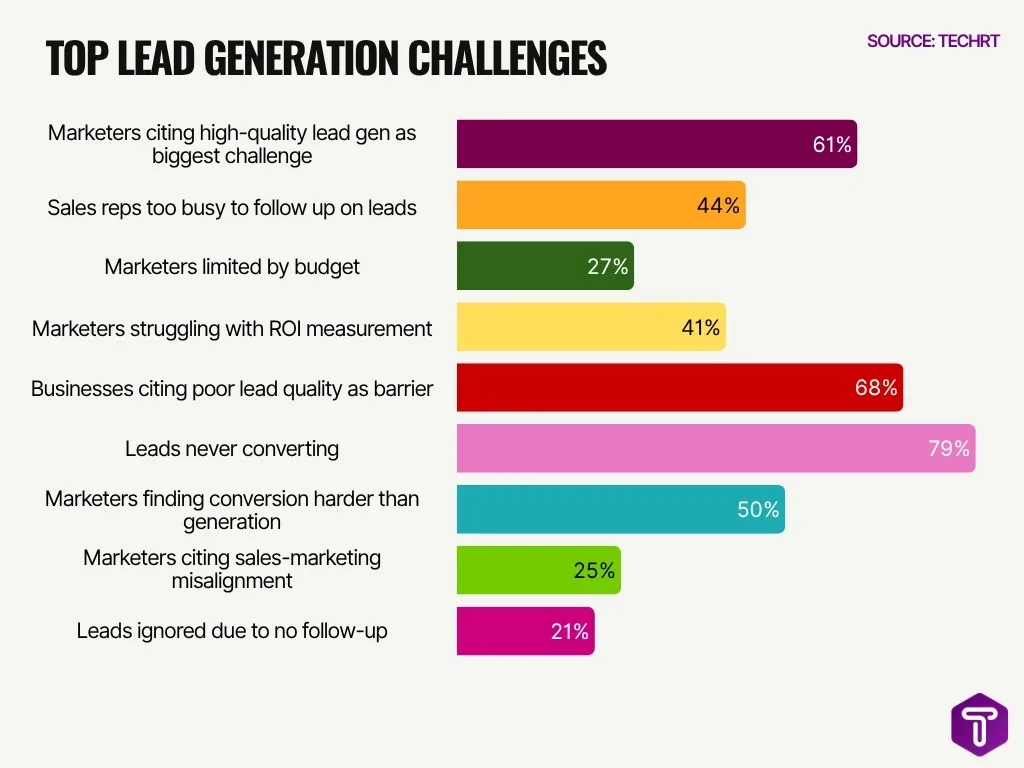
- 61% of marketers say generating high-quality leads remains their biggest challenge.
- 44% of sales reps report they are too busy to follow up on leads, which slows conversions.
- 27% of marketers say a lack of budget limits their lead generation efforts.
- 41% of marketers struggle with measuring ROI across multiple lead channels.
- 68% of businesses cite poor lead quality as a key barrier to achieving sales targets.
- 79% of leads never convert, often due to weak nurturing processes.
- 50% of marketers say converting leads into customers is harder than generating them.
- 25% of marketers report that misalignment between marketing and sales teams affects lead handling.
- 21% of leads are ignored entirely due to a lack of follow-up systems.
Lead Quality vs Lead Quantity Statistics
- Quality leads generate 3x higher conversion rates compared to high-volume, low-quality leads.
- 68% of marketers prioritize lead quality over quantity in 2025–2026 campaigns.
- Companies that focus on lead quality see higher ROI by up to 45%.
- 80% of marketers say improving lead quality is their top objective.
- Poor-quality leads contribute to 67% of lost sales opportunities.
- 42% of businesses struggle to identify high-quality leads early in the funnel.
- Lead scoring systems improve qualification accuracy by up to 77%.
- 35% of sales teams say inaccurate lead data reduces close rates.
- Businesses using intent data see 2x higher lead quality scores.
Lead Generation Industry Size and Growth
- The global marketing technology ecosystem continues expanding, with platforms like HubSpot surpassing $3 billion in annual revenue.
- Companies investing in automation report significant lead growth, with 80% seeing measurable increases.
- Lead generation software adoption continues to rise as businesses seek scalable pipelines.
- Organizations using integrated CRM systems achieve more consistent pipeline growth and forecasting accuracy.
- Marketing budgets increasingly allocate funds toward inbound strategies like SEO and content.
- 49% of businesses use blogging specifically for lead generation.
- Lead generation remains a top focus for half of all marketers globally, signaling sustained demand.
- Digital channels now dominate lead acquisition, reducing reliance on outbound methods like cold calling.
- Data-driven marketing strategies improve conversion rates by 22% compared to traditional methods.
Cost Per Lead (CPL) by Industry
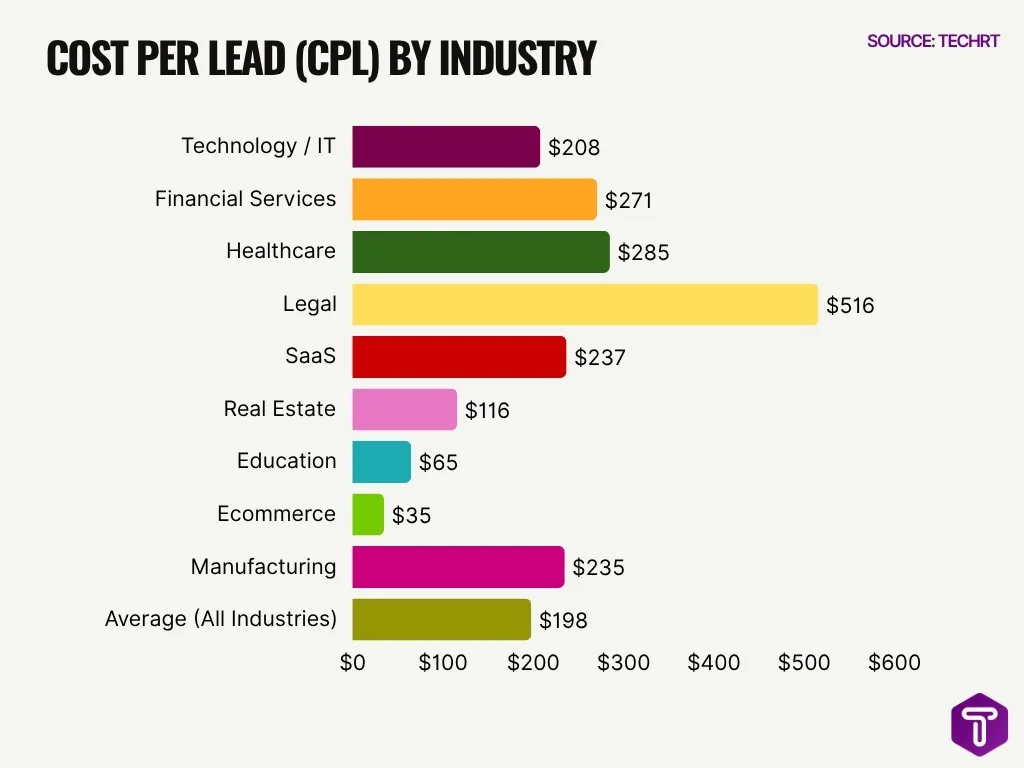
- The average cost per lead across all industries is $198, serving as a key benchmark for performance comparison.
- The Legal industry has the highest CPL at $516, indicating extremely competitive and high-value client acquisition.
- Healthcare ($285) and Financial Services ($271) also show significantly above-average CPLs, reflecting strict regulations and high customer lifetime value.
- The Technology / IT sector averages $208, slightly above the overall benchmark, driven by competitive B2B demand.
- Manufacturing ($235) and SaaS ($237) fall in the mid-to-high CPL range, highlighting moderate competition and longer sales cycles.
- Real Estate has a relatively lower CPL at $116, making it more cost-efficient compared to most industries.
- Education ($65) and Ecommerce ($35) have the lowest CPLs, indicating cheaper lead acquisition and higher volume strategies.
- There is a massive CPL gap of $481 between Legal ($516) and Ecommerce ($35), showcasing a wide variation across industries.
- Industries with high-ticket services (Legal, Healthcare, Finance) tend to have higher CPLs, while volume-driven sectors (Ecommerce, Education) maintain lower costs.
- Businesses should benchmark their CPL against industry averages to optimize marketing spend and ROI effectively.
Online and Digital Lead Generation Statistics
- 68% of businesses generate leads primarily through digital channels.
- Websites and digital assets account for over 90% of lead generation opportunities.
- SEO generates 1,000%+ more traffic than organic social media.
- 53% of website traffic comes from organic search, making it a major lead driver.
- 75% of users never scroll past the first page of search results.
- Paid ads drive 15–20% of total leads across industries.
- 80% of consumers research online before making a purchase decision.
- Companies with strong digital presence generate 2x more leads than those without.
- Video content increases conversion rates by up to 86%.
B2C Lead Generation Statistics
- 63% of B2C marketers rely on social media advertising for lead generation.
- Email marketing drives 20% of B2C leads, making it a key channel.
- 57% of consumers prefer brands that offer personalized experiences.
- Mobile devices account for over 60% of B2C lead interactions.
- 79% of consumers say user-generated content influences their purchase decisions.
- B2C landing pages convert at an average rate of 9.9%, higher than B2B benchmarks.
- 48% of B2C marketers say video marketing generates the most leads.
- 72% of consumers engage only with personalized messaging.
- Paid social campaigns generate more than 25% of B2C leads.
Most Effective B2B Lead Generation Channels
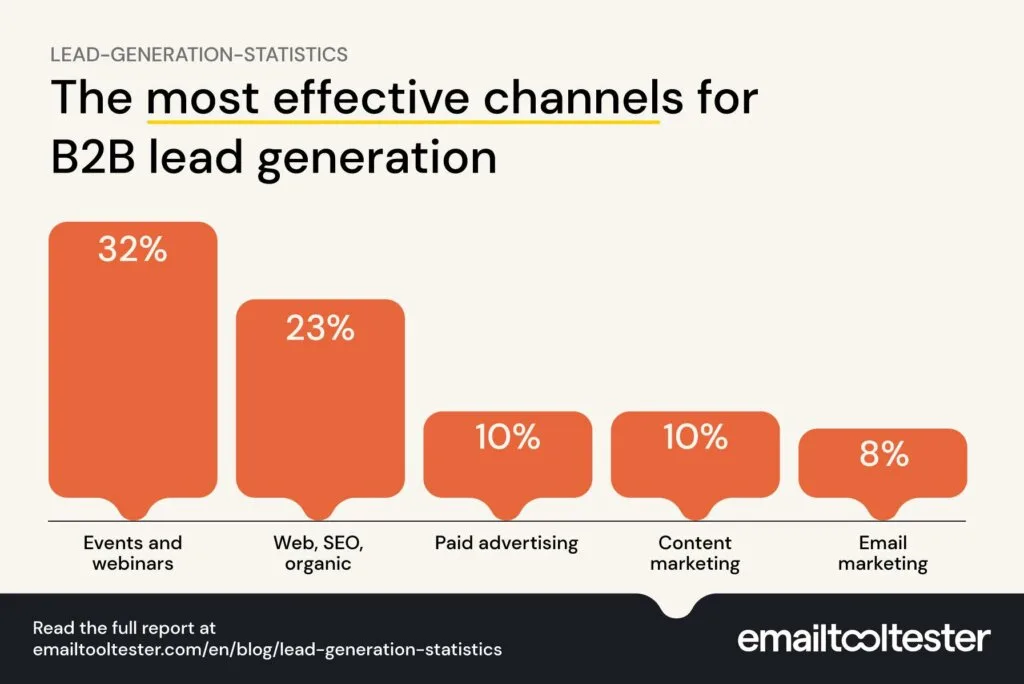
- Events and webinars dominate B2B lead generation with the highest share at 32%, making them the top-performing channel for acquiring high-quality leads.
- Web, SEO, and organic channels rank second at 23%, highlighting the strong impact of inbound marketing and long-term traffic strategies.
- Both paid advertising and content marketing contribute equally at 10% each, indicating that while effective, they play a supporting role rather than leading channels.
- Email marketing generates 8%, making it the least effective channel among the listed options, though still valuable for lead nurturing and retention.
- The top two channels alone (32% + 23%) account for 55% of total effectiveness, showing a clear concentration of performance in fewer channels.
- There is a significant drop (13%) between the first (32%) and second (23%) channels, emphasizing the exceptional performance gap of events and webinars.
- Lower-tier channels (paid ads, content, email) collectively contribute 28%, suggesting that a multi-channel strategy is still essential despite lower individual impact.
- The data indicates a preference for interactive and organic channels over purely promotional ones in B2B lead generation.
Website and Landing Page Lead Generation Statistics
- Businesses with 40+ landing pages generate over 500% more leads than those with fewer than 10.
- Landing pages with optimized forms (reducing fields from 11 to 4) improve conversions by up to 160%.
- The average landing page conversion rate is 6.6% across industries.
- 48% of marketers build a new landing page for each campaign.
- Pages with fewer form fields (e.g., 4 vs. 11) convert up to 50% higher than long forms.
- Adding testimonials to landing pages can increase conversions by 34%.
- 70% of small businesses lack a clear call-to-action on their website.
- Mobile-optimized landing pages achieve 11-12% conversion rates, higher than non-optimized.
- Websites that load in under 2 seconds have 3x higher conversion rates than those taking 5 seconds.
SEO and Organic Search Lead Generation Statistics
- Organic search drives 53% of all website traffic, making it the largest lead acquisition channel.
- SEO generates 1,000%+ more traffic than organic social media, reinforcing its dominance.
- 75% of users never scroll past the first page of search results, increasing competition for top rankings.
- 68% of online experiences begin with a search engine like google.com.
- Businesses that blog get 55% more website visitors, directly boosting lead potential.
- SEO leads have a 14.6% close rate, compared to 1.7% for outbound leads.
- Long-form content generates 77% more backlinks, improving search rankings and lead flow.
- 61% of marketers say improving SEO is their top inbound marketing priority.
- Companies investing in SEO are 13x more likely to see positive ROI.
Most Effective Content for Lead Generation
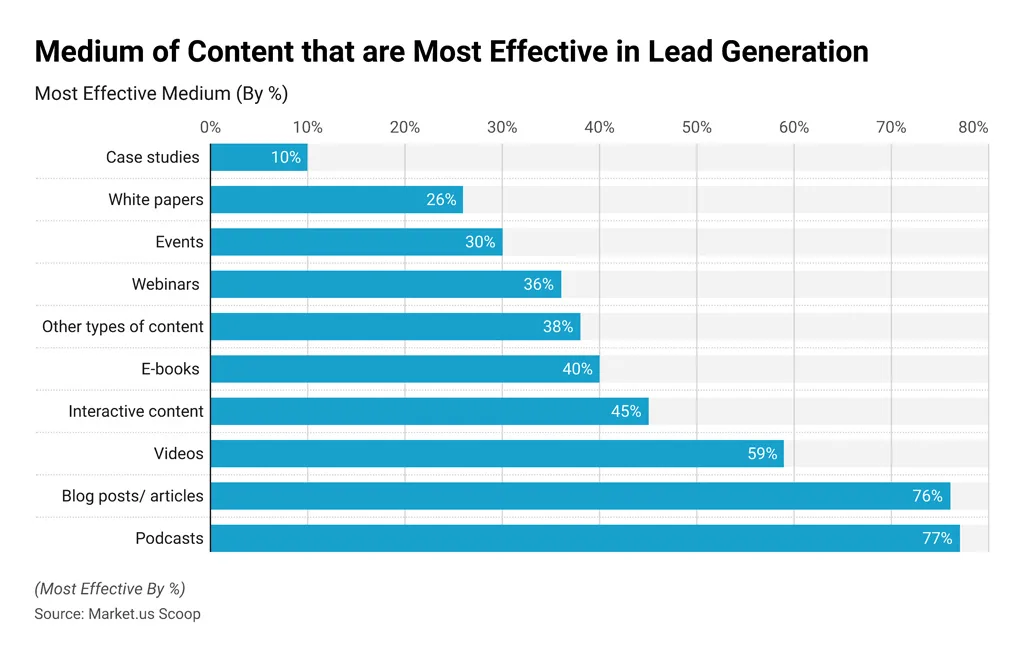
- Podcasts lead the chart at 77%, making them the most effective content format for generating leads.
- Blog posts and articles follow closely at 76%, proving that written content still dominates in lead acquisition.
- Videos rank third with 59%, highlighting the growing importance of visual and engaging content.
- Interactive content (45%) performs strongly, showing that user engagement-driven formats significantly boost lead generation.
- E-books achieve 40% effectiveness, indicating that long-form gated content remains valuable for capturing leads.
- Other content types (38%) and webinars (36%) deliver moderate performance, often used for education and nurturing leads.
- Events contribute 30%, suggesting that in-person or virtual networking still plays a role but is less scalable.
- White papers generate 26%, showing a declining but still relevant impact in B2B lead generation strategies.
- Case studies rank lowest at 10%, indicating they are more effective for conversion and trust-building rather than initial lead capture.
- Overall, content formats that are engaging, accessible, and easy to consume (podcasts, blogs, videos) outperform more technical or static formats (case studies, white papers) in lead generation.
Email Marketing Lead Generation Statistics
- Email marketing delivers an average ROI of $36 for every $1 spent.
- 77% of marketers have seen increased email engagement in recent years.
- Personalized email campaigns generate 6x higher transaction rates.
- 59% of consumers say email influences their purchase decisions.
- Segmented campaigns result in 30% more opens and 50% more click-throughs.
- Automated email workflows generate 320% more revenue than non-automated campaigns.
- 87% of brands use email marketing to distribute content and capture leads.
- Mobile devices account for over 50% of email opens, shaping campaign design.
- Welcome emails generate 4x higher open rates compared to standard campaigns.
Social Media Lead Generation Statistics
- 68% of marketers say social media helps generate leads.
- LinkedIn accounts for 80% of B2B social media leads.
- 54% of social users research products on platforms before purchasing.
- Short-form video delivers the highest ROI among social formats.
- 25% of consumers have purchased directly via social media in the past year.
- Social ads contribute to over 25% of total leads for B2C brands.
- 91% of businesses use social media for marketing and lead generation.
- Influencer marketing delivers 11x higher ROI than traditional digital campaigns.
- 78% of salespeople using social media outperform peers who don’t.
Social Media ROI for In-App Product Sales
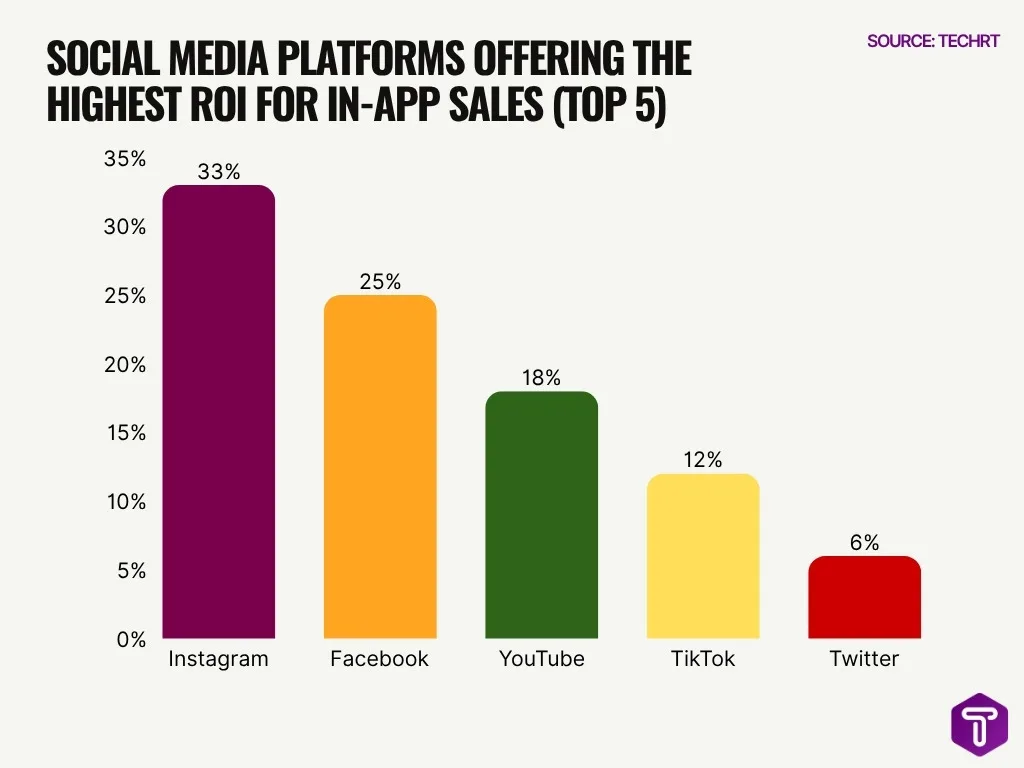
- Instagram leads significantly with the highest ROI at 33%, making it the most effective platform for direct in-app selling.
- Facebook ranks second with 25% ROI, showing strong performance but still 8 percentage points lower than Instagram.
- YouTube delivers moderate returns at 18%, positioning it as a valuable but less dominant channel for conversions.
- TikTok, despite its popularity, generates 12% ROI, indicating growing potential but still trailing behind established platforms.
- Twitter shows the lowest ROI at just 6%, suggesting limited effectiveness for direct in-app product sales.
- There is a sharp drop of 27 percentage points between the top performer (Instagram – 33%) and the lowest (Twitter – 6%).
- The top two platforms (Instagram + Facebook) together dominate with a combined 58% ROI share, highlighting the importance of Meta-owned platforms.
AI, Marketing Automation, and Lead Scoring Statistics
- 80% of marketing automation users report increased lead generation.
- AI adoption in marketing has grown to over 60% of organizations.
- Companies using AI for lead scoring improve conversion rates by up to 30%.
- 71% of marketers say AI improves content performance and lead engagement.
- Predictive analytics increases lead qualification accuracy by 20–40%.
- Automated lead nurturing generates 50% more sales-ready leads.
- Businesses using CRM systems see 29% higher sales productivity.
- Chatbots handle up to 70% of initial customer interactions, improving lead capture rates.
- AI-driven personalization increases engagement rates by up to 50%.
Lead Conversion Rate and Funnel Performance Statistics
- The average landing page conversion rate is 9.7% across industries.
- Top-performing companies achieve conversion rates of 15% or higher.
- 63% of leads are not ready to buy on first interaction, requiring nurturing.
- Businesses that nurture leads see 47% higher purchase values.
- Multi-step funnels improve conversion rates by up to 300%.
- 79% of leads never convert due to a lack of nurturing.
- Faster response times increase conversions by up to 391%.
Frequently Asked Questions (FAQs)
What is the average cost per lead in 2026?
What percentage of leads typically convert into marketing-qualified leads (MQLs)?
What is the average lead conversion rate across industries?
How effective are LinkedIn lead generation forms compared to landing pages?
How much higher are conversion rates for intent-based leads?
Conclusion
Lead generation reflects a clear shift toward data-driven, multi-channel strategies. SEO, content marketing, and email continue to deliver consistent results, while AI and automation reshape how marketers qualify and nurture leads. At the same time, challenges around lead quality, cost, and conversion efficiency remain critical areas for improvement.
Businesses that prioritize high-quality leads, faster response times, and personalized engagement consistently outperform competitors. As digital channels evolve, marketers must balance scale with precision to drive sustainable growth. The statistics in this article offer a practical benchmark to refine strategies and build stronger, more predictable pipelines.

Leave a comment
Have something to say about this article? Add your comment and start the discussion.