



Marketing automation has evolved from a helpful add-on into a core driver of modern business growth. Today, companies rely on automation to streamline email campaigns, nurture leads, and deliver highly personalized customer experiences at scale. This is especially critical in industries like ecommerce and SaaS, where real-time engagement and relevance directly impact conversion rates and customer retention.
As customer journeys become more complex, marketing teams use automation to connect multiple channels, reduce manual workloads, and make faster, data-driven decisions. At the same time, advances in AI and predictive analytics are pushing automation beyond simple workflows into intelligent systems that can optimize campaigns automatically. These capabilities allow businesses to improve efficiency while driving measurable revenue growth. Let’s explore the latest statistics shaping marketing automation.
Editor’s Choice
- 96% of marketers have used or plan to use marketing automation platforms in 2026.
- The global marketing automation market is projected to reach $47.02 billion in 2025, growing rapidly toward 2030.
- Businesses earn an average of $5.44 for every $1 spent on marketing automation.
- Around 56% of companies already use marketing automation tools globally.
- 79% of marketers automate at least part of their customer journey.
- 70% of marketing leaders plan to increase automation investment in 2025–2026.
- Companies using automation report up to 451% increase in qualified leads.
Recent Developments
- AI adoption in marketing is expected to reach 94% usage in content workflows by 2026.
- AI-driven campaigns deliver 10–20% higher ROI compared to traditional approaches.
- 80% of organizations are expected to adopt intelligent automation systems by 2025.
- Cloud-based automation platforms account for 73.6% of deployments in 2025.
- The analytics and reporting segment is growing at a 13% CAGR, reflecting demand for data-driven insights.
- Mobile-first automation is the fastest-growing channel integration segment globally.
- 41% of marketing teams have significantly automated customer journeys, while others remain partially automated.
- Marketing automation now integrates deeply with CRM and data platforms to enable real-time personalization at scale.
Global Marketing Automation Market Size and Growth Statistics
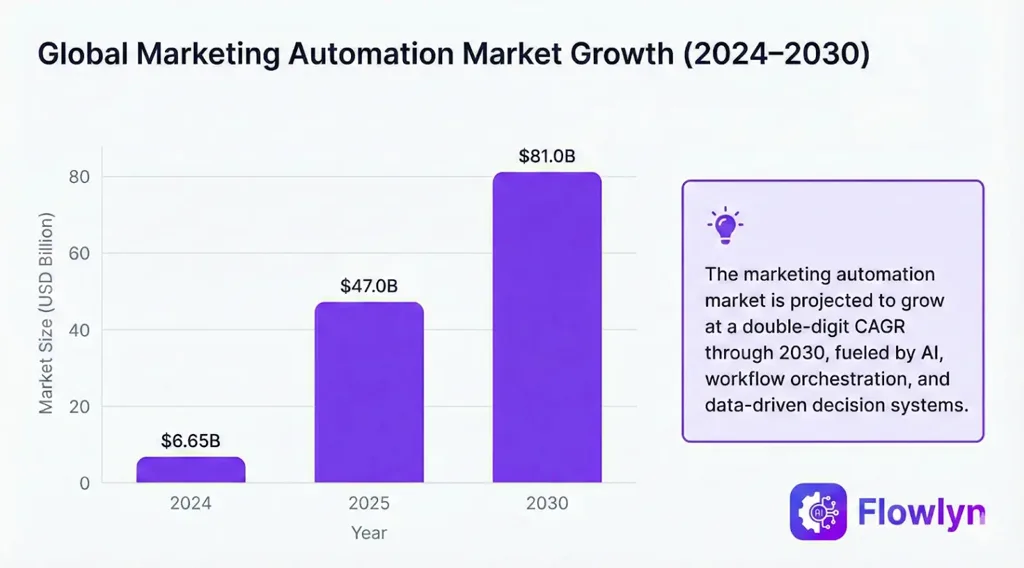
- The global marketing automation market is projected to grow from $6.65 billion in 2024 to $81.0 billion by 2030, indicating massive long-term expansion.
- A sharp surge is visible between 2024 and 2025, where the market jumps to $47.0 billion, highlighting rapid early-stage adoption.
- The market is expected to grow by over 12x in just six years, showcasing an aggressive scaling trend across industries.
- The increase from $47.0 billion in 2025 to $81.0 billion in 2030 reflects sustained momentum and continued enterprise investment.
- The industry is projected to grow at a double-digit CAGR through 2030, driven by accelerating digital transformation.
- Key growth drivers include AI-powered automation, workflow orchestration, and data-driven decision-making systems.
- The steep growth curve indicates rising demand for personalized marketing, customer journey automation, and real-time analytics.
- Businesses are increasingly investing in automation tools to improve lead generation, conversion rates, and marketing ROI.
- The market expansion signals strong adoption across both B2B and B2C sectors, especially among enterprises scaling digital operations.
- Overall, the data highlights marketing automation as a high-growth, future-critical technology segment in the global MarTech ecosystem.
Marketing Automation Adoption and Penetration Statistics Worldwide
- 56% of companies globally use marketing automation tools.
- 40% of B2B companies plan to adopt automation technologies soon.
- 96% of marketers have adopted or plan to adopt automation platforms.
- 79% of marketers automate customer journeys partially or fully.
- Only 21% of marketers report no automation usage at all.
- 76% of marketers rely more on automation than sales or finance teams.
- 67% of marketers depend on automation for demand generation and consistent performance.
- 80% of advertising processes are expected to become automated in the near future.
Marketing Automation Usage by Company Size Statistics
- Large enterprises held 62.5% of the marketing automation market share in 2024, dominating the adoption of advanced platforms.
- 76% of companies with >100 employees use marketing automation, compared to 26% in mid-sized firms (10-100 employees).
- 70% of marketing leaders plan to increase automation budgets in 2025, primarily in mid-to-large companies.
- SMEs show the fastest growth, with a 15.2% CAGR in marketing automation adoption through 2030.
- SMBs using automation report a 25-30% reduction in operational costs and manual tasks.
- 79% of SMBs achieve measurable productivity gains from marketing automation.
- Companies adopting automation see 10%+ revenue growth within 6-9 months across all sizes.
- 60% of firms with >$500M revenue use marketing automation, vs 3% in micro-businesses (<$5M).
- 91% of adopters report more leads, with 451% increase in qualified leads for automation users.
- 68% of marketing leaders increased automation budgets in 2025, focusing on AI-driven features.
Top Marketing Automation Platforms Market Share Insights
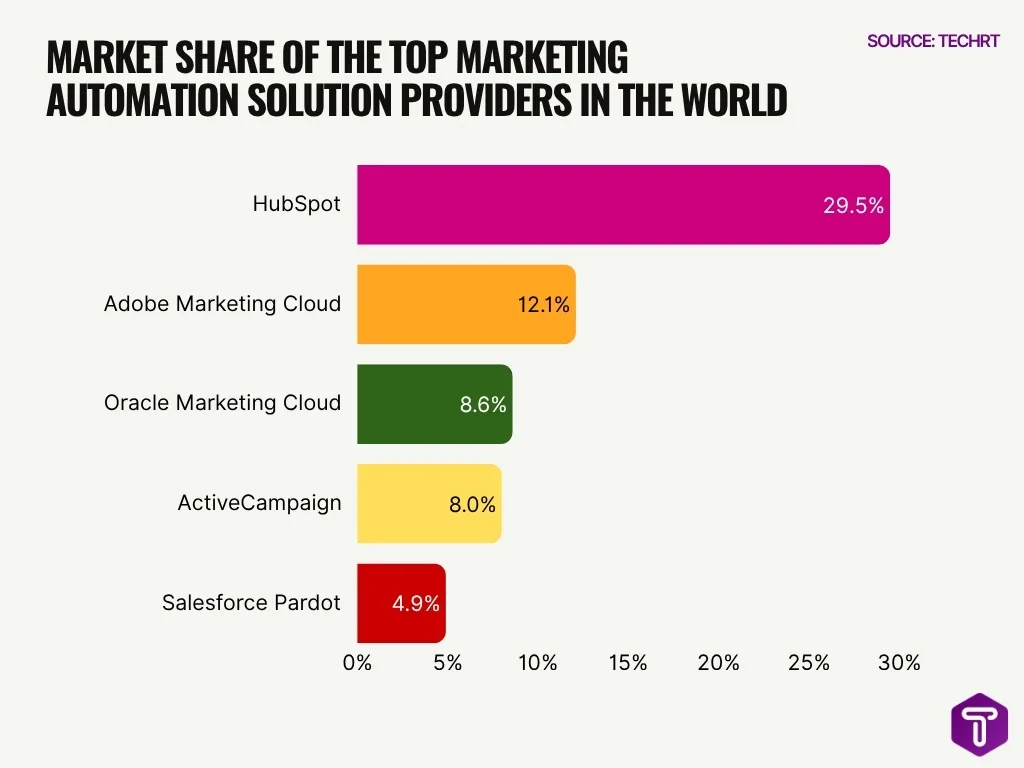
- HubSpot dominates the market with a massive 29.5% share, making it the clear leader among marketing automation providers.
- The gap between HubSpot (29.5%) and the second-largest player, Adobe Marketing Cloud (12.1%), is more than 17 percentage points, highlighting strong market concentration.
- Adobe Marketing Cloud holds 12.1%, securing its position as the second-largest platform globally.
- Mid-tier competitors include Oracle Marketing Cloud (8.6%) and ActiveCampaign (8.0%), both competing closely with less than a 1% difference.
- Salesforce Pardot trails with 4.9%, indicating a relatively smaller footprint compared to other major players.
- The top three providers (HubSpot, Adobe, Oracle) collectively account for 50.2% of the total market, controlling over half of the industry.
- The market shows a steep drop after the top player, suggesting HubSpot’s strong competitive advantage and brand dominance.
- There is a tight competition among mid-level platforms, especially between Oracle (8.6%) and ActiveCampaign (8.0%), signaling potential shifts in ranking.
- The combined share of the four smaller players (Adobe, Oracle, ActiveCampaign, Salesforce) totals 33.6%, still trailing behind HubSpot alone.
- Overall, the data reflect a highly competitive yet top-heavy market structure, where a single leader significantly outperforms others.
Marketing Automation Usage by Industry and Vertical Statistics
- The advertising sector expects up to 80% automation in campaign processes, with organizations seeing a $5.44 return for every dollar spent on marketing automation.
- Ecommerce businesses abandon an average of 74.8% of shopping carts, and automation generates $28.89 in revenue for the top 10% of abandoned cart workflows.
- B2B marketers using automation see an increase in leads by 8 in 10 users, and 77% see an increase in conversions through lead nurturing workflows.
- SaaS and B2B companies using lead nurturing automation generate 50% more sales-ready leads at 33% lower cost compared to those without structured nurturing.
- Retail and ecommerce brands leveraging personalization automation experience a 405x increase in conversions when shoppers receive behavior-based emails.
- Financial services and healthcare organizations automate customer communication, with 79% of marketers automating their entire customer journey.
- Across industries, 91% of organizations report increasing demand for automation, with marketing automation revenue projected to reach $13.97 billion by 2030 at a 12.8% compound annual growth rate.
- The transportation industry leads with 65% automation adoption, followed by the retail and ecommerce sectors using automation for personalized product recommendations at scale.
- Top 10% of email workflows generate $16.96 in revenue per recipient, demonstrating that automated workflows generate up to 30x more revenue per recipient than campaigns.
Marketing Automation Software Revenue and Pricing Statistics
- Marketing automation software revenue is projected to exceed $8.44 billion by 2026.
- Subscription-based pricing models dominate, with over 70% of vendors offering SaaS-based billing.
- Entry-level automation tools cost between $50 and $300 per month for small businesses.
- Mid-market platforms typically range from $800 to $2,500 monthly, depending on features and contacts.
- Enterprise solutions can exceed $10,000 per month, especially with advanced analytics and AI features.
- 58% of companies report rising software costs due to advanced AI and data integration features.
- Pay-as-you-go and usage-based pricing models are growing, especially among startups and SaaS firms.
- Vendors increasingly bundle automation with CRM, analytics, and CDP capabilities to justify higher pricing tiers.
Marketing Automation Priorities: Key Areas Businesses Are Investing In
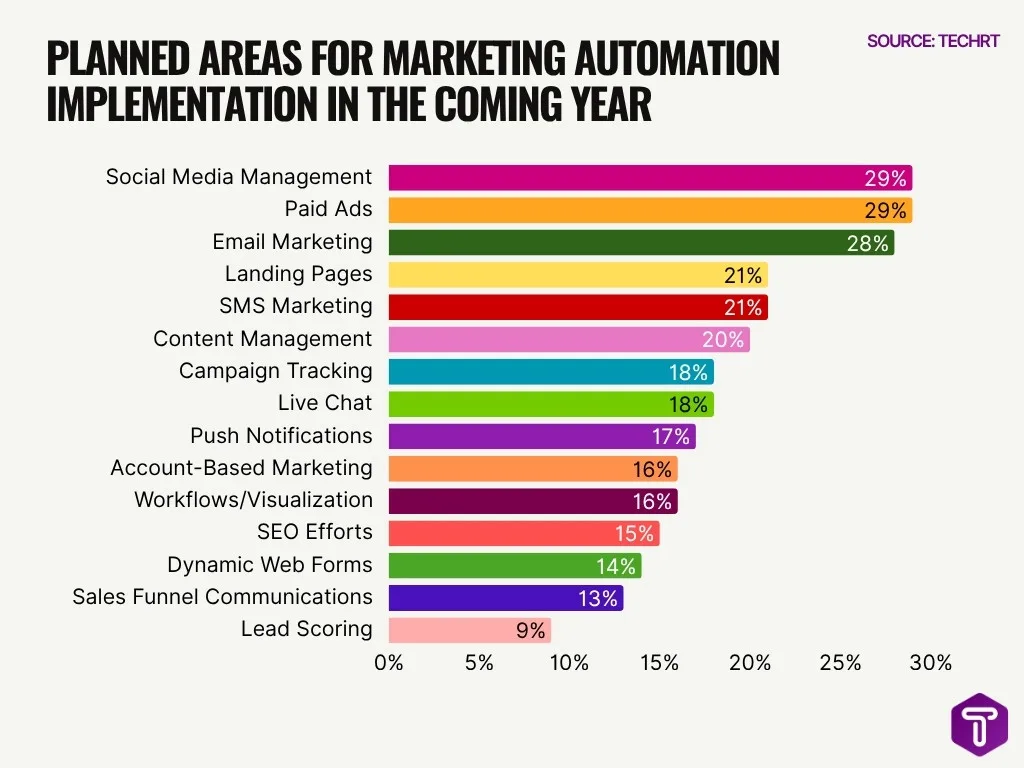
- Social media management and paid ads lead the adoption, with both at 29%, highlighting a strong focus on customer acquisition and brand visibility.
- Email marketing remains a core automation channel, with 28% adoption, reinforcing its role in lead nurturing and customer retention.
- Landing pages and SMS marketing are equally prioritized, each at 21%, indicating growing emphasis on conversion optimization and direct communication.
- Content management automation stands at 20%, showing businesses are investing in scalable content strategies and personalization.
- Campaign tracking and live chat tools are adopted by 18%, reflecting the importance of real-time engagement and performance measurement.
- Push notifications (17%) and account-based marketing (16%) highlight a shift toward targeted and personalized outreach strategies.
- Workflows and visualization tools (16%) indicate businesses are focusing on process automation and operational efficiency.
- SEO efforts account for 15%, suggesting automation is being used to enhance organic visibility and search performance.
- Dynamic web forms (14%) and sales funnel communications (13%) show increasing adoption in lead capture and funnel optimization.
- Lead scoring ranks lowest at 9%, suggesting it is either less prioritized or more complex to implement compared to other automation areas.
Marketing Automation Effectiveness and Success Rate Statistics
- 91% of marketing leaders say automation is crucial to overall success.
- Companies using automation report 14.5% higher sales productivity.
- Marketing automation improves lead conversion rates by 77% on average.
- Businesses experience a 12% reduction in marketing overhead costs with automation.
- Automated campaigns deliver higher engagement rates across all channels compared to manual campaigns.
- 63% of companies outperform competitors after adopting automation tools.
- Campaign execution speed improves by 30–50% with automation platforms.
- Marketing teams save 6+ hours per week through automation workflows.
Customer Journey and Lifecycle Marketing Automation Statistics
- Companies using lifecycle automation see 20% higher customer satisfaction rates.
- Automated onboarding flows increase customer retention by 15–25%.
- 68% of businesses use automation to manage multi-stage customer journeys.
- Personalized lifecycle campaigns improve engagement rates by up to 74%.
- Customer journey mapping tools are integrated into over 60% of automation platforms.
- Businesses using automation reduce customer churn by up to 18%.
- Lifecycle-based segmentation drives higher conversion rates compared to generic campaigns.
- Automation enables real-time engagement across touchpoints such as email, web, and mobile.
Marketing Automation ROI Timeline and Impact Insights
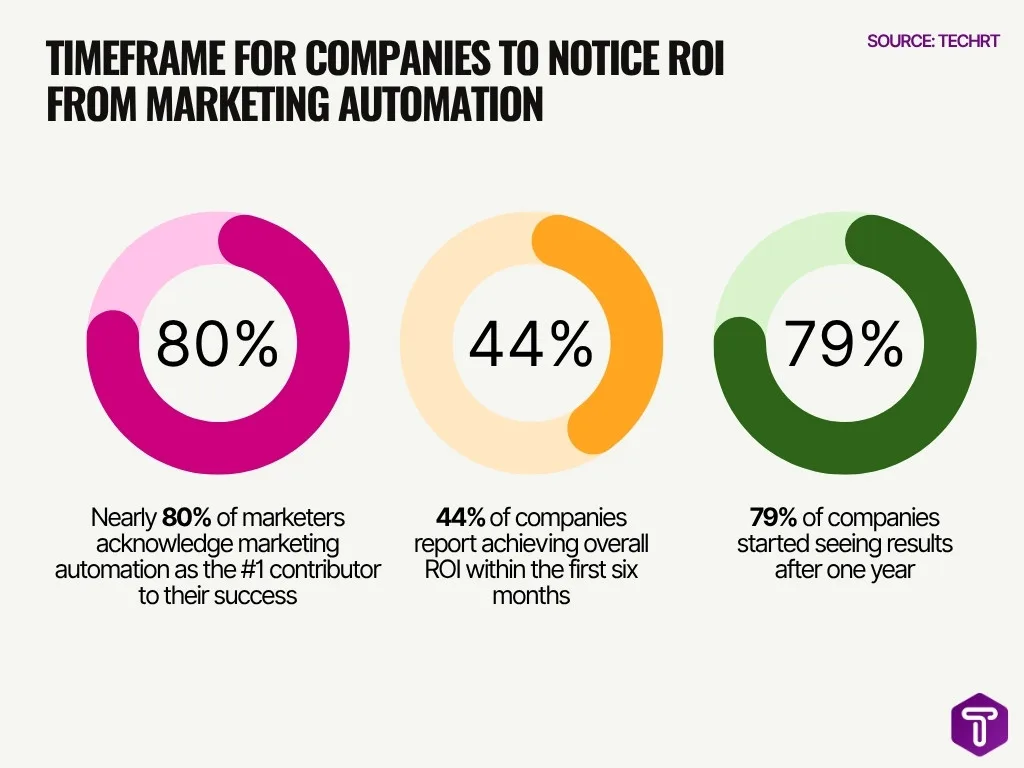
- Nearly 80% of marketers identify marketing automation as the #1 contributor to their success, highlighting its critical role in modern marketing strategies.
- Around 44% of companies report achieving measurable ROI within the first six months, indicating that automation can deliver relatively fast returns when implemented effectively.
- A significant 79% of businesses begin seeing tangible results after one year, showing that long-term commitment enhances overall ROI outcomes.
- The data suggests a dual-phase ROI curve, where early adopters see quick wins (within 6 months), while the majority achieve full-scale results over 12 months.
- The gap between 44% (6 months) and 79% (1 year) indicates that ROI compounds over time, reinforcing the importance of sustained usage and optimization.
- With 4 out of 5 marketers crediting automation for success, businesses that delay adoption risk falling behind competitors leveraging automation tools.
- These insights emphasize that marketing automation is both a short-term performance driver and a long-term growth engine, making it essential for scalable marketing operations.
Marketing Automation Lead Generation and Lead Nurturing Statistics
- Companies using automation generate 451% more qualified leads compared to those that don’t.
- Lead nurturing emails achieve 4–10x higher response rates than standalone campaigns.
- Businesses that automate lead nurturing see a 20% increase in sales opportunities.
- 79% of top-performing companies have used marketing automation for lead nurturing for more than two years.
- Nurtured leads make 47% larger purchases than non-nurtured leads.
- Automated lead scoring improves sales efficiency by 30% or more.
- Companies using lead nurturing workflows experience shorter sales cycles by up to 23%.
- Only 35% of marketers currently use advanced lead nurturing workflows, leaving room for growth.
Marketing Automation Conversion Rate and Sales Impact Statistics
- Marketing automation increases conversion rates by up to 77%.
- Automated campaigns generate 320% more revenue than non-automated campaigns.
- Companies report a 14.5% increase in sales productivity after adopting automation.
- Businesses using automation see 10% or higher conversion improvements within the first year.
- Automated personalization can increase conversion rates by up to 202%.
- 63% of companies outperform competitors after implementing automation tools.
- Sales teams benefit from better-qualified leads, reducing time spent on unqualified prospects.
- Automation improves alignment between marketing and sales teams, leading to higher close rates.
Automation Demand Across Business Functions: Key Insights
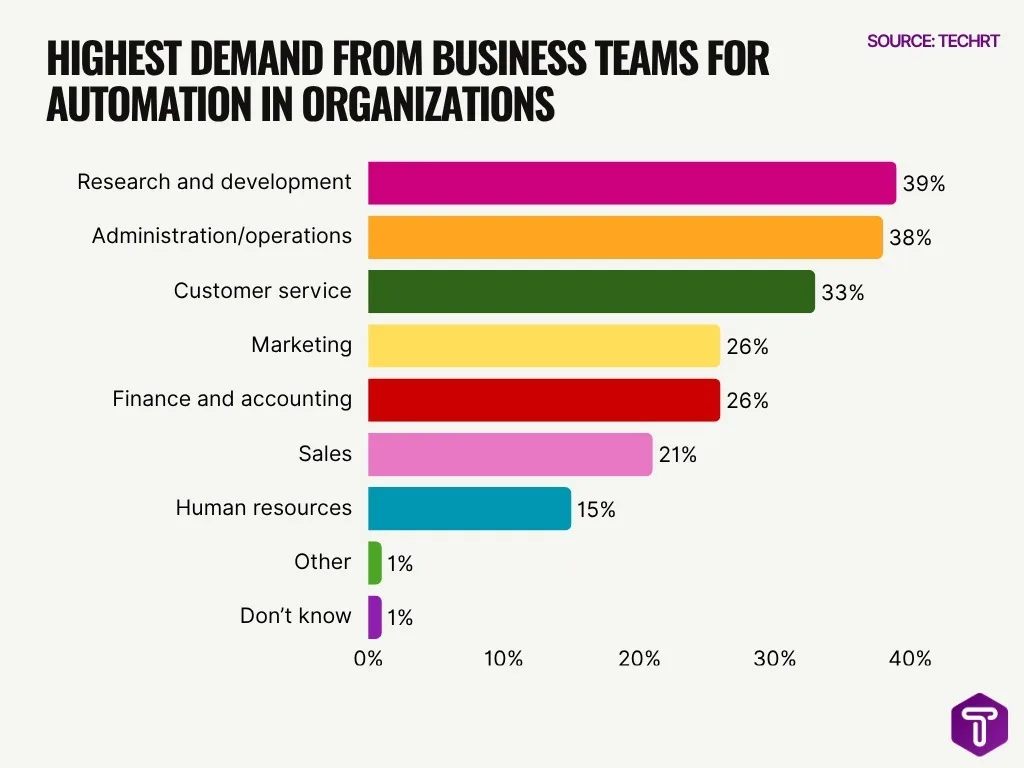
- Research and development lead automation demand at 39%, highlighting how innovation-driven teams prioritize efficiency and faster product development cycles.
- Administration and operations closely follow at 38%, indicating strong demand for automation in routine workflows, process optimization, and cost reduction.
- Customer service ranks third with 33%, reflecting the growing reliance on automation for chatbots, ticketing systems, and improved customer experience.
- Marketing and finance/accounting are tied at 26%, showing balanced adoption for campaign automation, analytics, financial reporting, and compliance tasks.
- Sales teams report a 21% demand, suggesting moderate adoption focused on CRM automation, lead scoring, and pipeline management.
- Human resources shows relatively lower demand at 15%, indicating slower but emerging use of automation in recruitment, onboarding, and employee management.
- Minimal demand is seen in “Other” (1%) and “Don’t know” (1%) categories, suggesting that most organizations have clear priorities for automation investments.
- Overall, technical and operational departments dominate automation demand, while people-centric functions like HR lag, revealing a gap in adoption maturity across business units.
Marketing Automation Personalization, Segmentation, and Targeting Statistics
- 85% of businesses using marketing automation report improved customer segmentation accuracy, leading to 30% higher open rates in campaigns.
- 68% of marketers leverage personalization tools for dynamic content, resulting in 20% uplift in conversion rates across email and web.
- Companies with advanced targeting strategies see 40% better lead qualification and 25% reduction in acquisition costs.
- 92% of B2B firms using segmentation in automation platforms experience 15–20% increases in deal closure rates.
- Behavioral targeting boosts click-through rates by 50%, with 73% of users reporting stronger brand loyalty.
- Real-time personalization via automation yields 6x higher engagement, adopted by 65% of enterprise marketing teams.
- AI-powered segmentation reduces customer churn by 35% and improves lifetime value by 28% on average.
- Multi-channel targeting with automation delivers 18% higher ROI, used by 77% of high-performing marketers.
- 76% of consumers expect personalized recommendations, driving 4.5x more purchases from automated campaigns.
AI-Powered and Agentic Marketing Automation Statistics
- 94% of marketers plan to use AI tools in marketing workflows by 2026.
- AI-powered campaigns deliver 10–20% higher ROI than traditional campaigns.
- 80% of organizations are expected to adopt AI-driven automation systems by 2025–2026.
- AI improves lead scoring accuracy by up to 40%.
- Chatbots powered by AI handle up to 80% of customer interactions.
- Predictive analytics helps businesses forecast customer behavior and optimize campaigns.
- AI-driven automation reduces manual marketing tasks by 30–40%.
- Generative AI tools are increasingly used for content creation, segmentation, and campaign optimization.
Key Marketing Automation Challenges and Insights
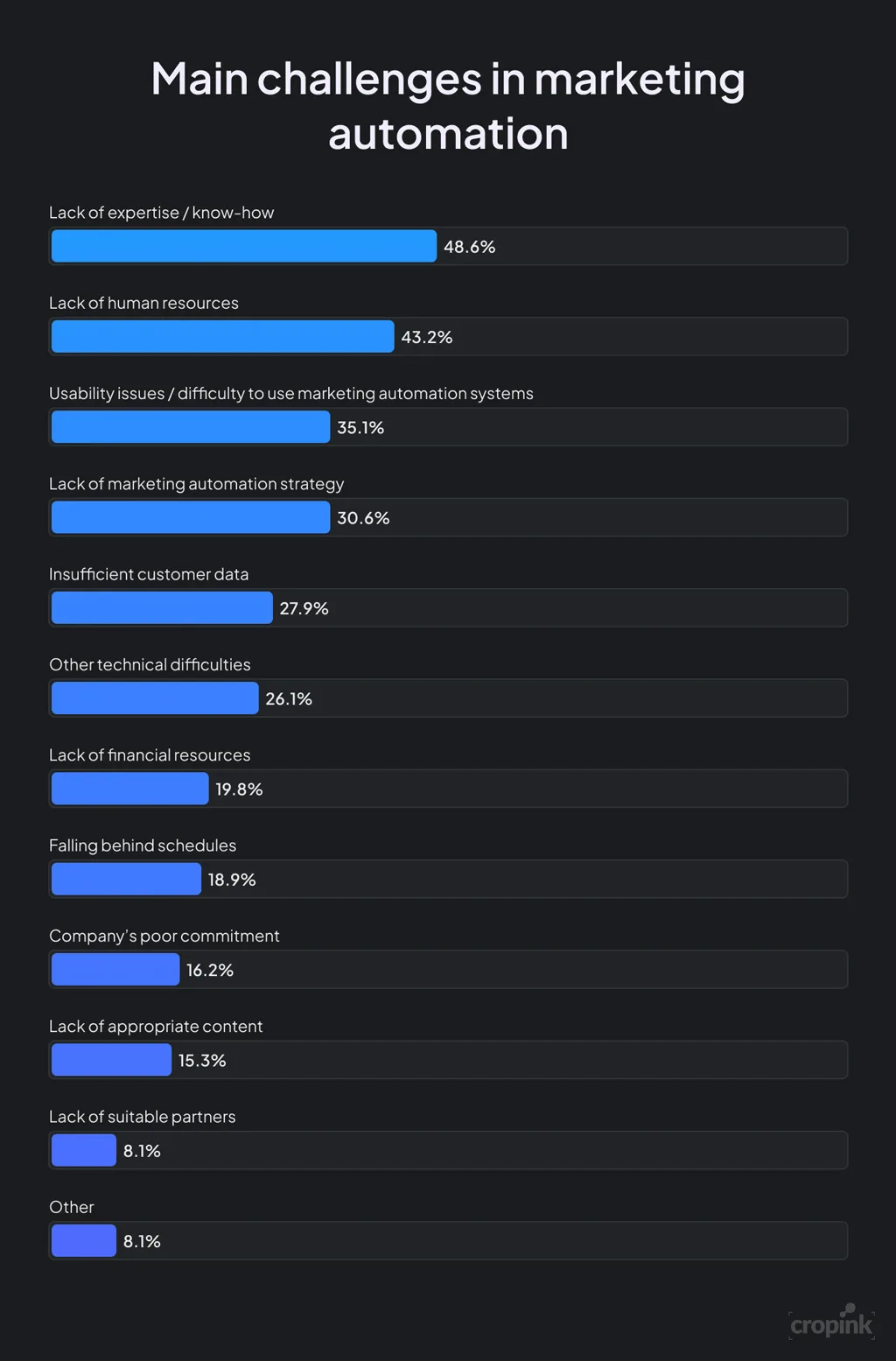
- The biggest barrier to adoption is a lack of expertise, reported by 48.6% of respondents, highlighting a major skills gap in marketing automation.
- 43.2% of businesses struggle with a lack of human resources, indicating that team capacity and staffing limitations are critical challenges.
- Around 35.1% face usability issues, showing that many platforms are still considered complex and difficult to implement.
- Nearly 30.6% cite a lack of marketing automation strategy, suggesting that many companies adopt tools without a clear execution roadmap.
- 27.9% report insufficient customer data, emphasizing the importance of data quality and availability for effective automation.
- 26.1% experience technical difficulties, reflecting ongoing challenges with integration, setup, and system performance.
- Budget constraints remain relevant, with 19.8% reporting a lack of financial resources as a limiting factor.
- 18.9% of organizations struggle with falling behind schedules, indicating issues in implementation timelines and project management.
- 16.2% point to poor company commitment, showing that organizational alignment and leadership support are crucial for success.
- Content gaps affect 15.3% of businesses, highlighting the need for relevant and scalable content strategies in automation.
- Only 8.1% report a lack of suitable partners, suggesting this is a less significant but still notable barrier.
- Another 8.1% fall under other challenges, indicating additional niche or organization-specific issues.
Future Trends and Forecasts in Marketing Automation Statistics
- The marketing automation market is projected to grow from $47.02 billion in 2025 to $81.01 billion by 2030 at a CAGR of 11.5%.
- The AI for sales and marketing market will surge from $57.99 billion in 2025 to $240.58 billion by 2030, with a CAGR of 32.9%.
- Omnichannel automated marketing platforms are expected to grow at a CAGR of 11.5% from 2025 to 2033.
- The customer data platforms (CDPs) market is forecasted to reach $71.94 billion by 2033, growing at a CAGR of 28.23% from 2025.
- The conversational AI market, powering voice marketing, is projected to hit $41.39 billion by 2030 at a CAGR of 23.7%.
- Predictive analytics usage in customer engagement tools has grown by 30%, with 71% of marketers planning AI solutions in 18 months.
- The autonomous AI agents market for agent-driven systems will expand from $9.9 billion in 2025 to $253.3 billion by 2034 at 43.4% CAGR.
- By 2026, 21 states will enforce comprehensive privacy laws shaping automation data handling.
- The analytics and reporting segment in marketing automation will grow fastest at 13.0% CAGR through 2030.
Frequently Asked Questions (FAQs)
What is the average ROI of marketing automation?
What percentage of companies use marketing automation globally?
How fast is the marketing automation market growing?
What percentage of marketers automate their customer journey?
Conclusion
Marketing automation continues to redefine how businesses attract, engage, and retain customers in an increasingly digital landscape. The data highlights clear benefits, including improved efficiency, stronger lead generation, and measurable revenue growth. Organizations that successfully implement automation gain better visibility into customer behavior, allowing them to deliver more relevant and timely experiences across every touchpoint.
However, the journey is not without challenges. Many companies still struggle with integration issues, skill gaps, and underutilized tools, which can limit the full potential of their automation investments. As technology continues to evolve, especially with the rise of AI-driven and agent-based systems, businesses will need to focus on strategy, data quality, and team enablement to stay competitive.
Looking ahead, companies that adopt a scalable, customer-centric approach to marketing automation will be better positioned to drive long-term growth, improve customer loyalty, and maintain a strong competitive edge in the market.

Leave a comment
Have something to say about this article? Add your comment and start the discussion.