



Email marketing continues to drive measurable growth across industries, from ecommerce brands recovering abandoned carts to SaaS companies nurturing long sales cycles. It offers a rare combination of scale, personalization, and cost efficiency, allowing businesses to reach customers directly without relying on third-party platforms. Moreover, brands use email to deliver targeted promotions, onboard new users, and build long-term relationships through consistent communication.
As inbox competition intensifies and automation tools become more advanced, marketers must rely on data to refine their strategies. Metrics such as open rates, click-through rates, and conversions now play a critical role in shaping campaigns that actually perform. Understanding these trends helps businesses optimize timing, content, and segmentation to stay relevant. Let’s explore the most important email marketing statistics.
Editor’s Choice
- Email marketing delivers an average ROI of $36 for every $1 spent, making it one of the highest-performing channels.
- Some ecommerce campaigns achieve up to $72 ROI per $1 spent, showing strong performance in retail sectors.
- Around 4.6 billion people are expected to use email globally by 2025–2026.
- Approximately 376 billion emails are sent daily worldwide, highlighting intense inbox competition.
- Nearly 59% of consumers say marketing emails influence purchase decisions.
- About 80% of marketers say email marketing is a key driver of customer retention.
- Automated email workflows generate 30x higher returns than one-off campaigns.
Recent Developments
- Only 13% of emails are human-written, with automation dominating modern email ecosystems.
- Around 87% of global email traffic now comes from automated systems, including marketing and SaaS tools.
- Email deliverability challenges are rising, with only 44% of emails reaching inboxes in some datasets.
- AI-driven personalization tools have increased adoption across campaigns, improving engagement rates.
- Apple Mail Privacy Protection continues to distort open rate tracking, shifting focus to clicks and conversions.
- Around 15% of marketers still rely on open rates despite changing measurement standards.
- Triggered and behavior-based emails are outperforming bulk campaigns across most industries.
- Privacy regulations and consent-based marketing are reshaping email list strategies globally.
Key Email Marketing Statistics Overview
- Email marketing ROI averages between 3600% and 4200%, depending on industry benchmarks.
- Email remains the most effective channel for many marketers, with about 50% ranking it as their top performer.
- Email campaigns achieve 2.8% conversion rates for B2C and 2.4% for B2B.
- Around 60% of consumers report purchasing a marketing email.
- Email accounts for a significant portion of customer retention strategies across industries.
- Welcome emails can achieve open rates above 60%, outperforming most campaign types.
- Email continues to outperform social media in ROI and direct response metrics.
- Personalized campaigns improve engagement rates significantly compared to generic campaigns.
Email Marketing Market Growth Trends
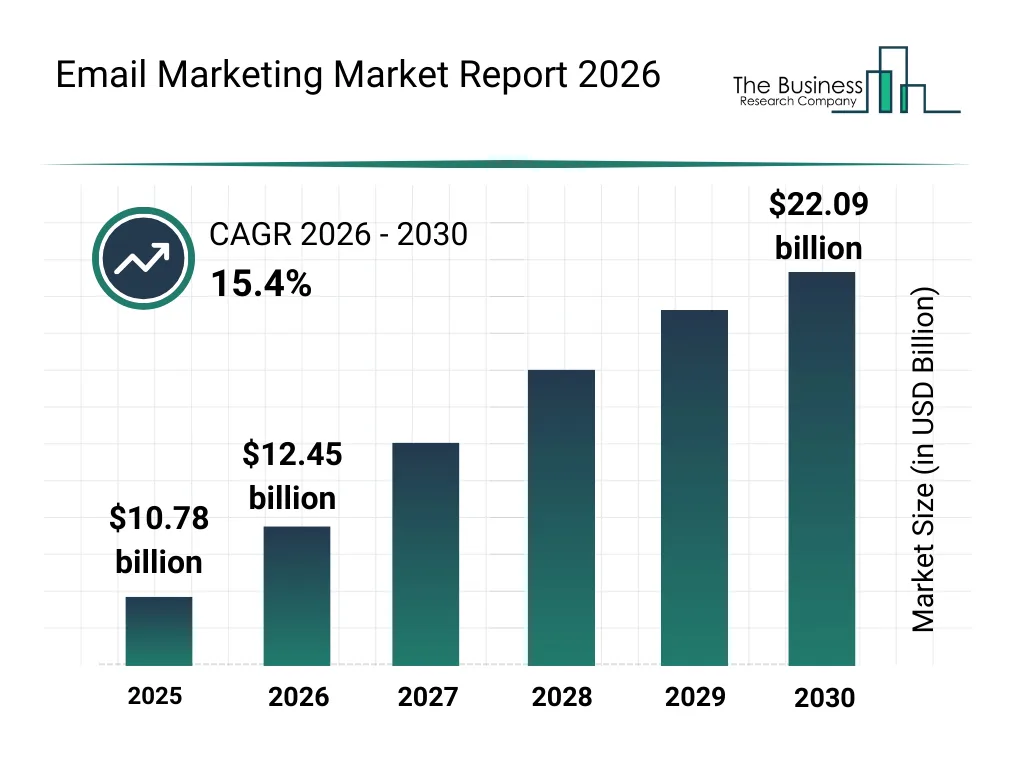
- The global email marketing market is projected to grow from $10.78 billion in 2025 to $22.09 billion by 2030, reflecting strong long-term expansion.
- The industry is expected to register a robust CAGR of 15.4% (2026–2030), indicating sustained high-growth momentum.
- Market size increases significantly from $12.45 billion in 2026, showing early acceleration in adoption and investment.
- By 2027, the market is estimated to cross approximately $14+ billion, highlighting steady year-over-year growth.
- The upward trend continues in 2028, reaching around $16.5 billion, driven by increasing automation and AI integration in email marketing.
- In 2029, the market is projected to approach nearly $19 billion, reflecting growing enterprise and SMB adoption globally.
- The jump from $10.78 billion (2025) to $22.09 billion (2030) represents more than a 2x market expansion within five years.
- The consistent yearly growth pattern indicates a compounding effect, rather than sporadic spikes, making it a stable growth sector.
- Rising demand for personalized marketing, automation tools, and ROI-driven campaigns is a key driver behind this expansion.
- The data highlights email marketing as one of the fastest-growing digital marketing channels, with strong scalability and measurable performance benefits.
Global Email Usage and Adoption Statistics
- Global email users are projected to reach 4.6 billion by 2026.
- Over 50% of the world’s population actively uses email.
- Daily email volume is expected to exceed 376 billion messages.
- Nearly 49% of all emails are classified as spam, indicating high competition for attention.
- Email remains the most widely used workplace communication tool globally.
- Mobile devices account for 43.5% of email opens, showing strong mobile dependency.
- Email usage continues to grow in emerging markets, especially across Asia and Africa.
- Younger audiences, including Gen Z, increasingly engage with email for brand communication.
Email Volume and Inbox Competition Statistics
- Over 376 billion emails are sent daily worldwide, projected to reach 392.5 billion by 2026 amid 4% annual growth.
- Nearly 45% of emails are spam, totaling around 176 billion junk messages daily in 2025.
- 44.99% of global email traffic was spam in 2025, per Kaspersky telemetry on malicious communications.
- Average office workers receive 121 emails daily, with business users handling up to 120 per day amid inbox overload.
- Global average inbox placement stands at 78-85%, but primary inbox rates average ~78% across providers.
- Gmail primary inbox placement is 57.8%, with 37.74% landing in the Promotions tab despite 95%+ deliverability.
- Email deliverability rates average 83-85% globally, with top benchmarks reaching 97-99% for compliant senders.
- 82-120 emails per day per user create intense inbox saturation, reducing per-message attention spans.
- Consumers check email 3-20+ times daily, with 93% daily engagement fueling fierce visibility competition.
- Email volume grows 4% yearly, from 376.4 billion daily in 2025 to 408 billion by 2027.
Top Industries With Highest Email Open Rates
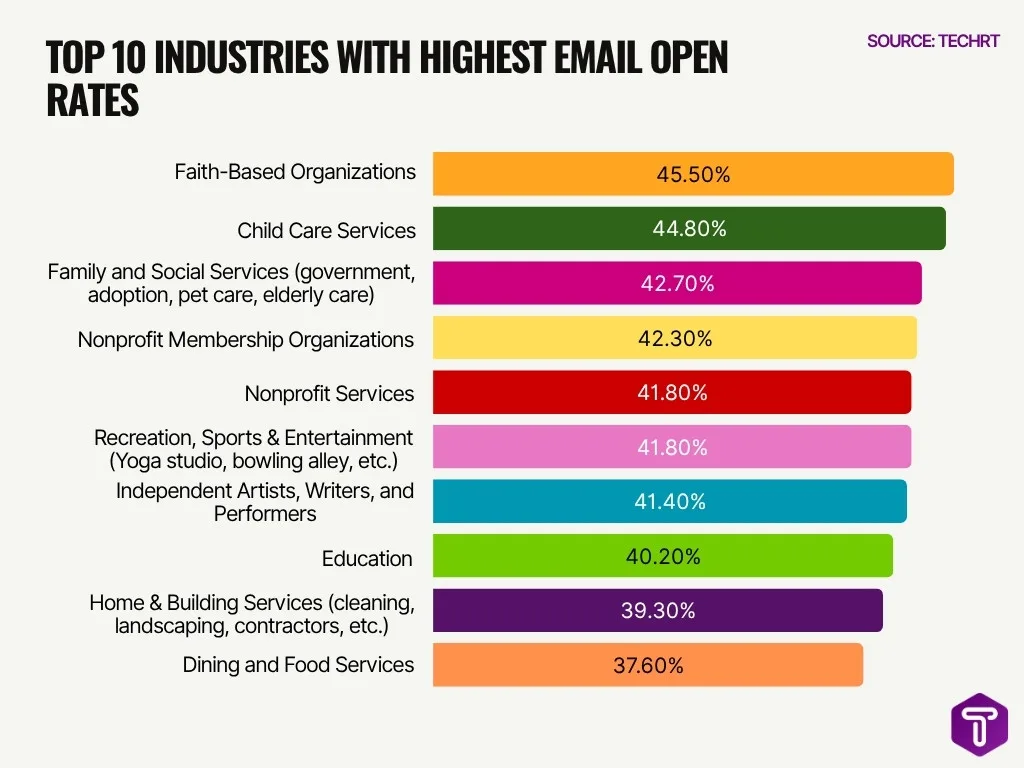
- Faith-Based Organizations lead with the highest open rate at 45.50%, indicating strong audience trust and engagement.
- Child Care Services follow closely with a 44.80% open rate, showing that highly relevant and personal content drives engagement.
- Family and Social Services achieve a 42.70% open rate, reflecting the impact of community-focused communication.
- Nonprofit Membership Organizations record 42.30%, highlighting the role of loyal subscriber bases in boosting email performance.
- Both Nonprofit Services and Recreation, Sports & Entertainment share a 41.80% open rate, demonstrating that interest-driven audiences engage more frequently.
- Independent Artists, Writers, and Performers see a 41.40% open rate, suggesting that personal branding and niche audiences improve email visibility.
- The Education sector maintains a solid 40.20% open rate, driven by informational and value-based content.
- Home & Building Services generate a 39.30% open rate, indicating that utility-based services still attract strong attention in inboxes.
- Dining and Food Services rank lowest among the top 10 but still achieve a notable 37.60% open rate, showing consistent consumer interest in offers and promotions.
- Overall, mission-driven and community-oriented industries dominate, with most sectors exceeding a 40% open rate benchmark, significantly higher than typical email marketing averages.
Email Click-Through and Click-to-Open Rate Statistics
- The average email click-through rate (CTR) across industries is around 2.3% to 3%.
- Click-to-open rates (CTOR) typically range between 10% and 15%, reflecting engagement quality.
- Emails with a single call-to-action can increase clicks by 371% compared to multiple CTAs.
- Personalized emails generate 6x higher transaction rates than non-personalized emails.
- Interactive emails (with polls or embedded content) boost click rates significantly.
- Mobile-optimized emails improve CTR by up to 15%, especially for ecommerce campaigns.
- Adding buttons instead of text links can improve click rates by 28%.
- Segmented campaigns result in 100%+ higher click-through rates compared to generic blasts.
- Triggered emails generate higher click rates than bulk campaigns.
Email Conversion, Revenue, and Sales Impact Statistics
- Email marketing drives up to 20% of total ecommerce revenue for many online stores.
- Automated emails account for 29% of all email-driven orders, despite lower send volume.
- Abandoned cart emails achieve conversion rates of 8% to 10%, significantly higher than standard campaigns.
- Email campaigns deliver conversion rates of around 2% to 5%, depending on the industry.
- Transactional emails generate 6x more revenue than bulk promotional emails.
- Nearly 60% of consumers report making purchases directly from marketing emails.
- Email marketing contributes to repeat purchases more than most other digital channels.
- Upsell and cross-sell emails increase average order value by measurable margins.
- Drip campaigns nurture leads and significantly improve long-term sales outcomes.
Email Usage and Consumer Behavior Insights
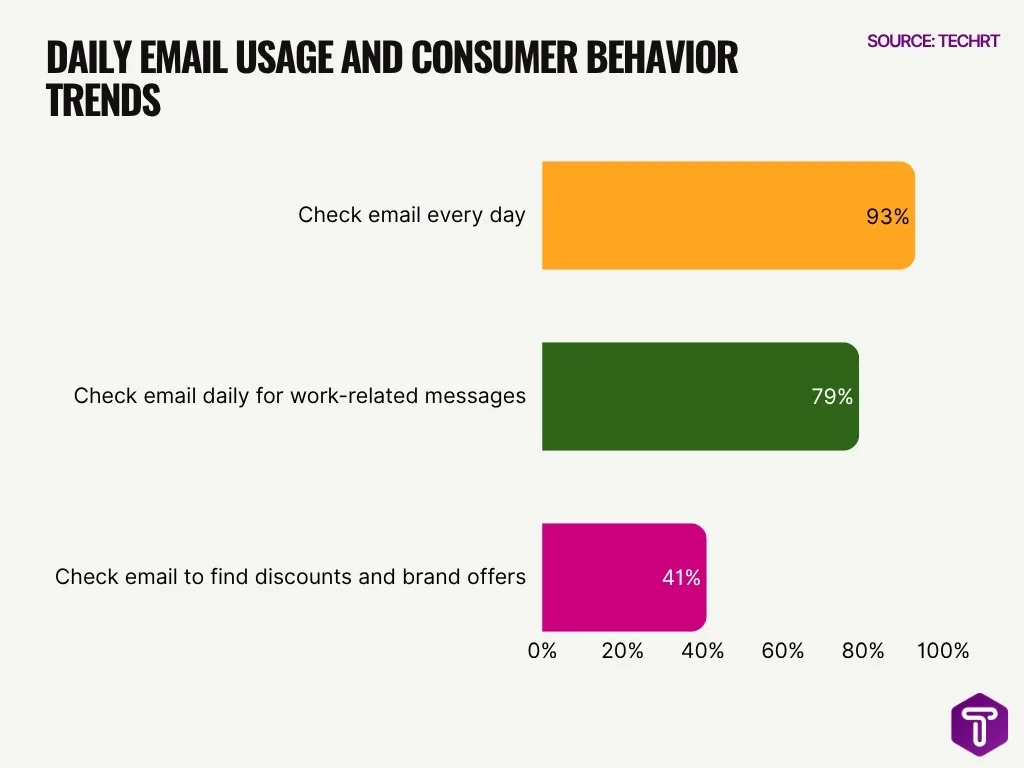
- A massive 93% of users check their email every day, highlighting email as one of the most consistently used digital communication channels.
- Around 79% of users check email daily for work-related messages, showing that email remains a critical tool for professional communication and productivity.
- Nearly 4 in 5 users rely on email for work, reinforcing its importance in business operations, collaboration, and client communication.
- About 41% of users check email to find discounts and brand offers, indicating strong potential for email marketing and promotional campaigns.
- The gap between daily usage (93%) and promotional intent (41%) suggests that while email is widely used, marketing emails must be highly relevant to drive engagement.
- With high daily engagement but lower promotional interaction, brands should focus on personalization, segmentation, and value-driven content to improve conversions.
- The data clearly shows that email serves a dual purpose: both professional communication (79%) and consumer marketing (41%), making it a versatile channel for businesses.
Email List Growth, Lead Generation, and Signup Statistics
- Businesses see an average email list growth rate of 1% to 3% per month.
- Pop-ups and signup forms can increase conversions by 3% to 10%, depending on design.
- Offering incentives like discounts can boost signup rates by 20% or more.
- Double opt-in lists show higher engagement and lower spam complaints.
- Around 60% of marketers say email is their primary lead generation channel.
- Landing pages optimized for email capture convert at 5% to 15%.
- Social media integration contributes to email list growth, but at lower conversion rates.
- GDPR and privacy laws have reduced list sizes but improved list quality.
- Lead magnets such as ebooks and webinars remain effective for subscriber acquisition.
Segmentation, Personalization, and Targeting Statistics
- Segmented campaigns generate 760% more revenue than non-segmented campaigns.
- Personalized subject lines improve open rates by 26%.
- About 80% of consumers are more likely to purchase from brands that personalize experiences.
- Behavioral targeting increases email engagement significantly.
- Dynamic content emails outperform static emails in click and conversion rates.
- Around 70% of marketers actively use segmentation in email campaigns.
- AI-driven personalization is becoming standard across enterprise email platforms.
- Location-based targeting improves campaign relevance for regional audiences.
- Personalized product recommendations increase revenue per email.
A/B Testing Channels Used by Marketing Professionals
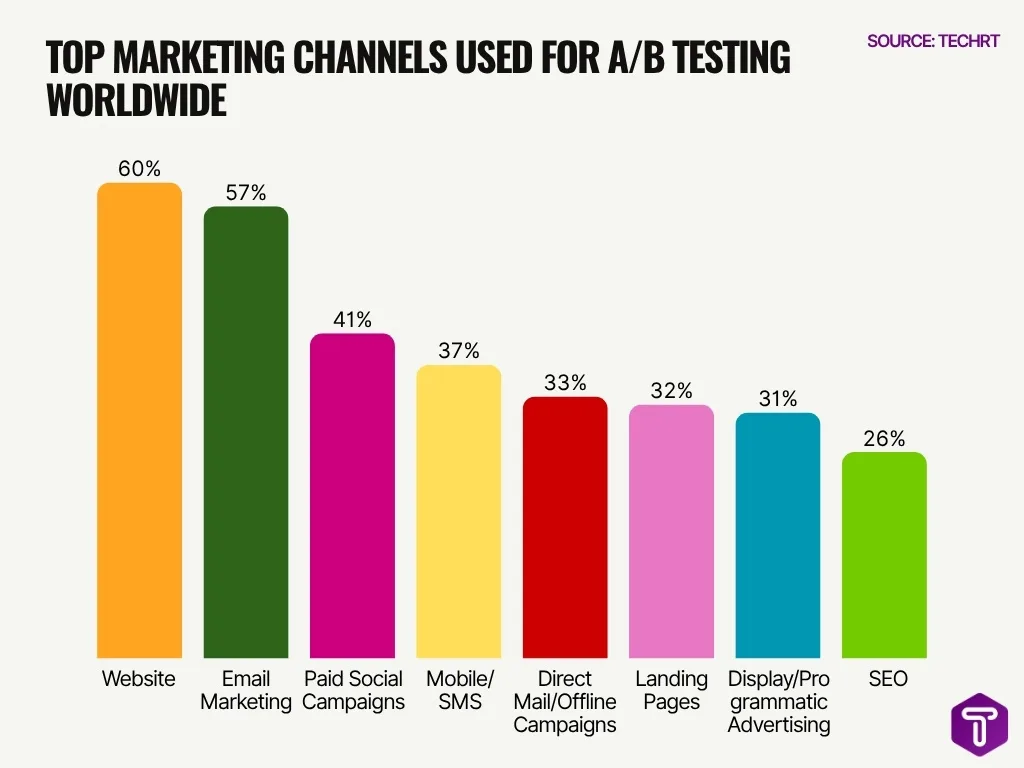
- Websites dominate A/B testing, with 60% of marketers using them, making it the most preferred channel for experimentation and optimization.
- Email marketing ranks second, with 57% adoption, highlighting its critical role in performance testing and conversion optimization.
- Paid social campaigns are widely tested, used by 41% of professionals, indicating strong reliance on social media ad optimization strategies.
- Mobile/SMS channels account for 37%, showing the growing importance of mobile-first testing approaches in marketing campaigns.
- Direct mail and offline campaigns still matter, with 33% usage, proving that traditional channels continue to benefit from A/B testing.
- Landing pages are tested by 32% of marketers, emphasizing their role in conversion rate optimization (CRO) and lead generation.
- Display and programmatic advertising see 31% adoption, reflecting ongoing efforts to improve ad targeting and performance.
- SEO has the lowest A/B testing usage at 26%, likely due to longer testing cycles and complexity in measuring direct impact.
- The gap between the top (60%) and lowest (26%) channels highlights a significant variation in testing maturity across marketing channels.
- Overall, digital channels dominate A/B testing, with email, websites, and paid social leading the strategy, while offline and SEO lag behind in adoption.
Marketing Automation and Triggered Email Statistics
- Automated emails generate 320% more revenue than non-automated emails.
- Triggered emails achieve open rates of 40% to 50%, significantly higher than bulk emails.
- Welcome email series generates 3x more revenue than single welcome emails.
- Abandoned cart emails account for a large share of ecommerce recovery revenue.
- Around 75% of businesses use marketing automation tools for email campaigns.
- Drip campaigns improve lead nurturing efficiency and reduce manual effort.
- Behavioral triggers, such as browsing activity, increase engagement rates.
- Automated re-engagement campaigns help recover inactive subscribers.
- AI-powered automation tools continue to improve targeting accuracy.
Mobile Email Usage and Responsive Design Statistics
- Around 43% to 50% of emails are opened on mobile devices, making mobile optimization essential.
- Nearly 70% of users delete emails that are not optimized for mobile.
- Mobile-friendly emails can increase click rates by 15% or more.
- About 85% of users access email via smartphones, especially among younger audiences.
- Responsive design improves engagement across both mobile and desktop users.
- Emails with larger fonts and simple layouts perform better on mobile screens.
- Mobile-first design strategies are now standard across major email platforms.
- iOS and Android devices dominate email opens, accounting for the majority of mobile engagement.
- Brands using responsive templates see improved retention and lower unsubscribe rates.
Types of Marketing Emails Companies Send
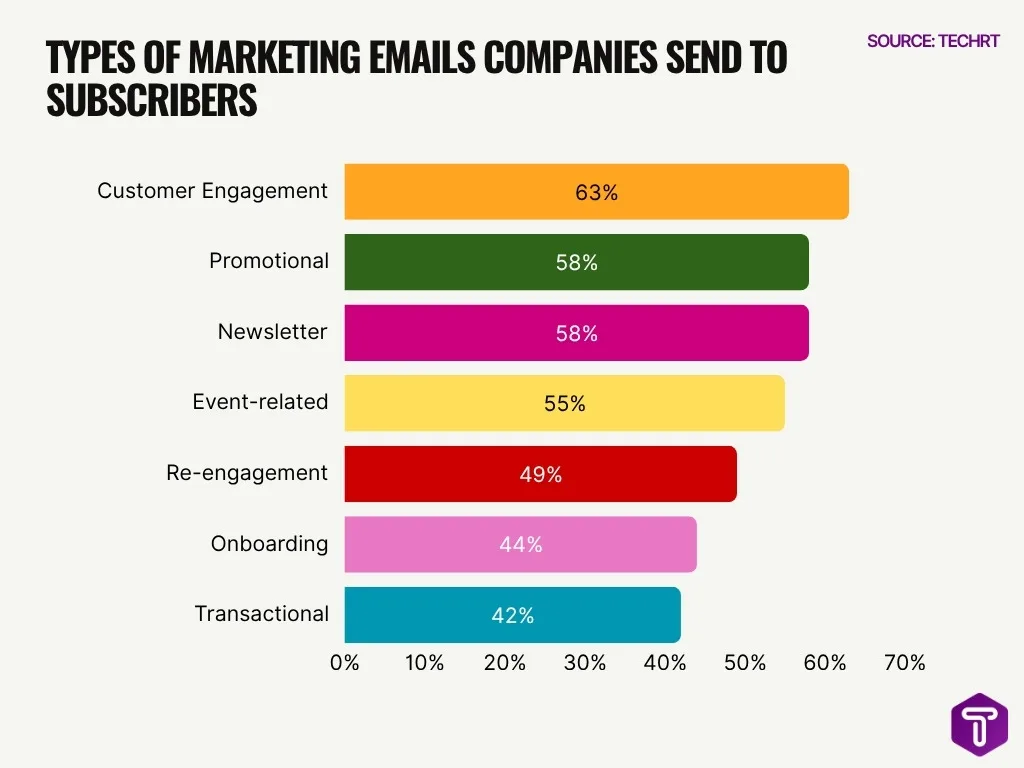
- Customer engagement emails lead the pack at 63%, making them the most widely used email type among businesses to build ongoing relationships with subscribers.
- Promotional and newsletter emails are equally popular at 58% each, highlighting their critical role in driving sales and delivering regular content updates.
- Event-related emails account for 55%, showing that more than half of businesses actively promote webinars, launches, and special events via email.
- Re-engagement emails are used by 49% of companies, indicating a strong focus on winning back inactive or dormant subscribers.
- Onboarding emails reach 44% adoption, emphasizing their importance in guiding new users and improving early-stage customer experience.
- Transactional emails are the least utilized at 42%, despite being essential for confirmations, receipts, and account-related communications.
- The data shows a clear trend toward relationship-building email strategies, with engagement-focused emails outperforming purely functional ones.
- There is a relatively small gap between most categories (42%–63%), suggesting that businesses are adopting a diversified email marketing mix rather than relying on a single type.
- The dominance of engagement and promotional emails indicates that conversion and retention remain top priorities for marketers.
- Lower adoption of onboarding and transactional emails suggests potential optimization opportunities in lifecycle and customer journey automation.
Email Send Frequency, Timing, and Cadence Statistics
- Sending 1-3 emails per week (or 2-4 per month) delivers optimal engagement across most industries, with B2B preferring lower cadences.
- Around 70% of subscribers unsubscribe due to excessive frequency, making it the top reason for opt-outs in email campaigns.
- Tuesday stands out as the peak day for email opens, followed closely by Wednesday and Thursday with high engagement rates.
- Emails sent between 9 AM and 12 PM achieve peak open rates up to 49%, especially on midweek mornings.
- B2B emails perform best during business hours (9-11 AM Tuesday), while B2C sees higher engagement in evenings or weekends.
- Triggered emails generate 624% higher conversions and 70.5% better open rates than fixed-schedule batch sends.
- Consistent weekly cadences (e.g., 6 emails/week) based on 199 million emails analysis maximize performance without fatigue.
- Over-sending leads to spam complaints above 0.3% threshold, harming deliverability for bulk senders per Google/Yahoo rules.
B2B Email Marketing Statistics
- About 87% of B2B marketers use email as a primary distribution channel.
- Email generates 2x more leads than other digital channels in B2B environments.
- B2B email open rates average between 15% and 25%, depending on industry.
- Around 31% of B2B marketers say email newsletters are their most effective content format.
- Lead nurturing emails produce 20% more sales opportunities.
- Decision-makers prefer email for receiving business-related content.
- Segmented B2B campaigns significantly outperform mass email blasts.
- Automation improves efficiency in long B2B sales cycles.
- Email remains a top channel for account-based marketing strategies.
B2B Prospecting Channels: Effectiveness Insights
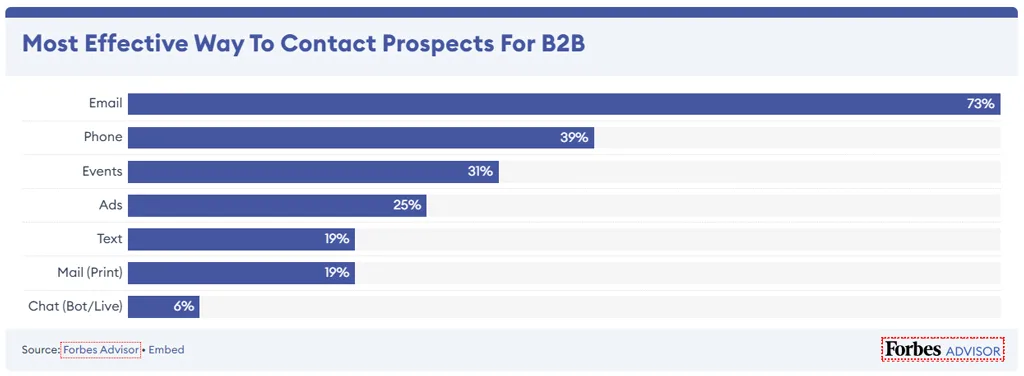
- Email dominates B2B outreach, with a 73% effectiveness rate, making it the most reliable and scalable communication channel.
- Phone calls rank second at 39%, highlighting that direct, personalized communication still plays a strong role in conversions.
- Events contribute 31% effectiveness, showing the continued importance of in-person and networking-based engagement in B2B relationships.
- Paid ads generate 25% effectiveness, indicating moderate performance compared to more direct outreach channels.
- Text messaging accounts for 19%, suggesting it is useful but less impactful for professional B2B communication.
- Print mail also stands at 19%, showing that traditional channels still retain niche effectiveness in certain industries.
- Chat (bot/live) is the least effective at just 6%, reflecting limited trust or engagement in automated or instant messaging channels for B2B prospecting.
- Overall, direct and personalized channels (Email and Phone) significantly outperform automated or passive channels (Chat and Ads) in B2B outreach strategies.
B2B Email Marketing Statistics
- About 87% of B2B marketers use email as a primary distribution channel.
- Email generates 2x more leads than other digital channels in B2B environments.
- B2B email open rates average between 15% and 25%, depending on industry.
- Around 31% of B2B marketers say email newsletters are their most effective content format.
- Lead nurturing emails produce 20% more sales opportunities.
- Decision-makers prefer email for receiving business-related content.
- Segmented B2B campaigns significantly outperform mass email blasts.
- Automation improves efficiency in long B2B sales cycles.
- Email remains a top channel for account-based marketing strategies.
B2C and Ecommerce Email Marketing Statistics
- Email marketing delivers a staggering $36 ROI for every $1 spent in B2C ecommerce, outperforming all other digital channels.
- Welcome email sequences achieve 68.6% open rates, generating 320% more revenue than standard promotional campaigns.
- Abandoned cart emails recover 10-15% of lost sales on average, generating $3.45 revenue per recipient in ecommerce.
- 52% of consumers made direct purchases from email last year, with retail emails hitting 5.10% CTR when optimized.
- Automated emails convert 2,361% better than campaigns in ecommerce, with 52% higher open rates and 332% higher clicks.
- Mobile-optimized emails boost CTR by 15%, critical since 70%+ of emails open on mobile devices.
- Ecommerce email campaigns average 2.5% conversion rates, while cart abandonment emails reach 18.64%.
- Personalized B2C emails based on past purchases rose to 60% adoption, with consumers expecting tailored interactions at 71%.
Email Deliverability, Spam, and Inbox Placement Statistics
- Average email deliverability rates globally stand at 83.1%, with 16.9% of emails failing to reach inboxes.
- Nearly 49% of global emails are classified as spam, creating increased competition for inbox placement.
- Around 20% of marketing emails never reach the inbox due to filtering issues.
- SPF, DKIM, and DMARC authentication protocols improve deliverability rates exceeding 95%.
- The average cross-industry email bounce rate is 1.2%, while uncleaned lists see 6.5%+ bounces.
- Spam complaint rates above 0.1% significantly affect inbox placement and sender reputation.
- Teams verifying emails in real time achieve 0.3% bounce rates and 95% inbox placement.
- Gmail achieves 57.8% primary inbox placement, while 37.74% of emails land in Promotions.
- A good email deliverability rate in 2026 falls between 95% and 99%.
- Engagement signals like opens, replies, and clicks are increasingly prioritized by ISPs for filtering decisions.
Frequently Asked Questions (FAQs)
What is the average ROI of email marketing in 2026?
How many emails are sent globally per day?
What is the average email open rate in 2026?
What is the average email click-through rate (CTR)?
How many people use email globally?
Conclusion
Email marketing continues to deliver consistent and measurable results, balancing scale with precision. As businesses adopt automation, AI-driven personalization, and behavior-based targeting, email has evolved into a highly strategic channel rather than just a communication tool. It now supports the entire customer journey, from acquisition and onboarding to retention and repeat purchases.
At the same time, increasing privacy regulations and stricter deliverability standards are pushing marketers to focus more on quality than quantity. Success now depends on sending relevant, well-timed, and personalized messages that align with user intent. Brands that invest in segmentation, mobile optimization, and data-driven testing will stand out in crowded inboxes.
Ultimately, email remains one of the most reliable and cost-effective marketing channels available. Businesses that continuously refine their approach using real-world data and performance insights will unlock stronger engagement, higher conversions, and long-term customer loyalty.

Leave a comment
Have something to say about this article? Add your comment and start the discussion.