




Live streaming has evolved from a niche form of entertainment into a mainstream digital channel that shapes how people consume content, interact online, and make purchasing decisions. Today, brands use live streaming to launch products, host virtual events, and drive real-time shopping experiences, while creators and gamers rely on it to build loyal communities and generate consistent income. Moreover, industries such as eCommerce, education, and media now integrate live streaming as a core engagement strategy rather than an optional add-on.
As platforms compete for user attention and monetization opportunities, understanding the data behind growth, audience behavior, and platform performance becomes essential. The following live streaming statistics provide a clear, data-driven view of where the industry stands today and where it is headed next.
Editor’s Choice
- The global live streaming market is projected to reach $62.4 billion in 2026, up from $56.3 billion in 2025.
- Total live streaming watch time hit 36.4 billion hours in 2025, reflecting sustained post-pandemic demand.
- The industry is expected to grow at a 23% CAGR through 2030, reaching over $345 billion.
- More than 28.5% of global internet users watch live streams weekly.
- YouTube accounts for over 47% of global live-streaming watch time outside China.
- Mobile devices contribute 55.2% of live streaming consumption globally.
- Gaming streams alone generated 8.5 billion hours watched in Q2 2025.
Recent Developments
- YouTube introduced AI-powered live streaming tools and real-time highlights in 2025 to boost engagement.
- Live streaming platforms now support dual-format streaming (vertical + horizontal) for mobile-first audiences.
- The 2025 Game Awards reached 171 million global livestreams, up 11% YoY.
- Twitch saw over 1.8 million peak concurrent viewers during the same event.
- Co-streaming grew significantly with 16,500 broadcasts on Twitch, a 50% increase YoY.
- YouTube Live expanded interactive features like real-time reactions and membership-based streams.
- New platforms like Kick gained traction, while DLive shut down in 2026 due to competition pressures.
- Smart TV streaming adoption is growing at a 32.6% CAGR, signaling a shift beyond mobile.
Global Live Streaming Market Size
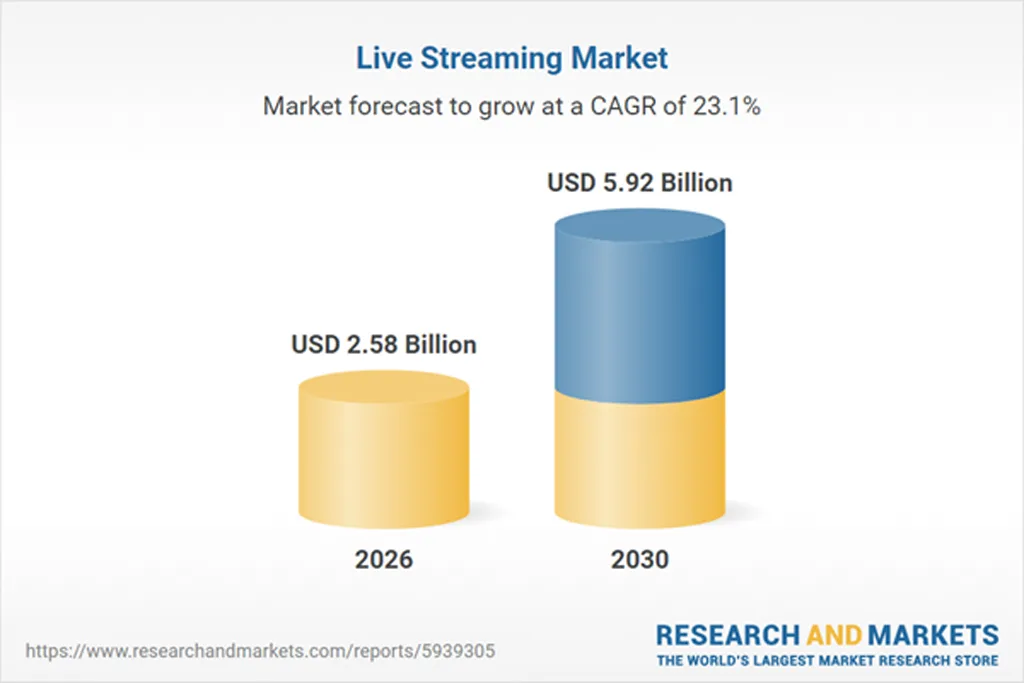
- The global live streaming market is projected to grow from $2.58 billion in 2026 to $5.92 billion by 2030, indicating strong industry expansion.
- The market is expected to register an impressive CAGR of 23.1%, highlighting rapid and sustained growth over the forecast period.
- The market size is set to more than double within just four years, showcasing increasing demand for real-time digital content consumption.
- This growth reflects rising adoption of live video platforms, especially across gaming, entertainment, e-commerce, and social media sectors.
- The sharp increase in valuation suggests significant investment opportunities and continued innovation in streaming technologies and monetization models.
- The surge also indicates a shift in consumer behavior toward interactive and on-demand live experiences, driving platform engagement and revenue.
Usage and Viewership Statistics
- Global live streaming reached 36.4 billion hours watched in 2025.
- Viewership grew 6% year-over-year from 2024 to 2025.
- Total watch time in 2024 stood at 32.5 billion hours, up 12% from 2023.
- Q2 2024 alone recorded 8.5 billion hours watched globally.
- Streaming now accounts for 25% of total TV viewing time in some markets.
- Over one-quarter of internet users watch live streams weekly.
- YouTube alone delivers billions of hours of live content monthly, dominating global consumption.
- Gaming live streaming generated over 8.5 billion hours in a single quarter (Q2 2025).
Concurrent Viewers Data
- The Game Awards 2025 saw 4.4 million peak concurrent viewers across platforms.
- YouTube alone recorded 2.4 million concurrent viewers during the event.
- Twitch recorded over 1.8 million peak concurrent viewers for the same event.
- Leading platforms collectively reach millions of simultaneous viewers daily.
- YouTube averages over 6.8 million concurrent viewers across streams globally.
- Peak concurrent viewership for major esports events often exceeds 1–3 million per stream.
- Co-streaming trends have increased total concurrency by up to 50% in major events.
- Weekend streams show higher and more stable concurrent viewer patterns.
Live Stream Shopping Adoption by Region
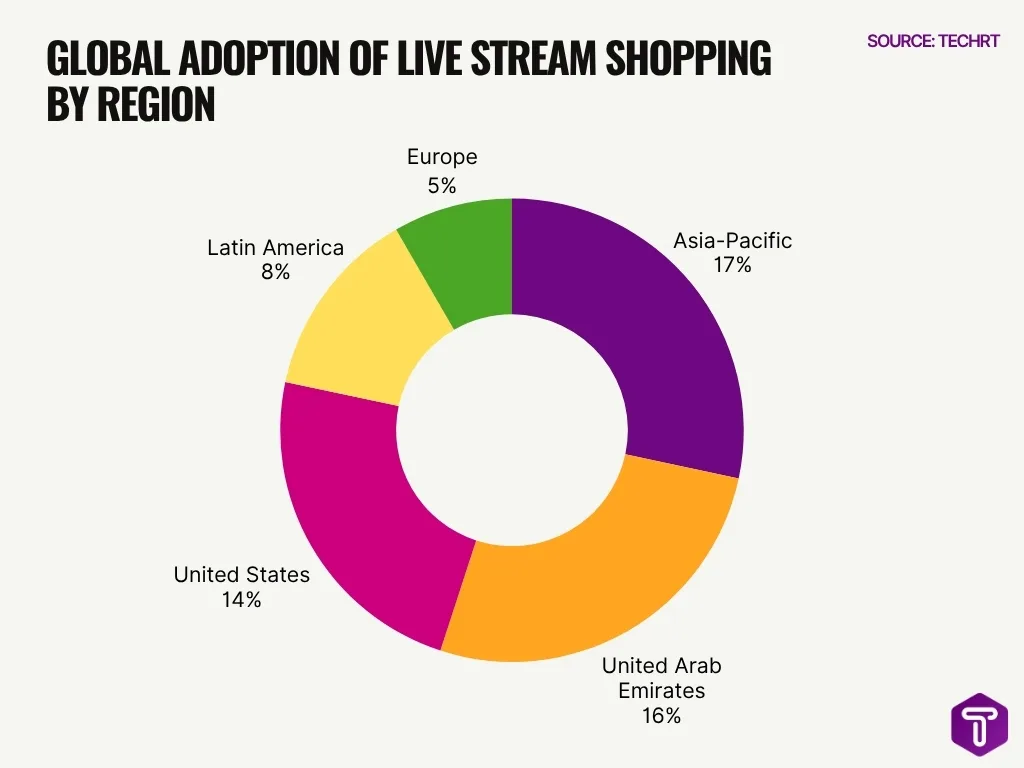
- Asia-Pacific leads globally with the highest adoption at 17%, highlighting its dominance in live commerce trends.
- The United Arab Emirates follows closely at 16%, indicating strong growth and consumer engagement in the Middle East.
- The United States records 14%, showing steady adoption but still trailing behind the Asia-Pacific and UAE markets.
- Latin America stands at 8%, reflecting emerging but comparatively lower penetration of live stream shopping.
- Europe has the lowest share at 5%, suggesting slower adoption and potential growth opportunities in the region.
- There is a significant gap of 12 percentage points between the highest (17%) and lowest (5%) regions.
- Overall, the data indicate that live stream shopping is more mature in Asia and select emerging markets than in Western regions.
Platform Market Share Statistics
- YouTube leads global platforms with 4.4 billion hours of watch time (March–April 2026), commanding significant market dominance.
- Twitch accounts for approximately 60.3% of live-streaming hours globally, maintaining strong positioning despite recent competition.
- Mobile devices drive 27% of all live-stream viewing hours globally, reshaping how audiences consume live content.
- TikTok Live generated a staggering 4.8 billion hours of watch time in Q1 2025, with 2.2 million concurrent viewers on average.
- Kick platform captured nearly 6% of the total live-streaming market share, emerging as a disruptive challenger within its first year.
- YouTube Gaming commanded 3 billion hours of gaming content watched on the platform in Q1 2024, establishing itself as the dominant gaming streaming destination.
- Facebook Live maintains relevance as a major platform with 42.6% of total live-stream users leveraging its social-first infrastructure.
- Live streaming consumption surged to 32.5 billion hours in 2024, representing a 12% year-over-year increase from 2023 levels.
- Internet users engaging with live content reached over 28.5% weekly, marking significant mainstream adoption of live streaming.
- Desktop and connected TV viewing accounts for approximately 73% of all live-stream watch time, with mobile representing the growing secondary segment.
Twitch Statistics
- Twitch recorded over 1.3 trillion minutes watched in 2024.
- The platform averaged 2.5 million concurrent viewers globally in 2025.
- Twitch hosts more than 7 million active streamers per month.
- Daily active users exceed 35 million globally, with strong US dominance.
- Gaming content makes up over 85% of Twitch streams, showing niche concentration.
- Twitch saw a 10% decline in watch hours in 2025, indicating competitive pressure.
- The average Twitch user spends 95 minutes per day watching streams.
- Top categories like “Just Chatting” generate 15%+ of total watch hours, reflecting diversification.
YouTube Live Viewership Trends
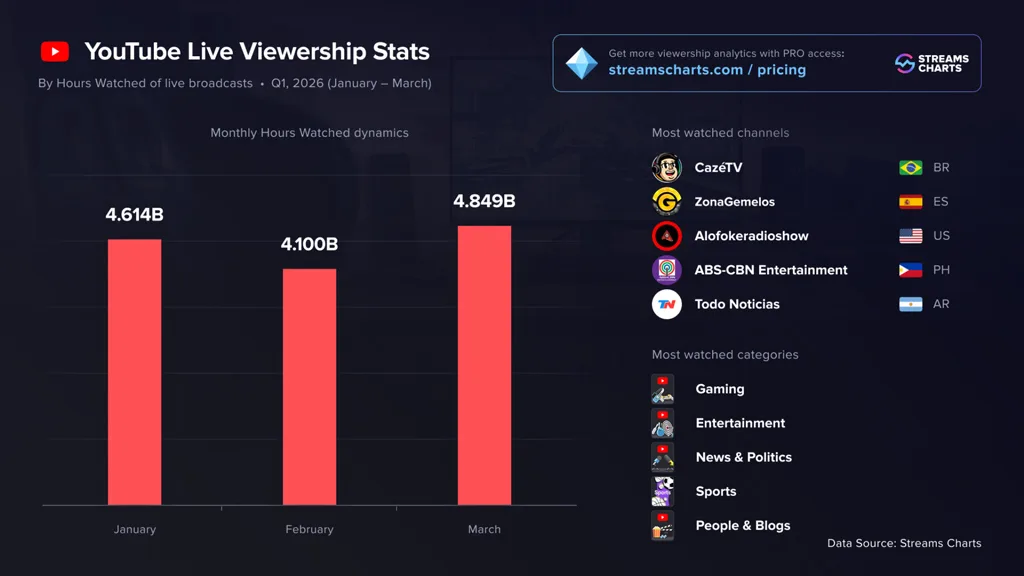
- Total watch time remained above 4 billion hours each month, highlighting consistently strong demand for live content on YouTube.
- March recorded the highest viewership at 4.849B hours, showing a strong rebound after a dip in February.
- February saw a decline to 4.100B hours, marking the lowest point in Q1 and a ~11% drop compared to January.
- January started strong with 4.614B hours watched, setting a high baseline for the quarter.
- From February to March, viewership grew by ~18%, indicating a sharp recovery in live streaming engagement.
- Gaming remains the dominant category, continuing to drive the largest share of live watch time.
- Other high-performing categories include Entertainment, News & Politics, Sports, and People & Blogs, reflecting diverse audience interests.
- Top-performing channels are globally distributed, with leaders from Brazil, Spain, the United States, the Philippines, and Argentina.
- CazéTV (Brazil) emerged as the most-watched channel, reinforcing the growing influence of regional creators.
- The presence of channels like ABS-CBN Entertainment and Todo Noticias highlights the strong role of media networks in live streaming.
- The data indicates that non-English and regional content is gaining significant traction, signaling a shift toward a more globalized streaming ecosystem.
- Overall, Q1 2026 demonstrates that YouTube Live continues to scale rapidly, with billions of hours watched monthly and strong cross-category engagement.
Emerging Platforms Growth
- Kick gained millions of users within its first year, reaching ~5% market share.
- TikTok Live surpassed 1 billion monthly active users engaging with live content.
- Instagram Live usage increased by 20% YoY in 2025, especially among creators.
- LinkedIn Live saw 2x growth in B2B streaming adoption between 2024 and 2025.
- Amazon Live is expanding eCommerce streaming, contributing to growing live shopping adoption.
- Niche platforms like Trovo and Rumble are growing with double-digit annual user increases.
- Live shopping streams in China generate over $500 billion annually, influencing global trends.
- Audio-first platforms grew over 25% in usage.
Audience Demographics
- Around 63% of live streaming viewers are under age 35, highlighting younger audiences.
- Gen Z accounts for over 40% of total live-streaming viewership globally.
- Male viewers represent ~60% of gaming live-stream audiences, while non-gaming is more balanced.
- Female participation in live streaming increased by 18% YoY in 2025.
- The US remains a top market, contributing over 20% of global streaming audiences.
- Asia-Pacific leads with 44%+ user share, driven by mobile adoption.
- Urban users account for over 70% of live-stream consumption, reflecting connectivity access.
- Over 50% of viewers watch streams daily or weekly, showing habitual usage.
Age Group Preferences
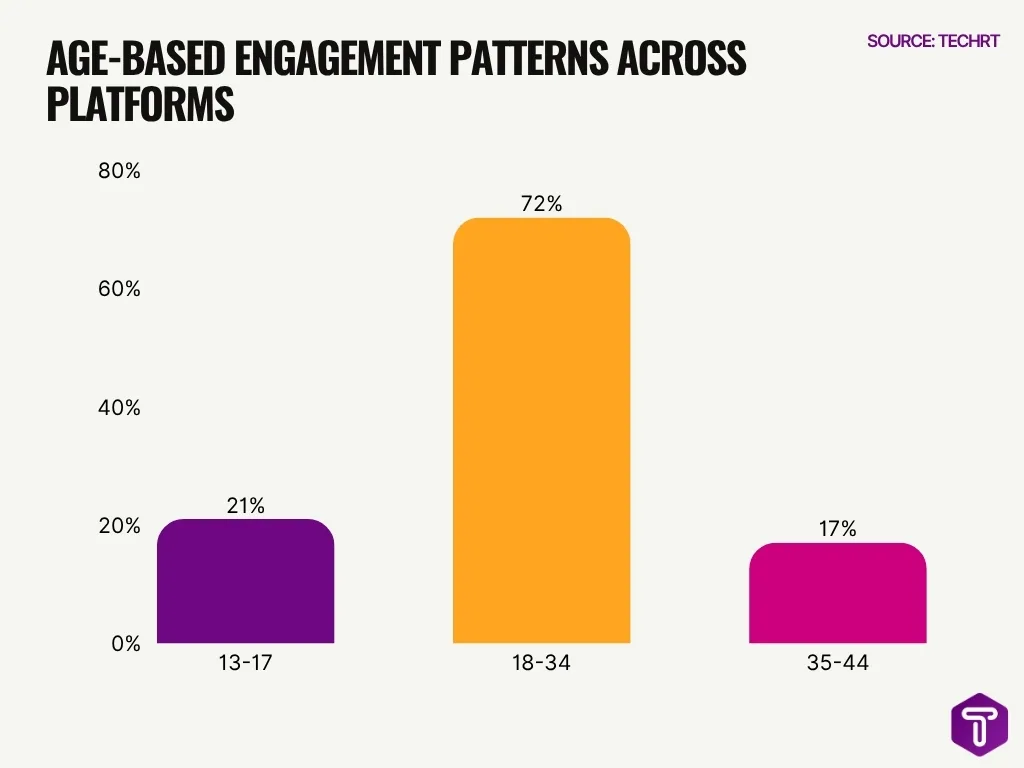
- Users aged 18–34 comprise 72% of total live-stream viewership across platforms.
- Teens aged 13–17 engage at 21% on TikTok Live, demonstrating a strong preference for short-form formats.
- Viewers aged 25–34 log 95 minutes daily on streaming platforms, the highest duration among all age demographics.
- Millennials (25–34) drive 40.3% of TikTok user engagement and dominate paid subscription adoption.
- Gen Z viewers show 42.8% live-stream participation rates, significantly exceeding general population engagement.
- Users aged 35–44 represent 16.5% of TikTok’s user base, showing steady growth in platform adoption.
- Adults aged 55+ have not watched live streams at rates of 40%, indicating limited adoption in older demographics.
- Mobile consumption accounts for 65% of viewing across all age groups, with smartphones dominating viewing methods.
- Nearly 70% of TikTok’s user base is under 35, with the 25–34 segment at 40.3% representing the platform’s largest cohort.
- Gen Z users engage via interactive features, including chat and reactions, at substantially higher rates than older age groups.
Top Streamers Rankings
- The top Twitch streamers generate millions of followers, with leaders exceeding 20–30 million followers.
- Streamers like Ninja and xQc consistently rank among the top 5 by watch hours.
- YouTube creators such as MrBeast dominate with hundreds of millions of subscribers and massive live reach.
- Top streamers can attract over 100,000 concurrent viewers per stream.
- The highest-earning streamers generate $3–5 million annually from streaming alone.
- Gaming streamers still dominate rankings, accounting for over 70% of top channels.
- Non-gaming creators are rising, especially in IRL and podcast-style streams.
- Regional stars in Asia attract millions of concurrent viewers, surpassing Western creators in scale.
Gaming and eSports Live Streaming Statistics
- Gaming live streams generated over 8.5 billion hours watched in Q2 2025 alone.
- The global esports audience reached 574 million viewers in 2024, with continued growth into 2026.
- Esports revenue is projected to exceed $2 billion by 2026.
- Twitch still hosts over 85% gaming-related content, making it the dominant gaming platform.
- YouTube Gaming surpassed Twitch in some quarters, capturing ~30%+ gaming watch share.
- Major esports events attract 1–5 million peak concurrent viewers.
- Mobile esports streaming contributes to over 40% of esports viewership.
- The US esports audience crossed 31 million viewers in 2025.
Top Non-Gaming Streaming Categories Statistics
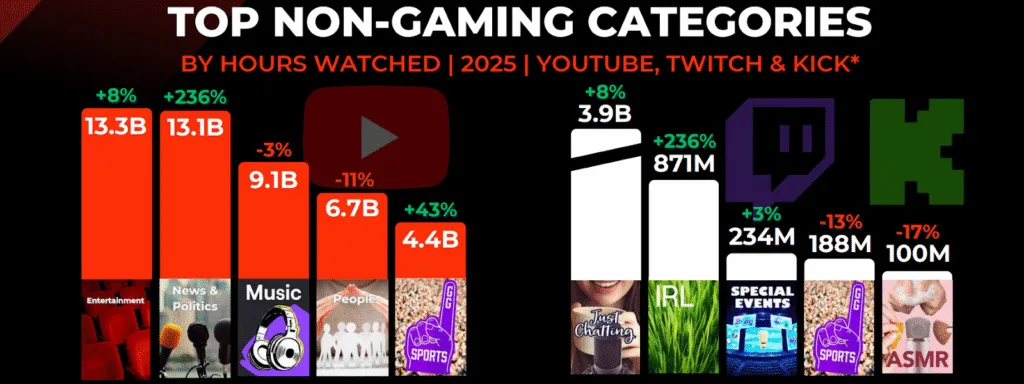
- Entertainment leads overall viewership, generating a massive 13.3 billion hours watched on YouTube, with steady +8% growth, making it the most dominant non-gaming category.
- News & Politics is the fastest-growing category, reaching 13.1 billion hours with an explosive +236% increase, signaling a major surge in demand for informational and real-world content.
- Music consumption is declining, dropping to 9.1 billion hours with a -3% decrease, indicating a shift away from traditional passive content.
- People (creator-driven content) see reduced engagement, recording 6.7 billion hours with a -11% decline, reflecting changing audience preferences.
- Sports is gaining traction, climbing to 4.4 billion hours watched with a strong +43% growth, highlighting rising interest in live and event-based content.
- Twitch’s “Just Chatting” dominates its platform, generating 3.9 billion hours with +8% growth, reinforcing the importance of real-time, interactive engagement.
- IRL content is booming across platforms, reaching 871 million hours on Twitch with a massive +236% growth, making it one of the fastest-growing content formats overall.
- Special Events show stable performance, contributing 234 million hours with a modest +3% increase, indicating consistent but slower growth.
- Sports underperforms on Twitch, declining to 188 million hours with a -13% drop, contrasting with its strong growth on YouTube.
- ASMR experiences the sharpest decline, falling to 100 million hours watched with a -17% decrease, signaling declining audience interest in niche relaxation content.
Popular Games Streaming Statistics
- League of Legends has surpassed 1 billion hours watched on Twitch historically.
- Grand Theft Auto V generated more than 1.4 billion hours watched across platforms.
- Valorant reached about 804 million hours of total streaming viewership.
- Fortnite exceeded 500 million hours watched on major streaming sites.
- PUBG Mobile drew 5.5 million hours watched in the last 7 days across platforms.
- League of Legends Worlds 2024 final peaked at 6.94 million concurrent viewers.
- Fortnite Zero Hour event hit 977.6K concurrent viewers on Twitch alone.
- Battle royale titles like Fortnite lead with 12.5 million weekly viewer hours on Twitch.
- Twitch averages 2.09 million concurrent viewers, mostly for popular games.
Streamer Monetization and Revenue Models
- Top streamers earn $3–5 million annually.
- Twitch subscriptions range from $4.99 to $24.99 per month.
- Ad-based revenue models account for over 60% of platform earnings.
- Donations contribute 20%–30% of streamer income.
- Sponsorship deals generate $10,000+ per campaign for mid-tier creators.
- YouTube monetization features show double-digit growth.
- Affiliate marketing and merchandise expand revenue streams.
- Live shopping taps into a $500B+ commerce market.
Why US Consumers Shop on Live Streams
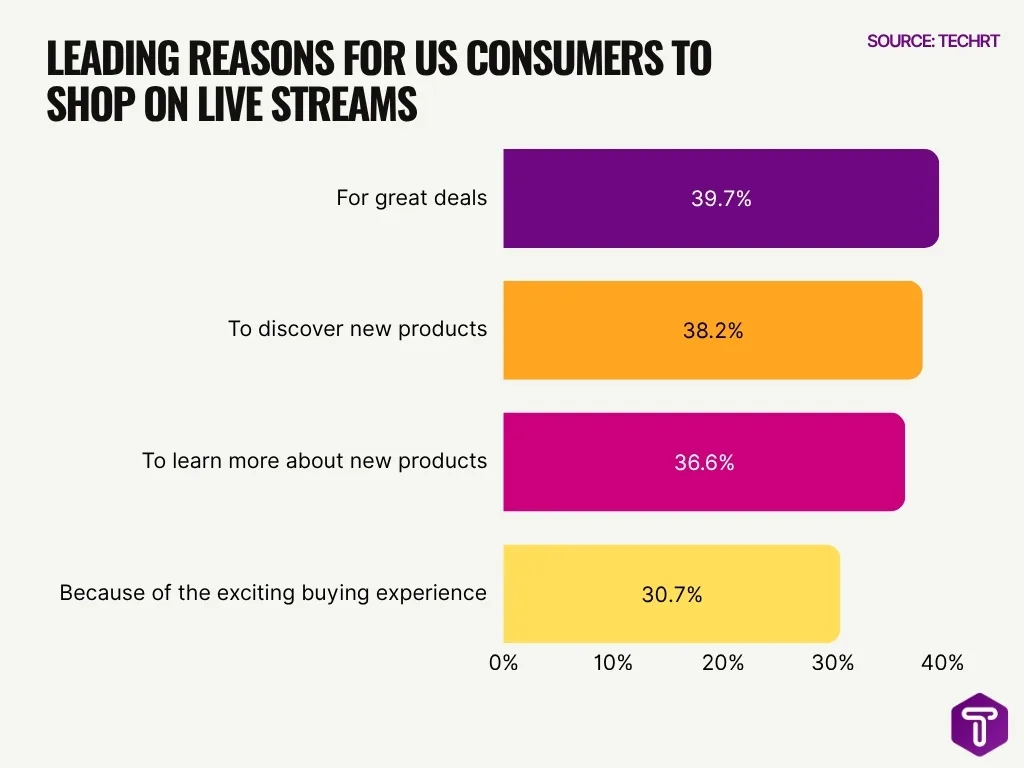
- The top motivation is savings, with 39.7% of shoppers joining live streams for great deals, making discounts the strongest driver of purchase behavior.
- Product discovery is nearly as important, as 38.2% of users shop live streams to discover new products, highlighting the platform’s role in exploration.
- A significant 36.6% of consumers tune in to learn more about new products, indicating strong demand for educational and demo-driven content.
- The entertainment factor matters, with 30.7% citing the exciting buying experience as a key reason, showing that engagement and interactivity influence conversions.
- The data reveals a clear pattern: value (deals), discovery, and education are the top three drivers, all closely clustered within a narrow range (36%–40%).
- While slightly lower, experiential shopping (30.7%) still plays a critical role, reinforcing that live commerce blends entertainment with eCommerce.
Engagement Metrics
- Live streams generate 10x more comments than pre-recorded content.
- Average watch time per live session reaches 25.4 minutes.
- Live streams see 3x higher engagement than recorded videos.
- Interactive features boost viewer participation by 30%.
- 57% of Instagram Live viewers watch at least 75% of the stream.
- Co-streaming among esports audiences increases viewership by 28%.
- Chat activity in live streams increases watch time by 27%.
- 51% of Gen Z prefer brands using interactive live videos.
- Viewers spend 10–20x longer on live video than on-demand.
Future Trends 2026
- 78% of the global live shopping market is currently dominated by China, with livestream shopping sales projected to exceed $1.1 trillion by 2026.
- 22% of shoppers use AI search tools like ChatGPT for product research, with millennials at 30% and Gen Zers at 26% leading adoption.
- 75% of surveyed executives believe OS-level AI assistants will increasingly control which shows and services appear on TV home screens by 2026.
- 21.1% of total retail sales are expected to come from global ecommerce in 2026 as platforms prioritize digital commerce expansion.
- 36% growth is projected for livestream shopping sales in the United States by 2026, accounting for more than 5% of total digital commerce sales.
- 75% of shoppers in India have already adopted livestream shopping, followed by Thailand at 73% and the UAE at 72%, demonstrating massive adoption in Asia and MENA regions.
- 6.7 billion global smartphone subscriptions currently exist, with projections to surge to 8 billion by 2028, marking a 19% rise in smartphone penetration, driving livestream commerce accessibility.
- AI-driven personalization is advancing from simple recommendations to personalized interfaces, dynamic thumbnails, adaptive content, and contextual awareness that adjusts based on viewer behavior and time of day.
Frequently Asked Questions (FAQs)
What is the projected live streaming market size in 2026?
How fast is the live streaming market growing globally?
How many hours of live streaming content are watched globally?
What percentage of internet users watch live streams regularly?
How much did livestream ecommerce sales reach in the US?
Conclusion
Live streaming reflects a rapidly expanding ecosystem shaped by mobile-first consumption, creator-led economies, and platform innovation. What began as a gaming-centric activity has now expanded into multiple industries, including retail, education, corporate communication, and entertainment. This shift highlights how audiences increasingly prefer real-time, interactive content over static formats.
At the same time, advancements in AI, 5G connectivity, and immersive technologies are pushing the boundaries of what live streaming can offer. Businesses are leveraging these capabilities to create more personalized and engaging experiences, while creators continue to diversify their revenue streams through subscriptions, sponsorships, and live commerce.
Looking ahead, live streaming will not only grow in scale but also in influence, becoming a central pillar of digital communication and content strategy. As user expectations evolve, platforms and creators that prioritize interactivity, authenticity, and seamless experiences will lead the next phase of growth in this dynamic industry.

Leave a comment
Have something to say about this article? Add your comment and start the discussion.