



Microsoft Teams has become a central hub for workplace communication, bringing chat, video meetings, file sharing, and app integrations into a single platform. Today, companies rely on Teams to coordinate remote engineering teams, manage customer support operations, and streamline workflows across distributed offices. For example, healthcare providers use it to enable real-time collaboration between clinicians, while global enterprises depend on it to run daily meetings across time zones.
As hybrid work becomes the norm and AI-powered features like Copilot reshape productivity, Teams continues to influence how organizations operate at scale. Understanding its growth, usage patterns, and market position helps businesses make informed decisions about collaboration tools. Let’s explore the latest Microsoft Teams statistics to see how it’s shaping the future of work.
Editor’s Choice
- Microsoft Teams reached over 320 million monthly active users globally by 2024–2025.
- The platform recorded ~320 million daily active users in 2025, up from 270 million in 2022.
- Teams is used by more than 1 million organizations worldwide, reflecting enterprise-wide adoption.
- About 93% of Fortune 100 companies rely on Teams for collaboration.
- Monthly active users grew to ~360 million by mid-2025, showing continued expansion.
- Teams Phone reached 26 million PSTN users in 2025, up from 20 million in 2024.
- The platform processes hundreds of billions of meeting minutes daily, highlighting massive engagement.
Recent Developments
- Microsoft introduced a new Teams client with faster performance, improving load times and memory usage.
- AI-powered features like Copilot in Teams now generate meeting summaries and action items automatically.
- Teams Phone adoption grew by 30% between 2024 and 2025, signaling demand for integrated calling.
- Microsoft unbundled Teams from Microsoft 365 in parts of Europe due to antitrust scrutiny.
- Daily message activity peaks mid-morning, with 54% of users active by 11 a.m., reflecting workday patterns.
- Teams continues replacing legacy tools like Skype for Business, consolidating Microsoft’s communication stack.
- Organizations increasingly integrate Teams with third-party apps and workflows, expanding its ecosystem.
- Hybrid work trends drive ongoing feature updates focused on flexibility and asynchronous collaboration.
Key Microsoft Teams Statistics Overview
- Microsoft Teams launched in 2017 as part of the Microsoft 365 ecosystem.
- The platform supports 48+ languages, enabling global adoption.
- Teams integrates with Microsoft 365 apps like SharePoint and Exchange, forming a unified workspace.
- It surpassed 300 million monthly users in 2023, continuing upward growth.
- Teams accounts for ~80% of Microsoft 365 active users’ engagement, highlighting deep integration.
- Around 50% of Microsoft 365 commercial users actively use Teams.
- The platform supports chat, video conferencing, file sharing, and app integrations in one interface.
- Teams usage surged during COVID-19, jumping from 44 million DAUs in 2020 to over 145 million in 2021.
Microsoft Teams User Growth Over Time (2017–2026)
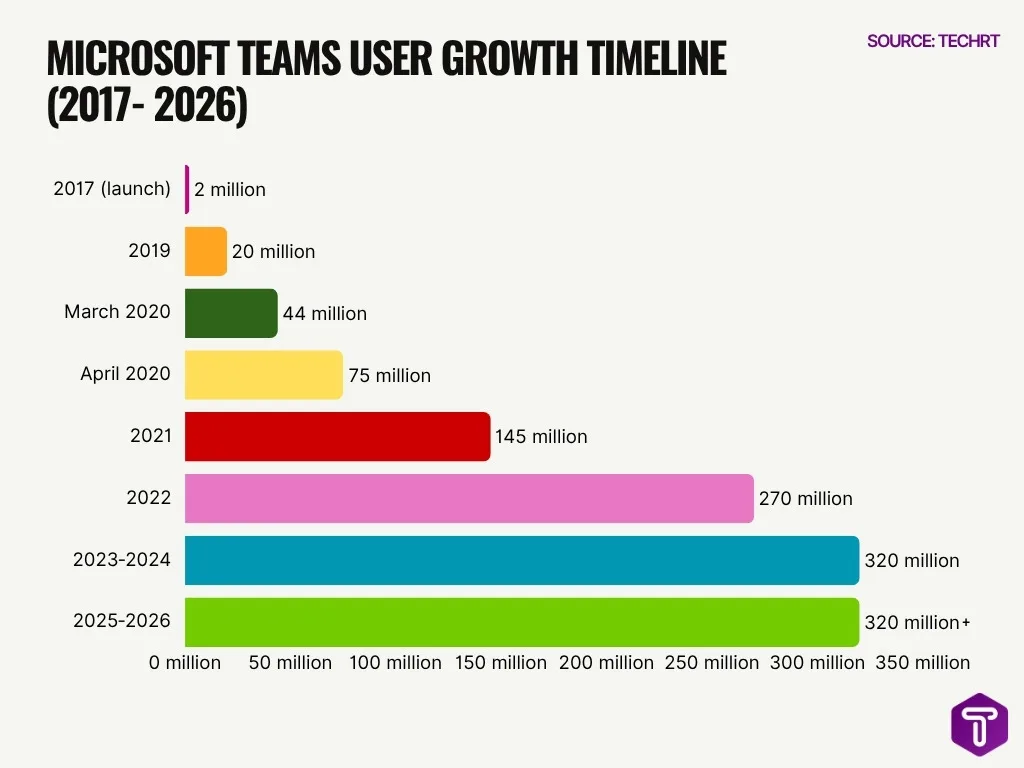
- Teams started with ~2 million users in 2017, shortly after launch.
- Daily active users reached 20 million in 2019, showing early traction.
- Usage surged to 44 million DAUs in March 2020 during early pandemic shifts.
- By April 2020, Teams hit 75 million daily users, nearly doubling in weeks.
- In 2021, Teams reached 145 million daily active users, driven by remote work adoption.
- Monthly users climbed to 270 million in 2022, maintaining post-pandemic growth.
- By 2023–2024, Teams crossed 320 million users, marking a major milestone.
- In 2025–2026, daily users stabilized around 320 million+, showing maturity with continued incremental growth.
Microsoft Teams Usage and Adoption Snapshot (2026)
- Microsoft Teams has approximately 320 million daily active users in 2025–2026.
- Monthly active users reached up to 360 million in 2025, showing steady adoption.
- Over 1 million organizations globally use Teams as a primary collaboration tool.
- In the United States alone, ~8 million businesses rely on Teams.
- Teams leads enterprise collaboration tools, outperforming Slack’s ~65 million MAUs.
- Adoption continues in hybrid workplaces, with Teams serving as a central digital workspace.
- About 25% of Teams users leverage calling features (Teams Phone).
- Teams has remained one of the fastest-growing enterprise SaaS platforms since 2020.
Daily and Monthly Active Users of Microsoft Teams
- Microsoft Teams recorded approximately 320 million daily active users (DAUs) in 2025, reflecting steady engagement.
- Monthly active users (MAUs) reached ~360 million in 2025, up from 320 million in 2023.
- In 2022, Teams had around 270 million MAUs, showing a strong post-pandemic baseline.
- Daily meeting participants exceeded 100 million users per day during peak hybrid work adoption.
- Teams users generate billions of chat messages daily, indicating high interaction levels.
- About 70% of users engage with Teams daily, highlighting habitual usage patterns.
- Teams meetings account for hundreds of millions of meeting minutes daily, reflecting sustained usage.
- The average Teams user spends 30–60 minutes daily on the platform for collaboration.
Microsoft Teams Adoption by Company Size
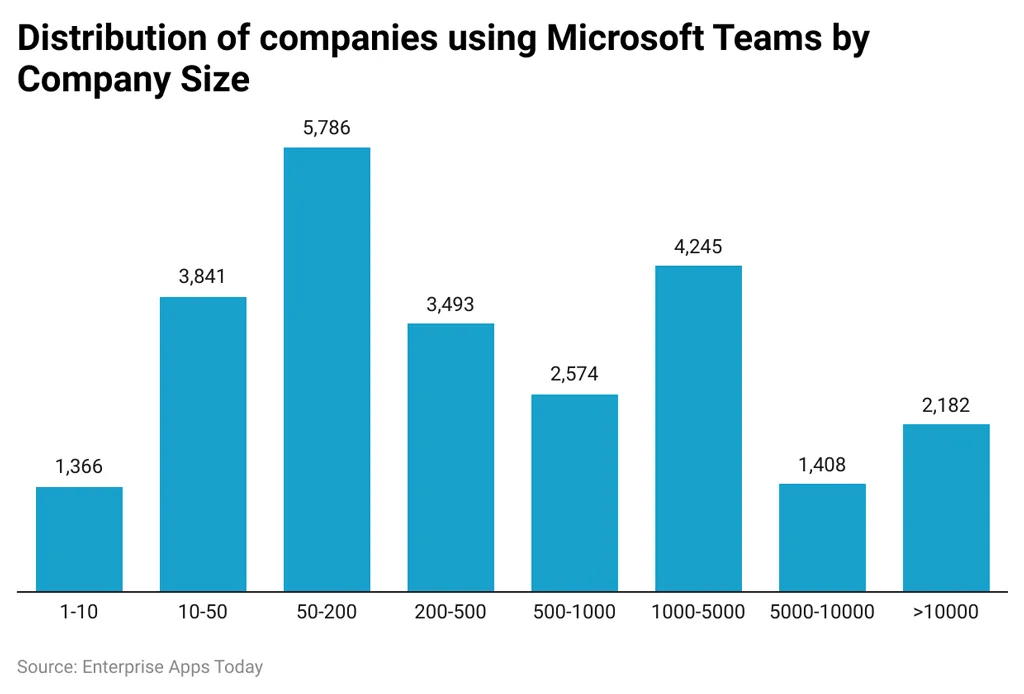
- The 50–200 employee segment leads adoption with 5,786 companies, making it the most dominant user group.
- Mid-sized businesses (10–50 employees) show strong usage with 3,841 companies, highlighting high SMB engagement.
- Companies with 1,000–5,000 employees account for 4,245 users, indicating significant enterprise-level adoption.
- The 200–500 employee segment contributes 3,493 companies, reinforcing steady mid-market penetration.
- Smaller organizations (1–10 employees) have relatively lower adoption at 1,366 companies, suggesting slower uptake among micro-businesses.
- Adoption drops in the 500–1,000 employee range to 2,574 companies, showing a slight dip in this segment.
- Large enterprises with over 10,000 employees still show solid usage at 2,182 companies, reflecting continued relevance at scale.
- The 5,000–10,000 segment records the lowest adoption among larger firms, with 1,408 companies.
- Overall, small-to-mid-sized businesses (10–200 employees) dominate Microsoft Teams usage, indicating its strong positioning in the SMB and mid-market segments.
Organizations Using Microsoft Teams Worldwide
- Over 1 million organizations globally use Microsoft Teams as of 2025.
- Approximately 93% of Fortune 100 companies rely on Teams for internal communication.
- More than 500,000 organizations adopted Teams within its first two years (2017–2019).
- In the US, around 8 million businesses use Teams, making it a dominant enterprise tool.
- Teams is deployed in 181 markets worldwide, supporting global operations.
- Government agencies and public sector organizations increasingly adopt Teams for secure collaboration environments.
- Educational institutions, including over 270,000 schools, use Teams for remote learning and collaboration.
- Healthcare providers use Teams to coordinate clinical workflows and telehealth services, expanding adoption in regulated sectors.
Microsoft Teams Usage by Region
- The United States accounts for over 35% of Teams users, making it the largest market.
- Europe represents ~30% of Teams adoption, with strong usage in the UK, Germany, and France.
- Asia-Pacific adoption is growing rapidly, with 20%+ annual growth in countries like India and Japan.
- Teams is available in 181 countries, supporting global enterprise operations.
- In the UK, over 500,000 organizations use Teams, reflecting high penetration.
- Canada and Australia show strong adoption, with enterprise usage exceeding 60%.
- Emerging markets in Latin America and Southeast Asia are seeing double-digit growth rates in Teams adoption.
- Microsoft’s cloud infrastructure expansion supports regional growth and lower latency, boosting adoption globally.
Global Adoption of Microsoft Teams by Country
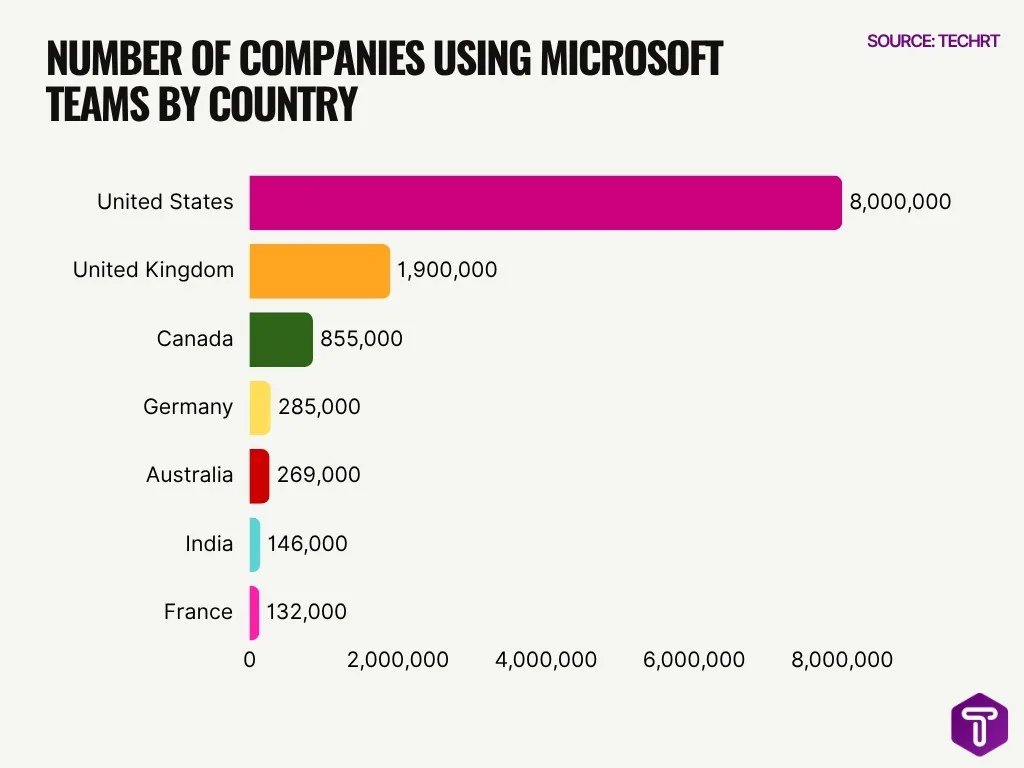
- The United States leads significantly with 8.0 million companies, making it the largest market for Microsoft Teams adoption.
- The United Kingdom ranks second with 1.9 million companies, showing strong enterprise and SMB penetration.
- Canada follows with 855,000 companies, reflecting high adoption across North American markets.
- Among European countries, Germany (285,000) and France (132,000) show moderate but growing adoption levels.
- Australia records 269,000 companies, indicating strong uptake in the Asia-Pacific region.
- India has 146,000 companies, highlighting emerging growth potential in a rapidly digitizing market.
- There is a sharp drop-off after the top two countries, with the U.S. alone accounting for a dominant share of adoption.
- English-speaking markets (U.S., U.K., Canada, Australia) collectively show higher adoption rates, suggesting language and ecosystem alignment advantages.
- Overall, adoption is heavily concentrated in developed economies, with expansion opportunities in emerging markets like India.
Microsoft Teams Meeting and Video Conferencing Statistics
- Teams hosts over 100 million meeting participants daily, highlighting its scale.
- The platform supports meetings with up to 1,000 interactive participants, expanding enterprise use cases.
- Teams Live Events can accommodate up to 20,000 attendees, supporting large-scale broadcasts.
- Video calls increased by over 1,000% during 2020–2022, with sustained high usage afterward.
- Teams users generate billions of meeting minutes monthly, reflecting consistent engagement.
- Approximately 80% of Teams users participate in meetings weekly, showing widespread reliance.
- Features like background blur and Together Mode improved user engagement and meeting experience.
- Hybrid meetings now dominate, with over 60% of meetings including remote participants.
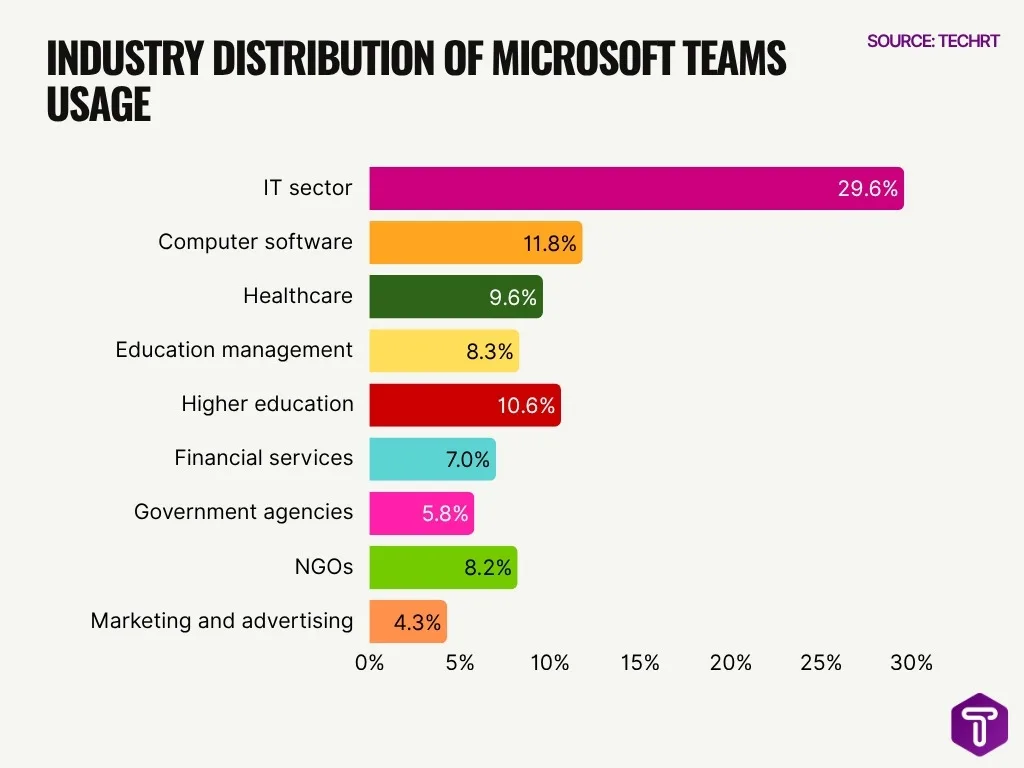
Microsoft Teams Usage by Industry and Sector
- The IT sector leads Microsoft Teams usage at 29.6% of total adoption, followed closely by computer software at 11.8%.
- Healthcare accounts for 9.6% of Teams users, supporting clinical coordination and telehealth.
- Education management represents 8.3% of usage, with higher education at 10.6% across schools and universities.
- Financial services comprise 7.0% of Teams adoption for secure collaboration and compliance.
- Government agencies make up 5.8% of users, leveraging Teams for remote policy discussions.
- Over 400,000 educational institutions globally use Teams, serving ~100 million students.
- NGOs account for 8.2% of Teams usage, aiding global project coordination.
- The marketing and advertising sectors represent 4.3%, focusing on campaign brainstorming.
- Teams supports 320 million daily active users across industries, with 93% Fortune 100 adoption.
Microsoft Teams Chat, Channels, and Message Volume Statistics
- Teams users send over hundreds of millions of chat messages daily across 320 million monthly active users.
- Average knowledge workers receive 153 Teams messages every weekday, up 6% year-over-year.
- Microsoft reported over 40 billion daily chat messages in 2022, with volumes growing into 2025-2026.
- The number of Teams channels created exceeds 200 million globally, with up to 1,000 channels per team.
- Around 60% of organizations report users preferring chat over email for internal communication.
- Teams processes over a billion chats weekly, supporting structured channels and private messages.
- Message activity shows posts and replies peaking during weekday hours, with 57% workweek in communication.
- Over 27% of users actively post in channel messages, driving cross-team collaboration.
- Users engage in group chats, 1:1, and threaded conversations, reducing email dependency significantly.
Microsoft Teams Mobile App Downloads and Device Traffic
- Microsoft Teams mobile app surpassed 100 million downloads on Android alone, reflecting strong mobile adoption.
- The app consistently ranks among the top business apps on iOS and Android stores.
- Mobile devices account for ~35% of total Teams usage, showing a shift toward on-the-go collaboration.
- Teams mobile usage grew by 25% between 2023 and 2025, driven by hybrid work trends.
- Over 50 million users access Teams via mobile daily, particularly frontline workers.
- iOS users contribute to ~45% of mobile traffic, while Android dominates in emerging markets.
- Push notifications drive engagement, with over 60% of mobile users responding within minutes.
- Mobile-first features like voice notes and quick replies increased daily engagement rates by 20%+.
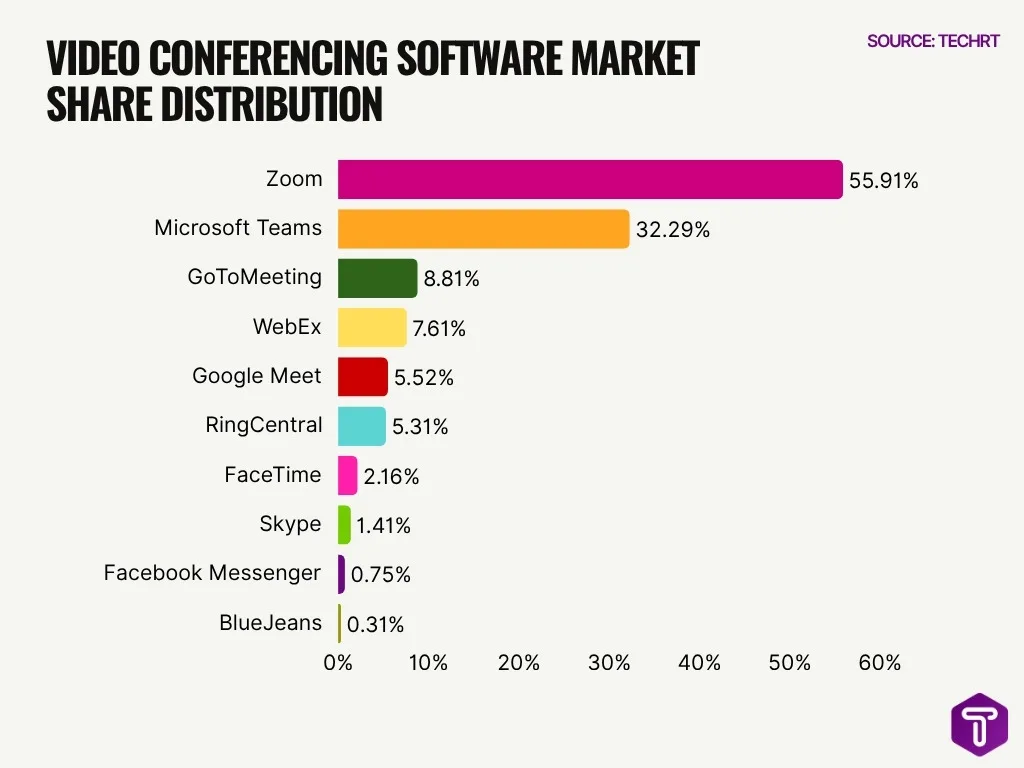
Video Conferencing Market Share Insights
- Zoom dominates the market with a commanding 55.91% share, making it the clear industry leader.
- Microsoft Teams holds a strong second position at 32.29%, highlighting its widespread adoption in enterprise and business environments.
- There is a significant gap of over 23 percentage points between Zoom and Microsoft Teams, indicating a highly concentrated market at the top.
- Mid-tier platforms like GoToMeeting (8.81%) and Cisco WebEx (7.61%) maintain moderate but much smaller shares.
- Google Meet captures 5.52%, reflecting steady usage, especially within the Google ecosystem.
- RingCentral accounts for 5.31%, competing closely with Google Meet in the mid-range segment.
- Lower-tier platforms such as FaceTime (2.16%) and Skype (1.41%) have relatively limited market presence.
- Consumer messaging tools like Facebook Messenger (0.75%) contribute minimally to the professional video conferencing market.
- BlueJeans has a negligible share of just 0.31%, indicating very low adoption compared to competitors.
- Overall, the market is heavily dominated by two platforms (Zoom + Microsoft Teams = 88.2%), showing a duopoly-like structure in the video conferencing industry.
Microsoft Teams Revenue and Financial Performance
- Microsoft does not report Teams revenue separately, but Microsoft 365 commercial revenue grew ~13% year-over-year in 2025.
- Microsoft’s Productivity and Business Processes segment generated over $69 billion in revenue in 2025.
- Teams contributes significantly to Microsoft 365 adoption, which has over 400 million paid seats globally.
- Enterprise customers drive the majority of revenue, accounting for over 70% of Microsoft 365 income.
- Teams Phone and premium add-ons contribute incremental revenue streams, especially in enterprise plans.
- Microsoft’s cloud revenue (including Teams) exceeded $110 billion annually, highlighting ecosystem strength.
- Subscription-based pricing ensures recurring revenue growth, tied to Teams usage.
- AI features like Copilot are expected to increase average revenue per user (ARPU) in the coming years.
AI, Copilot, and Premium Feature Usage in Microsoft Teams
- Microsoft 365 Copilot adoption grew rapidly in 2025, with millions of users leveraging AI features in Teams.
- AI-generated meeting summaries reduce note-taking time by up to 30%, improving productivity.
- Copilot can summarize chats and meetings, saving users hours per week on average.
- Premium Teams features, including webinars and advanced analytics, saw 20%+ adoption growth in 2024–2025.
- AI-powered noise suppression improves call clarity, used by over 70% of meeting participants.
- Teams Premium enables branding, advanced meeting controls, and security features, attracting enterprise users.
- Copilot integrates with Outlook and Word, creating a cross-platform AI productivity ecosystem.
- Early adopters report significant workflow efficiency gains, especially in large organizations.
Security, Compliance, and Admin Analytics Statistics for Microsoft Teams
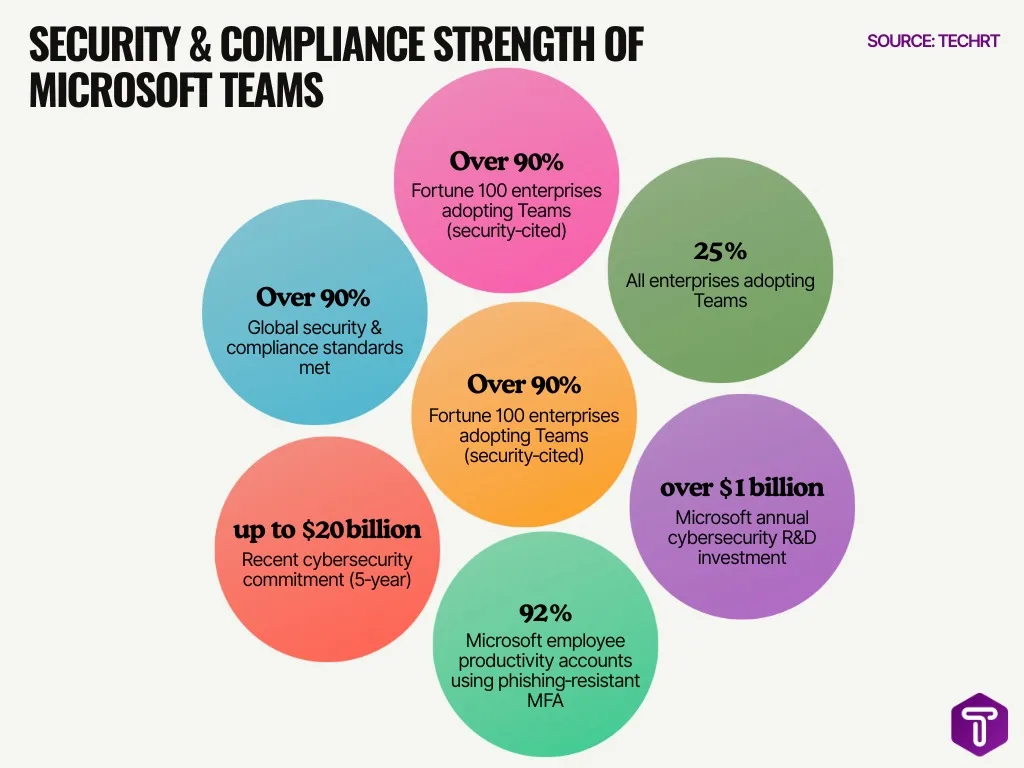
- Microsoft Teams complies with over 90 global security and compliance standards, including GDPR, HIPAA, ISO 27001, ISO 27018, SOC 1, SOC 2, and EU Model Clauses.
- Over 90% of Fortune 100 enterprises and 25% of all enterprises adopt Microsoft Teams, with security frequently cited as a primary driver.
- Microsoft invests over $1 billion annually in cybersecurity R&D, with recent commitments up to $20 billion over 5 years, directly enhancing Teams’ protection.
- 92% of Microsoft employee productivity accounts use phishing-resistant MFA, reflecting high enterprise adoption rates for Teams environments.
- Teams admin analytics provide aggregated usage metrics for 7, 30, 90, and 180 days, tracking user activity, posts, replies, and engagement.
- Microsoft Defender integration blocks over 7,000 password attacks per second and processes 78 trillion daily security signals, safeguarding Teams collaboration.
- 93% of Fortune 100 companies rely on Teams for secure collaboration, supported by end-to-end encryption and advanced threat protection.
- Teams analytics dashboards monitor active users, meetings, 1:1 calls, and channel messages, enabling admins to optimize performance and compliance.
Future Outlook and Growth Trends for Microsoft Teams
- Microsoft Teams is expected to exceed 400 million users by 2027, driven by AI and hybrid work adoption.
- AI integration will play a central role, with Copilot becoming a standard feature across enterprise plans.
- Hybrid work remains dominant, with over 70% of companies adopting flexible work models.
- Teams Phone is projected to grow beyond 30 million users by 2026, expanding unified communications.
- Integration with third-party apps will continue, with thousands of apps available in the Teams marketplace.
- Microsoft will focus on frontline worker solutions, increasing adoption in retail and manufacturing sectors.
- Enhanced analytics and automation will drive data-driven decision-making within Teams.
- Global expansion and cloud infrastructure investments will support growth in emerging markets.
Frequently Asked Questions (FAQs)
How many daily active users does Microsoft Teams have in 2026?
What is the monthly active user count for Microsoft Teams?
How many organizations use Microsoft Teams worldwide?
What market share does Microsoft Teams hold in video conferencing software?
How many users are on Microsoft Teams Phone?
Conclusion
Microsoft Teams has firmly established itself as a cornerstone of modern workplace collaboration, evolving far beyond a simple messaging tool into a comprehensive productivity platform. Its widespread adoption across enterprises, small businesses, and public sector organizations highlights its flexibility and ability to support diverse use cases, from virtual meetings to complex project coordination. Additionally, the integration of AI features like Copilot is redefining how teams manage information, automate tasks, and make decisions in real time. As hybrid and remote work models continue to expand, organizations increasingly look for unified solutions that reduce tool fragmentation and improve efficiency, and Teams fits that role effectively.
Looking ahead, continued innovation in AI, security, and integrations will likely strengthen its position in the collaboration market. Overall, the data makes one thing clear: Microsoft Teams is not just keeping up with the future of work; it is actively helping shape it.

Leave a comment
Have something to say about this article? Add your comment and start the discussion.