




Digital PR has become a core driver of modern marketing, blending media outreach with SEO to build authority, visibility, and long-term brand equity. Today, brands rely on digital PR not just for press mentions, but to earn high-quality backlinks, improve search rankings, and generate sustained organic traffic. For instance, SaaS companies often launch data-driven campaigns to rank on google.com and dominate competitive keywords, while eCommerce brands leverage media coverage to boost referral traffic, credibility, and conversions.
As competition intensifies and content saturation grows, digital PR now plays a critical role in standing out across crowded digital channels. Let’s explore the latest data shaping digital PR and what it means for marketers, agencies, and growing brands.
Editor’s Choice
- 48.6% of SEO professionals rank digital PR as the most effective link-building tactic in 2026.
- The global digital PR market reached $12.3 billion in 2023 and is projected to hit $25.4 billion by 2032.
- 85.8% of digital PR practitioners cite backlinks as the primary benefit of campaigns.
- The average press pitch open rate is 44% in 2025, reflecting strong engagement in outreach.
- Around 60% of earned media articles include backlinks, reinforcing SEO value.
- Digital PR campaigns generate results fast, with 85.2% showing SEO impact within 3–6 months.
- Only 2.2% of online content earns multiple backlinks, highlighting how competitive PR-driven coverage is.
Recent Developments
- 58% of SEOs increased their link-building budgets in 2026, signaling rising investment in digital PR.
- Search interest in “digital PR” grew 120% between 2024 and 2025, showing rapid adoption.
- 72% of PR professionals say digital PR became harder in 2025, due to competition and higher standards.
- About 45% of professionals struggle to prove ROI from digital PR campaigns.
- Nearly 60% of PR teams now shift budgets from traditional PR to digital PR.
- AI adoption in PR enables 40% faster campaign ideation and execution.
- Journalist expectations are rising, with 68% preferring data-backed pitches.
- Increased competition has led to 20–40% growth in publisher placement costs.
- 87% of link builders consider digital PR important for future strategies.
Digital PR Search Growth Trends
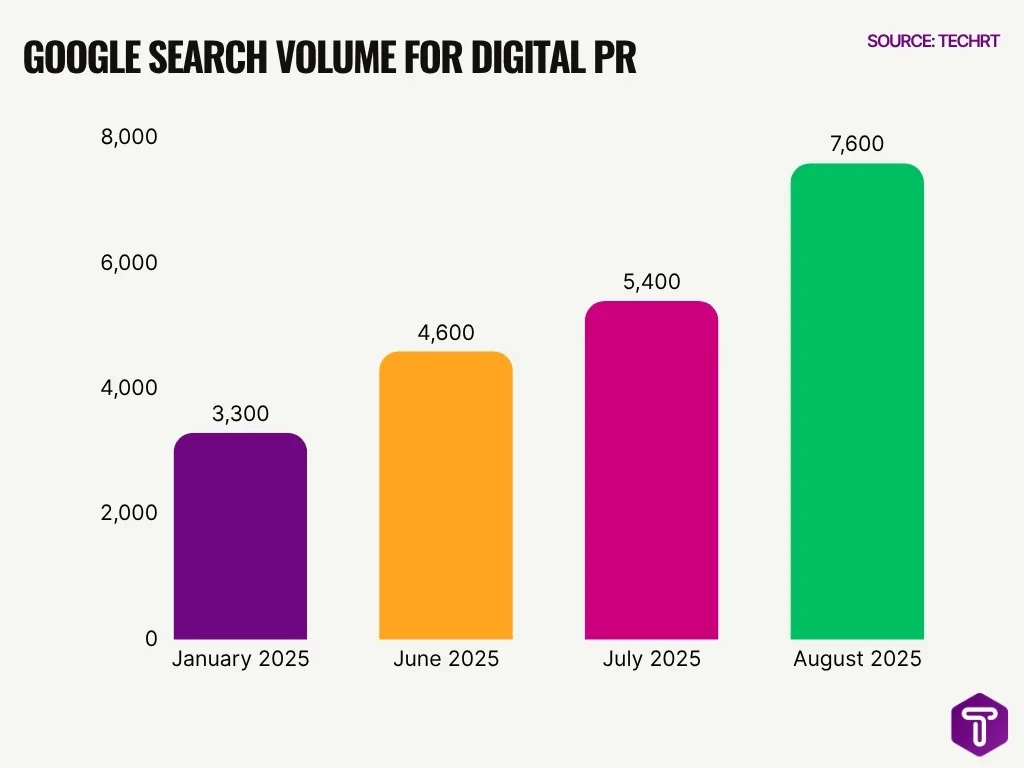
- Search interest in Digital PR shows a strong upward trajectory, growing from 3,300 in January 2025 to 7,600 in August 2025.
- There is a 130%+ increase in search volume between January and August, indicating rapidly rising industry interest.
- Mid-year momentum is evident, with searches climbing to 4,600 in June 2025, a 39% increase from January.
- Growth accelerates further in July 2025 (5,400 searches), reflecting a steady month-on-month expansion.
- The largest spike occurs in August 2025, where search volume jumps to 7,600, marking the peak demand period in the dataset.
- Overall, the data highlights a consistent and compounding growth trend, suggesting increasing adoption and awareness of Digital PR strategies.
- The sharp rise in later months may indicate seasonal demand, budget cycles, or increased marketing investments in the second half of the year.
Popularity of Digital PR Over Time
- Digital PR adoption has surged, with 45.6% of SEOs actively using it in 2026.
- 73% of link builders used digital PR as a strategy in 2025.
- Over 90% of campaigns now rely on data-led content, reflecting evolving strategies.
- Digital PR is now considered the top-performing link-building method by 34% of SEOs.
- PR-style outreach delivers the best results for 55% of marketers.
- Search demand for digital PR increased by over 100% year-over-year.
- Traditional PR budgets are shifting, with 60% of teams reallocating funds to digital channels.
- Digital PR is widely viewed as essential, with 87% of professionals rating it important.
Digital PR Campaign Statistics
- The average campaign earns links from 42 unique referring domains.
- Typical digital PR links have an average Domain Rating (DR) of 61, indicating strong authority.
- Over 20% of links come from DR70+ websites, including major publications.
- A successful press release generates 5 to 20 backlinks, with a median of 13.
- 95% of campaigns use data-led content, making it the dominant format.
- Around 8% of PR pitches result in media coverage, showing low but impactful conversion.
- PR professionals pitch an average of 31 journalists per campaign for one response.
- Most campaigns secure placements within 2–6 weeks of launch.
- High-performing placements can drive 1,000+ referral visits to a website.
Digital PR Collaboration Trends: SEO Dominates Cross-Team Work
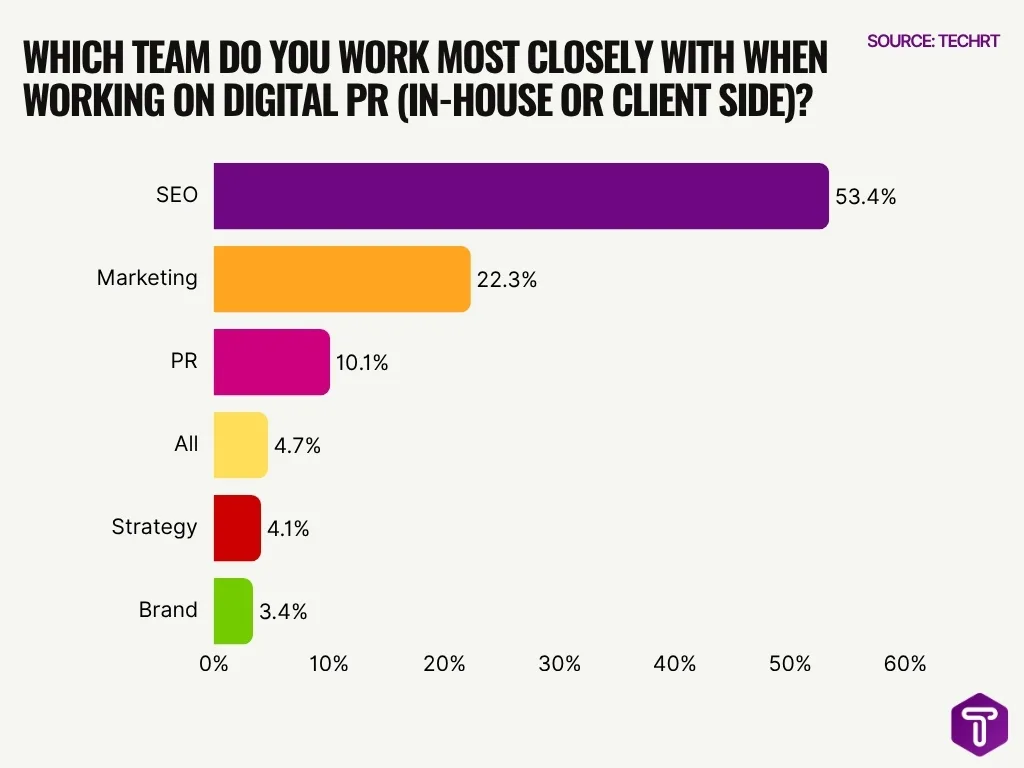
- SEO teams lead collaboration by a wide margin, with 53.4% of respondents working most closely with them, making SEO the primary driver of digital PR alignment.
- Marketing teams rank second at 22.3%, showing that integrated campaigns and brand messaging still play a significant supporting role.
- Only 10.1% collaborate most with PR teams, indicating a shift from traditional PR to performance-driven digital strategies.
- A small segment (4.7%) works across all teams, suggesting that fully integrated cross-functional collaboration is still limited.
- Strategy teams (4.1%) and Brand teams (3.4%) have the lowest direct involvement, highlighting that tactical execution (SEO/Marketing) outweighs high-level planning in daily PR workflows.
- Overall, the data underscores a clear trend: digital PR is increasingly SEO-centric, with link building, search visibility, and rankings driving collaboration priorities.
Digital PR Open Rate Statistics
- The average press email open rate reached 44% in 2025, up from ~39% in 2024, showing stronger engagement.
- Personalized subject lines improve open rates by 26% to 33%, especially in journalist outreach.
- Emails sent on Tuesdays record the highest open rates at 22% higher than average.
- Subject lines under 40 characters see up to 12% higher open rates than longer ones.
- Including a journalist’s name in the subject line increases open rates by 18%.
- Mobile optimization matters, as 61% of journalists open pitches on mobile devices.
- Follow-up emails can increase open rates by 21%, especially when sent within 48 hours.
- Emails with clear value propositions in the first sentence improve engagement by over 30%.
- Campaigns using segmented outreach lists see 17% higher open rates compared to generic lists.
Digital PR Backlink Statistics
- 85.8% of digital PR professionals identify backlinks as the top campaign outcome.
- The average campaign earns 42 backlinks from unique domains.
- Only 2.2% of online content generates multiple backlinks, making PR campaigns critical.
- High-authority backlinks (DR70+) account for 20%+ of placements in strong campaigns.
- Around 60% of media mentions include backlinks, improving SEO value.
- The average cost per backlink ranges between $500 and $2,000, depending on authority.
- Campaigns using data studies earn 2x more backlinks than generic content.
- Digital PR links typically have a Domain Rating of 50–70+, higher than most outreach links.
- Evergreen PR campaigns continue to generate backlinks for 6–12 months post-launch.
Backlink Distribution Trends by URL Rating
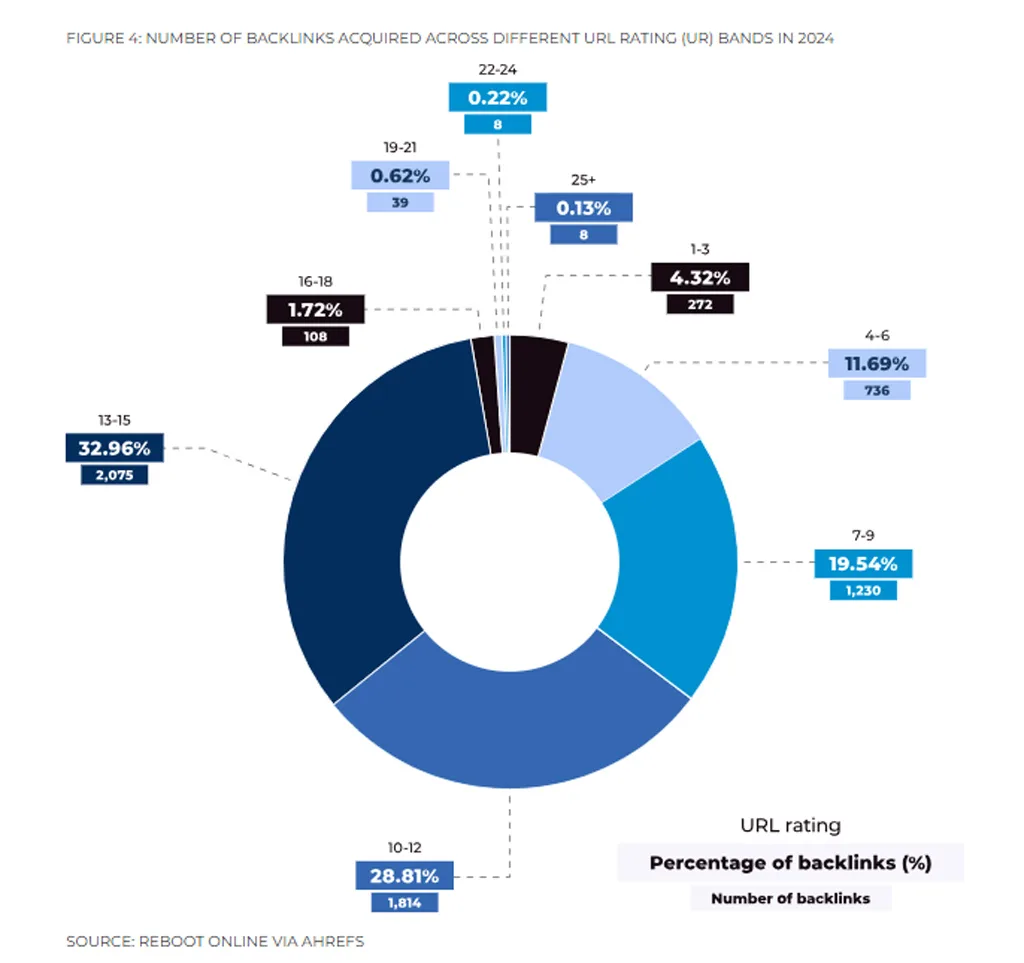
- The majority of backlinks are concentrated in the mid-range UR bands (10–15), contributing a combined 61.77% of all backlinks.
- The 13–15 UR band alone dominates with 32.96% (2,075 backlinks), making it the most significant contributor.
- The 10–12 UR band follows closely with 28.81% (1,814 backlinks), reinforcing the strength of mid-tier authority links.
- Lower UR bands still contribute meaningfully, with 7–9 UR accounting for 19.54% (1,230 backlinks) and 4–6 UR contributing 11.69% (736 backlinks).
- The lowest UR range (1–3) represents 4.32% (272 backlinks), indicating limited but present low-authority link acquisition.
- High-authority backlinks (UR 16 and above) are extremely scarce, contributing less than 3% combined.
- 16–18 UR: 1.72% (108 backlinks)
- 19–21 UR: 0.62% (39 backlinks)
- 22–24 UR: 0.22% (8 backlinks)
- 25+ UR: 0.13% (8 backlinks)
- The data clearly highlights a steep drop-off in backlink volume as URL Rating increases beyond UR 15, suggesting difficulty in acquiring high-authority links.
- Overall, the backlink profile is heavily skewed toward moderate authority sources, emphasizing that scalable link-building strategies rely more on mid-tier domains than premium ones.
Media Outreach Performance
- The average journalist response rate to PR pitches is 3.43%, highlighting the need for scale.
- Around 8% of pitches result in coverage, meaning only 1 in 12 emails lands a placement.
- Journalists receive 50–100+ pitches per day, increasing competition for attention.
- Nearly 68% of journalists prefer exclusive or original data in pitches.
- About 73% of journalists say relevance is the top factor in opening a pitch.
- Follow-ups increase reply rates by 28%, especially when tailored.
- Media placements in top-tier publications generate 2–5x more referral traffic than mid-tier outlets.
- Journalists reject over 80% of irrelevant pitches, reinforcing the need for targeting.
- PR campaigns with multimedia assets (images, charts) improve coverage likelihood by up to 55%.
Outreach Emails
- The average outreach email length that performs best is 50–150 words, balancing clarity and brevity.
- Emails under 200 words have a 40% higher response rate than longer emails.
- Including one clear CTA improves response rates by over 20%.
- Emails sent between 10 a.m. and 12 p.m. achieve the highest engagement.
- Personalized emails outperform generic outreach by 32% in response rates.
- Campaigns that include data or statistics in emails see 45% higher success rates.
- Outreach emails with attachments reduce response rates by 12%, suggesting a preference for inline content.
- Using bullet points in emails improves readability and increases replies by 16%.
- Follow-up emails account for 55% of total replies in PR outreach campaigns.
Digital PR Backlinks Statistics by Type of Link
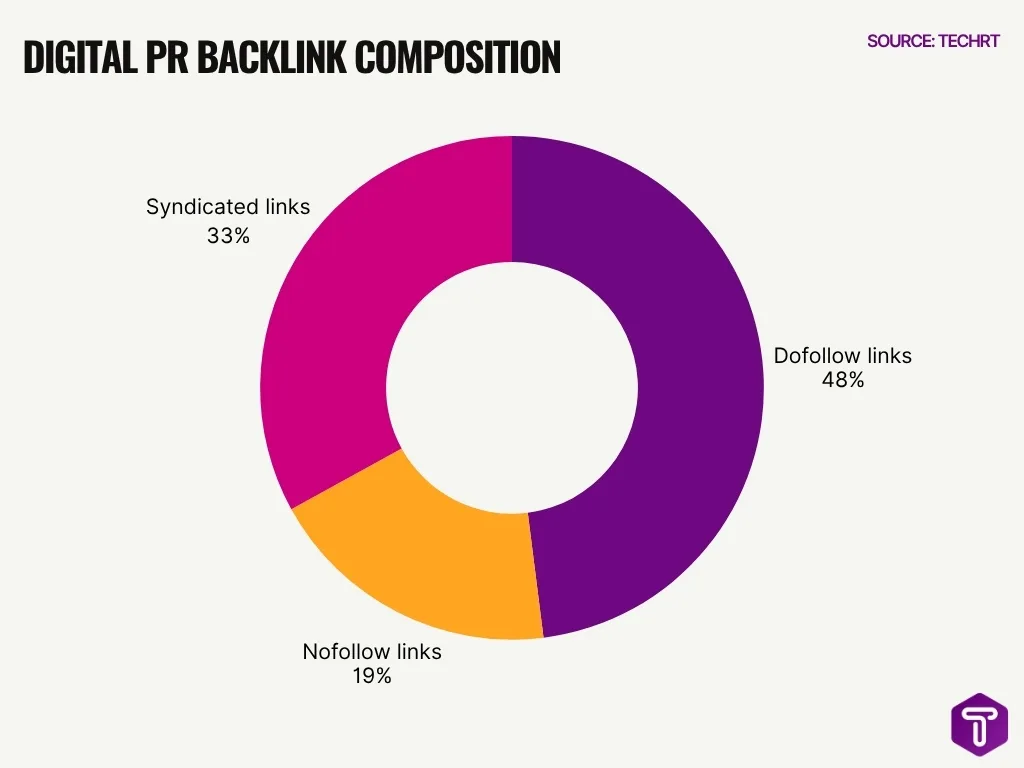
- Dofollow links account for 48% of digital PR backlinks, far outpacing other types.
- Nofollow links comprise 19% of digital PR backlinks in analyzed campaigns.
- Syndicated links make up 33% of total digital PR backlinks earned annually.
- Digital PR is deemed most effective by 89.6% of link builders for gaining backlinks.
- Homepage backlinks boost domain authority more than inner page links by distributing link juice site-wide.
- Editorial links from high-DR sites (70-79) represent 20.62% of digital PR backlinks.
- 53.2% of digital PR campaigns include syndicated links in their total backlink count.
SEO & Link Results From Digital PR
- Websites with strong backlink profiles rank 3.8x higher on average in search results.
- Digital PR campaigns can increase organic traffic by up to 30% within 3 months.
- Pages with more backlinks receive 91% more organic traffic than those without.
- The top Google result has 3.8x more backlinks than positions 2–10.
- 85.2% of campaigns show measurable SEO impact within 6 months.
- High-quality backlinks improve domain authority scores by 10–25% over time.
- Referral traffic from PR placements converts 25% higher than average traffic.
- Digital PR contributes to over 50% of off-page SEO success factors.
- Brands investing in digital PR see 2x faster ranking improvements compared to traditional link building.
Content That Wins Coverage
- Data-driven studies are used in over 90% of successful campaigns.
- Interactive content (quizzes, tools) increases coverage rates by up to 40%.
- Infographics generate 3x more shares and backlinks than standard blog posts.
- Newsjacking campaigns deliver 2–5x higher media pickup rates when timed correctly.
- Content with original research is 68% more likely to be cited by journalists.
- Long-form content (1,500+ words) earns 77% more backlinks than shorter pieces.
- Campaigns tied to trending topics see up to 60% higher engagement.
- Visual assets increase journalist pickup rates by 55%, especially charts and maps.
- Regional or niche datasets drive higher coverage in local media, improving relevance.
Digital PR Budget Allocation Insights
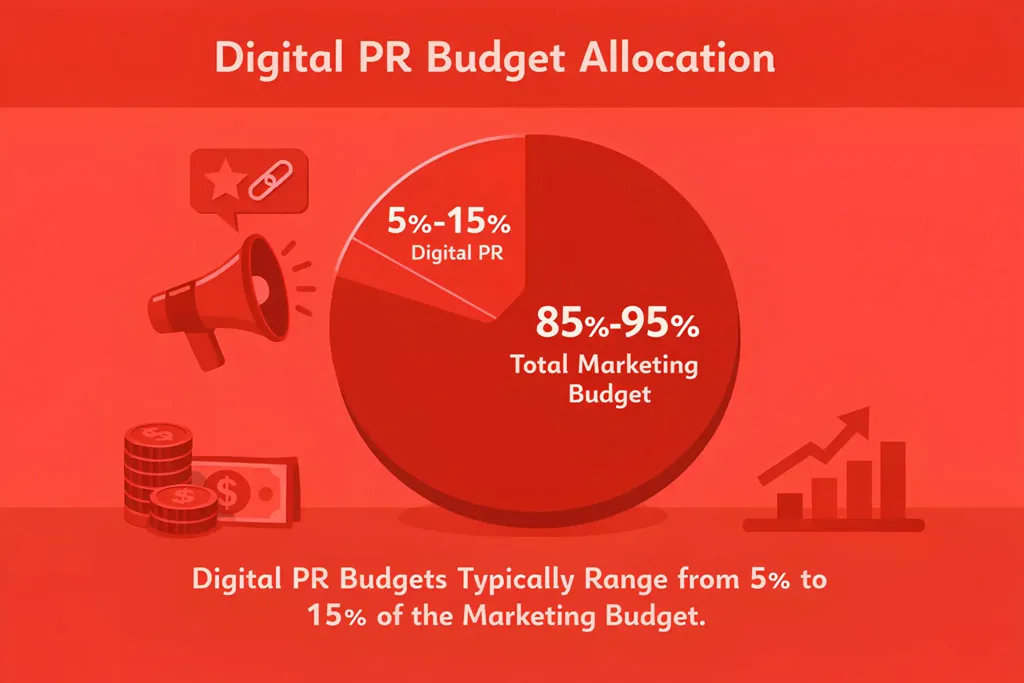
- Digital PR receives a relatively small share, typically just 5%–15% of the total marketing budget.
- The majority of the budget (85%–95%) is allocated to other marketing channels, highlighting where most spending is concentrated.
- Despite its smaller allocation, Digital PR plays a strategic role in brand visibility, backlinks, and authority building.
- The 5%–15% range indicates variability depending on company size, industry, and campaign priorities.
- Businesses investing closer to 15% in Digital PR are likely prioritizing organic growth and earned media.
- A lower allocation (around 5%) suggests traditional or performance marketing channels dominate the strategy.
- The data reflects a balanced marketing mix, where Digital PR complements paid ads, content marketing, and SEO efforts.
- Increasing Digital PR spend could signal a shift toward long-term brand equity over short-term ROI.
Digital PR Cost Statistics
- The average cost of a digital PR campaign ranges from $3,000 to $15,000 per campaign.
- High-end campaigns can exceed $50,000, especially for global brands.
- The average cost per backlink remains between $500 and $2,000, depending on authority.
- Freelance digital PR specialists charge $50 to $150 per hour.
- Agency retainers for PR services typically range from $2,000 to $10,000 per month.
- About 46.5% of companies spend $5,000–$10,000 monthly on PR and outreach.
- Small businesses often spend under $5,000/month, limiting campaign scale.
- Campaigns with data-led content cost 20–30% more, but deliver higher ROI.
- Paid media placements can increase total campaign costs by 40% or more.
Digital PR Impact on Brand Awareness, Trust, and Reputation
- Around 61% of businesses say increasing brand awareness is a top outcome of PR efforts.
- Brands mentioned in high-authority publications see up to 35% higher brand recall.
- 88% of consumers trust earned media more than traditional advertising.
- Companies featured in media outlets experience up to 2x higher trust scores compared to those without coverage.
- Positive media mentions increase purchase intent by 20–50%, depending on industry.
- 72% of marketers report that digital PR improves brand credibility and authority.
- Businesses with consistent PR coverage see up to 30% higher direct traffic growth.
- Negative press can reduce brand trust by 22% on average, showing the importance of reputation management.
- Campaigns that include thought leadership content increase brand trust by over 40%.
Key Risks of Generative AI in PR
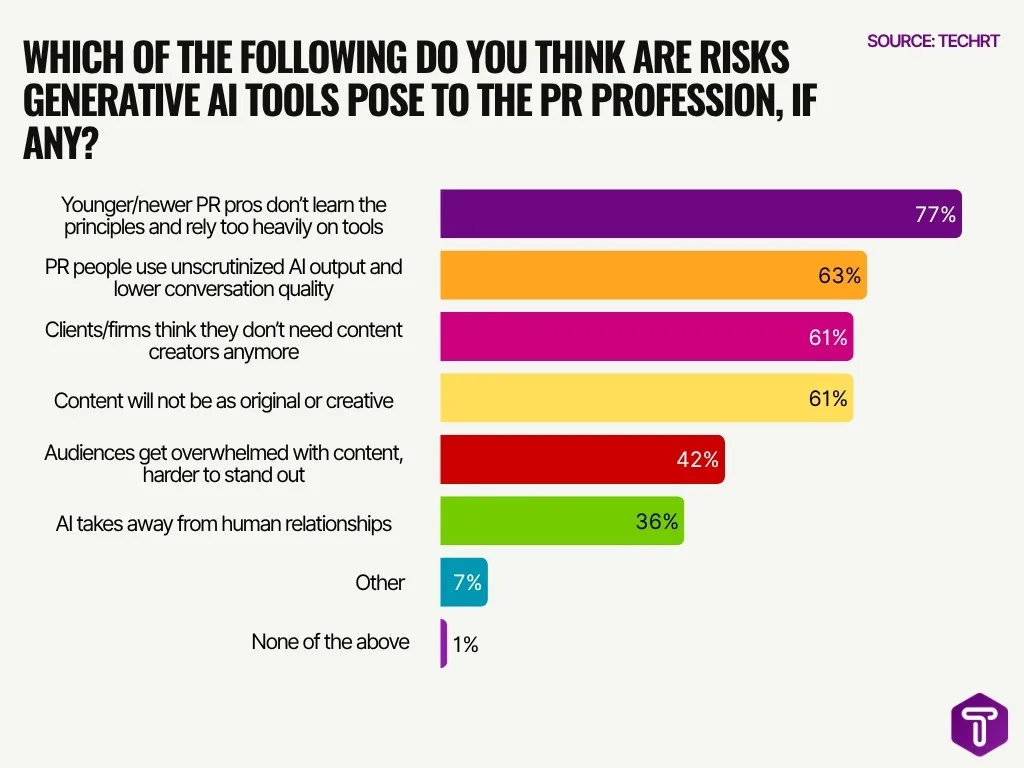
- Over-reliance on AI is the top concern, with 77% of respondents saying younger PR professionals may skip learning core principles and depend too heavily on tools.
- A significant 63% believe that unscrutinized AI-generated content is being used, which can reduce the quality of PR conversations and messaging.
- About 61% of respondents think that clients or firms may undervalue content creators, assuming AI can replace them entirely.
- Similarly, 61% say content originality and creativity are at risk, highlighting fears of generic or repetitive outputs from AI tools.
- Content saturation is a growing challenge, with 42% noting that audiences are becoming overwhelmed, making it harder for PR campaigns to stand out.
- 36% feel that AI could weaken human relationships, which are critical for trust-building and media relations in PR.
- A small segment (7%) identified other risks, indicating some additional niche or emerging concerns.
- Only 1% believe there are no risks at all, showing an overwhelming consensus that generative AI introduces real challenges to the PR profession.
Biggest Challenges
- 72% of PR professionals say digital PR is more competitive than ever.
- Around 45% struggle to prove ROI, making measurement a top concern.
- Journalists ignoring pitches remains a major issue, with over 80% of emails going unanswered.
- 38% of PR teams cite limited budgets as a barrier to campaign success.
- Content saturation means only 2.2% of content earns backlinks, increasing competition.
- 27% of businesses find PR reporting unclear or confusing.
- Maintaining consistent media relationships is challenging for over 50% of PR teams.
- Algorithm updates impact SEO results, affecting over 60% of PR-driven campaigns.
- Talent shortages in digital PR roles affect nearly 35% of agencies.
Frequently Asked Questions (FAQs)
What percentage of marketers consider digital PR the most effective link-building tactic?
How much content actually earns backlinks in digital PR campaigns?
What is the average cost per digital PR backlink?
What percentage of link builders use digital PR in their strategy?
How long does it take to see results from a digital PR campaign?
Conclusion
Digital PR continues to evolve as a critical link between SEO, content marketing, and brand building, with measurable impact across traffic, rankings, and reputation. The data shows that while competition is rising and campaign costs are increasing, the returns in terms of backlinks, visibility, and consumer trust remain strong and often outperform traditional marketing channels. Brands that invest in data-driven campaigns, targeted outreach, and clear performance metrics consistently achieve better results and long-term growth.
At the same time, the integration of AI is reshaping how campaigns are planned, executed, and optimized, making efficiency and personalization more accessible than ever. Ultimately, businesses that treat digital PR as an ongoing growth engine, rather than a one-time tactic, will be better positioned to build authority, capture attention, and sustain competitive advantage in the evolving digital landscape.

Leave a comment
Have something to say about this article? Add your comment and start the discussion.