



First-party data has become the backbone of modern digital marketing as brands move away from third-party tracking and opaque data-sharing practices. Instead of relying on external sources, companies now collect and manage data directly from their customers through websites, mobile apps, CRM systems, and loyalty programs. This shift not only improves data accuracy but also helps businesses stay compliant with evolving privacy regulations like GDPR and CCPA.
In practical terms, first-party data powers many of the experiences consumers now expect. eCommerce brands use it to deliver real-time product recommendations based on browsing behavior, while streaming platforms refine content suggestions to keep users engaged longer. Similarly, financial services and SaaS companies rely on first-party insights to personalize onboarding journeys and improve retention. As data ownership becomes a competitive advantage, understanding the latest statistics helps marketers make smarter, future-ready decisions.
Editor’s Choice
- 78% of marketers say first-party data is their most valuable data source in 2025.
- 92% of organizations are increasing investments in first-party data strategies due to privacy changes.
- Google’s phaseout of third-party cookies impacts over 60% of digital advertising ecosystems.
- 63% of consumers expect brands to use their data to deliver personalized experiences.
- Companies using first-party data see up to 2.9x higher revenue growth compared to competitors.
- 71% of consumers are more likely to trust brands that clearly explain data usage.
- Brands leveraging first-party data achieve up to 50% lower acquisition costs.
Recent Developments
- In 2025, Google delayed full third-party cookie deprecation but confirmed Privacy Sandbox rollout across Chrome.
- Apple’s App Tracking Transparency (ATT) reduced cross-app tracking by over 40% globally.
- 80% of marketers now prioritize first-party data over third-party alternatives post-ATT.
- Data clean rooms adoption increased by 70% year-over-year in 2024–2025.
- Retail media networks powered by first-party data grew by $45 billion globally in 2025.
- CDP (Customer Data Platform) adoption rose to 78% among enterprise companies.
- Regulatory frameworks like GDPR and CCPA influenced over 65% of global data strategies.
- AI-driven personalization using first-party data increased campaign ROI by up to 30% in 2025.
What is First-Party Data?
- First-party data refers to data collected directly from customers via owned channels like websites, apps, and CRM systems.
- 91% of marketers define first-party data as the most reliable data type.
- Website analytics contribute to over 60% of first-party data collection efforts.
- Email subscriptions remain a top source, with 77% of brands using email data for targeting.
- CRM systems store up to 85% of structured first-party customer data.
- Mobile apps generate 3x more behavioral data per user than desktop platforms.
- First-party data accuracy is 2–3 times higher than third-party datasets.
- 68% of companies rely on loyalty programs to collect first-party insights.
First-Party Data Adoption and Usage
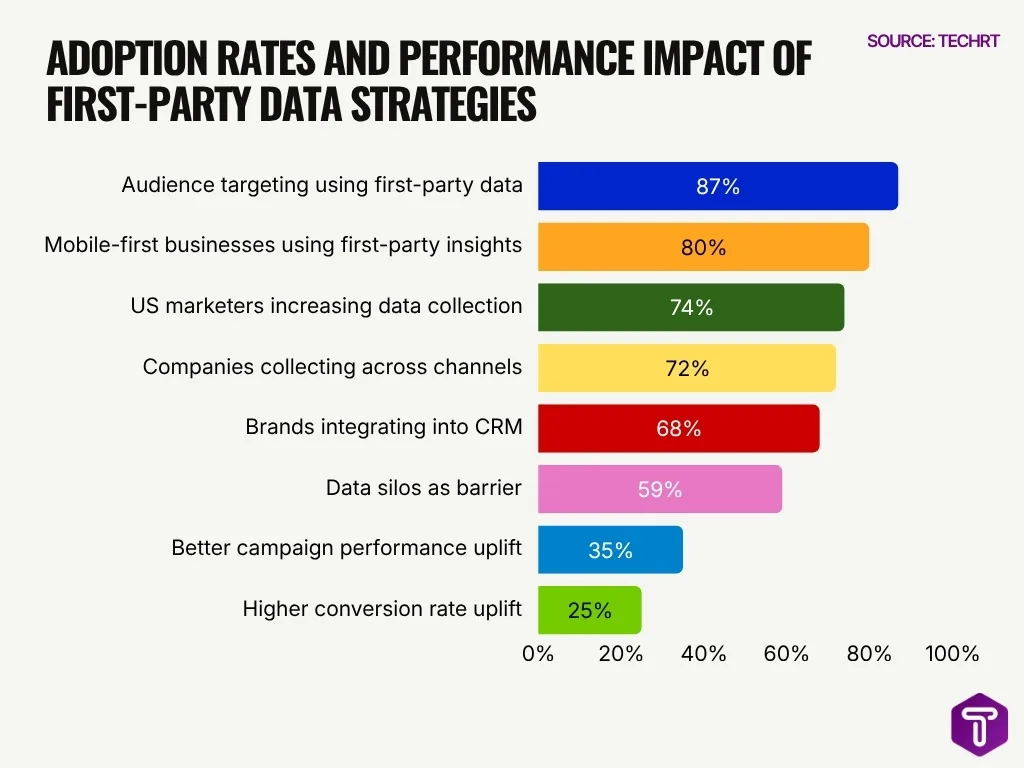
- 87% of marketers say first-party data is their primary source for audience targeting.
- 72% of companies actively collect first-party data across multiple channels.
- Organizations using first-party data report 25% higher conversion rates.
- 68% of brands integrate first-party data into their CRM systems.
- Mobile-first businesses rely on first-party data for over 80% of user insights.
- 59% of marketers say data silos remain a barrier to effective first-party data usage.
- Companies with unified first-party data strategies see up to 35% better campaign performance.
- 74% of US marketers increased first-party data collection efforts after privacy regulations tightened.
Importance of First-Party Data for Marketing
- 85% of marketers say first-party data is critical for delivering personalized campaigns.
- Brands using first-party data achieve up to 40% higher customer lifetime value.
- 73% of consumers prefer brands that use their data responsibly for better experiences.
- First-party data improves ad targeting accuracy by over 50% compared to third-party data.
- Companies using owned data see 20% faster campaign optimization cycles.
- Email campaigns powered by first-party data deliver up to 6x higher ROI.
- 64% of marketers cite privacy compliance as a key benefit of first-party data.
- Businesses using first-party data report 30% higher engagement rates across channels.
First-Party Data Market Size and Growth
- The global customer data platform market is expected to reach $10.3 billion by 2026.
- First-party data-driven advertising is projected to account for over 70% of digital ad spend by 2026.
- The data analytics market, driven by first-party data, will exceed $150 billion globally by 2025.
- 62% of enterprises increased budgets for first-party data infrastructure in 2024–2025.
- Retail media networks leveraging first-party data grew over 20% annually.
- Customer data platforms saw 34% CAGR growth between 2022 and 2025.
- 75% of brands plan to phase out reliance on third-party data by 2026.
- Investments in data privacy and compliance tools grew by 28% year-over-year.
How Advertisers Grow First-Party Data
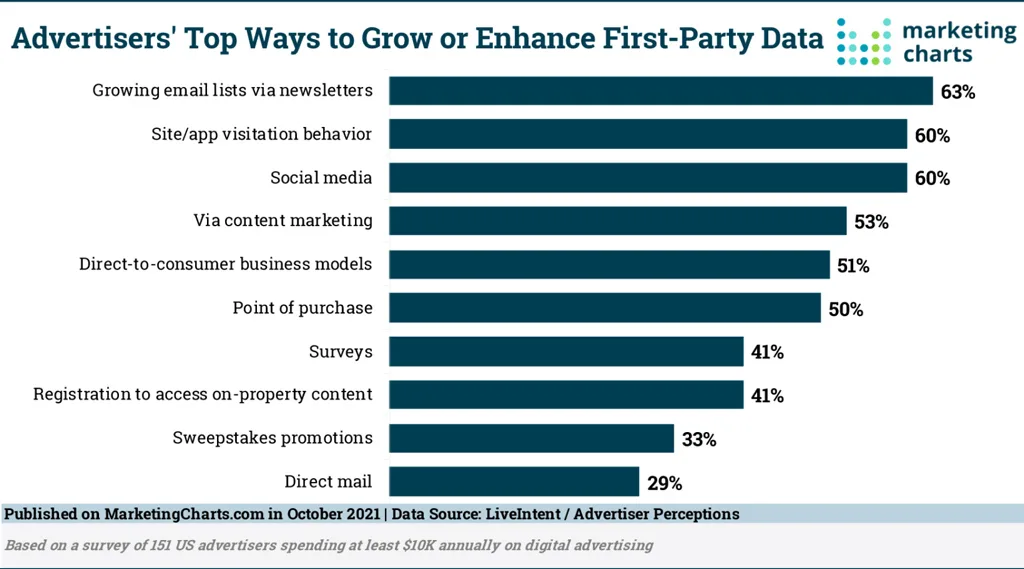
- Email newsletters dominate, with 63% of advertisers using them, making it the most effective and preferred strategy for first-party data growth.
- Behavioral tracking is critical, as 60% leverage site/app visitation data, highlighting the importance of user activity insights in data collection.
- Social media is equally powerful, also at 60%, showing its role as a major channel for capturing audience data and engagement signals.
- Content marketing drives value, with 53% adoption, proving that valuable content encourages users to willingly share data.
- Direct-to-consumer (DTC) models are rising, used by 51% of advertisers, emphasizing ownership of customer relationships and data control.
- Point-of-purchase data collection remains strong, at 50%, indicating that transaction moments are key opportunities for capturing first-party data.
- Surveys and gated content are equally utilized, both at 41%, reflecting a balanced strategy between explicit data collection (surveys) and value exchange (content access).
- Promotional tactics are less dominant, with sweepstakes used by 33%, suggesting lower reliance on incentive-based data collection.
- Traditional channels are declining, as only 29% use direct mail, showing a clear shift toward digital-first data strategies.
- Overall, the data highlights a strong preference for digital, behavior-driven, and value-exchange methods, while traditional and incentive-based approaches lag behind.
First-Party Data Sources
- CRM systems remain the top source, storing over 80% of structured customer data.
- Website analytics platforms contribute to 60%+ of behavioral first-party data.
- Email marketing databases are used by 77% of businesses for segmentation and targeting.
- Transactional data from purchase accounts for nearly 70% of actionable insights in retail.
- Customer support interactions generate 45% of experience-related data points.
- Mobile apps contribute to over 55% of user engagement data in digital-first companies.
- Loyalty programs provide first-party insights for 2 out of 3 brands globally.
- Offline channels (in-store, call centers) still account for 30% of first-party data collection.
- Event registrations and webinars generate 25% more qualified first-party leads than cold outreach.
First-Party Data vs Third-Party Data
- First-party data delivers 2–3x higher accuracy than third-party datasets.
- 68% of marketers report declining effectiveness of third-party data due to privacy changes.
- Third-party cookie deprecation impacts over 60% of programmatic advertising.
- First-party data-driven campaigns achieve up to 50% higher ROI.
- 71% of consumers distrust brands that rely heavily on third-party data.
- Third-party data costs are rising, with acquisition costs increasing by 30% year-over-year.
- First-party data enables real-time personalization, while third-party data often lags by hours or days.
- 75% of companies plan to reduce third-party data reliance by 2026.
- Compliance risks are 2x higher when using third-party data compared to owned data.
First-Party Data: A Critical Driver of Advertising Success
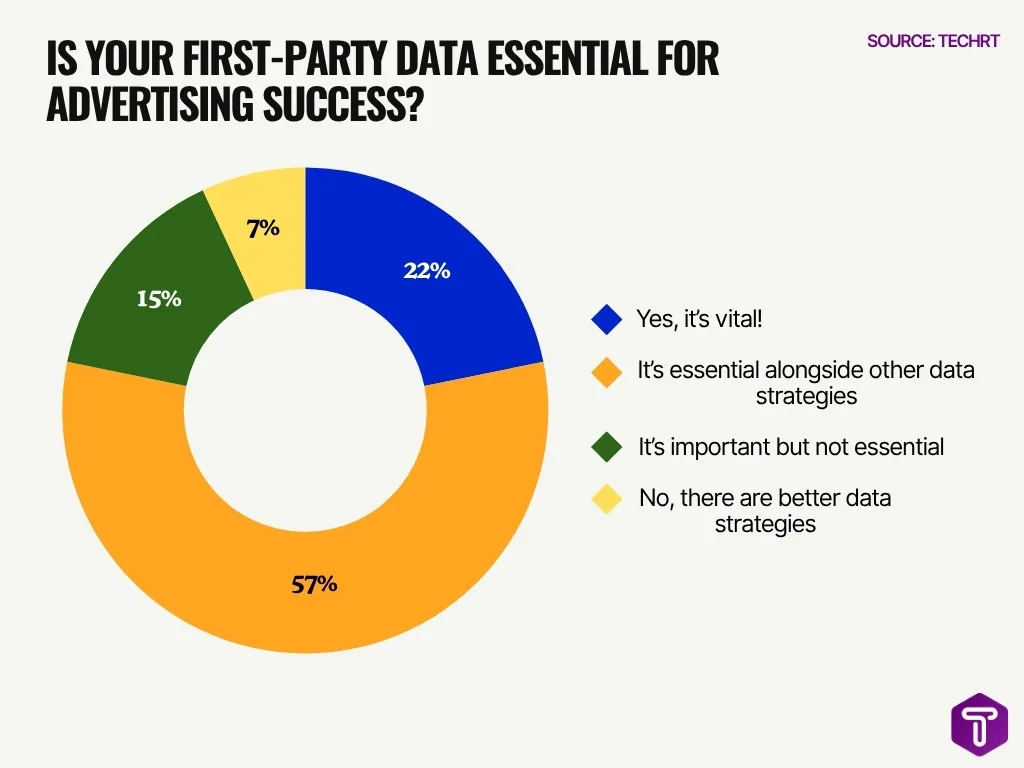
- A dominant 57% of respondents believe first-party data is essential alongside other data strategies, highlighting a hybrid data approach as the industry standard.
- Only 22% consider first-party data as fully vital on its own, indicating that while important, it’s rarely seen as a standalone solution.
- Around 15% say it is important but not essential, suggesting some marketers still rely on alternative or supplementary data sources.
- A small minority of just 7% believe there are better data strategies than first-party data, reinforcing its strong market trust and adoption.
- Overall, a significant 79% (57% + 22%) agree that first-party data is essential in some capacity, underlining its central role in modern advertising strategies.
- The data reflects a clear shift toward privacy-focused, owned data ecosystems, especially in a cookieless and regulation-heavy environment.
First-Party Data in Cookieless Marketing
- Google Chrome’s cookie phaseout affects over 65% of the global browser market share.
- 83% of marketers are preparing for a cookieless future by investing in first-party data.
- First-party identifiers like email and login data are used by 72% of brands for tracking.
- Contextual targeting adoption increased by 48% in 2025 as cookies declined.
- Data clean rooms adoption grew by 70% YoY, supporting privacy-safe data sharing.
- 60% of advertisers report improved campaign performance using cookieless strategies.
- Retail media networks, powered by first-party data, are projected to surpass $60 billion in ad spend.
- Identity resolution technologies saw 35% growth in adoption between 2024 and 2025.
- 69% of US marketers believe cookieless marketing will improve consumer trust.
First-Party Data for Personalization
- 80% of consumers are more likely to purchase from brands offering personalized experiences.
- Personalization powered by first-party data can increase revenue by up to 15%.
- 71% of consumers expect personalized interactions from brands.
- Email personalization improves open rates by 26% on average.
- Website personalization increases conversion rates by 20–30%.
- 65% of companies use first-party data to tailor product recommendations.
- Personalized push notifications boost engagement by up to 4x.
- 74% of marketers say personalization is impossible without first-party data.
- AI-driven personalization using first-party data increases customer satisfaction by 25%.
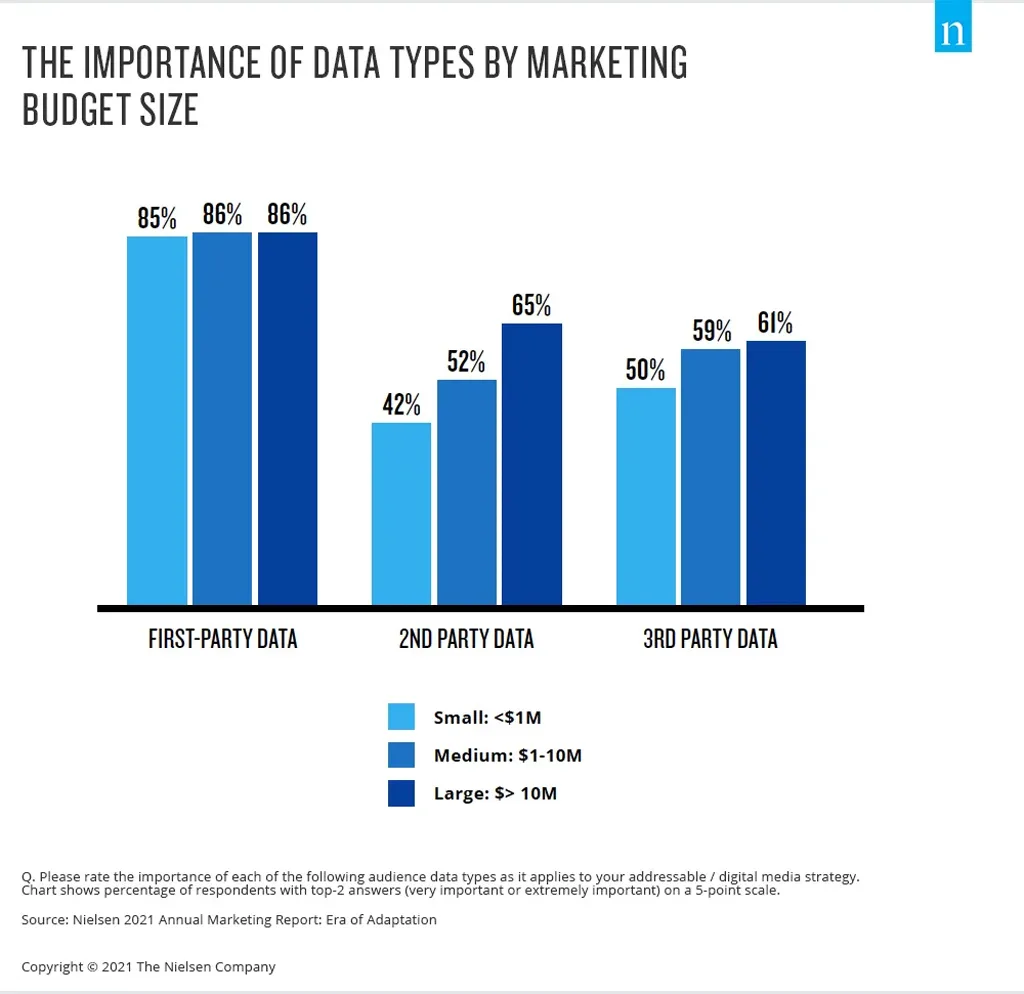
Importance of Data Types by Marketing Budget
- First-party data dominates across all budgets, with 85% (small), 86% (medium), and 86% (large) marketers rating it as highly important, showing near-universal reliance.
- Second-party data gains importance with budget size, rising from 42% (small budgets) to 52% (medium) and reaching 65% (large budgets), a 23-point increase from small to large.
- Third-party data shows steady relevance, increasing from 50% (small) to 59% (medium) and 61% (large), indicating consistent but secondary importance.
- Large-budget marketers prioritize all data types more heavily, especially second-party data (65%), reflecting more advanced data strategies and partnerships.
- The gap between first-party and second-party data is significant in small budgets (85% vs. 42% = 43-point gap), but narrows in large budgets (86% vs. 65% = 21-point gap).
- First-party data remains the most trusted and valuable asset, outperforming third-party data by 35 points (small budgets) and 25 points (large budgets).
- Mid-sized companies ($1–10M budgets) show balanced adoption, with 86% (first-party), 52% (second-party), and 59% (third-party), indicating a transitional data maturity stage.
- Overall trend: As marketing budgets increase, dependence on diversified data sources (especially second- and third-party) grows, while first-party data remains consistently critical.
First-Party Data for Paid Media Performance
- Campaigns using first-party data see up to 2x higher ROAS (return on ad spend).
- 70% of advertisers report improved targeting accuracy using first-party data.
- First-party audience segments reduce cost-per-click (CPC) by 20–30%.
- 63% of marketers use first-party data for programmatic advertising optimization.
- Lookalike audiences built from first-party data improve conversion rates by 35%.
- First-party data improves ad relevance scores by over 25%.
- 58% of brands rely on CRM data for paid media targeting.
- Retargeting campaigns using first-party data achieve up to 150% higher engagement.
- Privacy-safe targeting methods reduce wasted ad spend by up to 40%.
First-Party Data and Customer Acquisition
- Companies using first-party data reduce acquisition costs by up to 50%.
- 68% of marketers say first-party data improves lead quality.
- First-party data-driven campaigns generate 2x more qualified leads.
- 59% of brands rely on owned data for prospect targeting.
- Conversion rates increase by 25% when using first-party data insights.
- 73% of US consumers prefer engaging with brands that use their own data responsibly.
- First-party data enables faster lead nurturing, reducing sales cycles by 15–20%.
- 62% of B2B marketers say first-party data is critical for account-based marketing.
- Businesses using first-party insights see 30% higher acquisition efficiency.
First-Party Data and Customer Experience
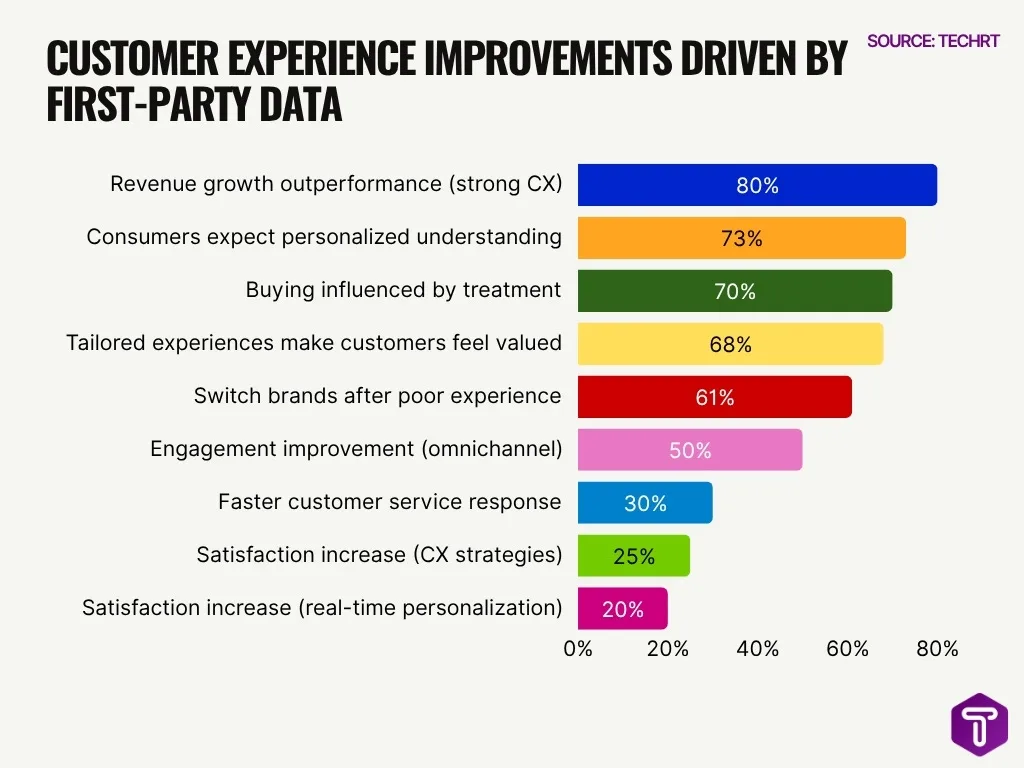
- 73% of consumers expect companies to understand their unique needs.
- First-party data-driven CX strategies increase satisfaction scores by up to 25%.
- 68% of customers say tailored experiences make them feel valued.
- Businesses using unified first-party data see 30% faster response times in customer service.
- Omnichannel experiences powered by first-party data improve engagement by up to 50%.
- 61% of consumers will switch brands after poor customer experiences.
- Real-time personalization increases customer satisfaction by 20% or more.
- 70% of buying experiences are influenced by how customers feel they are treated.
- Companies with strong CX strategies outperform competitors by nearly 80% in revenue growth.
First-Party Data and Customer Retention
- Companies using first-party data improve customer retention rates by up to 35%.
- 65% of consumers say personalized experiences influence their loyalty to a brand.
- Loyalty programs powered by first-party data increase repeat purchases by 20–30%.
- Brands leveraging behavioral data see 25% higher repeat purchase rates.
- 57% of marketers use first-party data specifically for retention strategies.
- Email retention campaigns using first-party data deliver 2x higher engagement rates.
- Subscription-based businesses rely on first-party data for over 80% of churn prediction models.
- Customer retention costs are 5x lower than acquisition when using first-party insights effectively.
- Companies using predictive analytics from first-party data reduce churn by 15–25%.
First-Party Data and Privacy Compliance
- 79% of consumers are concerned about how companies use their data.
- GDPR fines exceeded €4 billion cumulatively by 2025.
- 64% of marketers say compliance is easier with first-party data.
- CCPA impacts over 75% of US businesses handling consumer data.
- 71% of consumers are more likely to trust brands with transparent data practices.
- Privacy regulations influence over 65% of global data strategies.
- Companies investing in compliance tools saw 28% YoY growth in spending.
- First-party data reduces compliance risk exposure by up to 50% compared to third-party sources.
- 82% of organizations increased privacy investments after regulatory changes.
Challenges in First-Party Data Collection
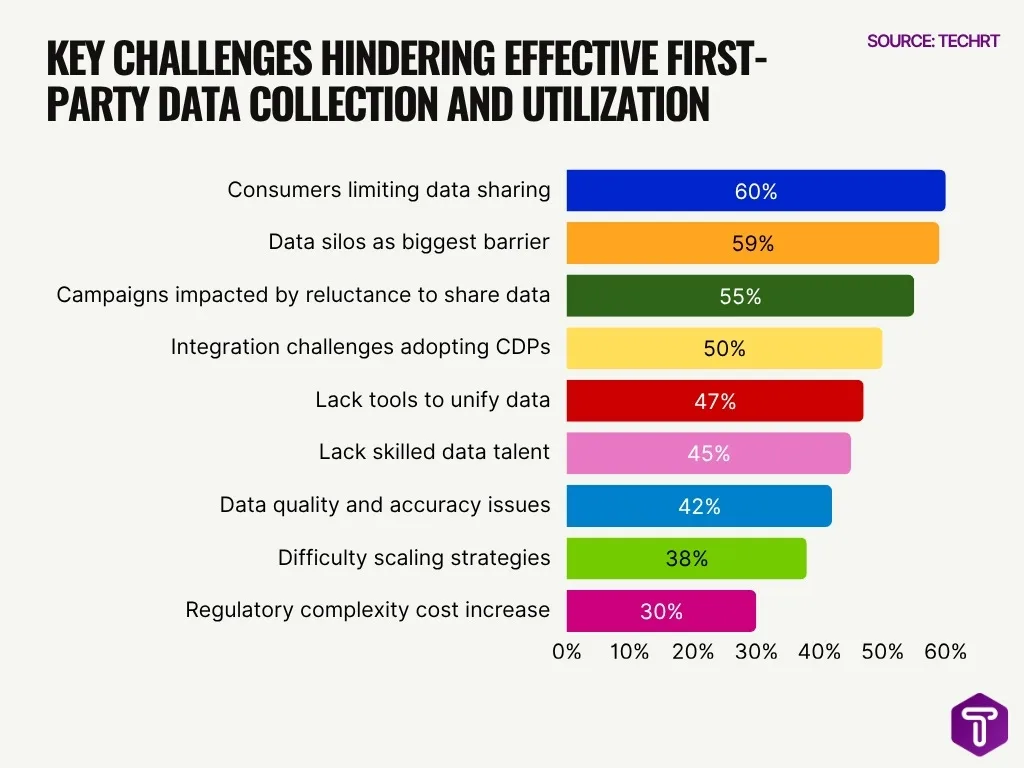
- 59% of marketers cite data silos as the biggest barrier.
- 42% of companies struggle with data quality and accuracy issues.
- Privacy concerns limit data sharing for over 60% of consumers.
- 47% of marketers lack the tools to unify first-party data sources.
- Integration challenges affect over 50% of organizations adopting CDPs.
- 38% of businesses report difficulty in scaling first-party data strategies.
- Regulatory complexity increases operational costs by 20–30%.
- 45% of marketers say they lack skilled talent for data analysis.
- Consumer reluctance to share data impacts over 55% of campaigns.
First-Party Data Security and Breaches
- The average cost of a data breach reached $4.45 million in 2025.
- 83% of organizations experienced more than one data breach.
- Human error accounts for over 74% of data breaches.
- Companies using strong encryption reduce breach risks by up to 40%.
- 60% of small businesses shut down within six months of a major cyberattack.
- Insider threats contribute to 20% of data breaches.
- Organizations investing in zero-trust architecture reduce breach impact by 30%.
- 69% of companies increased cybersecurity budgets in 2025.
- Data breaches involving customer data lead to up to 25% loss in brand trust.
Impact of First-Party Data on ROI
- Companies using first-party data achieve 2.9x higher revenue growth.
- Marketing ROI improves by up to 30% with data-driven strategies.
- 70% of marketers report measurable ROI improvements from first-party data.
- First-party data reduces customer acquisition costs by up to 50%.
- Businesses see 20–40% efficiency gains in campaign performance.
- Personalized campaigns powered by first-party data deliver 5–8x ROI.
- 61% of executives say data-driven marketing is critical to profitability.
- Companies using advanced analytics report 15–20% profit increases.
- First-party data improves attribution accuracy by up to 35%.
Frequently Asked Questions (FAQs)
What percentage of marketers prioritize first-party data in 2025?
What share of advertisers are already using first-party data targeting in 2026?
What percentage of US browsers are expected to become cookieless in the coming years?
What proportion of US browsers already block third-party cookies by default?
What percentage of marketers consider first-party data their top asset for the cookieless future?
Conclusion
First-party data now sits firmly at the center of modern marketing strategies, driven by stricter privacy regulations, declining third-party data reliability, and rising consumer expectations for personalized experiences. Businesses across industries, from retail and media to SaaS and finance, are actively investing in first-party data infrastructure to gain deeper customer insights and maintain control over their marketing performance.
The data throughout this report highlights a clear trend: organizations that effectively collect, unify, and activate first-party data consistently outperform their competitors. They achieve stronger ROI, lower acquisition costs, higher retention rates, and improved customer satisfaction. At the same time, they reduce compliance risks and build greater trust with their audiences.
Looking ahead, the importance of first-party data will only grow as cookieless marketing becomes the norm. Companies that prioritize transparency, invest in data quality, and integrate advanced analytics will be best positioned to unlock long-term growth. In a landscape defined by privacy and personalization, first-party data is no longer optional; it is essential for sustainable marketing success.

Leave a comment
Have something to say about this article? Add your comment and start the discussion.