




Digital upskilling now shapes hiring, productivity, and workforce retention across nearly every industry. Companies use digital learning programs to prepare employees for AI-powered workflows, cloud systems, cybersecurity risks, and data-driven operations. At the same time, workers increasingly pursue certifications and online training to stay competitive in a rapidly changing labor market.
From healthcare providers adopting AI-assisted diagnostics to manufacturers implementing smart factory systems, organizations now depend on digitally skilled teams to maintain efficiency and innovation. This article explores the latest digital upskilling statistics, covering employer priorities, employee demand, AI’s influence, and global adoption trends.
Editor’s Choice
- The World Economic Forum reported that 44% of workers’ core skills will change by 2028 because of technological disruption and AI adoption.
- LinkedIn’s Workplace Learning Report found that 89% of learning leaders believe proactive upskilling is essential for navigating the future of work.
- According to IBM, companies that invest heavily in employee training generate 24% higher profit margins than those that spend less on workforce development.
- Coursera’s 2025 Global Skills Report revealed that demand for AI-related course enrollments increased by more than 300% year over year globally.
- Gartner estimated that by 2026, 80% of enterprises will integrate generative AI APIs or applications into production environments, accelerating digital skill demand.
- Amazon Web Services reported that 75% of employers worldwide cannot find enough workers with advanced digital skills.
- PwC found that organizations with strong digital learning cultures are 2.5 times more likely to achieve faster innovation outcomes than peers.
Recent Developments
- Microsoft launched expanded AI Skills Initiative programs in 2025 with a target to train millions of workers globally in generative AI usage.
- Google announced additional AI and cybersecurity certificates through Google Career Certificates in 2025 as employer demand for practical digital skills continued to rise.
- In 2025, IBM expanded its SkillsBuild initiative to provide free AI and cybersecurity learning resources to underserved communities worldwide.
- According to the World Economic Forum, six in 10 workers will require retraining before 2027 due to rapid AI integration.
- Udemy Business reported a 3,500% increase in generative AI course consumption during 2024 and early 2025.
- The U.S. government increased workforce technology training investments through CHIPS Act-related programs focused on semiconductor and digital manufacturing skills.
- India’s Digital India initiatives expanded AI literacy and digital capability programs throughout 2025 and 2026.
- Deloitte reported that organizations adopting AI tools increased spending on employee reskilling programs by 42% in 2025 compared to the previous year.
- SAP’s 2025 workforce research showed that 74% of executives now prioritize digital learning investments over traditional leadership training.
Employer Priorities in Digital Upskilling
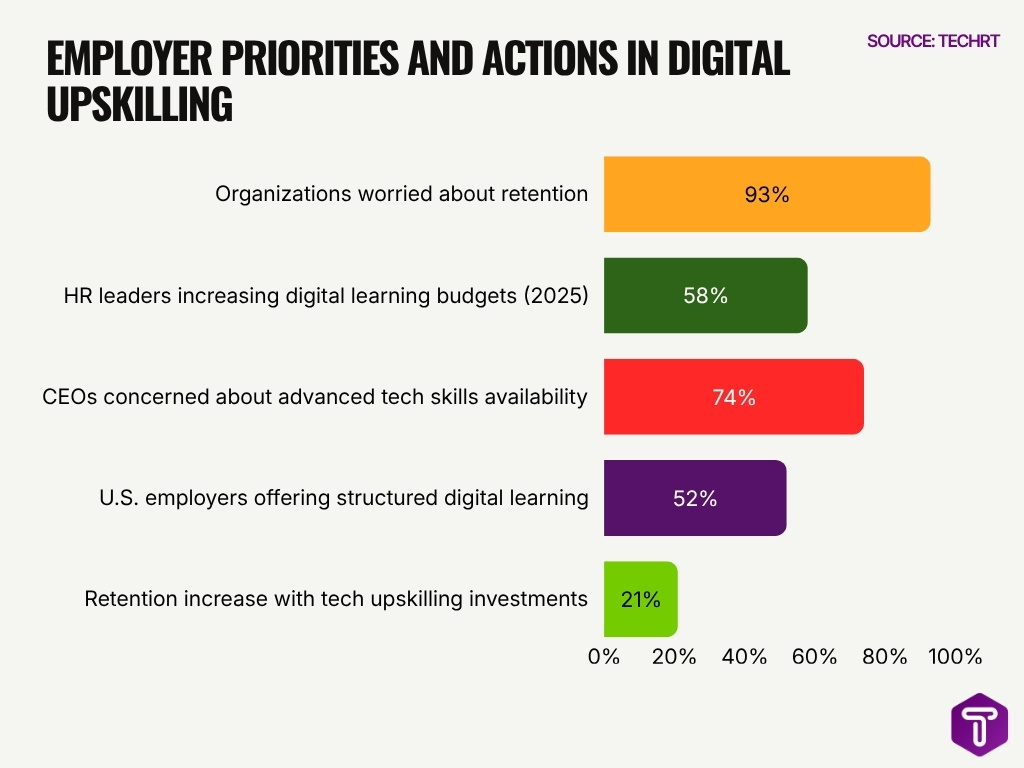
- LinkedIn found that 93% of organizations worry about employee retention, making career development and upskilling top HR priorities.
- Gartner reported that 58% of HR leaders increased digital learning budgets in 2025.
- IBM research showed that executives rank AI, cybersecurity, and cloud computing among the top three workforce capability gaps.
- According to Deloitte, nearly 70% of business leaders believe digital capability shortages directly affect innovation speed.
- PwC found that 74% of CEOs are concerned about the availability of workers with advanced technology skills.
- Microsoft’s Work Trend Index revealed that employers increasingly seek workers capable of collaborating with AI systems rather than replacing employees outright.
- SHRM data showed that 52% of U.S. employers now offer structured digital learning programs internally.
- Skillsoft reported that organizations investing in tech upskilling experienced 21% higher employee retention rates compared to companies without formal programs.
- According to McKinsey, companies using continuous digital training strategies are more likely to outperform competitors in operational efficiency and automation adoption.
Global Digital Upskilling Adoption
- Coursera reported that global learner registrations surpassed 162 million users in 2025, driven largely by digital and AI-related learning demand.
- The OECD estimated that more than 1 billion jobs worldwide will require significant reskilling because of automation and digital transformation trends.
- LinkedIn Learning data showed that technology skills became the fastest-growing learning category globally in 2025.
- According to PwC, 77% of CEOs worldwide believe skill shortages threaten business growth over the next decade.
- Salesforce research found that 82% of workers now consider digital skills essential for career advancement.
- Amazon Web Services projected that digital upskilling could contribute $6.5 trillion to global GDP by 2030 through productivity gains.
- UNESCO reported growing government-backed digital literacy initiatives in over 70 countries by 2025.
- In Southeast Asia, Google and Temasek estimated that the digital economy workforce will exceed 20 million workers by 2030, increasing regional upskilling investments.
- European Commission data showed that only 55.6% of EU adults possessed basic digital skills in 2025, prompting expanded reskilling programs.
- According to the International Labour Organization, digital transformation now influences employment structures in more than 80% of surveyed economies.
Employee Interest in Digital Upskilling
- Coursera found that employee enrollments in AI and machine learning courses rose by over 400% during 2025.
- LinkedIn Learning reported that workers spent 47% more time learning digital skills in 2025 compared to the prior year.
- Udemy Business identified generative AI as the fastest-growing workplace learning topic globally.
- Salesforce research showed that 76% of employees believe they must continuously learn new digital skills to remain employable.
- According to Pearson, younger workers increasingly prioritize employers offering learning benefits and certification reimbursement.
- A Pluralsight survey found that 81% of technology professionals planned to pursue additional certifications in cloud, AI, or cybersecurity during 2025.
- Degree research revealed that employees are more likely to stay with organizations that provide personalized digital learning paths.
- Women entering technology reskilling pathways cited career flexibility and job opportunities as major motivators in a 2025 systematic review.
- Skillsoft reported that employees participating in digital learning programs were significantly more confident about adapting to AI-driven workplace changes.
Digital Upskilling Adoption by Industry
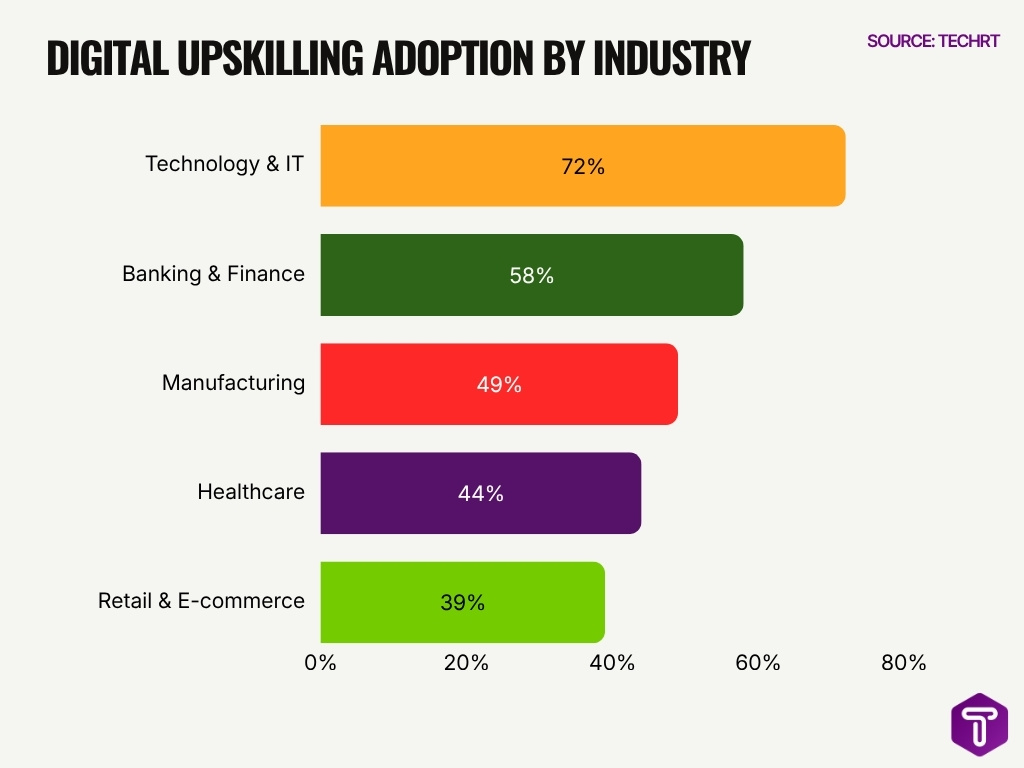
- Technology & IT leads digital upskilling adoption at 72%, showing that tech-driven industries are investing heavily in continuous learning.
- Banking & Finance ranks second with 58% adoption, reflecting the growing need for digital skills in fintech, cybersecurity, automation, and data analytics.
- Manufacturing shows a strong adoption rate of 49%, driven by smart factories, robotics, AI, and Industry 4.0 transformation.
- Healthcare has 44% adoption, as digital tools such as telehealth, electronic records, and AI diagnostics become more important.
- Retail & E-commerce records 39% adoption, supported by the rise of online selling, digital payments, customer analytics, and automation.
- The gap between the highest and lowest industries is 33 percentage points, with Technology & IT far ahead of Retail & E-commerce.
- Overall, the data shows that industries with faster digital transformation are more likely to prioritize employee upskilling and future-ready digital capabilities.
Impact of AI on Digital Upskilling Demand
- The World Economic Forum estimated that AI and automation will create 170 million new jobs globally by 2030 while displacing many routine roles.
- Gartner projected that generative AI will affect more than 80% of enterprise software applications by 2026.
- Microsoft research found that 75% of knowledge workers already use AI tools at work in some capacity.
- IBM reported that executives now prioritize AI literacy training even for nontechnical departments such as HR, finance, and marketing.
- McKinsey estimated that generative AI could add between $2.6 trillion and $4.4 trillion annually to the global economy.
- According to Deloitte, organizations implementing AI systems increased employee reskilling investments because of workflow redesign and compliance needs.
- AWS research showed that 92% of organizations plan to adopt AI-powered solutions by 2028, intensifying demand for digital upskilling.
- A 2026 labor transition study found that only 24.4% of workers in high-automation-risk jobs had clear transition pathways without major retraining.
- TechRadar reported that UK manufacturers increasingly rely on AI-driven learning platforms and VR simulations to close workforce capability gaps.
- LinkedIn’s 2025 data showed that AI literacy became one of the fastest-growing skills added to professional profiles worldwide.
Digital Upskilling by Job Level and Profession
- Entry-level employees are the most active learners, with over 60% participating in digital training programs.
- Mid-level professionals account for the highest investment in upskilling, as companies aim to future-proof core roles.
- Senior executives increasingly participate in AI and digital leadership programs, with over 45% enrolling in such initiatives.
- IT professionals lead digital upskilling participation, with over 70% actively learning new technologies annually.
- Marketing professionals are rapidly adopting analytics and automation tools, with training participation rising by over 30%.
- Finance professionals show growing interest in data analytics and fintech skills.
- Healthcare workers are adopting telehealth and digital record systems, requiring ongoing training.
- Blue-collar workers increasingly engage in digital training for automation and robotics operations.
- Freelancers and gig workers are investing in digital skills to remain competitive in global marketplaces.
Top Digital Skills Employers Need Most
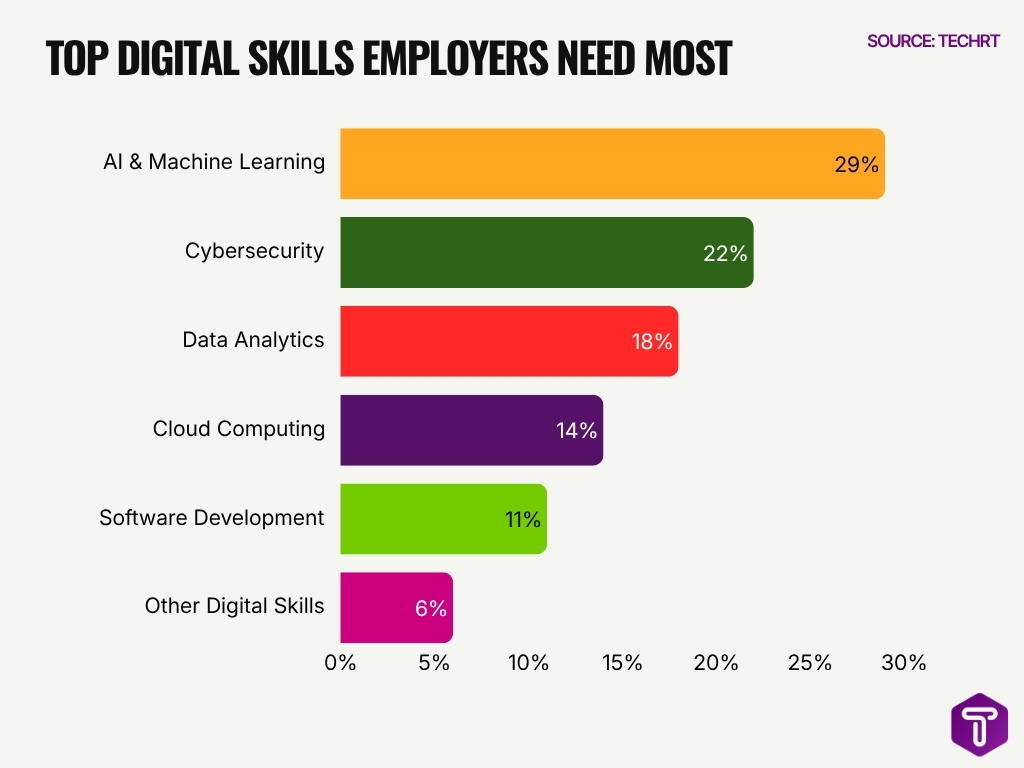
- AI & Machine Learning is the most in-demand digital skill area, accounting for 29% of total demand.
- Cybersecurity ranks second with a 22% share, showing strong employer focus on data protection, threat prevention, and secure digital operations.
- Data Analytics represents 18% of demand, highlighting the growing need for professionals who can interpret business data and support decision-making.
- Cloud Computing holds a 14% share, driven by continued adoption of cloud platforms, remote infrastructure, and scalable enterprise systems.
- Software Development accounts for 11% of demand, showing that coding, application development, and digital product creation remain important workforce skills.
- Other Digital Skills make up the remaining 6%, including areas such as digital marketing, automation tools, UX design, and basic digital literacy.
- Together, AI & Machine Learning, Cybersecurity, and Data Analytics represent 69% of total digital skills demand.
- The data suggests that employers are prioritizing advanced technical skills over general digital capabilities.
- The strong demand for AI-related skills reflects how automation, generative AI, and machine learning tools are reshaping job requirements.
- Businesses investing in digital upskilling should focus first on AI, cybersecurity, and analytics, as these categories dominate current workforce demand.
Regional and Country-Wise Digital Upskilling Trends
- North America education technology market grows at a 18% CAGR from 2025-2030, valued to increase by $93.95 billion.
- EU targets 80% basic digital skills for the population aged 16-74 by 2030.
- Asia-Pacific e-learning market anticipates 16.33% CAGR through 2030.
- India leads globally with 3.6 million GenAI enrollments in 2025.
- China plans AI training for 280 million students by 2030.
- Africa e-learning market expands at 9.14% CAGR, from $4.17 billion in 2026 to $8.39 billion by 2034.
- 84% of Latin American employers plan to upskill their workforce for digital talent demand.
- UAE sees 344% growth in GenAI enrollments, with 13% labor force learning on Coursera.
- Australia forecasts a 30,000 cyber security professional shortfall over the next four years.
Digital Upskilling Participation by Age and Gender
- Younger workers aged 18–34 make up 63% of digital upskilling participants globally.
- Millennials and Gen Z account for 62% of all online learners worldwide.
- Only 38% of workers aged 45+ participate in digital learning programs.
- Women’s participation in digital upskilling rose from 41% to 54% between 2020 and 2025.
- Women hold just 28% of advanced tech roles globally despite rising enrollment.
- The gender gap in STEM fields leaves women with only 28% of tech jobs worldwide.
- 67% of women citing work-family balance switched to remote learning for upskilling.
- 44% of workers over 45 joined reskilling programs due to automation risks in 2025.
- Government programs reached 3.2 million underrepresented learners to close digital skill gaps in 2024.
Preferred Learning Formats Vary Strongly by Generation
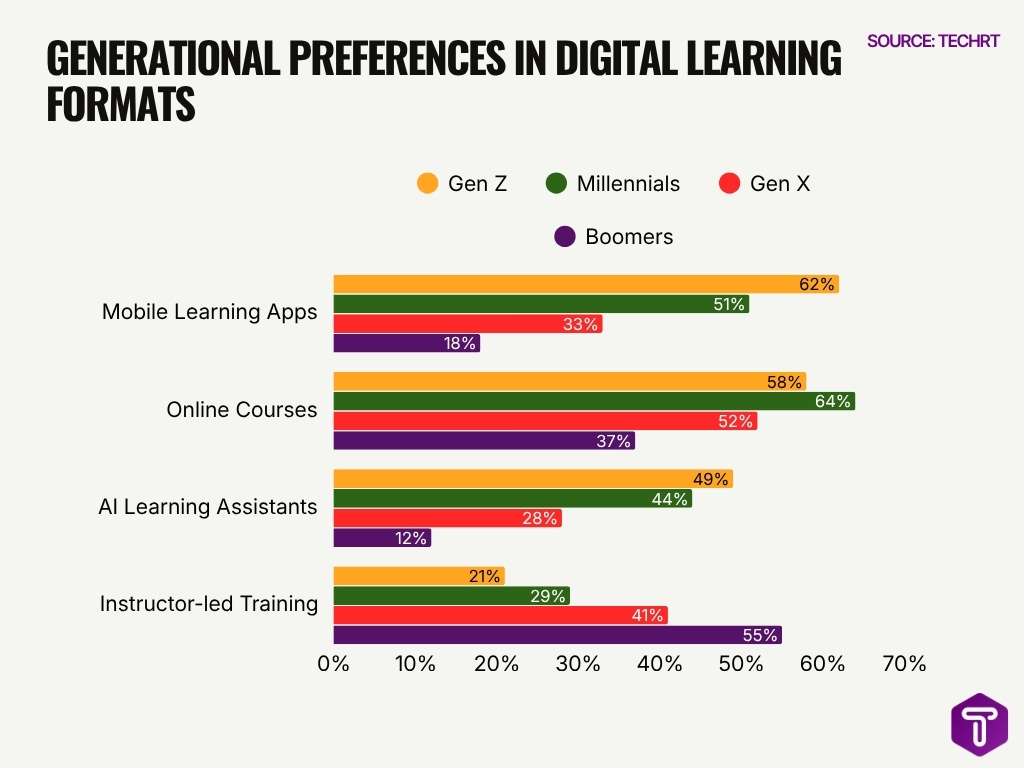
- Gen Z shows the highest preference for mobile learning apps, with 62% choosing this format, making it the most popular option among younger learners.
- Millennials prefer online courses the most, with 64% adoption, showing that structured digital learning is highly attractive to this age group.
- Online courses remain popular across all generations, with 58% of Gen Z, 64% of Millennials, 52% of Gen X, and 37% of Boomers using this format.
- AI learning assistants are most popular among Gen Z, with 49% usage, followed by 44% of Millennials, showing stronger acceptance of AI-based learning among younger workers.
- Gen X learners show a balanced preference, with 52% choosing online courses and 41% choosing instructor-led training.
- Boomers prefer instructor-led training the most, with 55% selecting this method, indicating a stronger preference for guided and traditional learning formats.
- Mobile learning apps decline sharply with age, dropping from 62% among Gen Z to just 18% among Boomers.
- AI learning assistant usage also falls by age, from 49% among Gen Z to only 12% among Boomers, showing a clear generational gap in AI-driven learning adoption.
- Instructor-led training becomes more popular with older age groups, rising from 21% among Gen Z to 55% among Boomers.
- Overall, the data shows that younger generations prefer digital-first and AI-enabled learning, while older generations rely more on instructor-led training.
Role of Online Learning Platforms in Digital Upskilling
- Coursera reached 168.2 million registered learners by the end of 2024, up 19% from 2023.
- 91% of Coursera learners achieved positive career outcomes post-completion.
- Udemy AI courses like Generative AI Mastery exceed 333,000 enrollments.
- 78% of Fortune 100 companies adopt LinkedIn Learning for enterprise training.
- Google Career Certificates yield 70%+ positive career outcomes within 6 months.
- The global online education market is expected to hit $363.72 billion in 2025.
- 95% of tech professionals need more support for upskilling via platforms.
- Digital education market grows at 24.2% CAGR to $95.7 billion by 2030.
- 70% of students prefer online learning over traditional learning for flexibility.
- Pluralsight serves over 2.9 million tech learners annually.
Employer-Sponsored vs Self-Directed Digital Learning
- LinkedIn reports that 94% of employees would stay longer at companies investing in their learning and development.
- Self-directed learners spend 72% more time on content they choose compared to assigned training.
- Online learning boosts employee retention by up to 80% over traditional methods.
- 62% of organizations adopt hybrid learning models blending employer support and self-paced options.
- 77% of brands offer online training selections, fueling self-directed learning growth on platforms like Coursera and Udemy.
- Companies with comprehensive employer-sponsored training have 218% higher income per employee.
- Employees engaging in self-directed learning show higher career satisfaction and proactive skill development.
- Skillsoft structured programs enhance completion rates over purely self-directed courses via benchmarks.
- Deloitte notes that over half of workers favor flexible digital formats in learning preferences.
Average Weekly Time Spent on Digital Upskilling by Employee Type
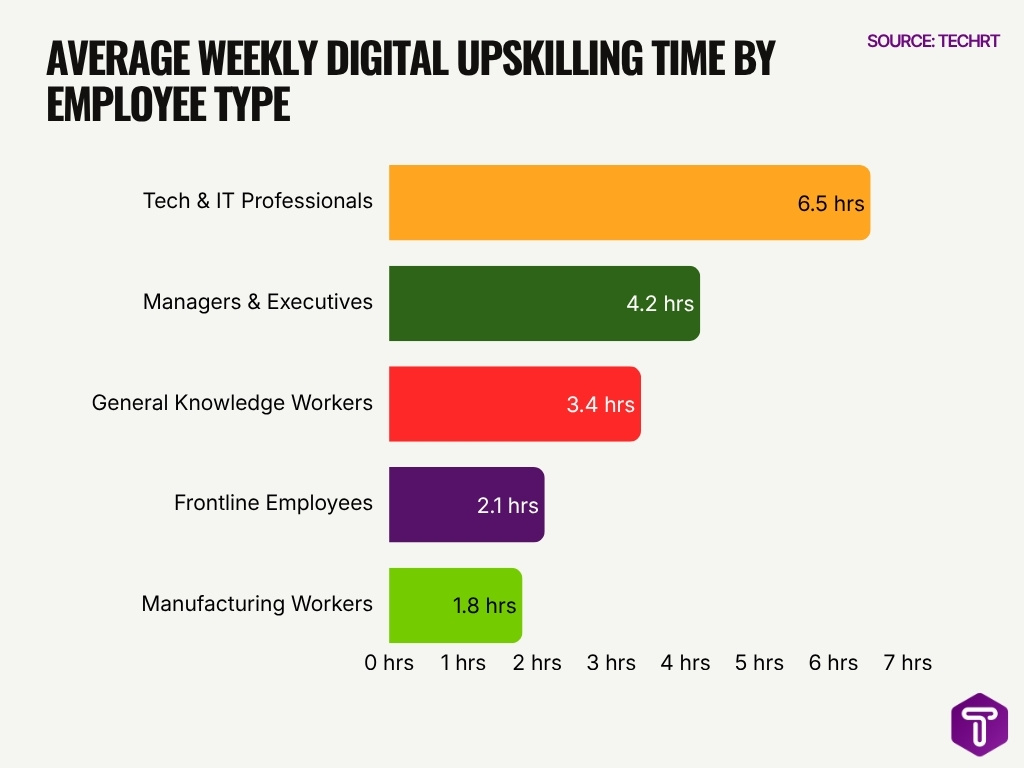
- Tech & IT professionals spend the most time on digital upskilling, averaging 6.5 hours per week.
- Managers and executives invest 4.2 hours per week, showing that leadership roles are also actively building digital capabilities.
- General knowledge workers spend an average of 3.4 hours weekly on digital learning and skill development.
- Frontline employees dedicate 2.1 hours per week, indicating lower but still meaningful participation in upskilling.
- Manufacturing workers record the lowest average, at 1.8 hours per week, suggesting a potential opportunity for more structured digital training.
- The gap between Tech & IT professionals and manufacturing workers is 4.7 hours per week, highlighting a major difference in upskilling intensity.
- Overall, the data shows that employees in more digitally focused roles tend to spend more weekly time on upskilling than in operational or frontline roles.
Return on Investment From Digital Upskilling Programs
- IBM found that companies investing in training generate 24% higher profit margins compared to those that do not.
- A PwC study revealed that effective upskilling programs can increase productivity by up to 20% across teams.
- According to LinkedIn, organizations with strong learning cultures are 92% more likely to innovate successfully.
- Deloitte reported that companies with robust learning strategies are 2.5 times more likely to be high-performing organizations.
- McKinsey found that reskilling employees can cost 30% less than hiring new talent for similar roles.
- Amazon Web Services estimated that digital training investments can deliver up to 300% ROI over time through productivity gains.
- Gallup research shows that organizations investing in employee development see 11% higher profitability.
- Skillsoft reported that companies with structured learning programs experience higher retention rates and reduced turnover costs.
- Accenture found that businesses that scale reskilling initiatives can unlock $6.5 trillion in global economic value by 2030.
Digital Upskilling and Remote or Hybrid Work
- Over 70% of employees now work in hybrid or remote settings, per Microsoft’s Work Trend Index.
- 54% of global knowledge workers use hybrid models in 2026, with 17% fully remote.
- Gartner predicts 48% of employees will work remotely at least part-time through 2026.
- 51% of U.S. remote-capable employees follow hybrid schedules in 2026.
- Buffer reports 98% of remote workers want to continue remotely at least part-time.
- McKinsey notes companies using digital tools boost productivity by 20-25% in remote setups.
- 52% of the global workforce engaged in remote work in 2026.
- Remote workers value flexibility, with 67% citing it as a top benefit per Buffer.
- Digital nomads exceed 40 million worldwide amid hybrid trends.
Key Reasons Behind Tech Skills Gaps in the US
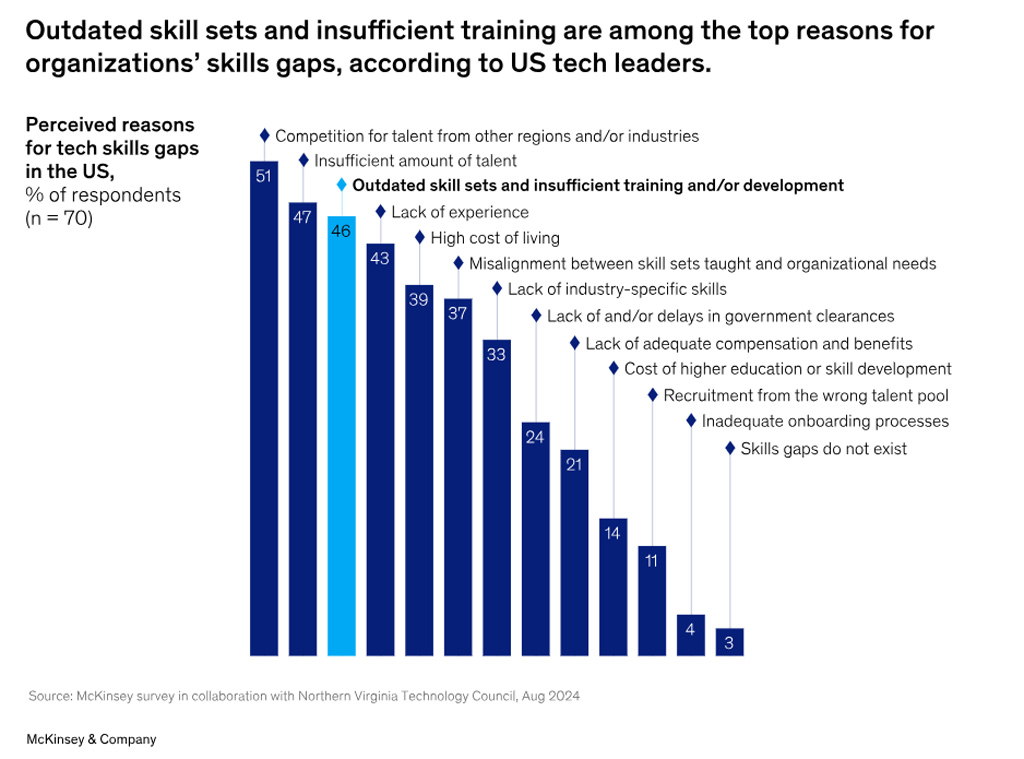
- Talent competition is the biggest reported reason for tech skills gaps, cited by 51% of US tech leaders.
- Insufficient talent availability is another major issue, with 47% of respondents saying there are not enough qualified workers.
- Outdated skill sets and insufficient training rank third, affecting 46% of organizations and showing the growing need for continuous digital upskilling.
- Lack of experience is also a leading barrier, mentioned by 43% of respondents, suggesting that many candidates may have skills but not enough practical exposure.
- High cost of living contributes to tech talent gaps for 39% of organizations, likely making it harder to attract and retain workers in expensive regions.
- Misalignment between education and employer needs is a concern for 37% of tech leaders, showing that training programs may not always match real workplace demands.
- Lack of industry-specific skills affects 33% of organizations, highlighting the need for more targeted and role-based upskilling programs.
- Government clearance delays are a challenge for 24% of respondents, especially in sectors where security clearance is required.
- Compensation and benefits gaps are cited by 21% of leaders, indicating that pay competitiveness still plays a role in tech hiring challenges.
- Only 3% of respondents said skills gaps do not exist, strongly suggesting that tech skills shortages are widely recognized across organizations.
Micro-Credentials and Certifications in Digital Skills
- 87% of employers have hired at least one candidate with a micro‑credential in the past year.
- 96% of employers believe micro‑credentials strengthen a candidate’s job application.
- Workers who completed micro‑credentials reported an average 28% salary increase after completion.
- The global micro‑credential market is projected to exceed $3.5 billion in 2025, with over 17% annual growth through 2030.
- Google Career Certificates have helped over 1 million learners globally, with over 70% reporting a positive career outcome, such as a new job or raise.
- Credly by Pearson has issued its 100 millionth digital badge, signaling explosive growth in digital skills credentials.
- The cybersecurity certifications market reached $3.88 billion in 2025 and is projected to hit $7.5 billion by 2030.
- AWS certifications like Solutions Architect Associate attract over 45,000 job postings annually, reflecting strong demand for cloud‑skills validation.
- More than half of higher‑education institutions globally plan to expand credit‑bearing micro‑credentials within the next five years.
- 94% of students pursuing digital‑skills micro‑credentials say they build essential career‑ready competencies.
Government-Led Digital Upskilling Initiatives
- The CHIPS and Science Act allocates $200 million for semiconductor workforce training.
- EU‘s Digital Skills Agenda targets 80% of adults with basic digital skills by 2030.
- Canada‘s Digital Skills for Youth has supported over 6,900 youth internships since 2018.
- India‘s PMGDISHA under Digital India trained 6.39 crore rural individuals in digital literacy.
- Singapore‘s SkillsFuture saw 606,000 users use credits for training in 2025.
- Australia projects a 3,000 cybersecurity workforce shortage by 2026.
- South Korea invests $960 million in a national AI talent development plan.
- UAE‘s National AI Strategy emphasises widespread workforce upskilling programs.
- World Bank notes that less than 5% population in low-income countries have basic digital skills.
Frequently Asked Questions (FAQs)
What percentage of workers will need reskilling by 2028?
How much can companies improve profitability through employee training?
How many organizations plan to adopt AI-powered solutions by 2028?
What share of employees say they need new digital skills to stay employable?
How much did the demand for generative AI courses grow recently?
Conclusion
Digital upskilling has moved from a nice-to-have initiative to a core business and career strategy. As AI, automation, and cloud technologies reshape industries, both employers and employees must invest in continuous learning to stay relevant. The data clearly shows that organizations that prioritize digital training outperform competitors in productivity, innovation, and retention.
At the same time, workers who actively build digital skills gain stronger job security, higher earning potential, and greater career mobility. With governments, corporations, and online platforms all accelerating investments, digital upskilling will remain a defining trend of the global workforce.

Leave a comment
Have something to say about this article? Add your comment and start the discussion.