



Affiliate marketing has become a core revenue engine for modern digital commerce. Brands use affiliates to drive measurable sales through content sites, social media, and influencer partnerships, while publishers monetize traffic through performance-based commissions. Retailers such as Amazon rely heavily on affiliate partnerships to expand product reach, and SaaS companies use affiliate programs to scale customer acquisition efficiently. As ecommerce and creator-driven marketing continue to grow, affiliate marketing plays a critical role in revenue generation across industries. The statistics below explore market growth, adoption, and performance benchmarks shaping affiliate marketing.
Editor’s Choice
- The global affiliate marketing industry is projected to exceed $15.7 billion in 2024, continuing steady growth from $13 billion in 2023.
- In the United States alone, affiliate marketing spending surpassed $9.5 billion in 2023, reflecting strong adoption among ecommerce brands.
- Approximately 16% of all online orders globally come through affiliate marketing channels.
- Affiliate marketing drives around 20% of revenue for ecommerce brands on average, depending on the sector.
- More than 80% of brands worldwide run affiliate programs as part of their digital marketing strategy.
- Around 31% of web publishers cite affiliate marketing as one of their top revenue sources.
- Studies show that affiliate marketing delivers an average ROI of $15 for every $1 spent in performance marketing campaigns.
Recent Developments
- In 2024 and 2025, AI-driven affiliate platforms increased campaign optimization efficiency by nearly 30%, improving targeting and conversion rates.
- Major affiliate networks such as Awin and CJ Affiliate reported double-digit growth in influencer and affiliate hybrid campaigns in 2024.
- Retail media networks increasingly integrate affiliate partnerships, with over 40% of large ecommerce brands testing retail media and affiliate models in 2024.
- Influencer-led affiliate commerce surged, with more than 70% of creators using affiliate links in monetized content across YouTube, Instagram, and TikTok.
- The number of affiliate programs offered by SaaS companies increased by more than 25% between 2023 and 2025 as subscription businesses pursue scalable acquisition channels.
- Cookie-less tracking technology adoption rose significantly, with over 60% of affiliate networks implementing server-side tracking solutions by 2024.
- Performance-based partnerships gained traction as privacy regulations tightened, prompting 38% of brands to shift budget from display ads to affiliate programs in 2024.
- Affiliate platforms integrating first-party data analytics reported conversion rate improvements of 10% to 20% in 2025 campaigns.
- In the creator economy, affiliate commissions surpassed traditional sponsorships as a top revenue stream for many micro-influencers in 2024.
Affiliate Software Market Size and Growth Statistics
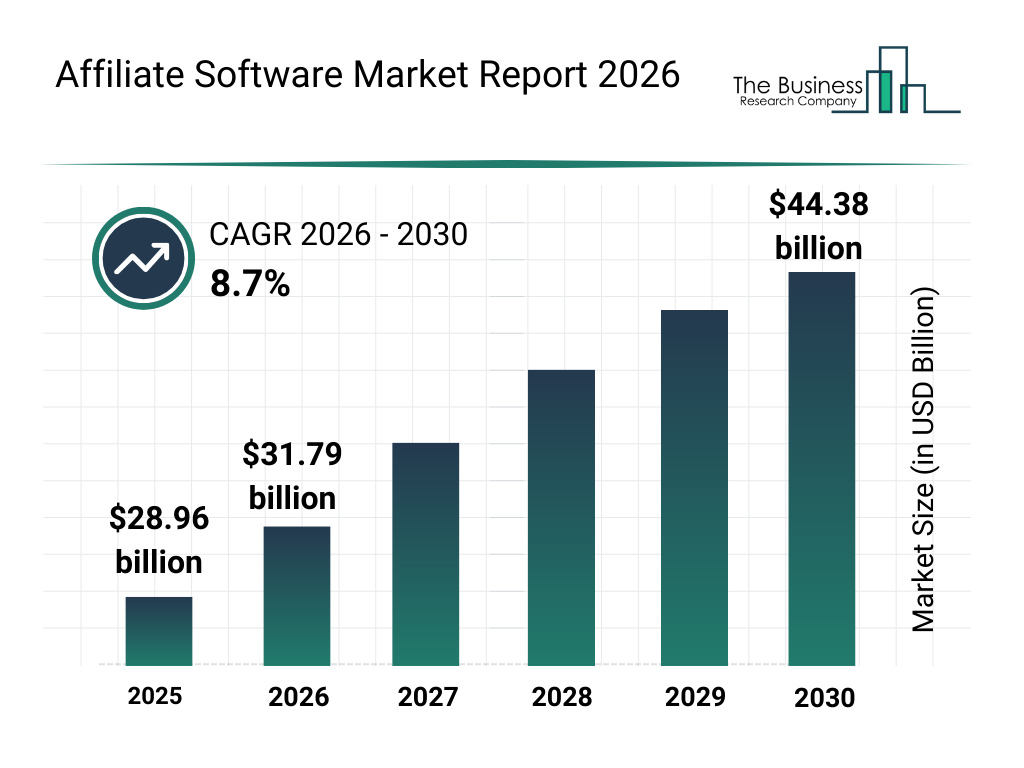
- The global affiliate software market was valued at $28.96 billion in 2025, highlighting the growing demand for platforms that help businesses manage affiliate partnerships and track performance.
- The market is projected to reach $31.79 billion in 2026, showing steady expansion as more brands adopt affiliate marketing tools and automation platforms.
- By 2027, the affiliate software industry is expected to grow to approximately $34.55 billion, reflecting increasing investment in performance-based marketing technologies.
- The market size is forecast to climb to around $37.55 billion in 2028, driven by the rising number of e-commerce brands and digital creators using affiliate programs.
- In 2029, the industry is predicted to reach $40.82 billion, supported by wider adoption of AI-driven tracking, attribution, and analytics tools.
- By 2030, the affiliate software market is expected to hit $44.38 billion, demonstrating strong long-term demand for affiliate management platforms and partner marketing solutions.
- Overall, the affiliate software industry is projected to grow at a compound annual growth rate (CAGR) of 8.7% between 2026 and 2030, indicating consistent expansion as businesses prioritize performance-based marketing strategies.
Global Affiliate Marketing Industry Statistics
- The global affiliate marketing industry grew from $13 billion in 2023 to an estimated $15+ billion by 2024, highlighting strong expansion in performance marketing.
- Affiliate marketing contributes around 15% to 16% of total digital media industry revenue globally.
- More than 80% of brands use affiliate programs to drive online sales and customer acquisition.
- Affiliate marketing drives up to 30% of revenue for some ecommerce retailers in sectors like fashion and electronics.
- The United States remains the largest affiliate marketing market, accounting for more than 40% of global affiliate spending.
- Over 11,400 affiliate programs currently operate worldwide, with thousands launched each year.
- Affiliate marketing generates roughly 16% of ecommerce sales in North America.
- Nearly 65% of retailers report increased affiliate-driven revenue year over year since 2022.
- Affiliate partnerships now represent one of the top three acquisition channels for online retailers globally.
- Small and mid-size publishers account for about 35% of global affiliate-driven traffic, highlighting the decentralized nature of the industry.
Affiliate Marketing Market Size and Growth
- The affiliate marketing market in the United States reached $9.56 billion in spending in 2023, nearly triple its 2015 value.
- Forecasts estimate that global affiliate marketing spending will exceed $18 billion by 2027.
- Affiliate marketing budgets grew around 10% to 12% annually between 2022 and 2025 among digital retailers.
- More than 80% of advertisers increased affiliate marketing budgets in the past two years.
- Affiliate networks reported 20% growth in partner registrations in 2024, largely driven by creator economy participation.
- SaaS companies have increased affiliate program investment by over 40% since 2022, using affiliates to reduce customer acquisition costs.
- The number of affiliate publishers globally surpassed 1.2 million active participants in 2024.
- The affiliate marketing software market value is expected to reach $1.1 billion by 2030, growing alongside ecommerce.
- Subscription businesses report customer acquisition costs up to 30% lower via affiliate programs compared with paid search ads.
Top Trends Shaping Affiliate Marketing Adoption
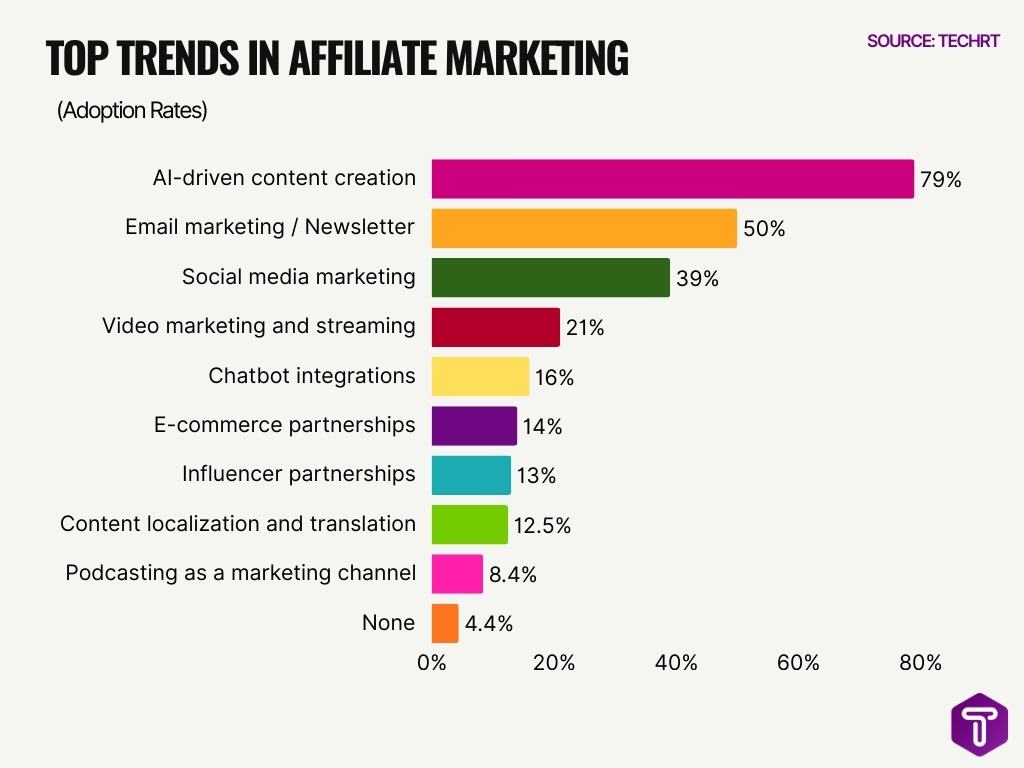
- AI-driven content creation leads the industry, with 79% of respondents adopting AI tools to produce affiliate content, showing how automation and generative AI are transforming marketing workflows.
- Email marketing and newsletters remain a core strategy, used by 50% of marketers, highlighting the continued importance of direct audience engagement and owned communication channels.
- Social media marketing ranks third, with 39% adoption, reflecting the strong role of platforms like Instagram, TikTok, and YouTube in driving affiliate traffic and product discovery.
- Video marketing and streaming are used by 21% of marketers, showing the growing impact of video content, tutorials, and product reviews in affiliate promotions.
- Chatbot integrations are adopted by 16% of respondents, indicating the increasing use of automated customer engagement tools to assist with conversions and support.
- E-commerce partnerships account for 14% adoption, demonstrating how brands collaborate with online stores and marketplaces to expand affiliate-driven sales.
- Influencer partnerships are used by 13% of marketers, highlighting the importance of creator-led promotion in reaching niche audiences and building trust.
- Content localization and translation are adopted by 12.5%, showing that affiliates are increasingly targeting global and multilingual audiences.
- Podcasting as a marketing channel is used by 8.4%, suggesting a smaller but growing segment leveraging audio platforms to promote affiliate products.
- Only 4.4% of respondents reported using none of these strategies, meaning over 95% of marketers actively leverage at least one affiliate marketing trend to grow their programs.
Affiliate Marketing Share of Ecommerce and Online Sales
- Affiliate marketing accounts for about 16% of all ecommerce sales globally, making it one of the largest digital acquisition channels.
- In the United States, affiliate marketing drives 15% to 20% of ecommerce revenue for major retailers.
- Fashion retailers report the highest affiliate contribution, with affiliate traffic generating up to 25% of online sales.
- Approximately 74% of online shoppers visit multiple affiliate websites before making a purchase.
- Affiliate referral traffic converts 3 to 5 times better than display advertising traffic.
- Nearly 40% of marketers say affiliate marketing is their top customer acquisition channel.
- Product review websites generate over 60% of affiliate-driven purchases in consumer electronics categories.
- Coupon and cashback affiliates account for over 30% of affiliate-driven ecommerce transactions.
- Content-based affiliates such as blogs and review sites generate roughly 45% of affiliate revenue globally.
Affiliate Marketing ROI and Performance Benchmarks
- Affiliate marketing delivers an average return on investment of $12 to $15 for every $1 spent, making it one of the most cost-efficient digital marketing channels.
- About 81% of brands say affiliate marketing positively impacts revenue, especially when integrated with content marketing and SEO strategies.
- Affiliate traffic converts at an average conversion rate of 1% to 5%, depending on industry and audience intent.
- Product review affiliates often see conversion rates exceeding 7%, particularly in technology and SaaS categories.
- Roughly 65% of marketers report better ROI from affiliate marketing compared with display advertising campaigns.
- Brands using advanced affiliate attribution models reported ROI improvements of 20% to 30% in 2024 campaigns.
- Coupon and cashback affiliate sites deliver average conversion rates of 8% to 10% during promotional periods.
- Nearly 40% of marketers rank affiliate marketing among their top three highest ROI channels alongside email marketing and SEO.
- Subscription-based SaaS companies report customer acquisition costs up to 30% lower via affiliate partnerships compared with paid ads.
Global Affiliate Marketing Industry Share by Region
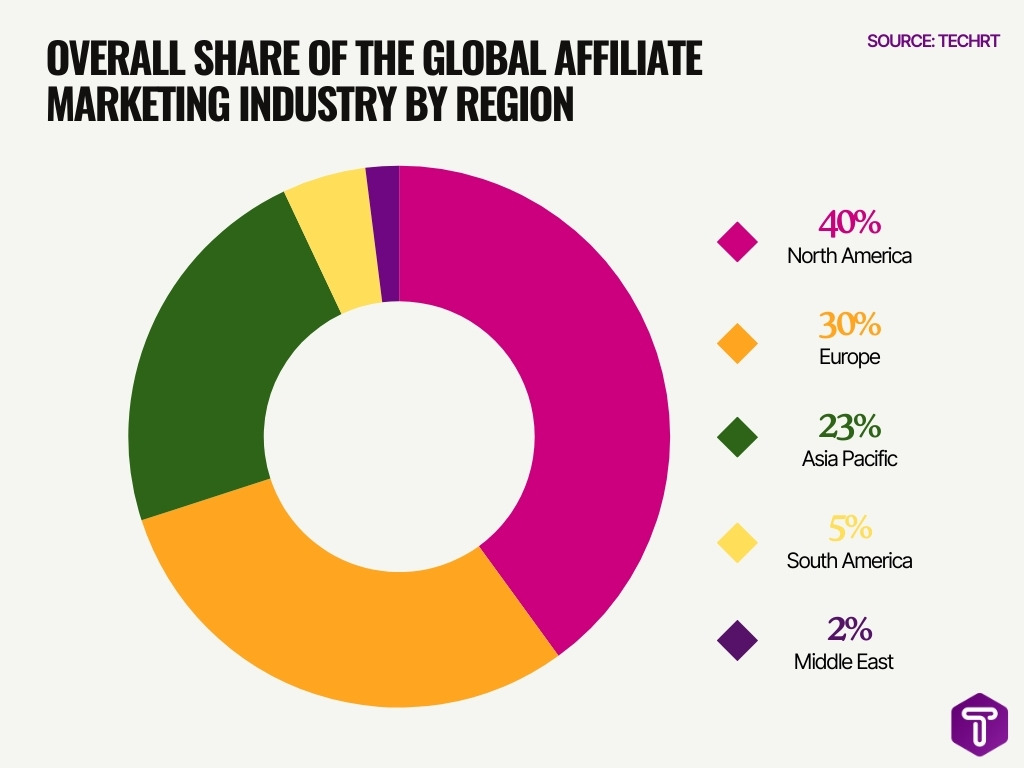
- North America dominates the global affiliate marketing industry, accounting for 40% of the total market share, making it the largest regional contributor.
- Europe holds the second-largest share at 30%, highlighting the region’s strong adoption of affiliate partnerships and performance-based marketing strategies.
- The Asia Pacific region captures 23% of the global affiliate marketing market, reflecting the rapid growth of e-commerce, digital platforms, and affiliate networks across countries like China, India, and Southeast Asia.
- South America represents 5% of the global market, showing emerging opportunities as online retail and digital marketing adoption continue to expand in the region.
- The Middle East accounts for the smallest share at 2%, but the region is experiencing gradual growth driven by increasing internet penetration and digital commerce adoption.
- Overall, North America and Europe together control 70% of the global affiliate marketing industry, indicating that mature digital advertising ecosystems and strong e-commerce infrastructure heavily influence affiliate marketing growth.
Business Adoption of Affiliate Marketing
- More than 80% of brands worldwide operate an affiliate program to acquire customers and increase revenue.
- Approximately 40% of US merchants consider affiliate marketing their primary digital acquisition channel.
- About 65% of retailers increased affiliate budgets between 2023 and 2025 due to improved ROI tracking.
- Nearly 31% of publishers say affiliate marketing is their top source of online income.
- Over 50% of SaaS companies now operate affiliate or referral programs to scale customer acquisition.
- Small businesses increasingly rely on affiliate partnerships, with around 40% launching new affiliate programs since 2022.
- Roughly 79% of online companies use affiliate marketing to engage influencers and content creators.
- Affiliate partnerships now account for one of the top five marketing channels used by ecommerce retailers globally.
- Businesses integrating affiliate programs with influencer marketing report 25% higher campaign performance on average.
Affiliate Marketing Revenue Contribution for Brands and Retailers
- Affiliate marketing contributes around 16% of all online orders globally, highlighting its role in ecommerce revenue generation.
- Some ecommerce brands generate over 30% of their total online revenue through affiliate partnerships.
- Affiliate marketing accounts for up to 20% of annual digital revenue for many retailers.
- Fashion and beauty retailers often see affiliate programs contributing 25% to 30% of online sales.
- Content publishers earn more than $12 billion annually from affiliate commissions worldwide.
- More than 70% of advertisers report steady revenue growth through affiliate partnerships year over year.
- Subscription services using affiliate marketing reported revenue growth of over 20% between 2023 and 2024.
- Travel companies generate around 15% of online bookings through affiliate partnerships.
- Electronics retailers report affiliate-driven revenue growth exceeding 18% annually since 2022.
Affiliate Marketing Adoption by Industry
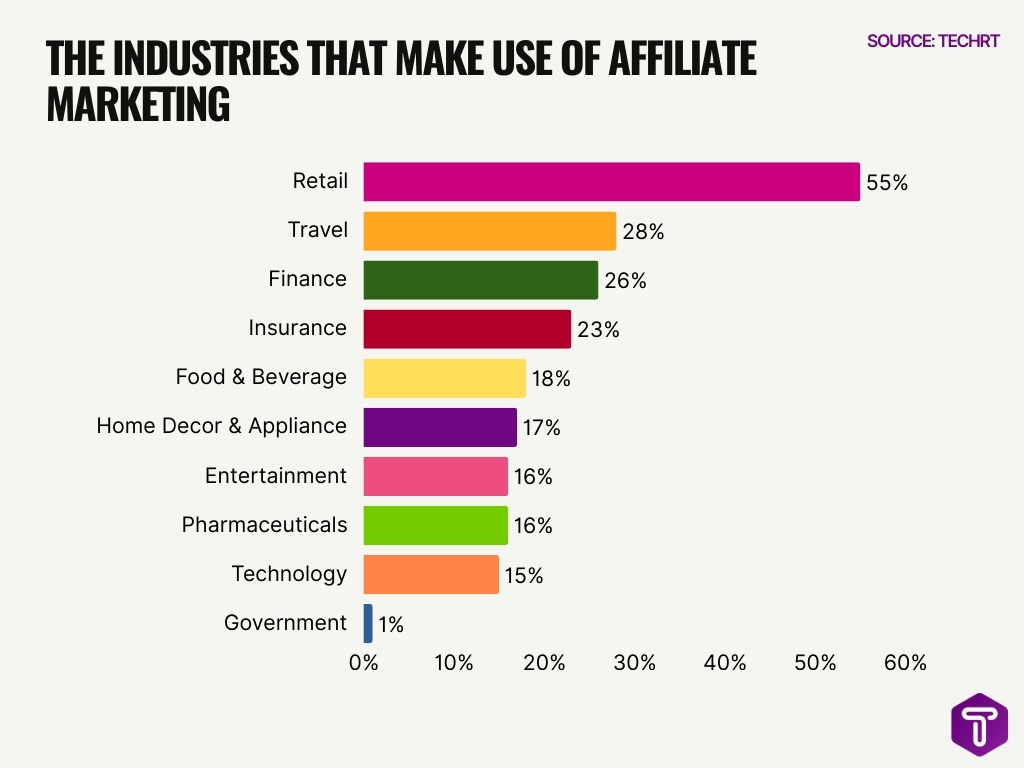
- The Retail industry dominates affiliate marketing adoption, with 55% of retailers actively using affiliate programs, making it the largest sector leveraging affiliate partnerships for sales and customer acquisition.
- The Travel sector ranks second, with 28% adoption, showing how airlines, hotel chains, and travel booking platforms heavily rely on affiliate websites, bloggers, and comparison platforms to drive bookings.
- Finance companies account for 26%, indicating strong affiliate usage among credit card providers, fintech apps, loan platforms, and investment services to generate leads and new customers.
- The Insurance industry follows with 23%, where insurers increasingly partner with comparison websites and financial publishers to attract policy buyers.
- Food and Beverage brands represent 18%, highlighting how restaurants, delivery platforms, and packaged food brands use affiliate promotions and influencer partnerships to boost visibility and orders.
- The Home Decor and Appliance sector reaches 17%, showing steady use of affiliate marketing among furniture brands, home improvement retailers, and appliance manufacturers.
- Both the Entertainment and pharmaceutical industries stand at 16%, reflecting moderate adoption for streaming services, gaming platforms, healthcare products, and wellness brands.
- The Technology sector records 15% adoption, with software companies, SaaS platforms, and hardware brands leveraging tech bloggers, review websites, and affiliate publishers.
- Government organizations show minimal participation, with only 1% adoption, indicating that affiliate marketing is primarily driven by private-sector industries.
- Overall, the data highlights that consumer-facing industries such as retail, travel, and finance lead affiliate marketing usage, while public sector involvement remains extremely limited.
Affiliate Marketing Statistics by Device and Platform
- Mobile devices generate over 65% of affiliate traffic globally.
- However, desktop users still produce higher conversion rates, often exceeding mobile conversions by 20% to 30%.
- Tablet users represent around 5% to 7% of affiliate-driven traffic, with higher purchase values on average.
- Mobile commerce growth contributed to over 70% of affiliate sales during major ecommerce events in 2024.
- Affiliate marketing platforms report mobile app tracking adoption increasing by nearly 40% since 2022.
- Nearly 60% of affiliate clicks now originate from mobile browsers.
- Mobile-first affiliate campaigns deliver up to 25% higher engagement rates on social platforms.
- Ecommerce brands optimizing affiliate landing pages for mobile report conversion improvements of around 15%.
- Cross-device tracking technologies improved affiliate attribution accuracy by over 20% in 2024.
Social Media Affiliate Marketing Statistics
- Over 70% of influencers monetize content using affiliate links, particularly on Instagram, YouTube, and TikTok.
- Instagram remains a leading affiliate platform, driving around 30% of influencer-based affiliate revenue.
- TikTok affiliate commerce experienced more than 45% growth in affiliate-driven product sales in 2024.
- YouTube creators frequently use affiliate links in video descriptions, influencing over 20% of consumer purchase decisions.
- Approximately 58% of shoppers say they have purchased a product recommended by an influencer through an affiliate link.
- Micro-influencers generate higher engagement rates, often between 4% and 7%, making them effective affiliate partners.
- Pinterest affiliate content drives strong conversion rates in lifestyle and home decor niches.
- Social commerce campaigns integrating affiliate links deliver conversion increases of about 25% compared with standard social ads.
- Around 65% of affiliate marketers promote products through at least one social media platform.
Preferred Channels for Affiliate Marketing (Excluding Social Media)
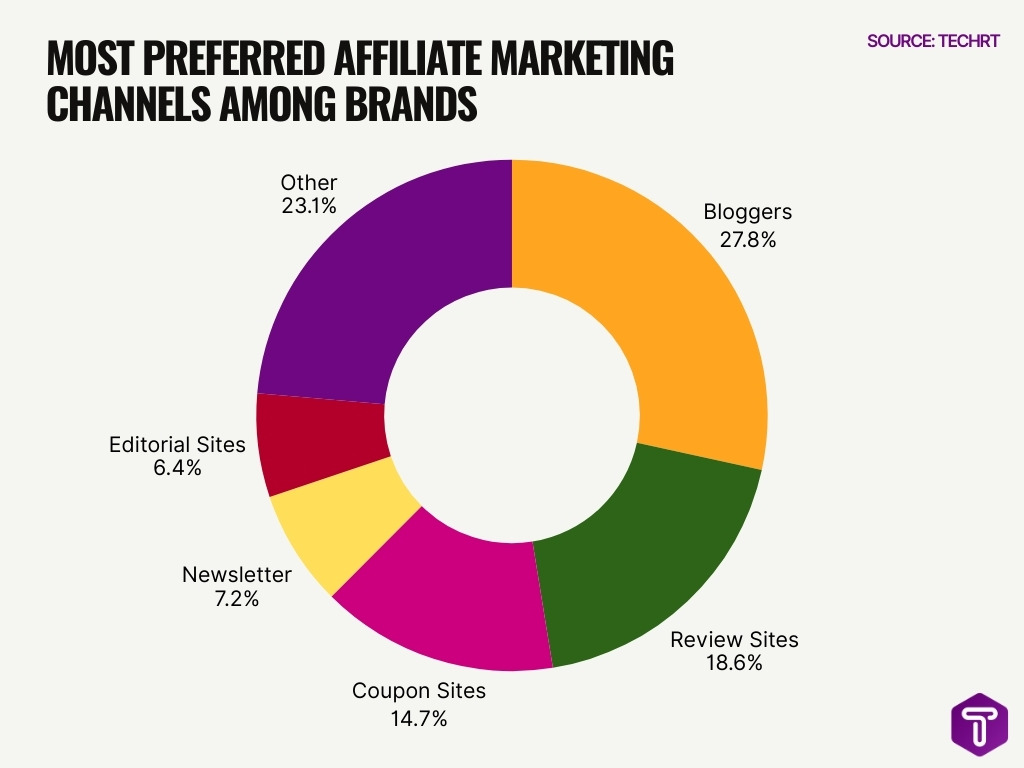
- Bloggers dominate affiliate marketing partnerships, with 27.8% of brands preferring to collaborate with bloggers. This highlights the strong influence of content creators and niche blogs in driving affiliate traffic and conversions.
- Review websites rank second, used by 18.6% of brands for affiliate marketing. These platforms are popular because product comparisons and detailed reviews help build trust and influence purchasing decisions.
- Coupon and deal sites account for 14.7% of affiliate marketing channels. Many brands leverage these platforms to attract price-sensitive shoppers and boost short-term sales through discounts and promotions.
- Newsletter-based affiliate marketing is used by 7.2% of brands, indicating that email marketing still plays a role in affiliate promotions, particularly for audiences that prefer curated deals and recommendations.
- Editorial websites represent 6.4% of affiliate marketing channels. These sites often integrate affiliate links within editorial content such as guides, news, or product roundups.
- A significant 23.1% of brands use other affiliate channels, showing that companies also rely on alternative partnerships and niche platforms beyond traditional affiliate sources.
- Overall, content-driven channels such as bloggers, review sites, and coupon sites together account for over 61% of affiliate marketing partnerships, emphasizing the importance of content marketing and trusted recommendations in affiliate strategies.
Affiliate Network and Program Statistics
- The global affiliate marketing industry was valued at around $18.5 billion in 2023 and is projected to reach $37.3 billion by 2026, reflecting rapid network and program expansion.
- Roughly 80–81% of brands worldwide now run at least one affiliate program, making networks and platforms a standard part of the marketing mix.
- There are about 107,000+ companies operating in the affiliate networks industry globally, underpinning thousands of programs across ecommerce, SaaS, and finance.
- A recent study found that 85% of US publishers use affiliate networks for monetization, rather than relying solely on independent programs.
- Top affiliate networks collectively serve partners in over 190 countries, enabling global participation for many affiliate programs.
- Around 60% of affiliate links are generated through affiliate networks, highlighting their central role in tracking and payouts.
- Surveys show 90% of new affiliates prefer joining established networks for support, tools, and easier onboarding compared to standalone programs.
- Data suggests 60% of affiliate marketing activity is coordinated through the top networks, which manage large pools of publishers and advertisers.
- Globally, there are about 9,600+ affiliate services/companies operating across continents, many acting as networks or multi-program platforms.
Affiliate Commission Rates and Payout Models
- Typical affiliate commission rates range from 5% to 30%, depending on the industry, with digital products offering higher margins.
- Ecommerce retailers usually offer 5% to 10% commissions for physical products sold through affiliate programs.
- SaaS companies often provide 20% to 40% recurring commissions for subscription referrals.
- Financial services affiliates may earn $100 to $500 per qualified lead for credit card or fintech offers.
- The cost-per-sale model remains the most common affiliate payout structure, used by more than 70% of programs.
- Cost-per-lead models are widely used in finance and insurance affiliate campaigns.
- Some affiliate programs now offer lifetime commissions for subscription referrals, particularly in SaaS industries.
- Hybrid payout models combining cost-per-sale and fixed bonuses increased by about 15% between 2023 and 2024.
- Affiliate payouts vary widely, with top-performing affiliates earning thousands per month from high-converting offers.
Affiliate Marketer Earnings Increase Significantly With Experience
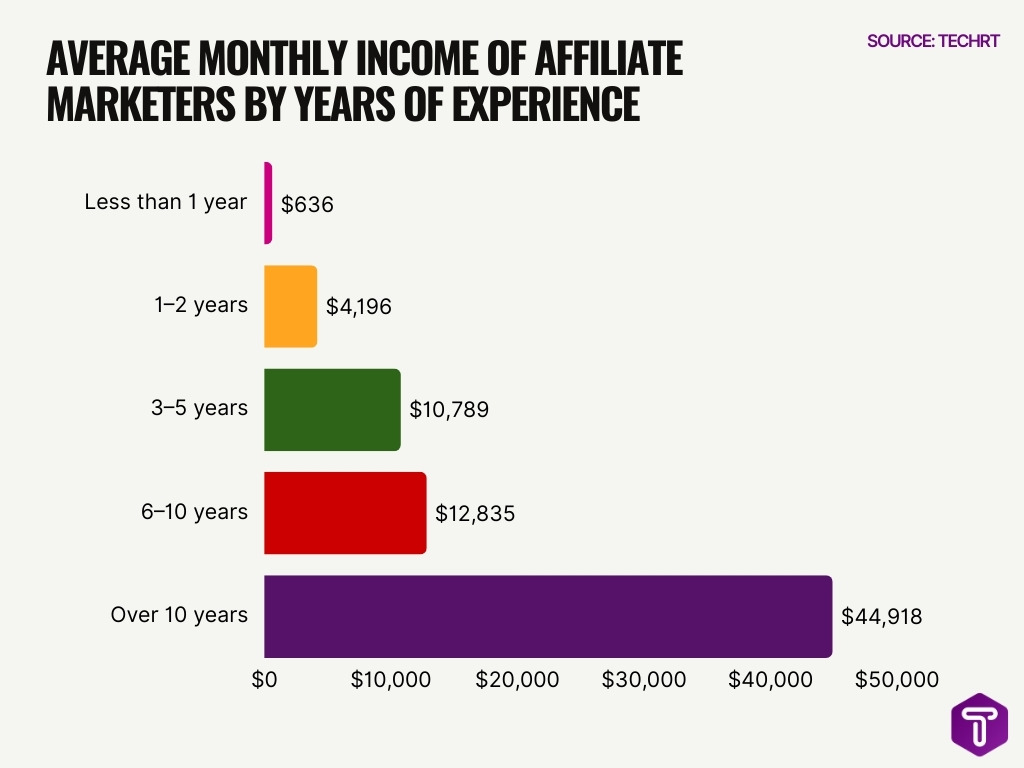
- Affiliate marketers with less than 1 year of experience earn an average monthly income of just $636, showing that beginners typically generate limited revenue in the early stages.
- After 1–2 years in the industry, the average monthly income jumps to $4,196, representing a major increase as marketers begin to build traffic, audiences, and optimized content.
- Those with 3–5 years of affiliate marketing experience earn about $10,789 per month, indicating that consistent strategy and established partnerships significantly improve earnings.
- Affiliates with 6–10 years of experience earn an average of $12,835 per month, demonstrating steady growth as marketers refine their funnels, SEO strategies, and conversion tactics.
- The highest earnings are seen among affiliates with over 10 years of experience, who generate an average monthly income of $44,918, highlighting the strong long-term earning potential of the affiliate marketing industry.
- Overall, the data shows a dramatic income gap between beginners and veterans, with affiliates having 10+ years of experience earning nearly 70× more than beginners.
Affiliate Marketer Income and Earnings Statistics
- Surveys show that around 9% of affiliate marketers earn over $50,000 annually from affiliate marketing alone.
- Approximately 35% of affiliate marketers earn at least $20,000 per year through affiliate commissions.
- Beginner affiliates often earn less than $10,000 annually during their first two years while building traffic and content.
- The top 3% to 5% of affiliate marketers generate more than $150,000 annually from performance-based partnerships.
- Nearly 60% of affiliate marketers operate as solopreneurs or independent content creators.
- About 65% of affiliate marketers say SEO and organic traffic are their primary revenue drivers.
- Content creators using affiliate links alongside digital products report revenue growth of 20% to 30% year-over-year.
- Bloggers with established websites can generate four-figure monthly affiliate income within 12 to 24 months of consistent publishing.
- Approximately 81% of affiliate marketers promote products through blogs or niche websites.
Affiliate Traffic, Clicks, and Conversion Rate Statistics
- The average affiliate program conversion rate typically falls between 1% and 5%, depending on the niche and traffic source.
- High-intent traffic from product reviews can reach conversion rates of 7% to 10%.
- Affiliate links embedded in comparison articles often achieve click-through rates above 5%.
- Email marketing affiliate campaigns report average click-through rates of around 3% to 4%.
- Mobile affiliate traffic generates more than 65% of total affiliate clicks globally.
- Coupon and cashback affiliates often deliver double-digit conversion rates during promotional events.
- Affiliate websites with high domain authority generate up to 50% more referral traffic compared with newer sites.
- Affiliate marketing campaigns that combine content marketing and SEO can increase conversion rates by 20% or more.
- Influencer-driven affiliate links frequently achieve engagement rates between 3% and 6% on social platforms.
Biggest Challenges Faced by High-Earning Affiliate Marketers
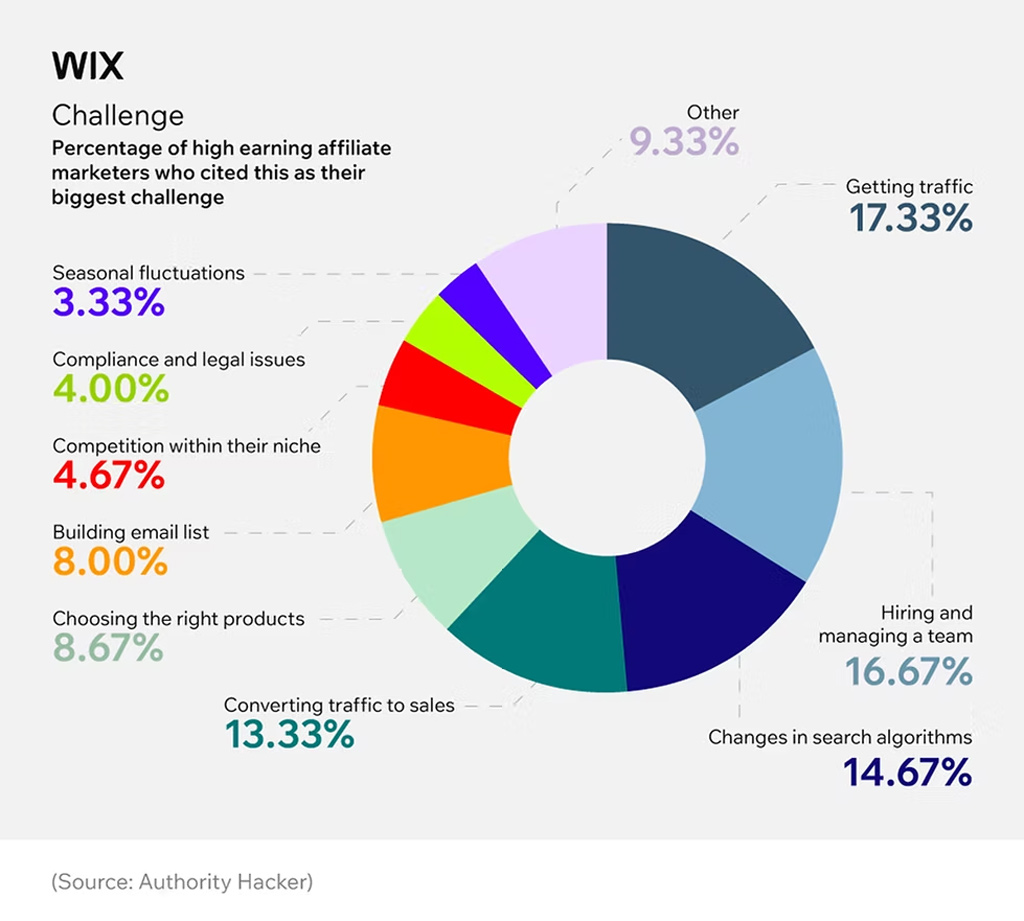
- Getting traffic is the biggest challenge, cited by 17.33% of high-earning affiliate marketers as their primary obstacle.
- Hiring and managing a team is the second-largest challenge, with 16.67% of affiliates struggling to scale operations and manage team members.
- Changes in search algorithms impact 14.67% of affiliate marketers, showing how heavily affiliates rely on SEO and search engine visibility.
- 13.33% of marketers report that converting traffic into sales remains a major issue despite successfully attracting visitors.
- Around 9.33% of affiliates face other unspecified challenges, highlighting the diversity of operational issues in affiliate marketing.
- Choosing the right products to promote is difficult for 8.67% of high-earning affiliates, reflecting the importance of product-market fit and audience alignment.
- Building an email list is a challenge for 8.00% of marketers, indicating that email marketing infrastructure still requires significant effort.
- Competition within their niche affects 4.67% of affiliates, especially in crowded and highly competitive markets.
- Compliance and legal issues are reported by 4.00% of affiliates, emphasizing the need to follow regulations, disclosure rules, and platform policies.
- Seasonal fluctuations impact 3.33% of affiliates, showing that market demand cycles can influence affiliate revenue stability.
Future Trends in Affiliate Marketing Statistics
- The global affiliate marketing industry is projected to surpass $18 billion in value by 2027.
- AI-powered affiliate campaign optimization is expected to improve conversion rates by 20% to 30% over the next five years.
- Influencer-affiliate hybrid marketing strategies will likely dominate creator monetization models by 2026 and beyond.
- Affiliate marketing integrated with social commerce platforms is projected to grow by more than 25% annually.
- First-party data strategies will become essential as third-party cookies phase out across major browsers.
- Affiliate networks are investing in server-side tracking technologies to improve attribution accuracy.
- The creator economy is expected to produce millions of new affiliate marketers globally by 2030.
- Ecommerce brands plan to increase affiliate marketing budgets by 10% to 15% annually through 2026.
- Video-based affiliate content on platforms such as YouTube and TikTok will continue to drive significant product discovery and conversions.
Frequently Asked Questions (FAQs)
What is the current global market size of affiliate marketing?
The global affiliate marketing industry is valued at about $17–18.5 billion in 2025, and it is projected to exceed $20 billion in 2026.
What is the expected CAGR of the affiliate marketing industry?
The affiliate marketing market is growing at a roughly 8–15% compound annual growth rate (CAGR), depending on the forecast model and region.
What percentage of brands use affiliate marketing programs?
More than 80% of brands and about 84% of publishers currently use affiliate marketing programs as part of their digital marketing strategy.
What share of ecommerce sales comes from affiliate marketing?
Affiliate marketing contributes around 16% of global ecommerce sales, making it one of the largest performance marketing channels online.
How much revenue can affiliate marketing generate relative to spend?
Affiliate marketing campaigns can generate about $6.50 to $15 in revenue for every $1 spent, depending on industry and campaign performance.
Conclusion
Affiliate marketing continues to evolve into a major performance marketing channel for both brands and creators. Businesses rely on affiliate partnerships to acquire customers at predictable costs, while publishers monetize content through commission-based revenue. Growth in ecommerce, influencer marketing, and creator-led commerce has accelerated the adoption of affiliate programs across industries. At the same time, innovations in tracking technology, AI optimization, and first-party data strategies are shaping the future of affiliate partnerships. As these trends continue, affiliate marketing will remain a powerful channel for scalable digital revenue and measurable customer acquisition.

Leave a comment
Have something to say about this article? Add your comment and start the discussion.