




Artificial intelligence continues to reshape the legal industry, changing how law firms research cases, draft contracts, review evidence, and manage operations. Legal teams now use AI to speed up due diligence, reduce document review time, and automate repetitive workflows that once consumed thousands of billable hours. In-house legal departments also rely on AI tools to control rising compliance costs and handle growing workloads with smaller teams.
Meanwhile, courts, regulators, and corporate clients increasingly expect faster legal outcomes and data-backed decision-making. From litigation support to contract lifecycle management, AI now plays a measurable role across the legal ecosystem. This article explores the latest AI in legal services statistics, adoption trends, market shifts, and operational impacts shaping the industry.
Editor’s Choice
- More than 95% of legal professionals expect generative AI to become central to legal workflows within the next five years.
- Around 31% of legal professionals at law firms reported individual generative AI usage in 2025, while organizational adoption remained lower at 21%.
- Generative AI adoption among small law firms increased from 27% in 2023 to 53% in 2025.
- Large law firms showed the highest AI adoption rates, with 87% of firms using AI-powered legal tools in some capacity by late 2025.
- The legal AI market is projected to reach $10 billion annually by 2030, driven by research automation, contract analytics, and litigation tools.
- Over 60% of surveyed federal judges in the US reported using AI for drafting, legal analysis, or hearing preparation in 2026.
- Legal AI company valuations continue to climb, with one major legal tech platform reaching a $5 billion valuation in 2025 after expanding AI-powered workflow products.
- A 2026 randomized legal education study found that AI training increased generative AI adoption among law students from 26% to 41%.
Recent Developments
- In May 2026, Anthropic expanded Claude’s legal AI integrations with platforms such as Westlaw, Practical Law, Box, Everlaw, and DocuSign.
- Thomson Reuters reported that law firms began experimenting with agentic AI systems in early 2025, with broader deployment expected through 2026 and beyond.
- One of the largest legal tech acquisitions in history occurred in 2025 when a legal operations platform acquired vLex for $1 billion to strengthen AI-powered legal research capabilities.
- Legal AI webinar participation exceeded 20,000 registrants in 2026, highlighting strong demand for AI training across the legal sector.
- New AI plug-ins focused on litigation, commercial contracts, and legal research entered the market in 2026 as vendors targeted specialized legal workflows.
- Courts across the US increasingly piloted AI-assisted drafting and case summarization tools during 2025 and 2026.
- Research published in 2026 showed that some AI statutory analysis systems achieved 92% effective accuracy after correcting benchmark limitations in prior legal datasets.
- Legal AI vendors accelerated partnerships with law schools in 2026 to familiarize future lawyers with generative AI workflows before graduation.
- Professional services surveys in 2026 showed legal teams increasingly demanded AI systems with built-in compliance controls and citation verification.
Global Overview of AI in Legal Services
- The global legal tech market reached an estimated $20.81 billion in 2025 and continues expanding due to AI-driven automation.
- Analysts project the broader legal tech industry could exceed $65 billion by 2034, supported by AI adoption in research, compliance, and contract review.
- Legal professionals in over 130 countries now use AI-enabled legal management platforms.
- A 2025 survey covering more than 2,800 legal professionals found rising personal AI usage across firms globally.
- North American law firms continue to lead AI implementation, although Europe and Asia-Pacific firms increased legal AI investment during 2025.
- AI adoption expanded rapidly among legal research providers after the release of generative AI tools in late 2022 and early 2023.
- Legal AI usage now extends beyond private law firms into courts, government agencies, legal aid organizations, and corporate legal departments.
- AI-based legal research platforms increasingly integrate retrieval-augmented generation systems to improve citation reliability and reduce hallucinations.
- Researchers reported that AI-assisted legal consultation systems reduced preliminary legal analysis time by more than 90% compared with traditional paralegal workflows.
AI Adoption Among Lawyers
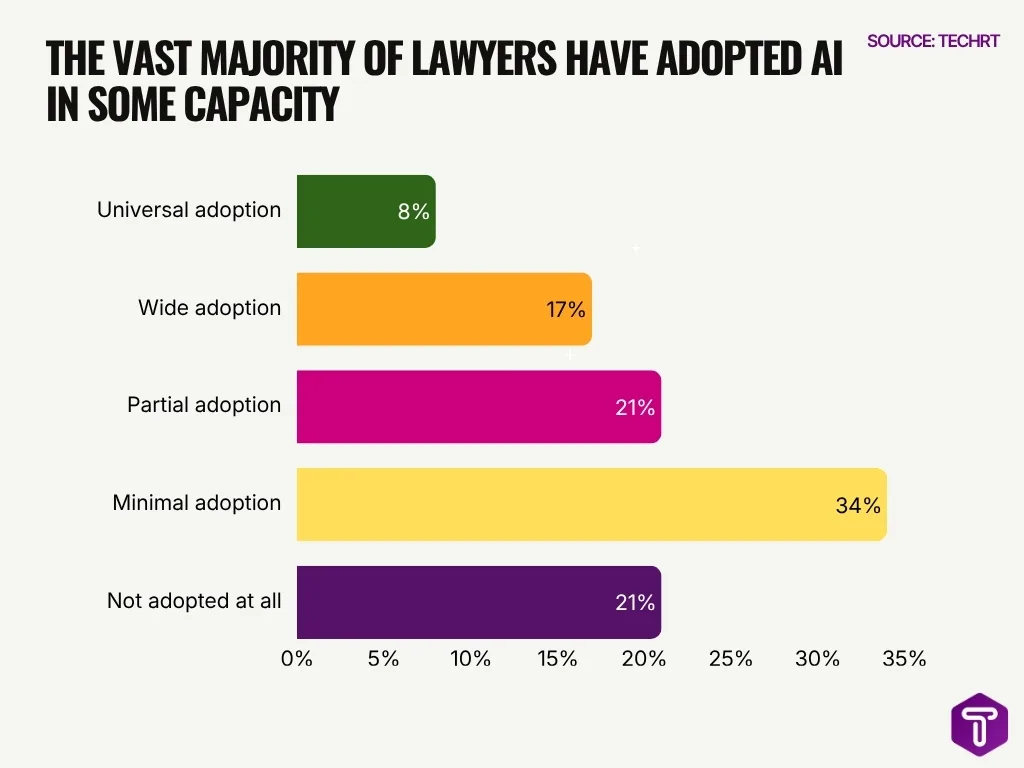
- 79% of lawyers have adopted AI in some capacity, showing that AI is now widely present in the legal profession.
- Only 21% of lawyers have not adopted AI at all, meaning non-adopters are now a minority in the legal sector.
- The largest group is lawyers with minimal AI adoption, accounting for 34% of respondents.
- Partial adoption stands at 21%, indicating that many legal professionals are still experimenting with AI rather than fully integrating it into workflows.
- 17% of lawyers report wide AI adoption, suggesting a growing segment of law firms and legal teams are using AI across multiple tasks.
- Universal AI adoption remains relatively low at 8%, showing that full-scale AI integration is still in the early stages.
- Combined, 46% of lawyers fall into the universal, wide, or partial adoption categories, indicating meaningful AI usage beyond basic experimentation.
- The data suggests that while AI is broadly accepted in legal services, most adoption is still limited or gradual, rather than fully embedded across legal operations.
- For legal technology providers, the 34% minimal adoption segment represents a major opportunity for education, onboarding, and workflow-specific AI tools.
AI Adoption Rates in the Legal Industry
- Around 21% of law firms reported using legal-specific generative AI tools in 2025.
- Individual generative AI use among legal professionals reached 31% in 2025.
- Large law firms recorded AI adoption rates of 87%, while solo firms still achieved adoption rates above 70%.
- Around 76% of in-house legal teams reported using generative AI weekly by 2026.
- Approximately 68% of law firm professionals used generative AI tools weekly in 2026.
- A Washington State Bar survey found 25% of lawyers used generative AI regularly in legal practice during 2025.
- More than half of surveyed law firms still lacked clear AI governance policies in 2025.
- AI adoption grew fastest among firms with integrated legal research, billing, and workflow management platforms.
- Legal professionals increasingly adopted AI for administrative and operational tasks beyond traditional legal research.
Impact of AI on Legal Productivity and Efficiency
- Legal professionals using generative AI saved up to 32.5 working days annually on tasks like drafting and research.
- AI-assisted legal research reduces time from 17-28 hours to 3-5.5 hours per litigation matter.
- 79% of legal professionals now use AI tools daily, up from 19% in 2023.
- 91% of in-house counsel cite efficiency gains as the top benefit of generative AI in drafting and research.
- 62% of professionals report 6%-20% weekly time savings from AI tools, boosting strategic focus.
- Lawyers anticipate saving 140 hours annually per person through AI-assisted work in 2026.
- AI boosts attorney efficiency by up to 140% while improving work quality by 28% in complex tasks.
- 93% of legal professionals say AI increases productivity, enabling higher matter volumes without added headcount.
- Firms using AI for research and drafting cut costs by 30-50% on routine tasks.
Common AI Use Cases in Law Firms
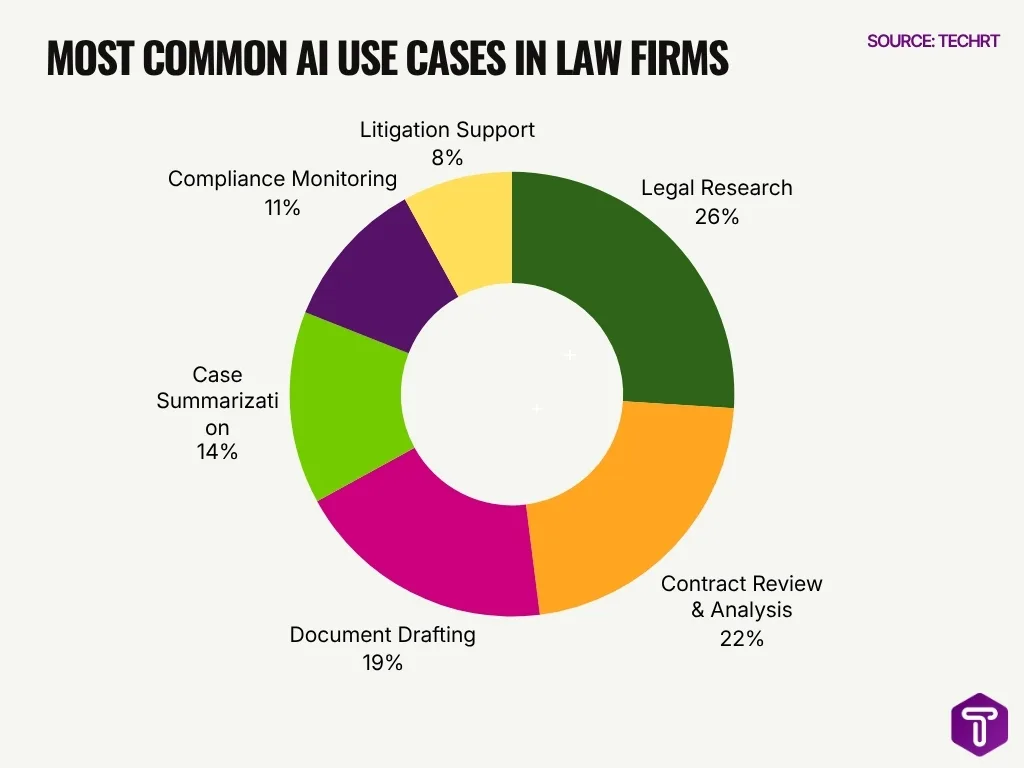
- Legal research is the most common AI use case in law firms, accounting for 26% of usage.
- Contract review and analysis ranks second with 22%, showing strong demand for AI tools that can speed up document-heavy legal work.
- Document drafting represents 19% of AI use, highlighting how law firms are using AI to prepare legal documents, templates, and first drafts more efficiently.
- Case summarization accounts for 14%, suggesting that AI is increasingly used to condense lengthy case files, judgments, and legal materials.
- Compliance monitoring makes up 11% of AI use, reflecting the growing role of automation in tracking regulatory risks and obligations.
- Litigation support has the smallest share at 8%, but it still shows AI’s value in trial preparation, evidence review, and legal strategy support.
- Overall, the data shows that AI adoption in law firms is strongest in research, contract analysis, and drafting, which together account for 67% of total use cases.
AI for Legal Research and Case Analysis
- Legal research remains the top AI application in law firms, with more than 69% of lawyers using AI tools for case law research and summarization in 2025.
- AI-powered legal research platforms reduced average research time by up to 80% compared with traditional manual workflows.
- Around 74% of corporate legal departments reported using AI-assisted legal research tools at least weekly in 2026.
- AI case analysis systems achieved citation accuracy rates above 90% in benchmark legal retrieval testing during 2026.
- Firms using AI-assisted legal research reported measurable improvements in litigation preparation speed and internal response times.
- AI-generated case summaries helped junior associates reduce research review workloads by several hours per matter.
- Retrieval-augmented generation systems gained traction because firms demanded stronger source verification and reduced hallucination risk.
- More than 60% of legal professionals surveyed in 2025 said AI improved access to relevant precedents and supporting authorities.
- AI legal research systems increasingly integrated court analytics, judge behavior tracking, and predictive litigation insights during 2025 and 2026.
AI in Contract Drafting and Review
- Contract drafting became one of the fastest-growing legal AI use cases, especially for NDAs, vendor agreements, and procurement contracts.
- AI-assisted contract review reduced review times by 50% to 80% in large-scale legal operations environments.
- Around 72% of legal departments reported using AI for contract lifecycle management by 2026.
- AI systems helped legal teams identify risky clauses, missing obligations, and inconsistent language across large agreement databases.
- Contract analytics tools improved due diligence efficiency during mergers and acquisitions by automating clause extraction and categorization.
- AI-generated first drafts reduced repetitive drafting workloads for associates and in-house legal teams.
- More than 65% of enterprises using AI contract tools reported fewer manual review errors in 2025.
- Legal AI platforms will increasingly be integrated directly with DocuSign, Microsoft 365, and enterprise procurement systems in 2026.
- AI contract management adoption accelerated fastest in financial services, healthcare, and technology sectors due to complex compliance demands.
AI in E-Discovery and Document Review
- AI-powered e-discovery platforms reduced manual document review workloads by up to 70% in large litigation matters.
- The global e-discovery market surpassed $18 billion in 2025, driven by growing litigation data volumes and AI automation.
- Predictive coding tools significantly improved review prioritization for litigation teams handling millions of files.
- AI-assisted document review lowered legal discovery costs by reducing the number of billable review hours required.
- Law firms increasingly use AI to detect duplicate files, classify privileged documents, and identify sensitive information automatically.
- Cloud-based e-discovery tools gained wider adoption as hybrid and remote legal work expanded after 2023.
- Around 58% of litigation professionals reported improved review accuracy after implementing AI-assisted discovery tools.
- AI-powered review systems shortened litigation preparation timelines by helping teams identify key evidence earlier in the discovery process.
- Legal AI vendors increasingly added multilingual review capabilities to support cross-border investigations and international arbitration cases.
AI in Law Firm Operations and Workflow Automation
- 79% of law firms using AI workflow automation reported improved operational efficiency in 2025.
- 86% of mid-sized law firms now use AI tools, with 60% having formal AI policies.
- 75% of law firm tasks are potentially exposed to AI automation in 2026.
- AI-powered automation saves up to 240 hours per lawyer annually.
- Firms using AI client intake cut admin time per file by 80%.
- Lead automation boosts qualified consultation bookings by 42%.
- AI billing tools improve time tracking accuracy by 30-40%.
- AI research tools reduce research time by up to 70%.
- AI-powered CRM enables automated client follow-ups and 24/7 support.
- Legal operations dashboards track billing realization rates and attorney utilization.
Most Legal Professionals Are Only Somewhat Confident Using AI
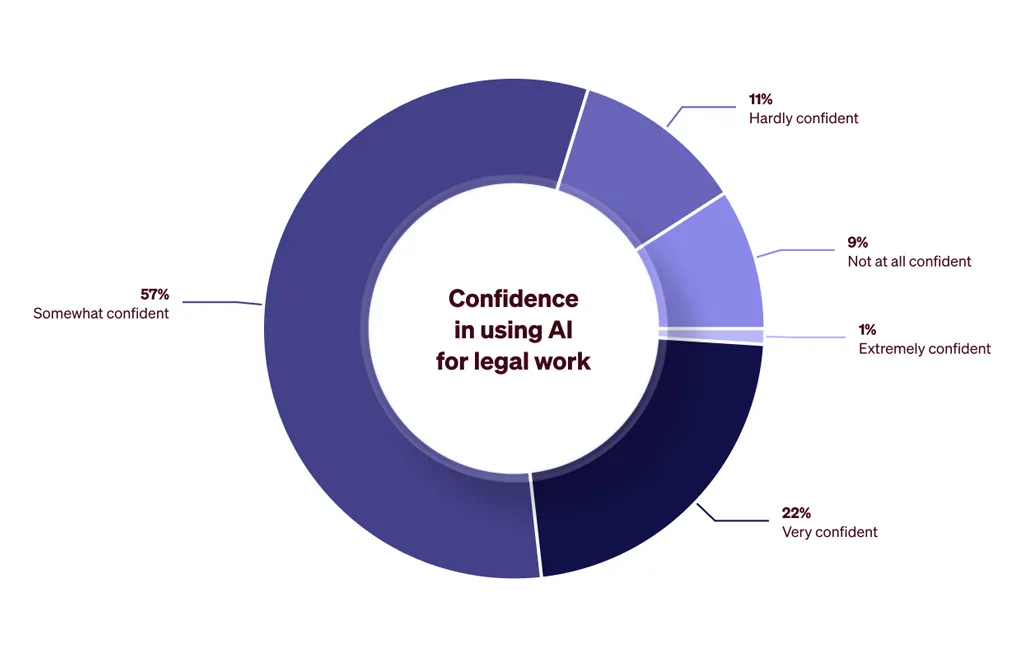
- The chart shows that 57% of respondents are somewhat confident in using AI for legal work, making it the largest group.
- Only 22% of respondents said they are very confident, suggesting that strong confidence in legal AI tools is still limited.
- Just 1% reported being extremely confident, showing that very few legal professionals feel fully comfortable relying on AI.
- A combined 20% of respondents expressed low confidence, including 11% who are hardly confident and 9% who are not at all confident.
- Overall, 80% of respondents showed at least some level of confidence in AI for legal work, but most are not yet highly confident.
- The data suggests that AI adoption in legal services may be growing, but many users still need more training, trust, accuracy, and compliance assurance before becoming fully confident.
- For law firms and legal teams, the findings highlight a major opportunity to improve AI confidence through clear usage policies, human review workflows, and AI literacy programs.
Time Savings from AI in Legal Workflows
- 80% reduction in research time for AI-assisted legal workflows.
- Contract review cycles shortened from 5–7 days to 2–4 hours with automation.
- Lawyers save 4–6 hours per week on repetitive writing using AI drafting assistants.
- E-discovery tools cut document sorting time by up to 70% in litigation matters.
- Workflow automation sped up client intake by 50%, reducing onboarding from 3 days to 1.5 days.
- AI summarization tools reduced review time for long cases by 60–65%.
- Compliance tracking automation saved legal ops teams 10–15 hours per month in 2026.
- AI search systems retrieve prior work in under 10 seconds instead of 1–2 hours.
- AI-assisted court drafting cut administrative processing time by 40% and hearing prep by 35%.
Cost Savings from AI-Enabled Legal Automation
- AI-enabled legal automation reduced operational costs by up to 30% in enterprise legal departments.
- Law firms using AI document review tools cut contract review outsourcing costs by 20–40%.
- Automated legal research platforms reduced research time and billable hours by nearly 35%.
- AI-driven contract lifecycle management systems shortened negotiation cycles by 25–50%, lowering admin overhead.
- Legal teams deploying AI compliance tools reduced regulatory monitoring costs by around 30%.
- AI-powered intake and workflow automation lowered administrative staffing needs by 20–25% during growth phases.
- Predictive coding in eDiscovery reduced litigation discovery costs by up to 70%.
- Over 50% of legal leaders expect significant cost savings from generative AI by 2027.
- Subscription-based AI legal tools reduced upfront technology costs by 40–60% for small law firms.
AI Adoption Trends by Legal Practice Area
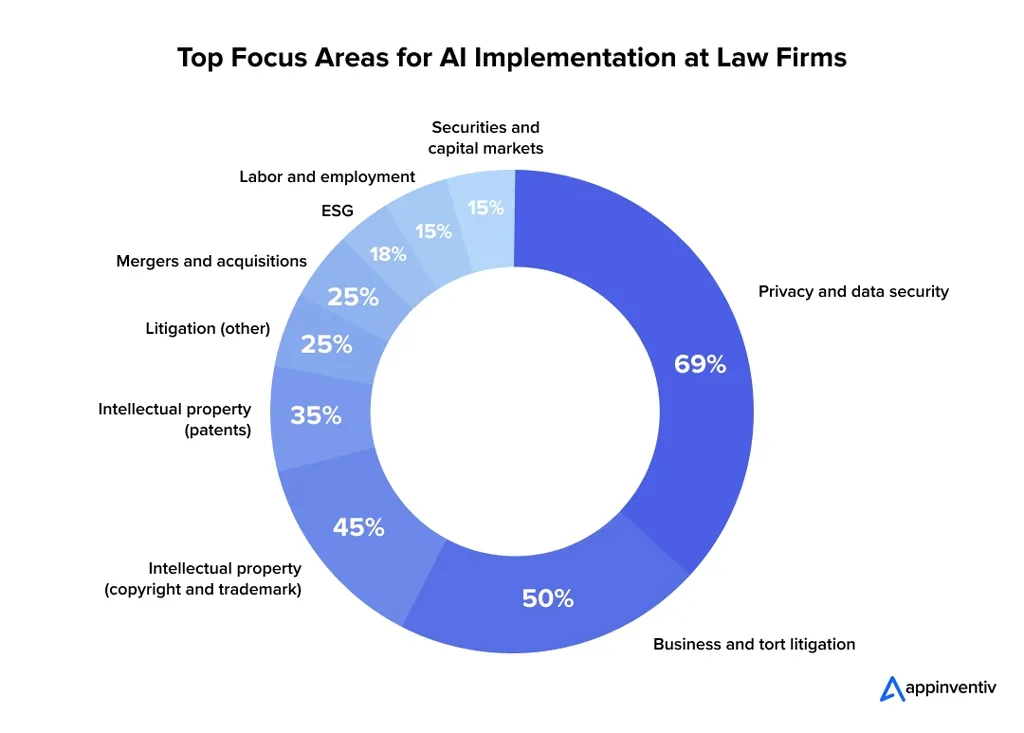
- Privacy and data security are the leading focus areas for AI implementation at law firms, with 69% prioritizing it.
- Business and tort litigation ranks second, with 50% of law firms focusing on AI use in this area.
- Intellectual property – copyright and trademark is another major AI focus, accounting for 45%.
- Intellectual property – patents follow with 35%, showing strong interest in AI for IP-related legal work.
- Litigation-related AI use is notable overall, with 25% focused on other litigation areas beyond business and tort litigation.
- Mergers and acquisitions also account for 25%, suggesting AI is being explored for deal review, due diligence, and transaction support.
- ESG-related legal work represents 18%, indicating a smaller but growing area for AI adoption.
- Labor and employment and securities and capital markets are tied at 15% each, making them the lowest-ranked focus areas in the chart.
- The data shows that law firms are prioritizing AI in areas involving risk management, litigation, data protection, and intellectual property.
- Overall, the strongest AI adoption interest appears in legal practices where firms handle large volumes of sensitive data, documents, contracts, and regulatory risk.
AI in Corporate Legal Departments and In-House Teams
- Around 52% of in-house legal teams use or evaluate AI for contract review in 2026.
- 87% of legal professionals say AI benefits contract review and redlining.
- AI contract review usage nearly quadrupled since 2024 among corporate legal departments.
- 64% of in-house teams expect less reliance on outside counsel due to AI.
- 79% of in-house teams report reduced time on routine legal tasks with AI.
- AI-powered CLM reduces contract cycle times by up to 40%.
- Legal teams achieve 82% time savings on contract tasks via AI automation.
- 96% of in-house teams adopted AI in some capacity by 2026.
- 87% of general counsel report generative AI use in their departments.
Ethical and Professional Concerns About AI in Law
- Around 61% of legal professionals reported concern about client confidentiality risks when using AI‑powered legal tools.
- Roughly 28% of attorneys reported using generative AI every day at work, raising ethical concerns about over‑reliance on machine‑generated content.
- Over 79% of legal professionals now use AI tools in some form, yet fewer than half work under firms with formal AI ethics policies.
- In one recent survey, 69% of legal professionals said they used general‑purpose generative AI weekly or more, but less than one‑third had structured AI‑ethics training.
- Nearly 84% of lawyers expect AI adoption in law to grow in the next three years, while over half flagged accountability and bias as top ethical worries.
- About 64% of in‑house legal teams said they anticipate depending less on outside counsel due to AI‑assisted research and drafting, heightening professional‑conduct risks.
- Around 31% of legal professionals personally used generative AI at work in 2025, up from 27% the year before, with many citing lack of oversight as a key concern.
- Approximately 46% of law firms reported implementing general‑purpose AI tools, while over half still lacked mandatory human‑review protocols for AI outputs.
- In one study, only 46% of firms had formal AI governance policies, despite near‑ubiquitous use of AI‑assisted legal drafting.
- Roughly 61% of lawyers said AI hallucinations and false citations were their primary ethical concern, prompting tighter review and disclosure rules in several US courts.
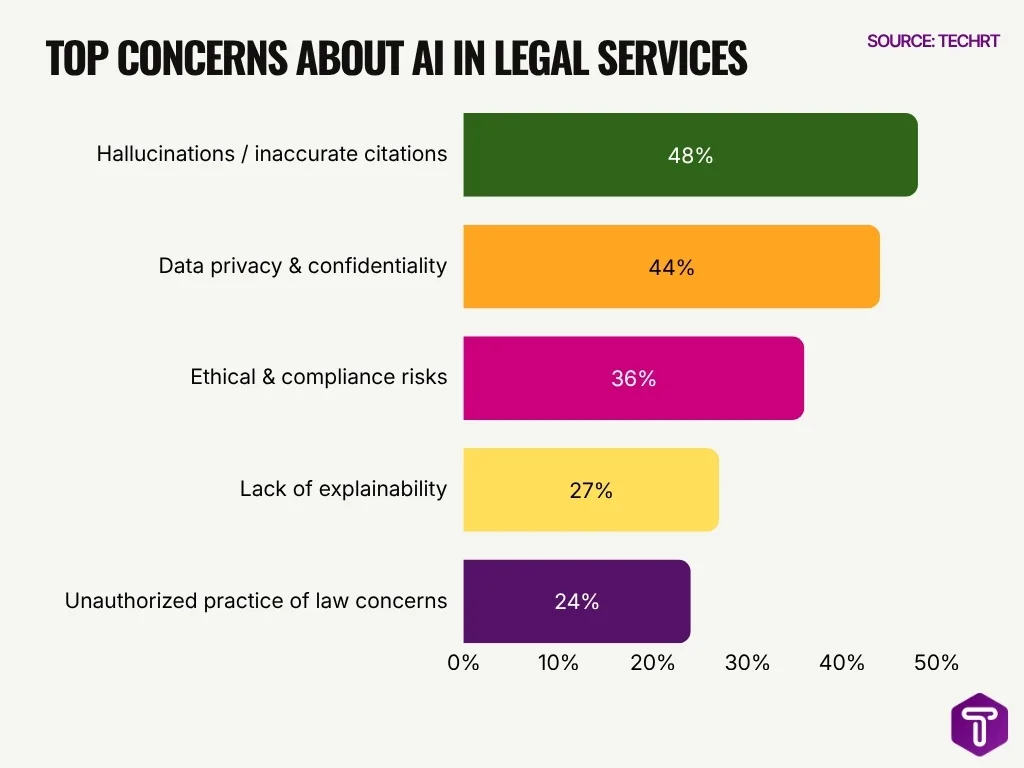
Top Concerns About AI in Legal Services
- Hallucinations and inaccurate citations are the biggest concern, cited by 48% of respondents, showing that accuracy remains the top barrier to AI adoption in legal work.
- Data privacy and confidentiality rank second at 44%, highlighting the legal sector’s strong focus on protecting sensitive client information.
- Ethical and compliance risks concern 36% of respondents, suggesting that law firms are still cautious about whether AI use aligns with professional standards and regulations.
- Lack of explainability is reported by 27%, showing that many legal professionals want clearer reasoning behind AI-generated outputs before trusting them.
- Unauthorized practice of law concerns account for 24%, indicating worries that AI tools could cross legal boundaries if used without proper human oversight.
- The data shows that legal professionals are most concerned about accuracy, confidentiality, and compliance, rather than just the technology itself.
- Since 48% worry about hallucinations and 44% worry about privacy, AI tools in legal services must prioritize verified citations, secure data handling, and human review.
- The relatively lower but still notable 24% concern around unauthorized practice of law suggests that firms need clear policies defining where AI can assist and where licensed attorneys must remain in control.
Market Size and Growth of AI in Legal Services
- The global legal AI market is projected to exceed $10 billion by 2030 as adoption expands across research, drafting, and legal operations.
- The broader legal technology market reached approximately $20.81 billion in 2025.
- Analysts forecast the legal tech industry could surpass $65 billion by 2034 because of automation demand and regulatory complexity.
- Investment activity in legal AI startups accelerated throughout 2025 and 2026, especially in contract analytics and litigation automation.
- One major legal technology platform achieved a $5 billion valuation in 2025 after expanding AI-enabled legal workflow products.
- North America remained the largest legal AI market because of strong enterprise legal spending and rapid cloud adoption.
- Asia-Pacific legal AI investment grew rapidly as firms modernized legal infrastructure and compliance systems.
- AI-driven contract lifecycle management emerged as one of the fastest-growing legal software categories during 2025 and 2026.
- Investors increasingly backed legal AI companies focused on retrieval-based research, secure enterprise deployment, and compliance automation.
Future Outlook and Predictions for AI in Legal Services
- Legal AI market to reach $156.22 billion by 2035, growing at 27% CAGR from 2025.
- 95% of legal professionals expect generative AI to be central to workflows within five years.
- 86% of mid-sized law firms now use AI for operational efficiency.
- Legal AI software market to grow by $3.51 billion at 30.9% CAGR through 2030.
- 80% anticipate AI having a high/transformational impact on legal work in five years.
- 74% support law school curriculum reform integrating AI literacy and ethics.
- Gartner predicts 40% of enterprise apps with AI agents by 2026, up from <5%.
- AI-powered contract analysis market to expand to $2.91 billion at 23.3% CAGR to 2030.
- Over 300 courts require AI disclosure by March 2026, with sanctions rising.
- 79% of legal professionals use AI, expecting further adoption growth.
Frequently Asked Questions (FAQs)
What is the projected size of the AI in the legal services market by 2035?
What percentage of legal professionals used generative AI in 2026?
How many law firms had integrated generative AI into legal workflows by 2025?
What is the CAGR of the global legal AI market through 2030?
What valuation did legal AI startup Harvey reach in 2026?
Conclusion
AI continues to reshape the legal industry, with law firms, courts, and corporate legal departments rapidly integrating automation into daily workflows. Legal professionals increasingly rely on AI for research, drafting, e-discovery, compliance monitoring, and operational management. At the same time, concerns surrounding ethics, confidentiality, hallucinated citations, and governance remain central to industry discussions.
The latest statistics show that AI adoption no longer sits at the experimental stage. Instead, legal organizations now view AI as a long-term operational necessity that can improve efficiency, reduce costs, and support faster legal outcomes. As generative AI platforms mature and governance standards evolve, the legal sector will likely move toward more structured human-AI collaboration models throughout the remainder of the decade.

Leave a comment
Have something to say about this article? Add your comment and start the discussion.