




Branding plays a critical role in how businesses attract attention, build credibility, and drive long-term growth. In today’s competitive landscape, customers rarely choose products based on features alone. Instead, they respond to how a brand looks, feels, and communicates across channels. For instance, ecommerce brands rely heavily on visual identity and consistent messaging to improve conversion rates, while SaaS companies use trust signals, storytelling, and customer experience to reduce churn and strengthen retention.
At the same time, the rise of social media, mobile-first behavior, and AI-driven personalization has reshaped how brands interact with audiences. Consumers now expect seamless, relevant, and authentic experiences at every touchpoint. This shift makes branding not just a marketing function, but a measurable business driver tied directly to revenue, loyalty, and customer lifetime value.
The statistics in this report highlight how branding influences real-world outcomes across industries. From awareness and perception to ROI and performance metrics, each data point reveals what drives success and beyond. Let’s dive into the numbers that define modern branding.
Editor’s Choice
- 81% of consumers say they must trust a brand before making a purchase.
- 75% of consumers recognize a brand by its logo, not its name or messaging.
- 55% of first impressions are based on visual elements like design and color.
- 94% of consumers recommend brands they feel emotionally connected with.
- Consistent branding can increase revenue by 10–20% on average.
- 77% of consumers prefer brands they follow on social media.
- Returning customers generate about 65% of a company’s revenue.
Recent Developments
- In 2026, 69% of marketers prioritize emotional branding as a core strategy.
- AI adoption in marketing exceeded 90%, influencing brand personalization and messaging.
- Nearly 75% of marketers now use AI for visual content creation, reshaping brand identity workflows.
- 64% of global consumers use social media to research brands before buying.
- 5.66 billion people globally use social media, expanding brand reach dramatically.
- Gen Z shows a shift in trust, 72% trust customer reviews more than influencer content.
- Brands with strong visual consistency see up to 3.5× higher visibility.
- AI-driven search is prioritizing third-party credibility over brand-owned content, shifting branding strategies.
- 92% of businesses integrate AI into marketing, including branding workflows.
Key Branding Statistics You Should Know
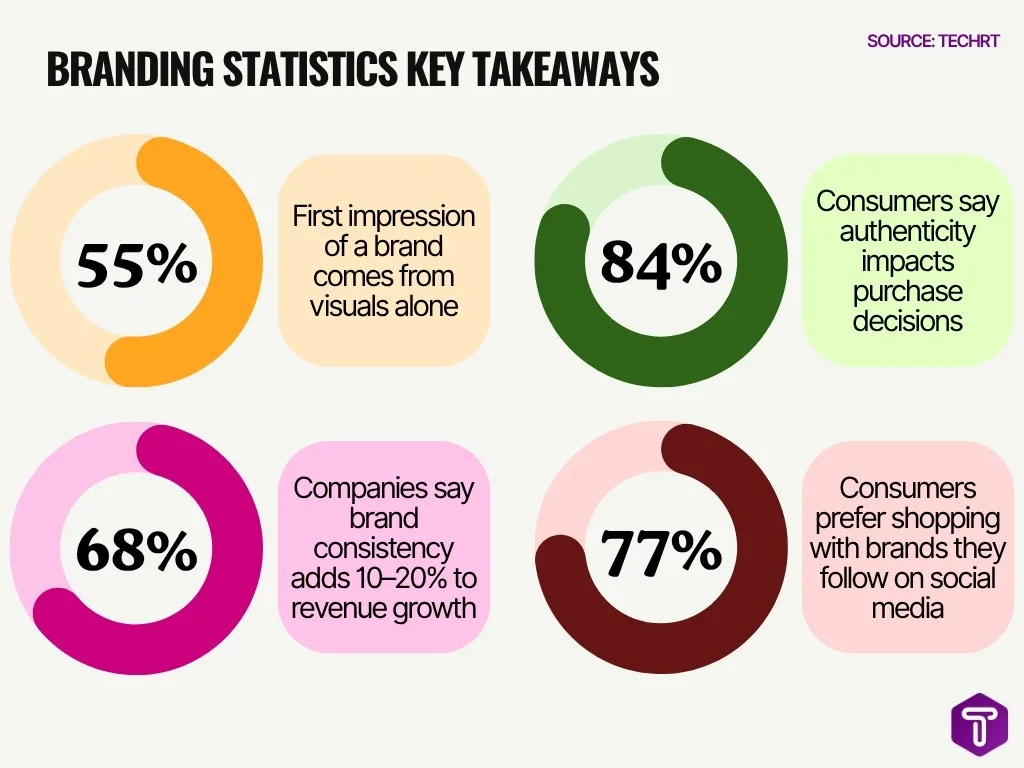
- 55% of a brand’s first impression comes from visual elements alone, highlighting the critical role of design, colors, and imagery in branding.
- A strong visual identity can significantly influence how quickly consumers form opinions about a brand, often within seconds.
- 84% of consumers say authenticity impacts their purchase decisions, making transparency and genuine communication essential for brands.
- Brands that focus on authentic storytelling and values are more likely to build long-term trust and loyalty.
- 68% of companies report that maintaining brand consistency contributes to 10–20% revenue growth, showing a direct link between branding and financial performance.
- Consistent branding across all channels, including websites, social media, and advertising, helps reinforce brand recognition and credibility.
- 77% of consumers prefer shopping with brands they follow on social media, emphasizing the importance of an active social media presence.
- Engaging content and regular interaction on social platforms can significantly boost customer engagement and conversions.
- Overall, the data shows that visual appeal, authenticity, consistency, and social media presence are the four pillars driving modern brand success.
Brand Awareness and Recognition Statistics
- 75% of consumers recognize brands by logo alone.
- Using a signature color can increase recognition by up to 80%.
- Consistent presentation increases brand visibility by 3.5×.
- Consumers need multiple exposures (5–7 times) before recognizing a brand.
- Visual identity contributes to over half of first impressions (55%).
- Social media plays a key role, with 73% of users researching brands online.
- 77% of consumers prefer brands they follow, increasing recognition frequency.
- Brand recall improves significantly with consistent messaging across channels.
- 10 seconds or less determines whether a visual identity sticks.
Brand Trust and Loyalty Statistics
- 81% of consumers need trust before buying from a brand.
- 94% of consumers stay loyal to transparent brands.
- 65% of consumers remain loyal to brands they see as genuine.
- 73% of consumers cite customer service as a key driver of loyalty.
- 83% of shoppers say loyalty programs influence repeat purchases.
- 93% decide after the first purchase whether to continue with a brand.
- It takes at least 3 purchases to build true loyalty.
- 80% of people trust brands they already use.
- 43% of consumers prioritize spending on brands they are loyal to.
Global Brand Investment & Industry Insights
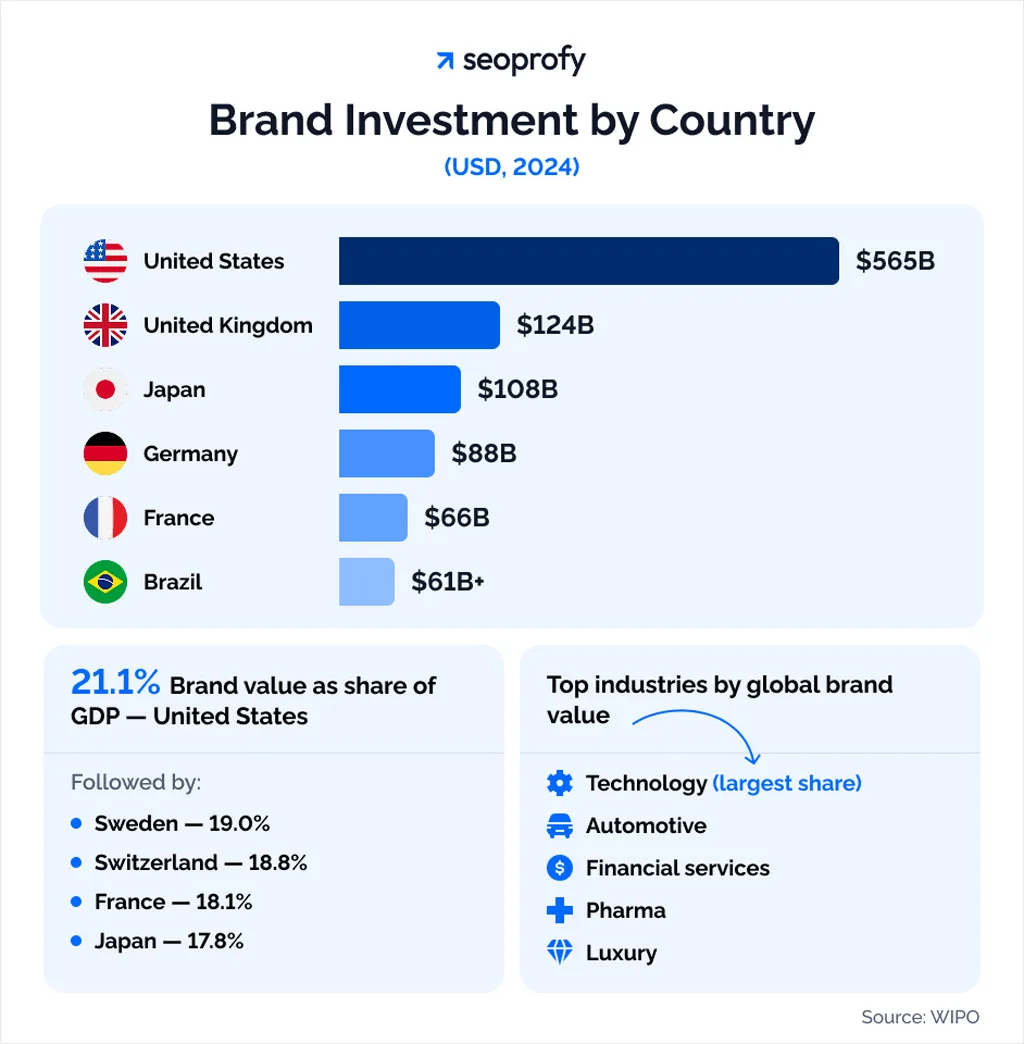
- The United States dominates global brand investment with a massive $565 billion, far ahead of all other countries.
- The United Kingdom ranks second at $124 billion, investing nearly 4.5x less than the U.S.
- Japan follows with $108 billion, highlighting strong brand-driven economic activity in Asia.
- Germany records $88 billion, reinforcing its position as a global industrial and branding powerhouse.
- France reaches $66 billion, driven largely by its strength in the luxury and premium branding sectors.
- Brazil leads emerging markets with $61B+, signaling rising brand investment in developing economies.
- Brand value contributes 21.1% of GDP in the United States, the highest share globally.
- Sweden (19.0%) and Switzerland (18.8%) follow, showing strong brand-centric economies despite their smaller sizes.
- France accounts for 18.1%, underlining its influence in global branding, especially in luxury.
- Japan stands at 17.8%, reflecting the importance of branding in its economic structure.
- Technology holds the largest share of global brand value, dominating across industries.
- The automotive sector remains a major contributor, supported by strong global demand and legacy brands.
- Financial services continue to drive value, fueled by banking and fintech expansion.
- The pharmaceutical industry contributes significantly, especially with increased global healthcare focus.
- Luxury brands maintain strong growth, benefiting from premium positioning and high consumer demand.
- Overall, brand investment is concentrated in developed economies, with technology-led industries driving the majority of global brand value growth.
Brand Perception and Sentiment Statistics
- 88% of consumers value authenticity when choosing brands.
- 84% say authenticity directly impacts purchase decisions.
- 64% of consumers boycott brands due to value misalignment.
- 76% stop buying from brands with a negative social or environmental impact.
- 87% of consumers respond positively to personalized brand content.
- 81% want brands to understand their preferences and timing.
- 77% are more likely to recommend brands after positive experiences.
- Emotional connection drives advocacy, with 94% recommending brands they feel connected to.
- 50% of consumers switch brands after a poor experience, impacting sentiment instantly.
Brand Differentiation and Positioning Statistics
- 64% of consumers say shared values are the main reason they build relationships with brands.
- Brands with strong differentiation achieve up to 2× higher revenue growth compared to generic competitors.
- 77% of B2B buyers state that a brand’s positioning influences vendor selection.
- Companies with a clearly defined brand positioning see 23% higher profitability.
- 72% of consumers prefer brands that reflect their personal identity and lifestyle.
- Unique brand positioning improves purchase intent by up to 43%.
- 68% of marketers say differentiation is their biggest branding challenge.
- Brands that clearly communicate their USP experience higher recall rates by 30%.
- 59% of consumers prefer buying from brands they perceive as unique rather than generic.
Most Valuable Brands Worldwide
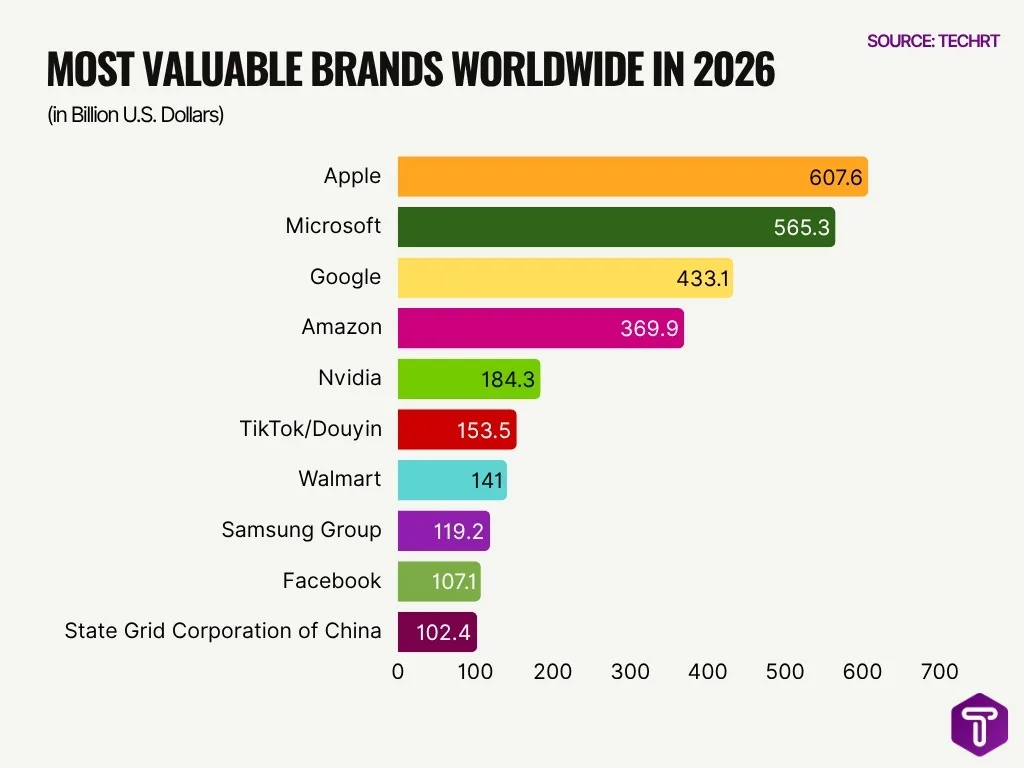
- Apple leads globally with a staggering brand value of $607.6 billion, maintaining a strong dominance over competitors.
- Microsoft ranks second at $565.3 billion, narrowing the gap with Apple and reinforcing its position in enterprise and AI-driven markets.
- Google holds third place with $433.1 billion, highlighting its continued strength in digital advertising and cloud services.
- Amazon stands at $369.9 billion, showcasing its powerful influence in e-commerce and logistics worldwide.
- There is a significant drop after the top 4, with Nvidia at $184.3 billion, indicating a clear valuation gap between tech leaders and the rest.
- NVIDIA’s rise to $184.3 billion reflects the growing importance of AI, chips, and semiconductor innovation.
- TikTok/Douyin reaches $153.5 billion, emphasizing the rapid growth of social media and short-form video platforms.
- Walmart ($141 billion) remains the only major traditional retail brand in the top ranks, proving the resilience of physical retail combined with digital expansion.
- Samsung Group at $119.2 billion shows steady performance driven by electronics, smartphones, and global supply chains.
- Facebook (Meta), valued at $107.1 billion, highlights the sustained relevance of social platforms despite increasing competition.
- State Grid Corporation of China ($102.4 billion) is the only non-tech, infrastructure-focused brand, reflecting the importance of energy and utilities in global markets.
- Technology brands dominate the list, accounting for 7 out of the top 10 positions, signaling a digital-first global economy.
- The top 3 brands alone exceed $1.6 trillion combined, demonstrating a massive concentration of brand value among a few giants.
- U.S. companies dominate the rankings, with most top brands headquartered in the United States, indicating strong global influence.
- The data highlights a clear trend: innovation, digital ecosystems, and AI adoption are key drivers of brand value growth in 2026.
Brand Equity and Brand Value Statistics
- Global brand value surpassed $8.7 trillion in 2025, reflecting steady growth into 2026.
- Strong brands outperform the market by up to 73% in shareholder return.
- Apple remains the most valuable brand, exceeding $500 billion in brand value.
- 46% of consumers are willing to pay more for brands with strong equity.
- Brand equity contributes to over 30% of a company’s market value in many industries.
- Companies investing in branding outperform peers by 20% in revenue growth.
- 77% of marketers say brand building is critical for long-term growth.
- High brand equity reduces customer acquisition costs by up to 50%.
- Brands with strong equity see higher retention rates by 33%.
Brand Consistency and Cohesion Statistics
- Consistent branding across channels can increase revenue by up to 23%.
- 90% of consumers expect consistent experiences across all brand touchpoints.
- Brands with consistent messaging see 3–4× higher visibility.
- 68% of businesses report that consistency contributes to revenue growth.
- Inconsistent branding can reduce revenue by up to 20%.
- 71% of companies say maintaining consistency is a top branding priority.
- Brands that maintain cohesion improve customer trust by over 30%.
- 60% of brands struggle to maintain consistency across digital platforms.
- Cohesive branding improves campaign performance by up to 32%.
Logo Color Trends Among Fortune 500 Companies
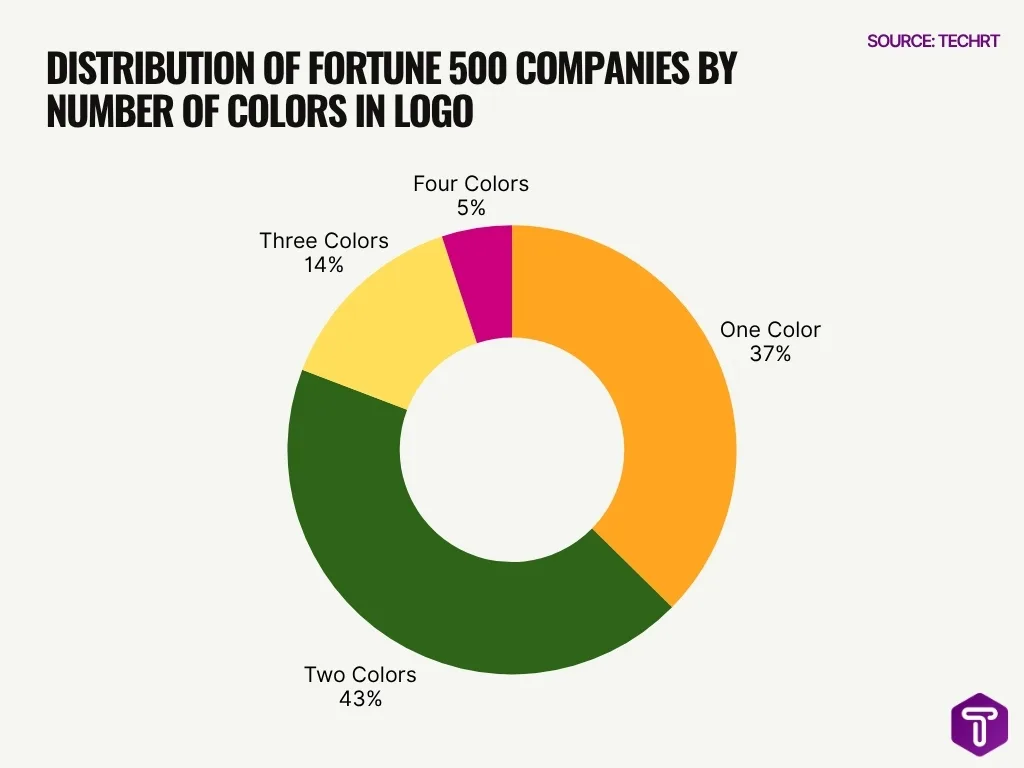
- A majority of companies prefer simplicity, with 43% of Fortune 500 companies using two colors in their logos, making it the most common choice.
- Single-color logos account for 37%, highlighting a strong inclination toward minimalistic and clean branding.
- Combined, a striking 76% of top companies use only one or two colors, reinforcing the dominance of simple color schemes in corporate identity.
- Logos with three colors are used by just 14%, indicating limited preference for moderately complex designs.
- Only 5% of companies use four colors, showing that highly colorful logos are rare among major brands.
- The data clearly suggests that fewer colors enhance brand recognition and consistency, making simplicity a strategic branding decision.
- Companies likely favor limited color palettes to ensure better scalability across digital and print platforms.
- Overall, the trend emphasizes that minimalism and clarity outperform complexity in logo design among Fortune 500 companies.
Brand Messaging and Storytelling Statistics
- 92% of consumers prefer ads that feel like stories.
- Storytelling increases brand recall by 22× compared to facts alone.
- 55% of consumers are more likely to buy from brands with compelling stories.
- 70% of marketers actively invest in storytelling strategies.
- Brands using storytelling see 30% higher conversion rates.
- 64% of consumers build relationships based on shared values communicated through messaging.
- 81% of buyers need to trust a brand’s message before purchasing.
- Story-driven campaigns improve engagement by up to 2×.
- 60% of consumers feel more connected to brands with human-centered messaging.
Emotional Branding Statistics
- 94% of consumers recommend brands they feel emotionally connected to.
- Emotional campaigns perform 2× better than rational campaigns.
- 70% of buying decisions are influenced by emotional factors.
- Brands with emotional appeal achieve 306% higher lifetime value.
- 82% of consumers want brands to share their values.
- Emotional branding increases customer loyalty by up to 52%.
- 65% of customers feel emotionally connected to at least one brand.
- Brands that evoke emotion see higher retention rates by 23%.
- Emotional storytelling improves ad effectiveness by up to 31%.
Consumer Attention on Brands by Category
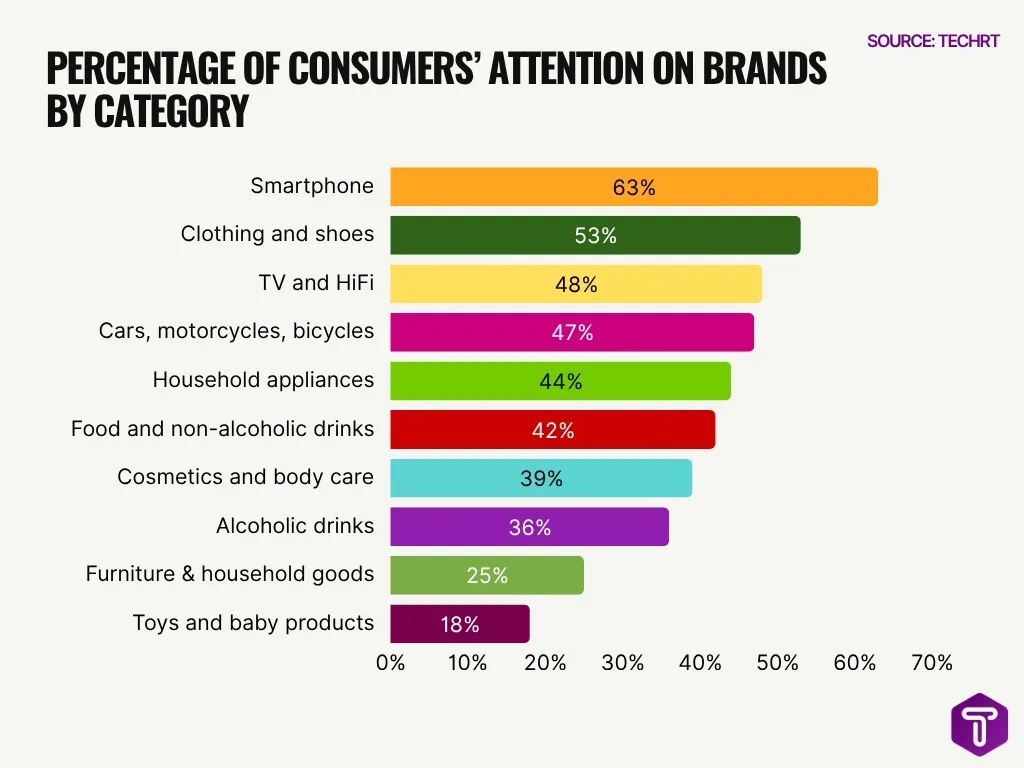
- Smartphones lead significantly, capturing the closest attention at 63%, indicating strong consumer engagement in tech-driven categories.
- Fashion-related products, including clothing and shoes, hold a high share with 53%, showing the importance of personal identity and lifestyle branding.
- Electronics like TV and HiFi attract 48% attention, highlighting continued interest in home entertainment and premium devices.
- Automotive categories (cars, motorcycles, bicycles) account for 47%, reflecting high involvement and longer decision-making cycles.
- Household appliances receive 44%, indicating steady attention due to utility-driven purchases and brand reliability factors.
- Food and non-alcoholic drinks capture 42%, showing consistent engagement in everyday consumption categories.
- Cosmetics and body care gain 39%, emphasizing the growing importance of personal care and beauty branding.
- Alcoholic drinks stand at 36%, suggesting moderate brand attention influenced by lifestyle and social factors.
- Furniture & household goods receive relatively lower attention at 25%, possibly due to less frequent purchase cycles.
- Toys and baby products rank lowest at just 18%, indicating niche or need-based consumer focus.
- Overall, tech and fashion dominate consumer attention, while essential and occasional purchase categories lag.
- Notably, the top three categories alone account for nearly half or more attention, reinforcing the dominance of high-involvement product segments.
Advertising and Brand Promotion Statistics
- Global ad spend is projected to exceed $1 trillion in 2026, with branding campaigns driving a major share.
- 72% of marketers say brand awareness is their top advertising goal.
- TV and digital video ads deliver 2–3× higher brand recall than static formats.
- 63% of consumers discover new brands through paid ads on digital platforms.
- Search ads increase brand awareness by up to 80%.
- Brands that invest in omnichannel promotion see 23% higher engagement rates.
- 76% of marketers increased branding budgets in 2025–2026.
- Native advertising improves brand favorability by 18% compared to traditional display ads.
- 59% of consumers say repeated ad exposure increases trust in a brand.
Content Marketing and Branding Statistics
- 70% of marketers actively invest in content marketing to build brand awareness.
- Content marketing generates 3× more leads than traditional marketing.
- Brands that blog regularly get 55% more website visitors.
- 82% of consumers feel more positive about a brand after reading custom content.
- Video content drives 1200% more shares than text and images combined.
- 60% of consumers prefer learning about brands through content rather than ads.
- Companies with strong content strategies see 6× higher conversion rates.
- Long-form content generates 77% more backlinks, improving brand visibility.
- 47% of buyers consume 3–5 pieces of content before engaging with a brand.
Top Social Media Branding Strategies Insights
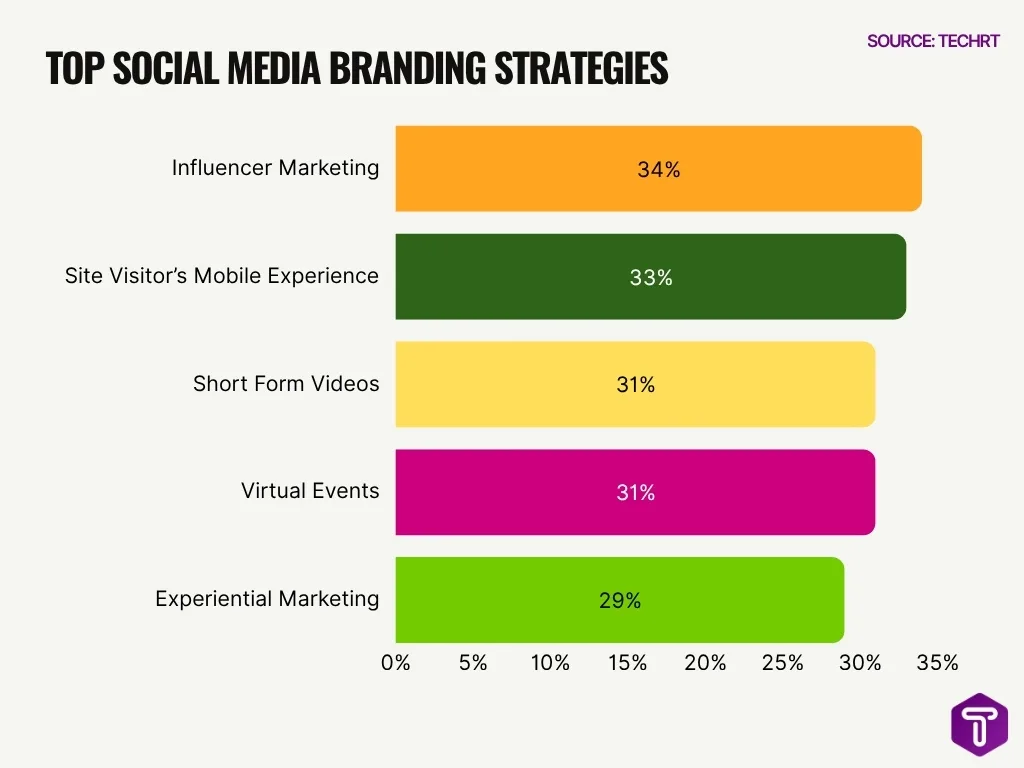
- Influencer Marketing leads at 34%, making it the most effective strategy for building brand credibility and reaching targeted audiences.
- Mobile experience optimization (33%) is nearly as important, highlighting the growing dominance of mobile-first users in digital engagement.
- Short-form videos (31%) are a major driver of engagement, reflecting the rise of platforms like TikTok and Instagram Reels.
- Virtual events (31%) remain highly relevant, showing that online interactions and webinars continue to attract audiences post-pandemic.
- Experiential marketing (29%) still holds strong value, emphasizing the importance of creating memorable, immersive brand experiences.
- The small gap between all strategies (29%–34%) indicates that brands must adopt a multi-channel approach rather than relying on a single tactic.
- Visual and interactive content formats (videos, events, experiences) collectively dominate, signaling a shift toward engagement-driven branding strategies.
- Digital-first strategies clearly outperform traditional methods, reinforcing the need for brands to prioritize online presence and user experience.
Influencer and Word-of-Mouth Branding Statistics
- 92% of consumers trust recommendations from friends and family over ads.
- Influencer marketing delivers an average ROI of $5.78 for every $1 spent.
- 61% of consumers trust influencer recommendations, especially in niche categories.
- Word-of-mouth drives 20–50% of purchasing decisions.
- Micro-influencers generate 60% higher engagement rates than macro influencers.
- 83% of consumers say they trust user-generated content more than brand-created content.
- Referral marketing increases conversion rates by 30% or more.
- 75% of consumers rely on reviews before making purchase decisions.
- Brands leveraging advocacy programs see 2× higher retention rates.
Mobile and Digital Branding Statistics
- Mobile devices account for over 60% of global web traffic.
- 70% of consumers use smartphones to research brands before purchasing.
- Mobile-first brands see 30% higher engagement rates.
- 53% of mobile users abandon sites that take longer than 3 seconds to load.
- Apps drive 3× higher conversion rates than mobile websites.
- 80% of consumers expect seamless digital experiences across devices.
- Digital branding investments increased by over 15% year-over-year in 2025–2026.
- 67% of marketers prioritize mobile optimization in branding strategies.
- Mobile video consumption accounts for 75% of total video views, influencing brand messaging.
Branding ROI and Performance Metrics Statistics
- Companies with strong branding see up to 20% higher revenue growth.
- Brand consistency increases revenue by 10–23%.
- Marketing ROI improves by 30% when branding aligns with customer experience.
- 74% of marketers say branding directly impacts revenue growth.
- Strong brands reduce acquisition costs by up to 50%.
- 89% of marketers track brand awareness as a key KPI.
- Customer lifetime value increases by 306% with emotional branding.
- Brands with high trust scores outperform competitors by 400% in market value growth.
- 60% of companies measure brand equity as part of performance metrics.
Frequently Asked Questions (FAQs)
What percentage of consumers need to trust a brand before buying?
How many brand impressions are required to build awareness?
What share of consumers are more likely to buy from recognizable brands?
What is the total value of the world’s top brands in recent reports?
What percentage of consumers discover brands through social media?
Conclusion
Branding goes far beyond logos and taglines. It shapes how customers discover products, build trust, and stay loyal across digital and physical touchpoints. Data shows that consistency, emotional connection, and personalized experiences drive the strongest results, while social media and mobile platforms amplify brand reach at scale.
As competition intensifies, companies that invest in clear positioning, cohesive messaging, and measurable branding strategies will outperform those that treat branding as a secondary effort. The statistics throughout this report highlight a clear pattern: brands that focus on trust, experience, and differentiation consistently achieve stronger growth and long-term value.

Leave a comment
Have something to say about this article? Add your comment and start the discussion.