



Holographic displays are moving from research labs into mainstream industries at a rapid pace. Automakers now test windshield-wide holographic dashboards, while hospitals use 3D holographic imaging to improve surgical planning and medical visualization. At the same time, retailers, gaming brands, and AR device makers continue to invest in immersive display experiences that do not require headsets or glasses.
The market’s momentum reflects growing demand for realistic 3D visualization, spatial computing, and interactive digital experiences. As AI, AR, and advanced optics continue to converge, holographic displays are becoming a key technology across healthcare, entertainment, automotive, defense, and enterprise applications. Explore the latest statistics, forecasts, and industry trends shaping the holographic display market.
Editor’s Choice
- The global holographic display market is projected to reach $5.14 billion in 2026, up from $4.36 billion in 2025.
- Industry forecasts suggest the market could exceed $40 billion by 2035, with CAGR estimates ranging from 18% to 25% depending on the segment analyzed.
- Digital holography applications alone generated $4.22 billion in 2024 globally.
- Healthcare remains one of the fastest-growing sectors, driven by demand for 3D medical imaging and surgical visualization systems.
- Automotive brands showcased full-windshield holographic interfaces and AR-enhanced dashboards during CES 2025 demonstrations.
- Looking Glass introduced holographic monitors ranging from 16-inch to 86-inch displays with pricing starting at $1,500 in 2025.
- Several market reports estimate annual holographic display growth above 20% CAGR through the next decade.
- Consumer-grade holographic devices entered the sub-$100 range in late 2025, signaling broader adoption potential.
Recent Developments
- In 2025, Looking Glass launched new holographic monitors featuring Hololuminescent Display technology with support for glasses-free 3D viewing.
- The company’s new displays support standard 2D content workflows, reducing development barriers for creators and advertisers.
- Samsung reportedly expanded R&D efforts around holographic smartphone displays capable of projecting interactive 3D visuals.
- Researchers demonstrated a dynamic holographic meta-projector with a 160° × 160° field of view, among the widest achieved in experimental holography.
- New AR holographic display research improved image realism through advanced occlusion handling and shadow rendering techniques.
- Holographic AR glasses research in 2025 introduced lightweight “light pipe” display systems to reduce headset bulk.
- Automotive companies, including Hyundai Mobis, demonstrated windshield-wide holographic display concepts for next-generation vehicles.
- Consumer-focused holographic photo displays entered crowdfunding markets in 2026 with prices as low as $99.
- AI integration has accelerated holographic visualization use cases, especially for digital assistants and interactive avatars.
Global Holographic Display Market Overview
- The holographic display market entered 2026 with valuations ranging from $5 billion to $16 billion, depending on segmentation models and application scope.
- North America continues to lead adoption due to strong investments in healthcare visualization, defense systems, and automotive innovation.
- Asia-Pacific remains the fastest-expanding production hub because of consumer electronics manufacturing growth and rising AR investments.
- Healthcare, retail advertising, gaming, and automotive industries account for a growing share of holographic display deployments.
- Enterprise demand for immersive collaboration tools increased after the broader adoption of hybrid work environments between 2023 and 2025.
- Automotive HUD systems represent one of the most commercially viable holographic display applications today.
- Many manufacturers now focus on glasses-free holographic experiences to improve consumer accessibility.
- AI-generated 3D content creation tools have reduced content production costs for holographic advertising and entertainment.
- Holographic visualization technologies increasingly support medical microscopy and biomedical research analysis.
- Industry competition intensified in 2025 as startups and established display manufacturers expanded commercialization efforts.
Holographic Display Market Growth Highlights
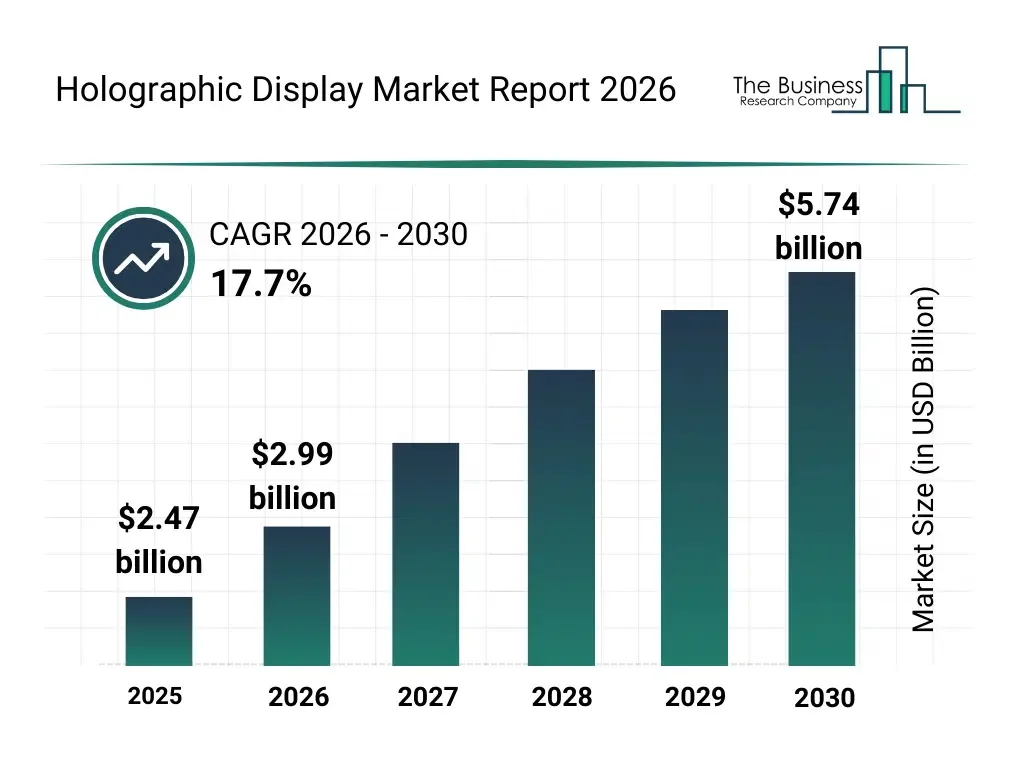
- The holographic display market is projected to grow strongly from $2.47 billion in 2025 to $5.74 billion by 2030.
- The market is expected to add around $3.27 billion in value between 2025 and 2030.
- In 2026, the holographic display market is estimated to reach $2.99 billion, up from $2.47 billion in 2025.
- The market is forecast to expand at a CAGR of 17.7% from 2026 to 2030, showing rapid adoption across commercial and industrial applications.
- By 2027, the market size is estimated to rise to approximately $3.52 billion, reflecting continued demand for advanced visual technologies.
- The market may cross the $4 billion mark by 2028, reaching an estimated $4.14 billion.
- In 2029, the holographic display market is projected to approach $4.88 billion, indicating steady year-over-year growth.
- By 2030, the market is expected to reach $5.74 billion, more than double its 2025 value.
- The strong growth trend suggests increasing use of holographic displays in sectors such as retail, healthcare, automotive, entertainment, education, and advertising.
- The projected 17.7% CAGR highlights holographic displays as a fast-growing segment within the broader immersive display and visualization technology market.
Holographic Display Market CAGR and Growth Forecast
- Multiple forecasts place the holographic display market CAGR above 20% through the next decade.
- One major forecast estimates a 25.2% CAGR from 2026 to 2036.
- Another report projects a 25.5% CAGR between 2026 and 2035.
- Mid-range market models estimate growth closer to 17.8% CAGR through 2031.
- Conservative projections still expect at least 8.6% CAGR between 2024 and 2029.
- Digital holography technologies alone are expected to grow at 20.3% CAGR through 2030.
- Healthcare imaging, defense simulation, and automotive HUD systems remain the strongest long-term growth drivers.
- AI-generated 3D content and spatial computing platforms are expected to accelerate enterprise demand after 2026.
- Wider commercialization of glasses-free displays could significantly increase consumer adoption rates by 2030.
- Research breakthroughs in optics, metasurfaces, and waveguide technologies continue improving display performance and scalability.
Holographic Display Market Forecast to 2030 and Beyond
- Market forecasts suggest holographic display revenues may exceed $16 billion by 2031.
- Long-term projections estimate the industry could surpass $40 billion by 2035 under high-growth scenarios.
- Some aggressive forecasts place future market potential near $75 billion by the mid-2030s.
- Automotive holographic HUDs are expected to become standard in premium vehicles before 2030.
- Healthcare imaging applications are projected to remain among the highest-value enterprise segments through the next decade.
- Retail advertising could emerge as a major commercial growth area due to the demand for immersive product visualization.
- AI-generated holographic avatars and digital assistants may create entirely new consumer use cases after 2027.
- Analysts expect glasses-free holographic experiences to dominate future consumer adoption trends.
- Defense simulation and military visualization programs are projected to increase investments steadily through 2030.
- Improvements in optical efficiency and lower hardware costs could accelerate mass-market adoption after 2028.
Holographic Display Market by Application
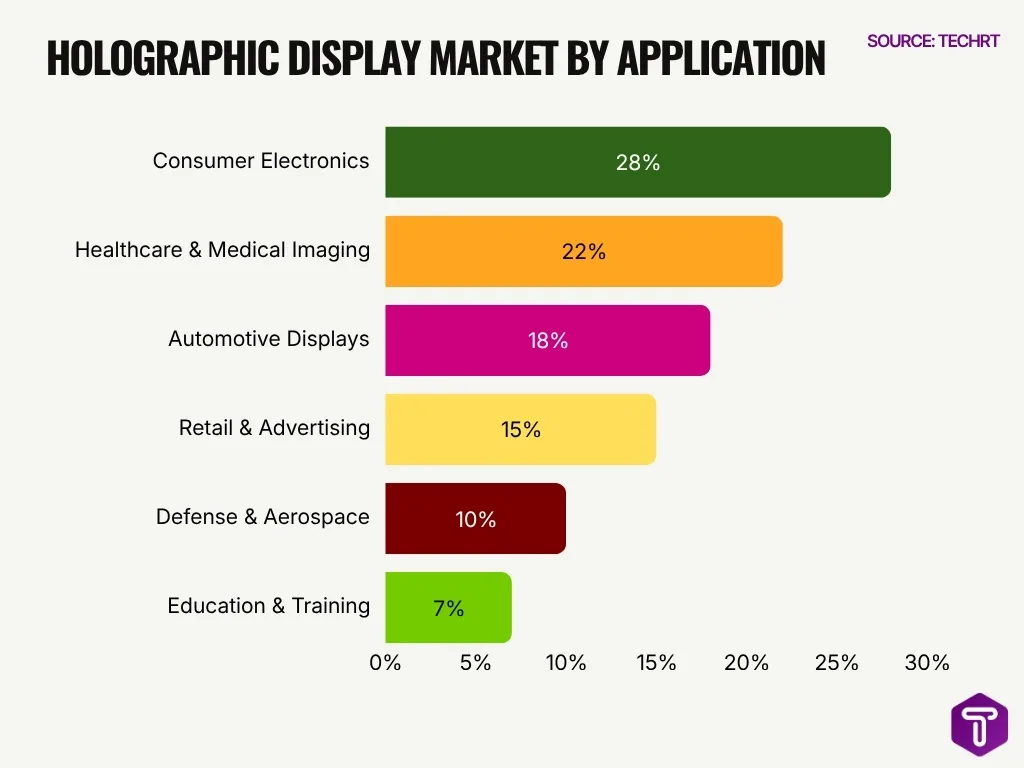
- Consumer Electronics holds the largest share of the holographic display market, accounting for 28% of total application usage.
- Healthcare & Medical Imaging is the second-largest application segment, with a market share of 22%, showing strong adoption in advanced diagnostics, surgical visualization, and medical training.
- Automotive Displays represent 18% of the market, driven by increasing use of holographic dashboards, heads-up displays, and smart vehicle interfaces.
- Retail & Advertising accounts for 15% of holographic display applications, highlighting growing demand for immersive product promotions and interactive brand experiences.
- Defense & Aerospace contributes 10% of the market, supported by use cases such as mission planning, simulation, navigation, and 3D visualization.
- Education & Training has the smallest share at 7%, but it shows potential for growth as holographic learning tools become more accessible.
- Together, Consumer Electronics and Healthcare & Medical Imaging make up 50% of the market, indicating that consumer-facing and medical applications are the strongest demand drivers.
- The top three segments, Consumer Electronics, Healthcare & Medical Imaging, and Automotive Displays, collectively represent 68% of the total holographic display market applications.
- The data shows that holographic displays are no longer limited to entertainment, with strong adoption across healthcare, automotive, defense, retail, and education sectors.
Holographic Display Adoption and Penetration Trends
- The global holographic display market reached roughly $4.3 billion in 2025, with projections above $16 billion by 2031 at around 25.5% CAGR.
- Automotive companies now account for about 18% of holographic display adoption, driven by in‑car 3D navigation and AR dashboards.
- The medical holography market is forecast to grow at roughly 29% annually through 2029, led by surgical‑planning and diagnostic‑imaging use cases.
- Retail holographic showcase deployments report up to 40% higher viewer engagement and up to 40% product‑sales uplifts compared with static signage.
- Enterprise demand for 3D collaboration and spatial‑visualization tools grew more than 40% between 2019 and 2021, as hybrid work pushed adoption of immersive interfaces.
- The gaming and entertainment sector contributed about 19% of the holographic display market growth, with immersive arenas, live concerts, and AR‑enhanced venues.
- Globally, consumer demand for glasses‑free 3D displays surged from $21.5 million in 2024 to about $26.5 million in 2025, targeting consumer electronics and signage.
- The Asia‑Pacific region is expected to grow at a CAGR of around 23.3% from 2024 to 2032, making it the fastest‑expanding enterprise‑holography hub.
- Medical holography adoption is accelerating alongside AI‑driven imaging platforms, with AI‑assisted 3D reconstructions now used in over 60–70% of advanced imaging centers in select markets.
- Industry analysts project that mainstream consumer holographic devices, including glasses‑free 3D smartphones and AR head‑up displays, could reach 10–15% penetration in key markets by 2030.
Holographic Display Market Drivers and Growth Factors
- The holographic display market was valued at $4.3 billion in 2025 and is projected to reach $50.95 billion by 2036 at 25.2% CAGR.
- Digital signage and kiosks captured 34.45% of market revenue in 2025, driven by immersive retail and exhibition installations.
- Healthcare and medical education are set to grow at 22.85% CAGR, with medical scanners advancing at 24.62% CAGR through 2031.
- Automotive HUDs form the second-fastest growth pool, with 7 million units of holographic displays eyed by 2030.
- The automotive holographic display market will grow from $3.87 billion in 2026 to $16.28 billion by 2035 at 17.3% CAGR.
- Hardware held 74.85% of the holographic display market share in 2025, while services forecast 22.32% CAGR to 2031.
- Electro-holographic solutions led with 40.25% revenue share in 2025, while touchable/mid-air haptic systems project 24.05% CAGR.
- North America dominated with 35% market share, driven by entertainment and healthcare demand.
Key Challenges and Restraints in Holographic Displays
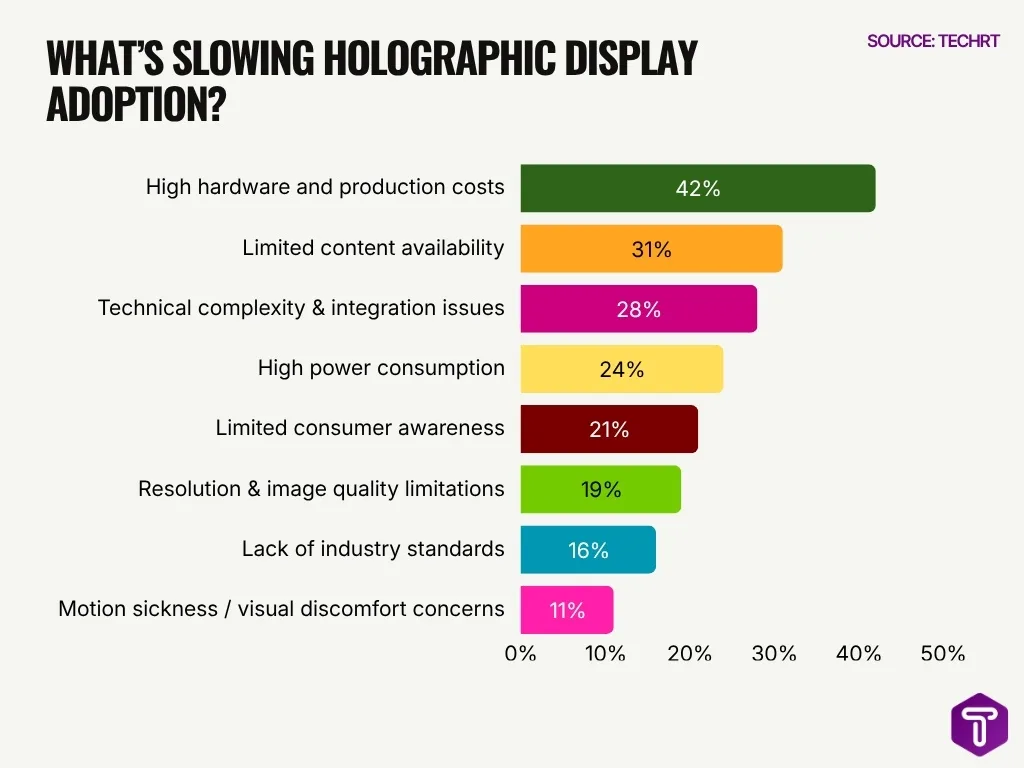
- High hardware and production costs are the biggest barrier, accounting for 42% of the total challenge share.
- Limited content availability ranks second at 31%, showing that holographic display adoption depends heavily on more compatible 3D and immersive content.
- Technical complexity and integration issues represent 28%, making implementation difficult for companies without advanced display infrastructure.
- High power consumption accounts for 24%, which may limit usage in portable, wearable, and consumer electronics applications.
- Limited consumer awareness holds a 21% share, indicating that many potential users still do not fully understand holographic display benefits.
- Resolution and image quality limitations make up 19%, suggesting that visual clarity remains a concern for broader commercial adoption.
- Lack of industry standards accounts for 16%, creating compatibility and development challenges across devices, platforms, and applications.
- Motion sickness and visual discomfort concerns have the lowest share at 11%, but they remain important for user experience in immersive holographic environments.
- Overall, the data shows that cost, content availability, and technical complexity are the top three restraints slowing down holographic display adoption in 2026.
Holographic Display Statistics by Region
- North America is projected to hold about 36.7% of the global holographic display market share by 2026.
- The United States alone accounts for roughly two‑thirds of North America’s holographic display value, driven by defense and healthcare deployments.
- Asia‑Pacific represented approximately 36.55% of holographic display revenue in 2025, making it the region with the largest share.
- The Middle East is forecast to grow at around 21.18% CAGR for holographic displays through 2031, the fastest regional pace.
- Europe’s automotive industry contributes nearly 50% of holographic display installations in Germany as of 2023.
- Over 3,500 holographic display units were installed in Germany by 2023, with a strong tilt toward AR‑enabled automotive HUDs.
- Latin America’s retail and entertainment sectors are expected to lift holographic advertisement spending by roughly 18–20% annually over the early 2030s.
- India’s AR‑focused digital infrastructure schemes have increased holographic‑ready display investments by more than 40% since 2022.
- Japan, South Korea, and China together account for over 65% of the Asia‑Pacific’s advanced display‑technology production capacity by 2025.
- Global government digital‑infrastructure programs have boosted regional holographic R&D funding by about 25% CAGR between 2020 and 2025.
Holographic Display Adoption in Healthcare and Medical Imaging
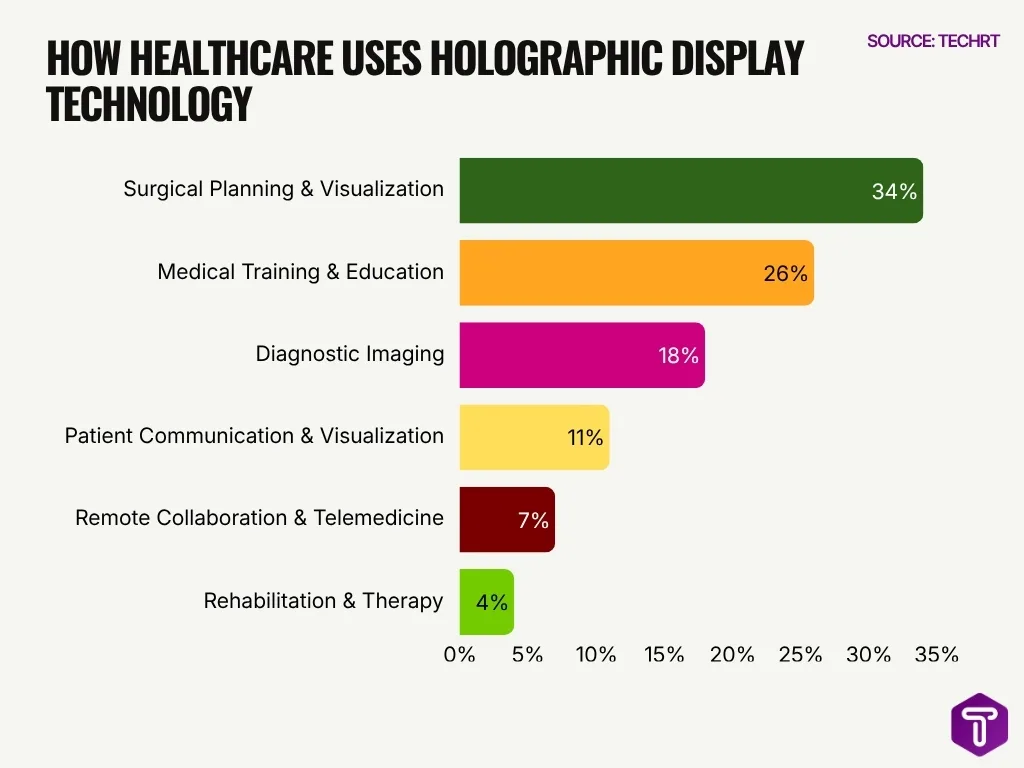
- Surgical Planning & Visualization leads healthcare holographic display adoption with the highest share of 34%.
- Medical Training & Education holds the second-largest share at 26%, showing strong use of holographic displays for immersive learning and anatomy visualization.
- Diagnostic Imaging accounts for 18% of adoption, highlighting the role of holographic displays in viewing complex medical scans and 3D anatomical data.
- Patient Communication & Visualization represents 11%, suggesting hospitals and clinics are using holographic visuals to explain procedures and conditions more clearly.
- Remote Collaboration & Telemedicine has a smaller adoption share of 7%, but it reflects growing interest in virtual medical consultations and specialist collaboration.
- Rehabilitation & Therapy records the lowest share at 4%, indicating that holographic display use in therapy and recovery programs is still in an early stage.
- Together, Surgical Planning & Visualization and Medical Training & Education make up 60% of total adoption, showing that clinical precision and medical education are the strongest healthcare use cases.
- The data suggests that holographic displays are gaining the most traction in areas where 3D visualization, accuracy, and interactive learning provide direct value.
Holographic Display Adoption in Automotive and Transportation
- The automotive holographic display market reached $1.2 billion in 2024 and will hit $8.7 billion by 2033 at 24.5% CAGR.
- Navigation and safety applications account for over 60% of automotive holographic display revenue in 2024.
- The passenger car segment contributes nearly 70% of the total automotive holographic display market revenue in 2024.
- Windshield displays and HUDs dominate the market, capturing over 65% of total revenue in 2024.
- Advanced HUD penetration is projected to exceed 40% of premium vehicles by 2030.
- The global holographic display market will reach $33.36 billion by 2034, expanding at 25.52% CAGR during 2026–2034.
- Automotive holographic display investment grew alongside EV development, with the market rising from $2.23 billion in 2024 to $2.50 billion in 2025.
- Electro-holographic architectures captured 40.25% revenue in 2025, remaining the safe choice for automotive HUDs.
- Automotive OEM adoption of AR holographic HUDs increased by +3.20% in Germany, China, and North America in the medium term.
Holographic Technology by Device Type
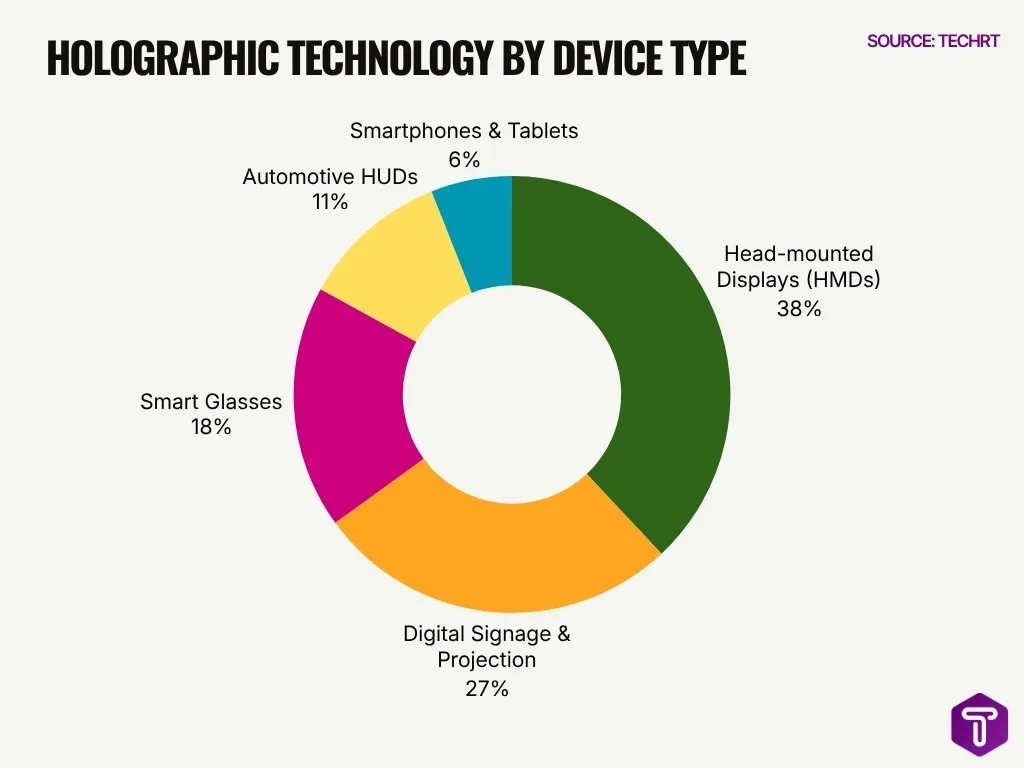
- Head-mounted Displays (HMDs) hold the largest share at 38%, showing that immersive wearable holographic devices are the leading device category.
- Digital Signage & Projection accounts for 27%, highlighting strong adoption in advertising, retail displays, exhibitions, and commercial visualization.
- Smart Glasses represent 18% of the market, indicating growing demand for lightweight, wearable holographic viewing solutions.
- Automotive HUDs capture 11%, reflecting increasing use of holographic displays in vehicle dashboards, navigation systems, and driver-assistance features.
- Smartphones & Tablets have the smallest share at 6%, suggesting that holographic integration in mobile devices is still at an early stage.
- Together, HMDs and Digital Signage & Projection make up 65% of the total share, showing that immersive viewing and large-format display applications dominate the market.
- Wearable holographic devices, including HMDs and Smart Glasses, account for a combined 56%, indicating strong consumer and enterprise interest in portable holographic experiences.
- The data shows that holographic technology is currently more concentrated in specialized display devices than in mainstream mobile devices.
Holographic Display Adoption in AR and VR Ecosystems
- The holographic display market will grow by $3.37 billion at a CAGR of 8.6% from 2024 to 2029.
- The global holographic display market is projected to reach $56.1 billion by 2030, expanding rapidly.
- AR glass market will surge from $0.98 billion in 2025 to $9.98 billion by 2030 at a CAGR 59.0%.
- Waveguide-based AR smart glasses shipments grew over 600% YoY in H2 2025, driving lightweight holographic systems.
- The spatial computing market size is estimated at $3.98 billion in 2025, reaching $23.45 billion by 2030.
- Enterprise AR adoption shows 60% of users report productivity gains from holographic 3D visualization tools.
- Holographic display market valued at $4.3 billion in 2025 with 25.5% CAGR expected through 2035.
- AR/VR integration contributes 20% growth to holographic display adoption by enabling seamless ecosystem fusion.
- Investor funding in holography startups exceeded $2.1 billion globally, with 470 startups backed by institutional capital.
Investment and R&D Spending in Holographic Displays
- $4.3B was the global holographic display market value in 2025, signaling strong R&D momentum across the sector.
- The market is projected to reach $5.38B in 2026 and $50.95B by 2036, implying a 25.2% CAGR.
- One 2025 funding round brought €27M ($28.27M) to a holographic display company to advance AI-powered AR smartglasses and HUDs.
- A separate startup had raised about $35.7M in total venture funding and was seeking $50M+ more to speed up hologram-chip development.
- Government-backed photonic-chip research in Europe received more than €16M across 18 projects, supporting enabling technologies for holographic systems.
- A 2025 U.S. digital health funding report showed startups raised $14.2B, with 54% of total funding going to AI-focused companies.
- Medical holography efforts included a startup that had raised $25M total, with its latest financing at $20M.
- Academic holography research advanced with a 2025 mixed-reality prototype, achieving a total optical stack thickness of less than 3 mm.
- Another 2025 study reported an order-of-magnitude less training data and time for AI-based holographic wavefront modeling.
- A 2024 holographic waveguide study described large software-steerable eyebox improvements for 3D AR glasses, reflecting continued research expansion.
Business Benefits of Holographic Display Adoption
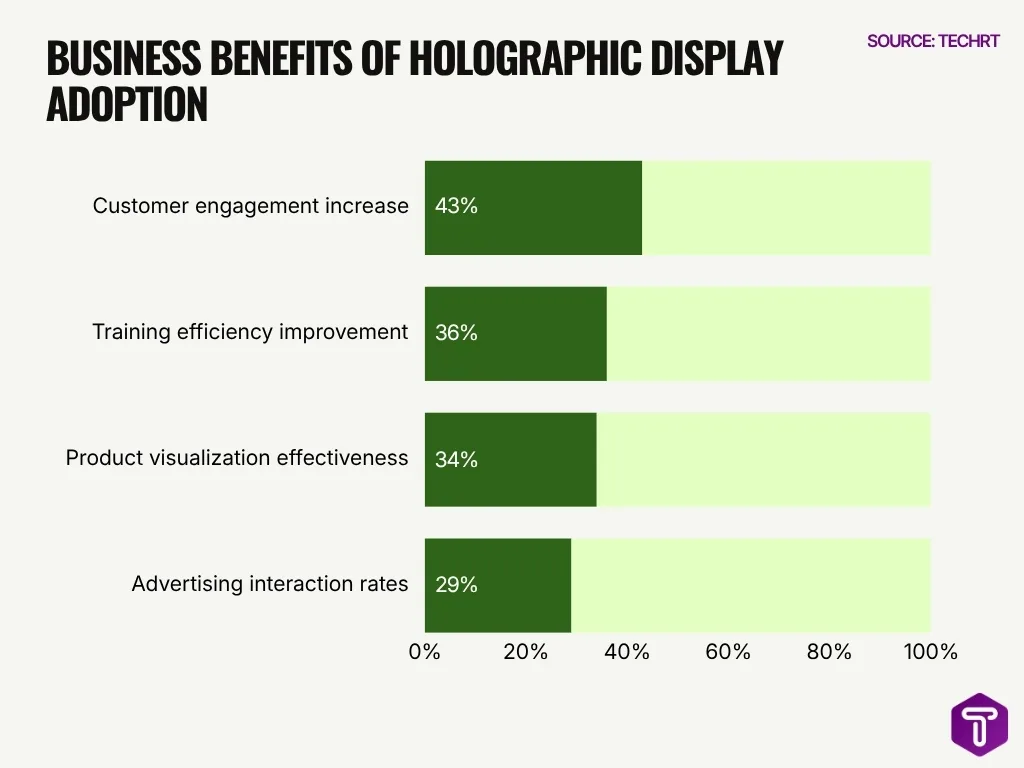
- Customer engagement shows the highest improvement at 43%, making it the strongest business impact area for holographic displays.
- Training efficiency improves by 36%, suggesting that holographic displays can make employee learning, simulations, and technical training more effective.
- Product visualization effectiveness increases by 34%, showing strong value for industries that rely on interactive product demos, 3D previews, and immersive presentations.
- Advertising interaction rates improve by 29%, indicating that holographic displays can help brands attract more attention and encourage stronger audience participation.
- The data shows that holographic displays deliver the greatest impact in customer-facing and experiential use cases, especially engagement and visualization.
- All measured business metrics report improvements above 25%, highlighting the broad commercial potential of holographic display adoption.
- The gap between the top metric, customer engagement at 43%, and the lowest metric, advertising interaction rates at 29%, is 14 percentage points, showing varied but consistently positive business outcomes.
Competitive Landscape and Market Share of Key Players
- The market was valued at $4.31 billion in 2025 and is projected to reach $5.42 billion in 2026, showing continued competitive expansion.
- Hardware accounted for 74.85% of market share in 2025, keeping device makers at the center of rivalry.
- Electro-holographic systems led with 40.25% revenue share in 2025, making optical architecture a key battleground.
- Digital signage and kiosks captured 34.45% of the market in 2025, while medical scanners and microscopes are growing at a 24.62% CAGR.
- Retail and exhibition use cases held 28.75% revenue share in 2025, while healthcare and medical education are forecast to grow at 22.85% CAGR.
- The holographic telepresence segment reached $2.3 billion in 2024 and is projected to expand at a 28.7% CAGR through 2033.
- Looking Glass reported 4% employee growth in 12 months, signaling visible commercial momentum among specialists.
- Samsung filed 3,716 patents between 2002 and 2022, underscoring its strong IP-driven competition in advanced display tech.
- Hyundai Mobis said pre-development of its holographic windshield display was completed in the first half of 2024, with a launch target as early as 2027.
- Patent activity around metasurfaces and waveguides intensified in 2025, with new designs targeting 10–600 nm nanostructure pitches and broader field-of-view performance.
Frequently Asked Questions (FAQs)
What is the projected size of the holographic display market in 2026?
What CAGR is expected for the holographic display market through 2035?
Which region holds the largest holographic display market share?
How large could the holographic display market become by 2036?
What is the expected value of the automotive holographic display market by 2035?
Conclusion
Holographic displays continue evolving from niche visualization systems into commercially viable technologies across healthcare, automotive, retail, entertainment, and enterprise applications. Strong growth forecasts, expanding AI integration, and rising investments in spatial computing have accelerated innovation throughout the industry.
Healthcare providers now use holographic imaging for advanced diagnostics and surgical planning, while automotive companies develop immersive windshield displays to improve safety and user experience. At the same time, AR and mixed reality ecosystems continue pushing demand for lightweight, glasses-free holographic interfaces.
Despite challenges related to production costs, hardware complexity, and content availability, the market outlook remains highly optimistic. As optical technologies improve and manufacturing scales further, holographic displays are expected to become more accessible to businesses and consumers worldwide throughout the next decade.

Leave a comment
Have something to say about this article? Add your comment and start the discussion.