




Micro-SaaS businesses continue to reshape the software economy as solo founders and lean teams launch profitable niche products with lower startup costs and faster release cycles. AI coding tools, no-code platforms, and subscription-based revenue models now allow creators to build targeted products for industries such as e-commerce automation, creator monetization, customer support, and workflow management. At the same time, companies increasingly prefer specialized tools that solve one operational problem instead of large, expensive software suites. This article explores the latest Micro-SaaS growth statistics, revenue benchmarks, and market trends shaping the industry.
Editor’s Choice
- The global SaaS market reached $435.4 billion in 2026, up from $370.4 billion in 2025, reflecting continued cloud software demand.
- SaaS revenue worldwide is projected to surpass $908 billion by 2030, growing at an annual rate of nearly 18.7%.
- North America accounted for 46.9% of the global SaaS market share in 2025, maintaining its lead into 2026.
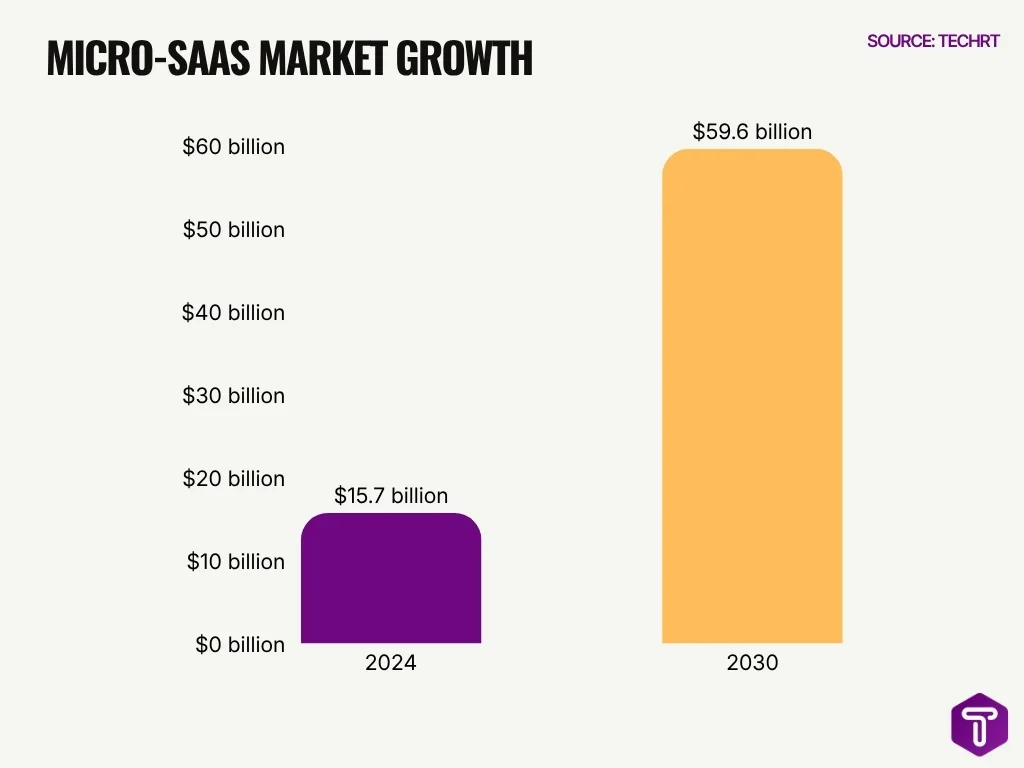
- The Micro-SaaS sector is projected to grow from $15.7 billion in 2024 to $59.6 billion by 2030.
- Nearly 36.3% of new startups launched in 2025 had solo founders, compared to 23.7% in 2019.
- AI-focused SaaS startups raised valuations that were 41% higher at the seed stage than non-AI SaaS startups in 2025.
- Organizations used an average of 106 SaaS applications in 2025, highlighting rising software fragmentation and demand for niche tools.
- Weekly SaaS product launches on one leading SaaS monetization platform reportedly tripled by the end of 2025.
Recent Developments
- AI-assisted development tools reduced software prototyping timelines by as much as 40% to 60% for small SaaS teams in 2025.
- Enterprise application acquisitions increased from 45 deals in 2024 to 48 deals in 2025, signaling stronger SaaS consolidation activity.
- Funding for enterprise SaaS applications reached $2.43 billion during the first nine months of 2025 despite broader venture slowdowns.
- AI-powered SaaS products became one of the fastest-growing startup categories in 2025 as companies automated customer service, analytics, and workflow management.
- Usage-based pricing models gained traction in 2026 as SaaS companies shifted away from rigid subscription tiers.
- More Micro-SaaS founders adopted vertical SaaS strategies targeting industries such as healthcare, logistics, education, and creator commerce in 2025.
- AI meeting assistant tools became a major Micro-SaaS niche, with that segment projected to grow from $3.24 billion in 2025 to $7.33 billion by 2035.
- Solo founders increasingly used generative AI as a replacement for outsourced consultants, marketers, and analysts in 2026.
- Research covering more than 160,000 product launches found that generative AI sharply increased solo entrepreneurship after ChatGPT adoption.
- AI integration became a survival requirement for SaaS vendors as valuations declined and competition intensified in 2025.
Micro-SaaS Market Size
- The global SaaS market size reached approximately $375.6 billion in 2026, according to recent industry estimates.
- Another industry analysis estimated the SaaS market at $435.4 billion in 2026, reflecting strong enterprise cloud adoption.
- The Micro-SaaS industry alone was valued at roughly $15.7 billion in 2024 and continues to expand rapidly.
- Analysts expect the Micro-SaaS market to approach $59.6 billion by 2030, driven by AI-native software tools.
- North America remained the largest SaaS region in 2025 with a market share of 46.9%.
- B2B SaaS spending is forecast to grow from $492.3 billion in 2026 to $1.58 trillion by 2031.
- Global SaaS revenue grew from $178 billion in 2020 to $317.6 billion in 2024, showing accelerated cloud adoption after the pandemic era.
- India’s SaaS market generated more than $15 billion in revenue during FY24, highlighting growing international competition in SaaS development.
- The SaaS segment represented nearly two-thirds of the public cloud services market by 2026.
- SaaS adoption continued to rise among SMBs because subscription-based software lowered upfront infrastructure costs and reduced deployment time.
Micro-SaaS Growth Rate
- The Micro-SaaS market is projected to grow at roughly 30% annually through 2030.
- The broader SaaS industry is expected to maintain a CAGR between 17.5% and 18.7% through the end of the decade.
- Micro-SaaS companies reportedly achieve an average annual revenue growth rate of 25%, outperforming many traditional SaaS startups.
- SaaS market growth accelerated from 10.2% in 2022 to 26.1% in 2023 as enterprise digital transformation spending increased.
- AI-powered SaaS categories became one of the fastest-growing software segments in 2025 and 2026.
- The share of solo-founded startups increased by more than 12 percentage points between 2019 and 2025.
- Weekly SaaS product launches on creator-focused ecosystems tripled during 2025 as development barriers declined.
- AI software revenue reached approximately $118.6 billion in 2025, helping accelerate Micro-SaaS experimentation.
- The B2B SaaS sector is forecast to grow at a CAGR of 26.24% between 2026 and 2031.
- More than 70% of companies adopted AI strategies by 2025, increasing demand for AI-focused SaaS products.
Micro-SaaS Revenue Trends
- Many successful Micro-SaaS founders target a recurring revenue range between $5,000 and $50,000 MRR.
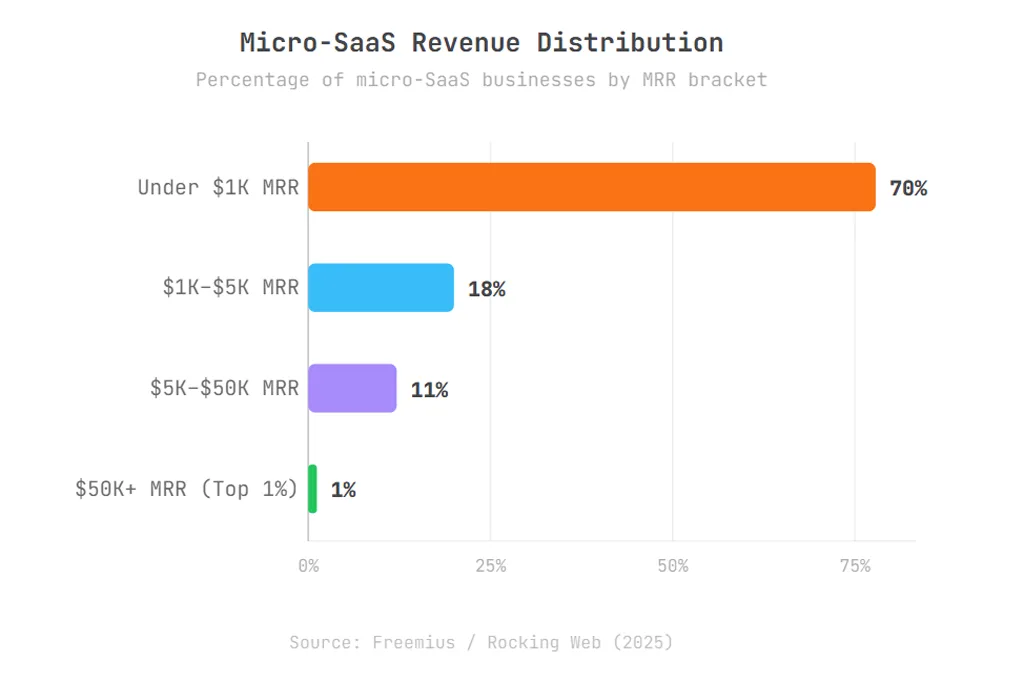
- A 2025 analysis of 1,000 Micro-SaaS companies found that 70% earned under $1,000 per month despite strong profitability potential.
- The same study reported that 95% of Micro-SaaS businesses became profitable within 12 months.
- Some niche AI Micro-SaaS products generated between $15,000 and $50,000 in monthly recurring revenue with minimal overhead.
- Subscription billing remained the dominant revenue model for Micro-SaaS businesses in 2026 because it improved cash-flow predictability.
- Usage-based pricing gained momentum among AI-driven SaaS products because customers preferred flexible billing structures.
- AI SaaS startups secured stronger early-stage investor interest and higher revenue expectations during 2025 fundraising cycles.
- Bootstrapped SaaS businesses increasingly prioritized profitability over hypergrowth as venture funding tightened in 2025.
- Vertical SaaS products targeting narrow customer segments showed stronger retention and monetization performance than generalized SaaS platforms in 2025.
- SaaS startups that integrated AI copilots and automation features reported faster enterprise adoption rates in 2025 and 2026.
Micro-SaaS Revenue Distribution by MRR
- The majority of micro-SaaS businesses are still in the early revenue stage, with 70% earning under $1K in monthly recurring revenue.
- Around 18% of micro-SaaS businesses generate between $1K and $5K MRR, showing that only a smaller share successfully moves beyond the beginner revenue bracket.
- About 11% of micro-SaaS businesses reach the $5K to $50K MRR range, indicating a more stable and scalable revenue stage.
- Only 1% of micro-SaaS businesses earn $50K+ MRR, placing them in the top-performing revenue category.
- The data shows a sharp revenue concentration, where most micro-SaaS founders operate at a modest income level while a very small group captures high recurring revenue.
- Moving from under $1K MRR to $5K+ MRR appears to be a major growth milestone for micro-SaaS companies.
- The chart suggests that while micro-SaaS has low barriers to entry, achieving significant recurring revenue remains difficult for most founders.
- The top 1% earning $50K+ MRR highlights the strong upside potential for successful micro-SaaS products.
Micro-SaaS Profitability Statistics
- Many Micro-SaaS businesses operate with profit margins between 60% and 90% because they rely on lean infrastructure and automation.
- A 2025 analysis of Micro-SaaS startups found that 95% reached profitability within their first year.
- Bootstrapped SaaS founders increasingly prioritize cash flow over aggressive hiring due to higher venture capital costs in 2025 and 2026.
- SaaS companies with fewer than 10 employees reported significantly lower operating expenses than venture-backed SaaS firms with comparable revenue levels.
- Infrastructure automation reduced cloud operations costs for small SaaS firms by up to 35% in 2025.
- AI customer support agents helped some Micro-SaaS startups reduce support costs by 40% to 60%.
- Subscription-based recurring revenue remains one of the strongest predictors of Micro-SaaS profitability because it improves financial forecasting.
- More founders adopted asynchronous work models in 2026 to reduce office and payroll costs.
- SaaS companies with annual billing plans often report stronger cash reserves and lower churn than monthly-only subscription businesses.
- Niche vertical SaaS products serving healthcare, legal, and logistics sectors reported higher customer lifetime value than horizontal SaaS tools in 2025.
Micro-SaaS Customer Acquisition Statistics
- $702 was the average SaaS customer acquisition cost in 2025, setting a high benchmark for Micro-SaaS teams.
- Micro-SaaS founders using organic channels often kept CAC near $0–$50, far below paid acquisition costs of $200–$600.
- SaaS companies using content marketing generated about 67% more leads than businesses without active blog-led acquisition.
- SaaS businesses focused on SEO reported up to 702% ROI, making organic search one of the strongest long-term acquisition channels.
- B2B buyers increasingly preferred digital self-service, with over 70% favoring self-serve and remote human interaction before speaking with sales.
- LinkedIn drove a major share of B2B demand, with 4 out of 5 social B2B leads originating there in 2025.
- Referral-led users tended to show greater retention, engagement, and purchases than paid-acquired customers, while also lowering CAC.
- Only 17% of SaaS products still maintained a freemium tier, while 66% offered a free trial instead.
- Reverse trials were converting at around 20%, showing why many Micro-SaaS founders favored trial-based acquisition over permanent free tiers.
- AI-supported onboarding helped some SaaS platforms handle 50%+ of user requests without human intervention, improving conversion and activation.
Leading Micro-SaaS Niches by Market Share
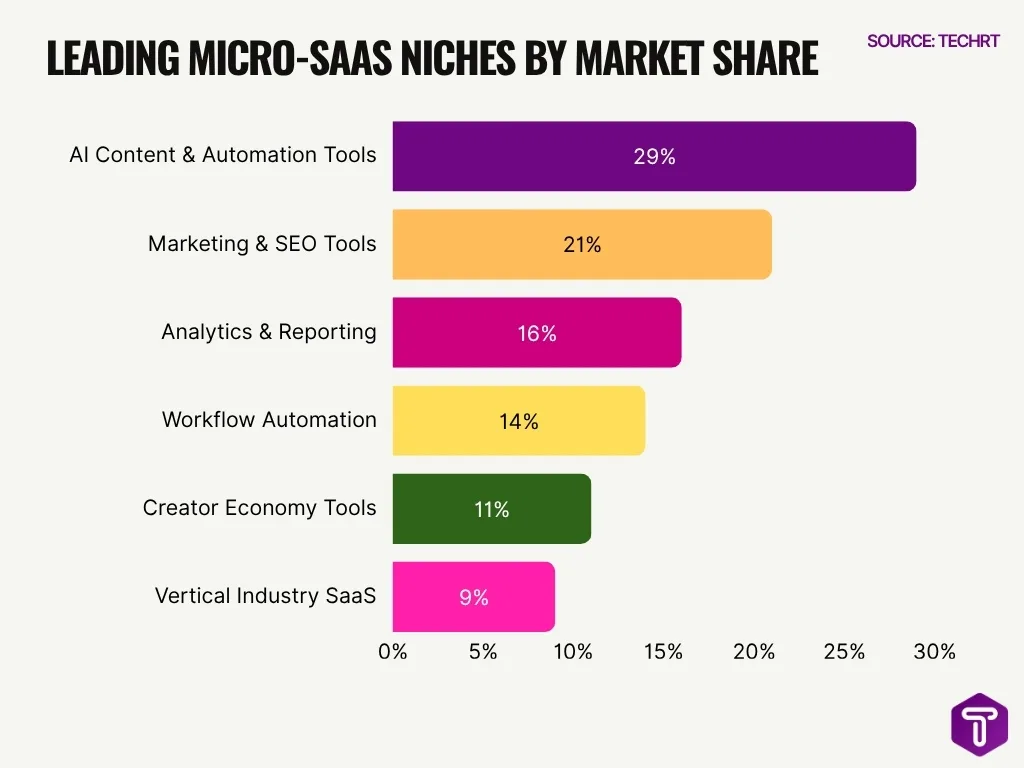
- AI Content & Automation Tools lead the Micro-SaaS category landscape with the highest share of 29%.
- Marketing & SEO Tools rank second, accounting for 21% of the total category share.
- Together, AI Content & Automation Tools and Marketing & SEO Tools represent 50% of the most popular Micro-SaaS categories.
- Analytics & Reporting tools hold a strong position with 16%, showing consistent demand for data-driven SaaS products.
- Workflow Automation accounts for 14%, highlighting the growing need for tools that save time and improve productivity.
- Creator Economy Tools make up 11%, reflecting rising demand from creators, influencers, and digital entrepreneurs.
- Vertical Industry SaaS has the smallest share at 9%, but it remains important for niche-specific business solutions.
- The data shows that Micro-SaaS founders are increasingly focusing on automation, AI, marketing, and analytics-driven products.
- Categories linked to productivity and digital growth, such as AI tools, SEO platforms, and workflow automation, dominate the market.
- The combined share of the top three categories is 66%, indicating that most Micro-SaaS demand is concentrated in a few high-growth niches.
Micro-SaaS Founder Statistics
- Solo founders represented 36.3% of all startup founders in 2025, compared to 23.7% in 2019.
- Nearly 38% of SaaS founders launched their first product while employed full-time, reducing early financial risk.
- The average age of successful SaaS founders increased to approximately 39 years old in 2025, reflecting higher demand for industry expertise.
- More than 52% of bootstrapped SaaS founders relied on personal savings instead of venture capital in 2025.
- AI-assisted coding tools allowed solo founders to launch products with smaller technical teams than in previous years.
- SaaS founders using no-code platforms reduced product launch timelines by nearly 50% on average.
- Female representation among SaaS founders improved gradually in 2025, though women still accounted for less than one-quarter of funded SaaS startups.
- Nearly 70% of Micro-SaaS founders focused on B2B software because recurring enterprise spending remains more predictable than consumer markets.
- Founder burnout became a growing concern in 2025 as solo operators managed development, marketing, and customer support simultaneously.
- Founders with audience-first strategies, including newsletters and creator communities, reported faster product validation cycles in 2026.
Solo Founder and Small Team Trends
- 36.3% of new startups were founded by solo entrepreneurs in 2025.
- >33% of startup founders operated as solo founders in 2025.
- 69% increase in LinkedIn users adding “founder” correlated with AI interest among prospective founders.
- 64% of startups globally now support fully remote or hybrid work models.
- 50%+ median annual growth for early-stage SaaS companies under $1M ARR.
- Median revenue per employee is $167,500 reported for private B2B SaaS startups.
- 41% of founders running companies under 24 months planned to hire within the next quarter.
- Solo founders take 3.6x longer to reach scale versus two-person founding teams.
- 77% of solopreneurs were profitable in their first year.
Key Benefits of Micro SaaS
- Recurring earnings are one of the biggest benefits of Micro SaaS, as businesses can generate steady income while keeping overhead costs lower than traditional SaaS.
- A remote framework allows Micro SaaS platforms to be managed from anywhere, making them ideal for solo founders, small teams, and location-independent businesses.
- Ownership gives founders more control because there is no outside interference from investors, allowing faster decision-making and product direction.
- Seamless updates improve the user experience because Micro SaaS products can receive continuous browser-based updates without complex installation processes.
- Micro SaaS often requires infrequent resources, meaning the platform can be built quickly with fewer people, lower budgets, and simpler infrastructure.
- The data suggests that Micro SaaS is attractive because it combines low operating costs, flexible management, and founder control.
- For startups, Micro SaaS can be a practical model because it supports recurring revenue while avoiding the heavy resource demands of traditional SaaS businesses.

Micro-SaaS Conversion Rate Statistics
- Micro‑SaaS products averaged 3–7% website‐to‑trial conversion rates in 2025.
- Free‑trial signups converted to paying customers at around 17–18% across sample SaaS cohorts.
- Interactive demos boosted lead‑to‑trial conversion by as much as 25% in B2B SaaS funnels.
- AI‑driven onboarding increased product activation by roughly 20–25% for small SaaS apps.
- Product‑led onboarding cut setup‑stage drop‑offs by about 30% compared with legacy flows.
- Landing pages with testimonials and case studies outperformed generic pages by 15–20% on conversion.
- Sub‑2‑second page‑load SaaS sites saw ~40% higher signup rates than slower counterparts.
- Personalized onboarding emails drove up to 3.5× higher free‑to‑paid conversion in key SaaS case studies.
- Usage‑based pricing raised conversion among SMB customers by roughly 20–30% in 2025 samples.
- Mobile‑optimized onboarding improved trial activation by 10–15% as smartphone usage grew.
Micro-SaaS Churn Rate Statistics
- 44% of SaaS churn happened because customers didn’t realize product value quickly enough.
- Average monthly SaaS churn rates fell between 3% and 8%, depending on category and segment.
- B2B SaaS companies had lower churn than B2C due to longer enterprise contracts.
- 63% of users canceled SaaS subscriptions in 2025 due to poor customer support.
- Companies with strong onboarding saw 27% lower churn in the first 90 days after signup.
- Annual billing reduced churn by 15–20% compared to monthly plans because of a longer commitment.
- AI-powered chatbots cut support resolution time by 40% and lowered churn risk by 12%.
- Proactive onboarding messages improved user retention by 22% versus reactive support-only strategies.
- Vertical SaaS tools achieved 5% lower churn than broad horizontal platforms by serving specialized industries.
- Net revenue retention averaged 105% for healthy SaaS companies as expansion offset cancellations.
Micro-SaaS Pricing Model Growth Performance
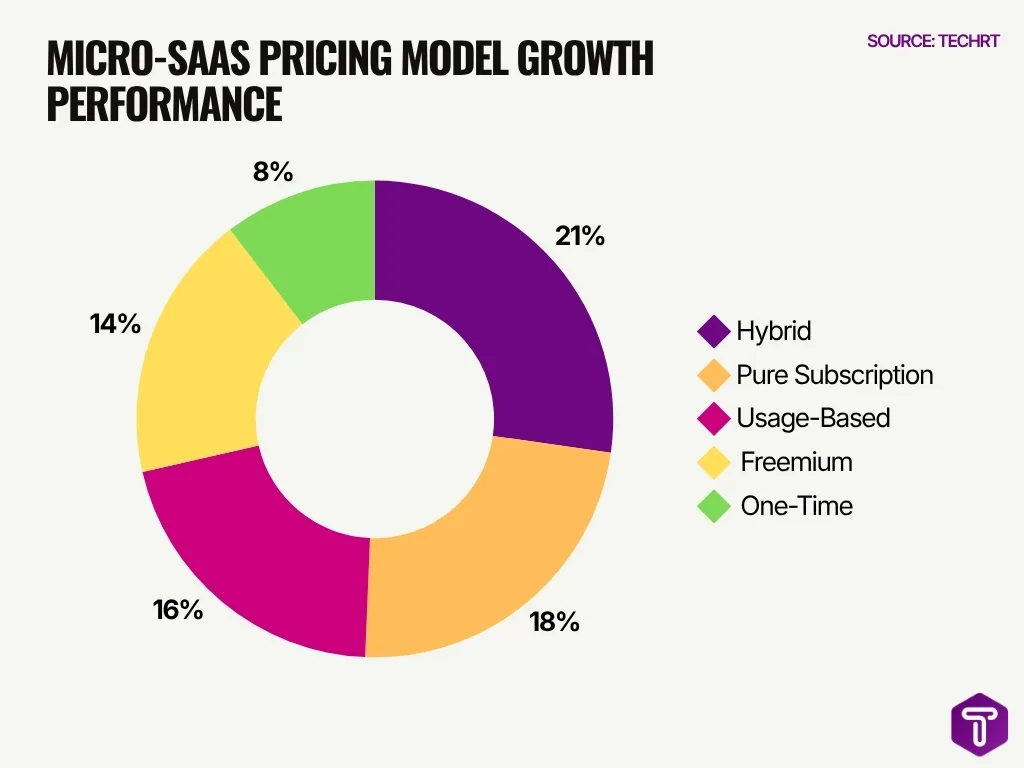
- Hybrid pricing models show the strongest performance, accounting for 21% of growth-related pricing adoption among Micro-SaaS businesses.
- Pure subscription pricing remains a major model, representing 18%, showing that recurring monthly or annual billing is still highly popular in Micro-SaaS.
- Usage-based pricing contributes 16%, indicating that more Micro-SaaS companies are charging customers based on actual product usage.
- Freemium pricing accounts for 14%, suggesting that free plans are still useful for attracting users, but may not drive growth as strongly as paid-first models.
- One-time pricing has the lowest share at 8%, showing that lifetime or single-payment models are less common for sustainable Micro-SaaS growth.
- The data suggests that recurring and flexible pricing models are more effective than fixed one-time payments in the Micro-SaaS market.
- Micro-SaaS founders are increasingly relying on hybrid, subscription, and usage-based pricing to improve revenue predictability and customer retention.
- Overall, the chart highlights that pricing flexibility plays an important role in Micro-SaaS growth, especially when businesses combine recurring revenue with scalable usage-based features.
Micro-SaaS Retention Statistics
- 90% of users churn if they do not understand a product’s value within the first week, making early onboarding a major retention lever.
- Strong onboarding can improve retention by up to 50%, while personalized onboarding can lift retention by 40% versus generic flows.
- Companies that reduce churn by just 5% can increase profits by 25%–95%, showing why retention often outperforms acquisition.
- About 92% of users who receive training during onboarding are more likely to renew, highlighting the impact of education on loyalty.
- Net revenue retention around 101%–104% became a key healthy-SaaS benchmark in 2025, with 100%+ NRR signaling expansion-led durability.
- Companies with high NRR were reported to grow 2.5x faster than lower-NRR peers, reinforcing retention as a growth engine.
- Community members showed 37% higher retention than non-community users, and active product-community users had 62% higher renewal rates.
- SaaS products with active communities were reported to have retention rates nearly 2x those of less-engaged competitors, boosting ecosystem loyalty.
- AI-powered churn models improve forecasting by analyzing login frequency, feature usage, support tickets, and sentiment to flag at-risk customers earlier.
- Enterprise SaaS churn stayed below 1.5% monthly, while SMB churn was concentrated in the first 90 days, with 43% of losses occurring in that period.
Micro-SaaS Trial and Freemium Statistics
- Average free trial conversion rates for SaaS businesses stayed around 17% in 2025, while freemium conversion typically sat at 2%–5%.
- SaaS products with onboarding checklists and guided setup flows saw stronger trial-to-paid performance, with systematic onboarding linked to 20%–28% more paid conversions.
- AI-powered onboarding personalization lifted engagement, and AI/ML products reached activation rates as high as 54.8% in benchmark data.
- Shorter free trials helped SMB buyers decide faster, with many SaaS teams using 7–14-day trials to create a clear decision point.
- Nearly 70% of B2B buyers preferred self-service discovery over sales calls, reinforcing product-led evaluation.
- SaaS companies using in-app tutorials and behavioral onboarding outperformed email-only flows, since skipping behavioral monitoring limited conversion gains to 4%–6%.
- Freemium remained common in AI tools, but more founders shifted to feature-limited free plans because trials often converted better than permanent free tiers.
- Product-led growth helped reduce customer acquisition costs, since free trials created faster payback periods and freemium increased blended CAC through non-converting users.
- SaaS businesses increasingly favored reverse trials and card-required trials, with card-upfront trials converting around 30% and reverse trials near 20% in benchmark data.
Micro-SaaS AI Adoption Statistics
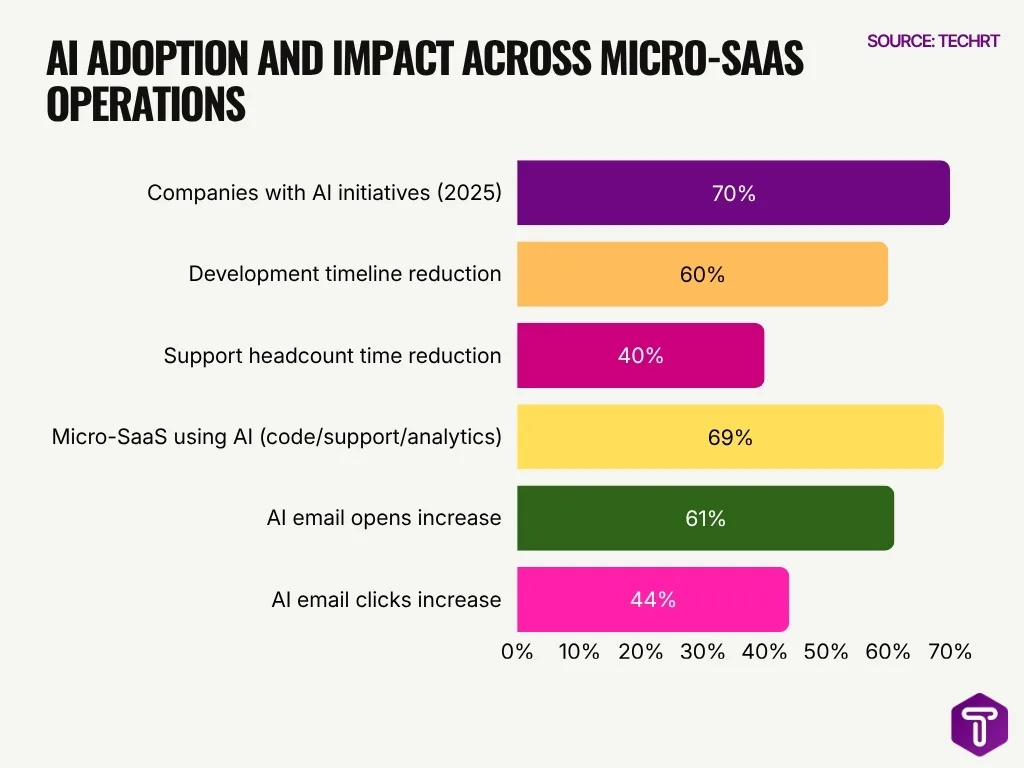
- >70% of companies had implemented AI initiatives by 2025.
- AI-assisted coding cut solo-founder development timelines by up to 60% in some workflows.
- Generative AI software revenue exceeded $118B in 2025.
- AI customer-support agents automated repetitive tickets and cut support headcount time by ~40% for many SaaS startups.
- AI-first SaaS startups commanded higher seed valuations than traditional SaaS during 2025 fundraising cycles.
- By early 2026, a majority of Micro‑SaaS products added AI copilots for automation, analytics, or productivity features.
- AI personalization lifts onboarding/retention metrics, with AI‑personalized emails showing +61% opens and +44% clicks in 2025 tests.
- Analysis of 160,000+ Product Hunt launches found that generative AI increased solo entrepreneurship after ChatGPT’s release.
- AI meeting‑assistant tools became one of the fastest‑growing Micro‑SaaS categories entering 2026.
Micro-SaaS Exit and Acquisition Statistics
- Around 28% more SaaS deals closed in 2025 than in 2024, marking record M&A volume for the sector.
- Micro‑SaaS businesses with above 90% net revenue retention attracted multiples roughly 2–3x higher than those below 85% NRR.
- The median acquisition multiple for private SaaS companies reached about 4.2x ARR in 2025, with top‑tier deals hitting 6x–12x ARR.
- Profitable bootstrapped Micro‑SaaS products with less than 10% churn commonly sell within the 3x–8x ARR range, depending on growth.
- AI‑native SaaS startups targeting workflows or automation saw acquisition interest spike by about 40–60% year‑on‑year in 2025–2026.
- Around 30% of SaaS M&A buyers in 2025 were private‑equity backed consolidators chasing stable, profitable Micro‑SaaS businesses.
- Niche SaaS products with ARR between $100k–$500k accounted for roughly 45% of Micro‑SaaS exits over the 2024–2025 period.
- Strategic enterprise buyers paid almost 2x higher premiums for SaaS assets with embedded AI automation versus traditional feature‑set tools.
- Founder‑led Micro‑SaaS exits in developer and creator‑tool categories made up about 20% of all software tuck‑in deals in 2025.
- Micro‑SaaS exits with strong ecosystem integrations closed at 15–25% higher valuations than standalone niche tools in comparable size bands.
Micro-SaaS Challenges and Risks
- 54% of startup founders reported burnout in the past 12 months, making founder burnout a major solo-operator risk in 2025–2026.
- 68% of SaaS companies said customer retention is a pressing concern, showing that churn remains a top challenge for weak onboarding or unclear value.
- B2B SaaS customer acquisition cost averaged about $1,200 per customer in 2025, which makes customer acquisition increasingly expensive for Micro-SaaS founders.
- Median SaaS CAC ratio hit $2.00 for every $1 of new ARR, with bottom-quartile performers at $2.82, highlighting tougher growth economics.
- SMB SaaS churn was 3–7% monthly in 2025, which translates to roughly 31–58% annually, reinforcing how fragile retention can be without strong onboarding.
- Global cloud infrastructure spending reached $399.6 billion in 2025 and rose 24% year over year, with AI driving more compute demand and higher costs.
- In a 2026 survey, companies spent an average of 10% of revenue on cloud services, and 22% of cloud costs were tied to AI and machine-learning workloads.
- More than 20 U.S. states had enacted comprehensive privacy laws by early 2025, while GDPR fines had exceeded EUR 4 billion, keeping compliance pressure high for global SaaS startups.
- 75% of organizations experienced a SaaS security incident in the past 12 months, underscoring rising cybersecurity risks for analytics, payments, and AI workflows.
- The AI software market grew from $292.71 billion in 2025 to $386.08 billion in 2026, and is projected to reach $995.45 billion by 2030, showing why AI SaaS saturation is intensifying competition.
Frequently Asked Questions (FAQs)
How large is the global SaaS market in 2026?
What is the projected growth rate of the Micro-SaaS market?
How much could the Micro-SaaS market be worth by 2030?
What share of the global SaaS market does North America hold?
How many SaaS applications does the average organization use?
Conclusion
Micro-SaaS businesses continue to expand rapidly as AI automation, no-code tools, and subscription-based software models lower the barriers to entrepreneurship. Solo founders and lean teams now compete in markets that once required large engineering departments and major venture funding. At the same time, customers increasingly prefer focused software products that solve a single operational problem efficiently.
The statistics also show that profitability, retention, and niche specialization matter more than pure scale. AI-powered automation, product-led growth, and usage-based pricing continue shaping the next phase of Micro-SaaS expansion. However, rising competition, customer acquisition costs, and founder burnout remain significant risks for long-term sustainability.
As the SaaS ecosystem evolves, Micro-SaaS companies that combine automation, strong retention strategies, and clear market positioning will likely capture the strongest growth opportunities over the next several years.

Leave a comment
Have something to say about this article? Add your comment and start the discussion.