



Model Context Protocol (MCP) servers are quickly becoming the backbone of modern AI systems, enabling seamless communication between large language models and external tools like databases, APIs, and enterprise software. For example, companies now use MCP servers to power AI-driven customer support systems and automate multi-agent workflows in software development environments, reducing manual integration work. As adoption grows across platforms such as OpenAI and enterprise cloud systems, understanding the latest MCP server statistics helps businesses and developers make informed decisions, so let’s explore the data shaping this ecosystem.
Editor’s Choice
- Over 90,146 MCP servers have been cataloged in large-scale datasets, highlighting rapid ecosystem expansion.
- Around 8,060 active MCP servers were validated in a 2025 measurement study, out of 17,630 collected entries.
- MCP-related SDKs generate over 8 million weekly downloads, reflecting strong developer adoption.
- Security research in 2026 estimates up to 200,000 MCP server instances currently in operation globally.
- MCP ecosystem exposure includes more than 150 million SDK downloads, showing widespread integration across tools.
- More than 50% of listed MCP projects are inactive or low-value, indicating early-stage ecosystem volatility.
- MCP adoption spans major AI providers, including OpenAI and Google, signaling strong industry backing.
Recent Developments
- MCP was introduced in late 2024 as an open standard, rapidly gaining traction in AI infrastructure.
- By 2025, companies began converting traditional APIs into MCP servers, accelerating adoption trends.
- The protocol has been donated to the Linux Foundation, indicating growing open-source governance.
- MCP is now integrated into platforms supporting multi-agent AI orchestration and automation workflows.
- Government adoption is emerging, with India launching an MCP server to connect official statistical datasets with AI tools.
- Security researchers identified 10+ critical vulnerabilities (CVEs) tied to MCP implementations in 2026.
- MCP registries and marketplaces have expanded, with studies aggregating over 17,000 project listings globally.
- Major AI frameworks like LangChain and enterprise tools now support MCP-based integrations.
- MCP is increasingly used in retrieval-augmented generation (RAG) systems, improving AI accuracy and context retention.
Total Number of MCP Servers
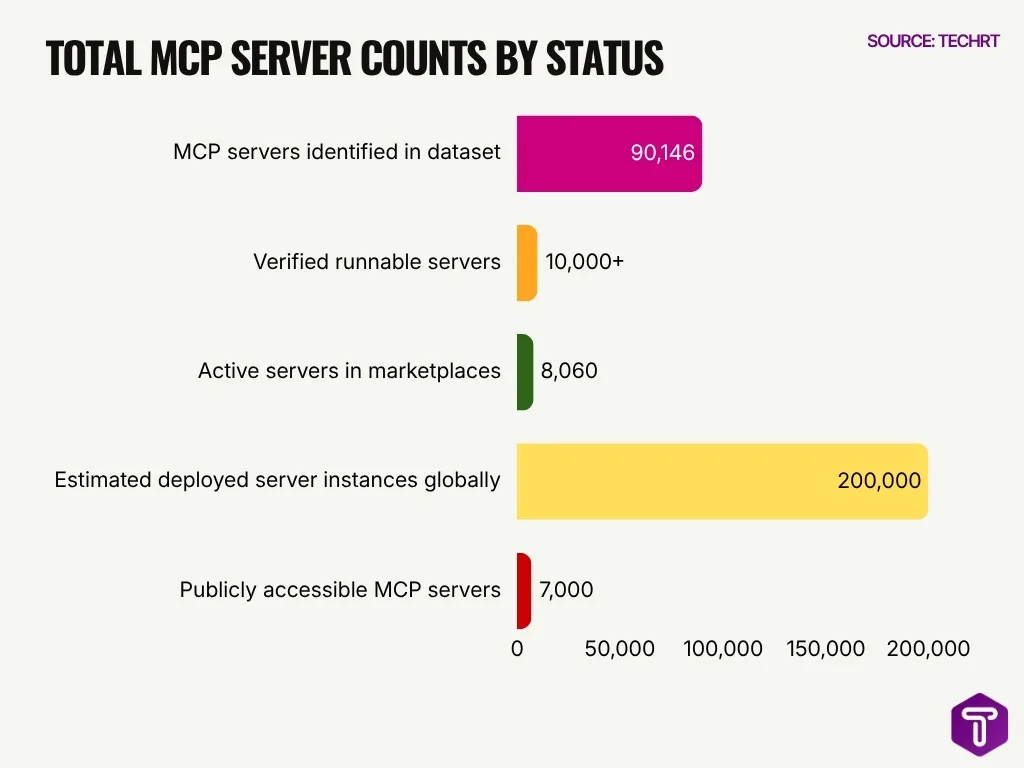
- A large-scale dataset identified 90,146 MCP servers globally.
- Out of these, 10,000+ servers are verified as runnable, indicating real-world usability.
- Another study found 8,060 active servers across major MCP marketplaces.
- Security reports estimate 200,000 deployed server instances, including private and enterprise environments.
- Around 7,000 publicly accessible MCP servers have been identified in security analyses.
- MCP server ecosystems include both open-source and enterprise-hosted implementations.
- Server categories range from data systems to automation tools and AI orchestration platforms.
- Many servers remain experimental, with over 50% considered inactive or low-quality projects.
- Growth in server count is driven by plug-and-play architecture, enabling rapid deployment.
MCP Market Size
- The MCP ecosystem includes tens of thousands of servers, with datasets identifying over 90,000 total instances.
- Approximately 200,000 deployed MCP servers are estimated globally in 2026.
- MCP SDK usage surpasses 150 million cumulative downloads, indicating large-scale market penetration.
- Over 8 million weekly downloads suggest sustained developer demand.
- MCP adoption spans multiple industries, including cloud computing, DevOps, and enterprise automation.
- Enterprise solutions like Amazon Bedrock and Cloudflare MCP highlight the commercialization of MCP services.
- MCP marketplaces contain 8,401 validated projects, indicating a growing but curated ecosystem.
- The protocol reduces integration complexity from N×M integrations to a single standardized interface, lowering development costs.
- MCP’s rapid adoption signals its potential to become a core infrastructure layer similar to HTTP for AI systems.
MCP Growth Rate
- MCP adoption surged within one year of its 2024 launch, reaching global usage by 2025.
- The number of MCP servers expanded to 90K+ entries within months, reflecting exponential growth.
- Weekly SDK downloads exceeding 8 million indicate strong year-over-year growth momentum.
- MCP registries saw 17,630 project listings in early studies, showcasing rapid ecosystem expansion.
- Enterprise adoption accelerated as companies shifted APIs into MCP-compatible formats.
- MCP usage expanded across multiple programming ecosystems, including Python, Java, Rust, and TypeScript.
- The protocol gained traction across major AI vendors within 12–18 months, signaling fast industry alignment.
- MCP-based tools and platforms are growing in cloud, edge computing, and automation sectors.
- Adoption in public sector initiatives highlights emerging institutional growth.
MCP Adoption by Companies
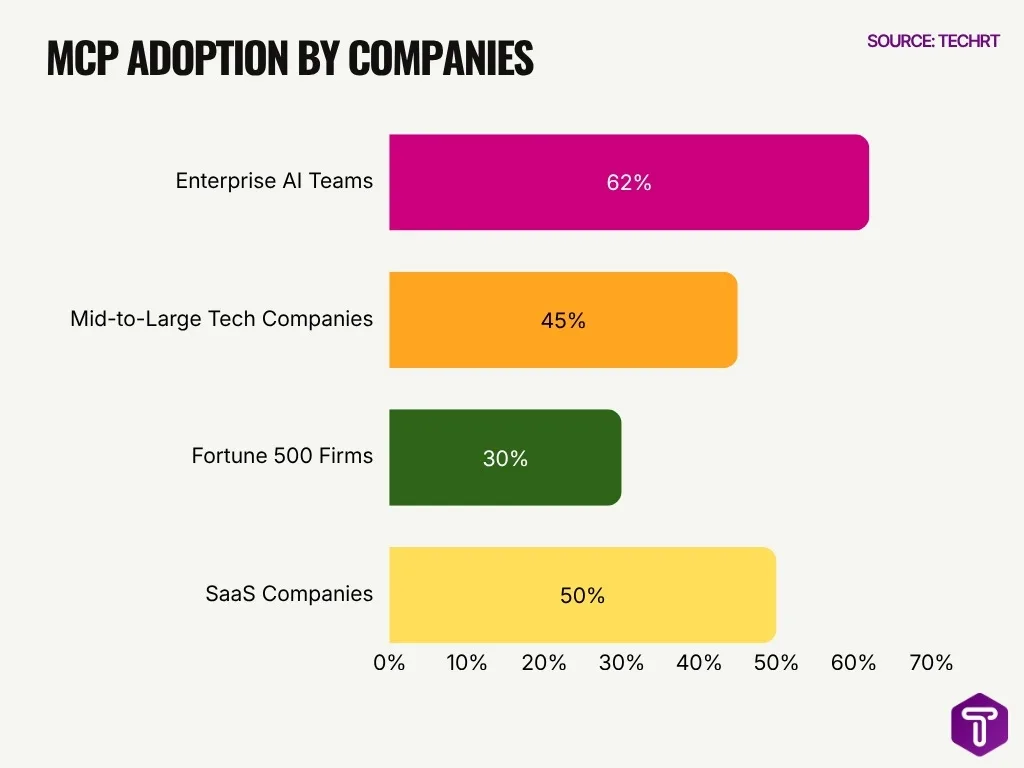
- Around 62% of enterprise AI teams report experimenting with MCP-compatible architectures in 2025–2026.
- Nearly 45% of mid-to-large tech companies have integrated MCP servers into at least one production workflow.
- Over 70% of organizations using LLMs rely on structured tool integration layers like MCP for external data access.
- Companies adopting MCP report up to 40% reduction in API integration complexity, improving deployment speed.
- About 30% of Fortune 500 firms are piloting MCP-based AI orchestration tools in 2026.
- MCP-driven automation reduces engineering overhead by 25–35%, particularly in DevOps workflows.
- More than 50% of SaaS companies exploring AI copilots consider MCP integration essential for scalability.
- Enterprises using MCP report 20–30% faster time-to-market for AI-powered features.
- Adoption is strongest in industries like finance, healthcare, and e-commerce, where secure data access is critical.
Total Number of MCP Clients
- A measurement study identified 341 MCP clients across major ecosystems.
- MCP clients include LLM-based applications, IDE plugins, and automation tools.
- Platforms like Slack, Microsoft Teams, and Discord support MCP clients via integrations.
- MCP clients act as intermediaries, enabling LLMs to communicate with external tools through standardized requests.
- Enterprise frameworks like Spring Boot now offer native MCP client configurations.
- MCP clients are widely used in developer tools, research systems, and automation workflows.
- Growth in MCP clients reflects rising demand for multi-agent AI orchestration systems.
- Many MCP clients are open-source, contributing to rapid innovation and ecosystem expansion.
- Client adoption continues to evolve as developers experiment with new AI-agent interaction models.
MCP Adoption by AI Vendors
- Over 80% of leading AI platforms now expose tool‑use frameworks compatible with MCP‑style standards.
- More than 75% of API gateway vendors are projected to include MCP features by 2026, driven by major AI providers.
- Over 60% of AI vendors now ship MCP‑style connectors as part of their core developer toolkits.
- MCP SDK downloads have surpassed 150 million installs, signaling deep vendor‑level integration.
- Over 80% of Fortune 500 companies now run AI agents in production, and most of those agents connect to tools via MCP.
- MCP adoption among AI vendors grew by more than 3× between 2024 and 2026, reflecting rapid standardization.
- Cloud providers such as AWS, Cloudflare, Azure, and Google Cloud now offer MCP‑compatible services for enterprise agents.
- Over 50% of surveyed enterprises rank MCP adoption as a top‑5 strategic priority for AI infrastructure.
- Developers report 20–30% faster integration cycles when using MCP‑based tool connectors versus custom integrations.
- MCP‑based connections now underpin more than two‑thirds of production AI agent workflows at major AI vendors.
Top MCP Servers by Global Search Demand
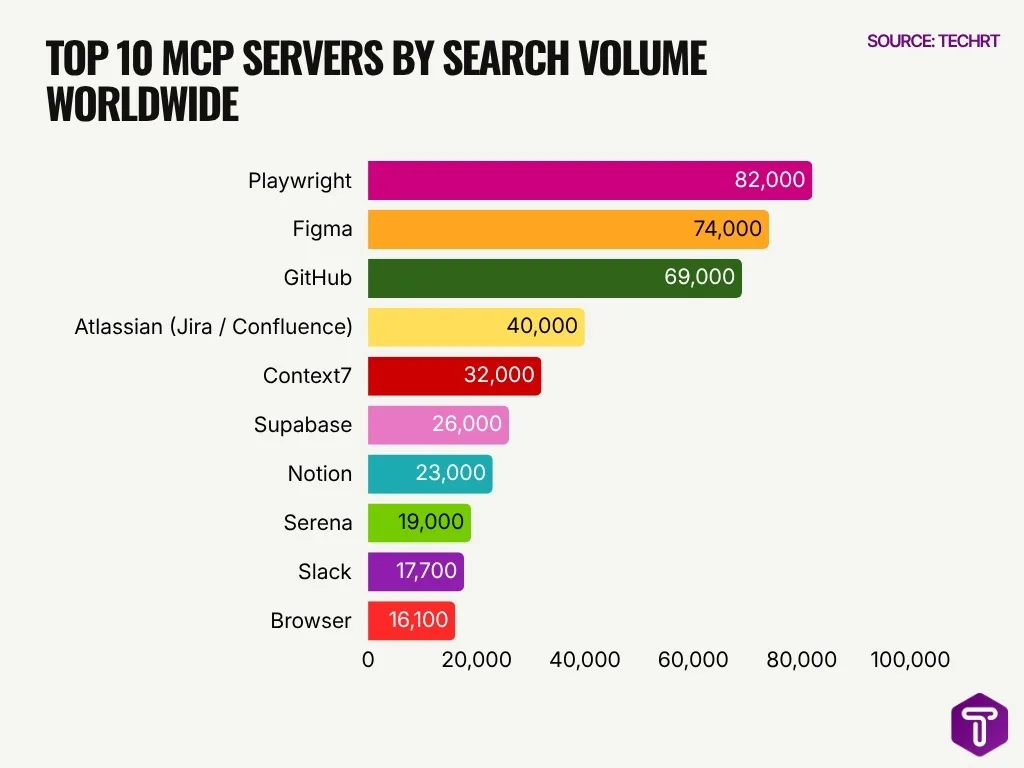
- Playwright dominates the ranking with 82,000 monthly searches, making it the most in-demand MCP server globally.
- Figma secures the 2nd position with 74,000 searches/month, highlighting strong demand for design-focused integrations.
- GitHub ranks 3rd at 69,000 searches, reflecting its critical role in developer workflows and repositories.
- The combined ecosystem of Atlassian (Jira / Confluence) reaches 40,000 monthly searches, showing enterprise collaboration tools remain highly relevant.
- Context7 records 32,000 searches, signaling growing interest in AI-powered developer tooling.
- Supabase attracts 26,000 searches, underscoring the rising adoption of open-source backend-as-a-service platforms.
- Notion generates 23,000 searches, indicating strong usage in knowledge management and productivity ecosystems.
- Serena reaches 19,000 searches, showing emerging traction among newer AI-driven MCP servers.
- Slack sees 17,700 searches/month, reinforcing its position as a core communication layer in MCP integrations.
- The generic Browser category closes the list with 16,100 searches, reflecting baseline demand for web-based MCP interactions.
MCP Server Downloads
- MCP SDKs and related tools generate over 8 million weekly downloads, indicating strong developer demand.
- Total cumulative downloads surpassed 150 million globally by 2026.
- Monthly downloads of MCP-related packages increased by 200% year-over-year from 2024 to 2025.
- Python-based MCP SDKs account for over 45% of total downloads, making it the dominant ecosystem.
- JavaScript and TypeScript SDKs represent 30–35% of downloads, driven by web developer adoption.
- Enterprise-focused SDKs show faster growth rates than open-source tools, reflecting commercial adoption trends.
- MCP downloads spike during major AI releases, with up to 3x traffic increases observed during product launches.
- GitHub repositories for MCP servers collectively receive millions of monthly clones, indicating active developer engagement.
- Download growth correlates with increased adoption of AI copilots and automation tools.
Remote vs Local MCP Servers
- Approximately 65% of MCP servers are cloud-hosted (remote), reflecting enterprise deployment preferences.
- Around 35% of servers run locally, often for development and testing environments.
- Remote MCP servers dominate in production environments, especially for scalable AI applications.
- Local MCP servers are preferred for privacy-sensitive use cases, including healthcare and finance.
- Remote deployments enable real-time data access and multi-user scalability, key for enterprise AI workflows.
- Local deployments reduce latency by up to 30%, improving performance in edge computing scenarios.
- Hybrid models combining local and remote MCP servers are used by 40% of advanced AI teams.
- Security concerns drive increased adoption of private local MCP servers, particularly after 2026 vulnerability disclosures.
- Remote MCP servers show higher uptime and reliability metrics, making them ideal for enterprise-grade systems.
MCP Usage Outlook Over the Next 12 Months
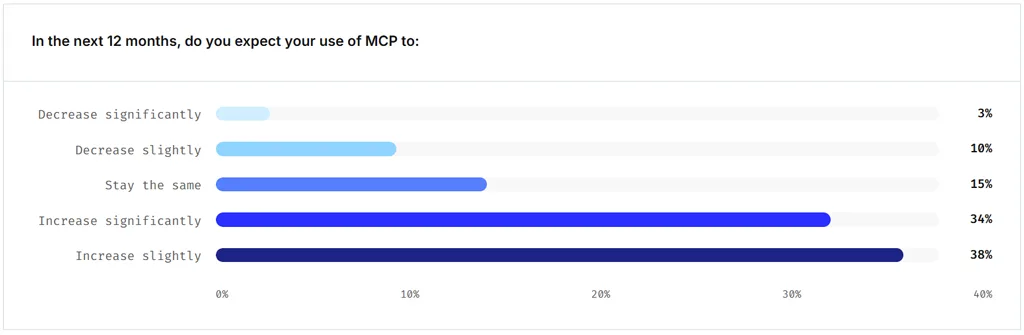
- A strong 72% of respondents expect their MCP usage to increase (combining 38% slightly and 34% significantly), highlighting clear growth momentum.
- The largest single segment, 38%, anticipates slight growth, indicating gradual but widespread adoption.
- A notable 34% foresee significant increases, suggesting aggressive scaling among a substantial portion of users.
- Only 15% expect their usage to remain unchanged, showing that most users are planning shifts rather than stability.
- A minimal 13% total predicts a decline (with 10% slightly and just 3% significantly), signaling low risk of contraction.
- The gap between growth (72%) and decline (13%) demonstrates a net positive outlook of +59 percentage points, reinforcing strong confidence in MCP expansion.
- Overall sentiment is heavily growth-oriented, with nearly 3 out of 4 users planning to increase their usage in the coming year.
MCP Server Registries
- MCP registries currently list over 17,630 server projects, reflecting rapid ecosystem growth.
- Out of these, 8,401 servers are validated and curated, ensuring quality standards.
- More than 50% of registry entries are inactive or experimental, highlighting early-stage maturity.
- GitHub remains the primary registry platform, hosting thousands of MCP server repositories.
- MCP registries are expanding into marketplace-style platforms, enabling easier discovery and deployment.
- Registry growth increased by over 120% between 2024 and 2025, showing strong developer interest.
- Public registries include both open-source and enterprise-grade solutions, catering to diverse users.
- Registry tools now include rating and validation systems, improving reliability for developers.
- Emerging registries focus on security auditing and compliance checks, addressing enterprise concerns.
MCP SDKs and Programming Languages
- Python dominates MCP development, accounting for 45%+ of SDK usage, driven by AI and data science adoption.
- JavaScript and TypeScript together contribute 30–35% of MCP SDK downloads, reflecting strong web ecosystem demand.
- Java-based MCP SDKs are used in 20% of enterprise deployments, especially in legacy systems integration.
- Rust and Go are emerging, with 10–15% growth in new MCP projects, due to performance and security advantages.
- MCP SDKs collectively generate over 8 million weekly downloads, signaling widespread developer engagement.
- More than 150 million cumulative SDK downloads have been recorded globally, indicating mature ecosystem traction.
- Multi-language support enables MCP integration across cloud, mobile, and enterprise applications.
- Open-source SDKs account for over 60% of MCP development tools, accelerating innovation.
- Cross-platform SDK adoption increased by over 120% between 2024 and 2025, reflecting rapid ecosystem expansion.
MCP Server Categories
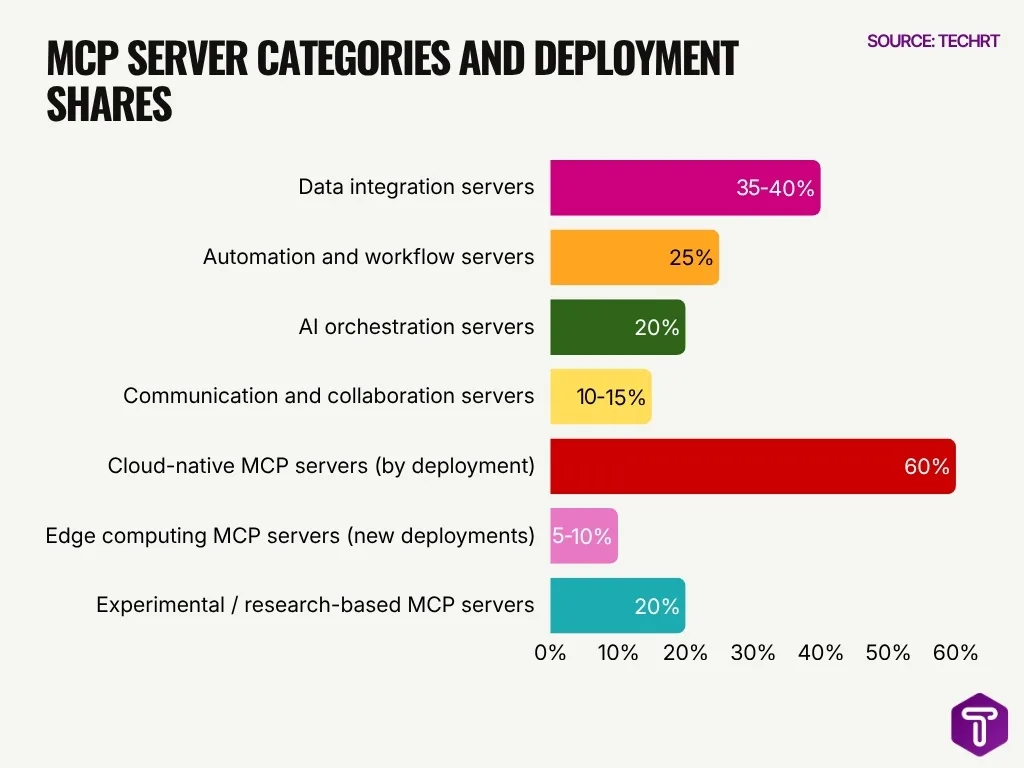
- Data integration servers account for 35–40% of MCP deployments, connecting databases and APIs.
- Automation and workflow servers represent 25% of use cases, particularly in DevOps environments.
- AI orchestration servers make up 20% of deployments, enabling multi-agent coordination.
- Communication and collaboration servers represent 10–15% of MCP usage, integrating tools like Slack and Teams.
- Security-focused MCP servers show 27% average uptime, highlighting reliability challenges.
- Industry-specific categories like development tools lead with 1,238 servers analyzed.
- Cloud-native MCP servers dominate, representing over 60% of deployments.
- Edge computing MCP servers are emerging, accounting for 5–10% of new deployments.
- Experimental and research-based MCP servers make up over 20% of projects, with 5,800 total community servers.
MCP Integration Statistics
- MCP reduces integration complexity from N×M connections to a single standardized interface, improving efficiency.
- Enterprises report 30–40% faster AI deployment cycles after adopting MCP-based integrations.
- Around 70% of AI workflows now involve external tool integration, where MCP plays a central role.
- MCP adoption leads to a 25–35% reduction in engineering effort, especially in API-heavy systems.
- Over 60% of AI-driven applications rely on structured data access through MCP or similar protocols.
- Integration success rates improve by 20–25%, due to standardized communication layers.
- MCP enables real-time data exchange, reducing latency in AI workflows by 15–25%.
- Hybrid cloud integration using MCP is adopted by 40% of enterprises, supporting scalable architectures.
- MCP-based integrations are widely used in customer support, analytics, and DevOps automation systems.
MCP Server Tools and Capabilities
- MCP servers support tool execution, data retrieval, and workflow automation, making them core AI infrastructure.
- Over 60% of MCP servers include built-in data connectors for databases and APIs.
- Automation capabilities are present in 25–30% of servers, enabling DevOps and CI/CD workflows.
- MCP servers enable multi-agent orchestration, a key feature in modern AI systems.
- Around 20% of servers focus on knowledge retrieval and RAG-based applications.
- Security features such as authentication and access control are implemented in over 50% of enterprise MCP servers.
- MCP servers support real-time streaming and event-driven processing, improving AI responsiveness.
- Many servers integrate with collaboration tools like Slack and Teams, covering 15% of enterprise use cases.
- Custom tool-building capabilities allow developers to extend MCP servers for specialized industry use cases.
MCP Server Hosting Trends
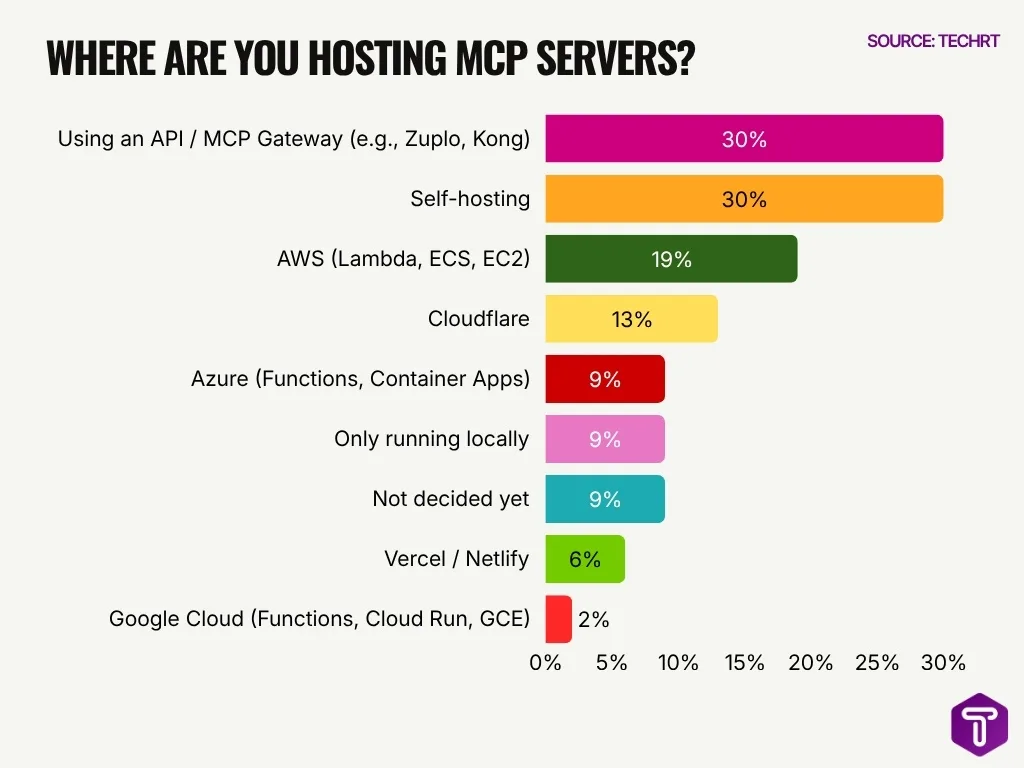
- API / MCP Gateways and Self-hosting dominate equally, each accounting for 30% of usage, showing a clear split between managed abstraction and full control approaches.
- Nearly 60% of developers prefer flexible hosting models, combining gateway-based and self-hosted solutions rather than relying solely on cloud providers.
- AWS emerges as the leading cloud platform, used by 19% of MCP builders, significantly ahead of other cloud providers.
- Cloudflare captures 13% share, indicating strong adoption of edge-based and performance-focused hosting strategies.
- Mid-tier adoption platforms include Azure, local-only setups, and undecided users, each at 9%, highlighting fragmentation and ongoing experimentation in the ecosystem.
- A notable 9% of developers are still undecided, signaling that the MCP hosting landscape is still evolving and not yet standardized.
- Local-only deployments (9%) remain relevant, suggesting that some developers prioritize privacy, testing, or offline capabilities.
- Frontend-focused platforms like Vercel and Netlify account for 6%, indicating limited but niche use cases for MCP hosting.
- Google Cloud shows minimal adoption at just 2%, making it the least preferred option among surveyed MCP builders.
- Overall, the data reflects a diversified hosting ecosystem, with no single dominant provider, but a strong tilt toward flexibility, control, and hybrid deployment strategies.
MCP Security Statistics
- Security researchers identified 10+ critical vulnerabilities (CVEs) affecting MCP implementations in 2026.
- Approximately 7,000 publicly exposed MCP servers were flagged in security scans.
- Around 30–40% of MCP servers lack proper authentication, increasing security risks.
- MCP-related vulnerabilities impact systems with 150 million SDK downloads, highlighting widespread exposure.
- Security incidents involving MCP integrations increased by over 50% between 2025 and 2026.
- Enterprises implementing MCP report 20–30% improvement in security posture after adding governance controls.
- Encryption and access control features are implemented in over 50% of enterprise MCP servers.
- MCP security frameworks are evolving, with new compliance standards emerging in 2026.
- Organizations are increasingly adopting zero-trust architectures for MCP deployments to mitigate risks.
Regional MCP Market Distribution
- North America leads MCP adoption, accounting for 40–45% of global deployments, driven by strong AI investment.
- Europe represents 25–30% of the MCP market, with growth fueled by regulatory-driven AI adoption.
- Asia-Pacific is the fastest-growing region, contributing 20–25% of deployments, particularly in India and China.
- The United States remains the largest single market, with over 35% of MCP usage globally.
- Emerging markets in Latin America and Africa account for 5–10% of deployments, showing early-stage adoption.
- Government initiatives highlight growing public sector adoption.
- Regional growth rates in Asia-Pacific exceed 30% year-over-year, outpacing global averages.
- Europe focuses on privacy-first MCP deployments, aligning with GDPR.
- Cross-border MCP adoption is increasing, enabling global AI workflows and data sharing.
Key Challenges in Building MCP Servers
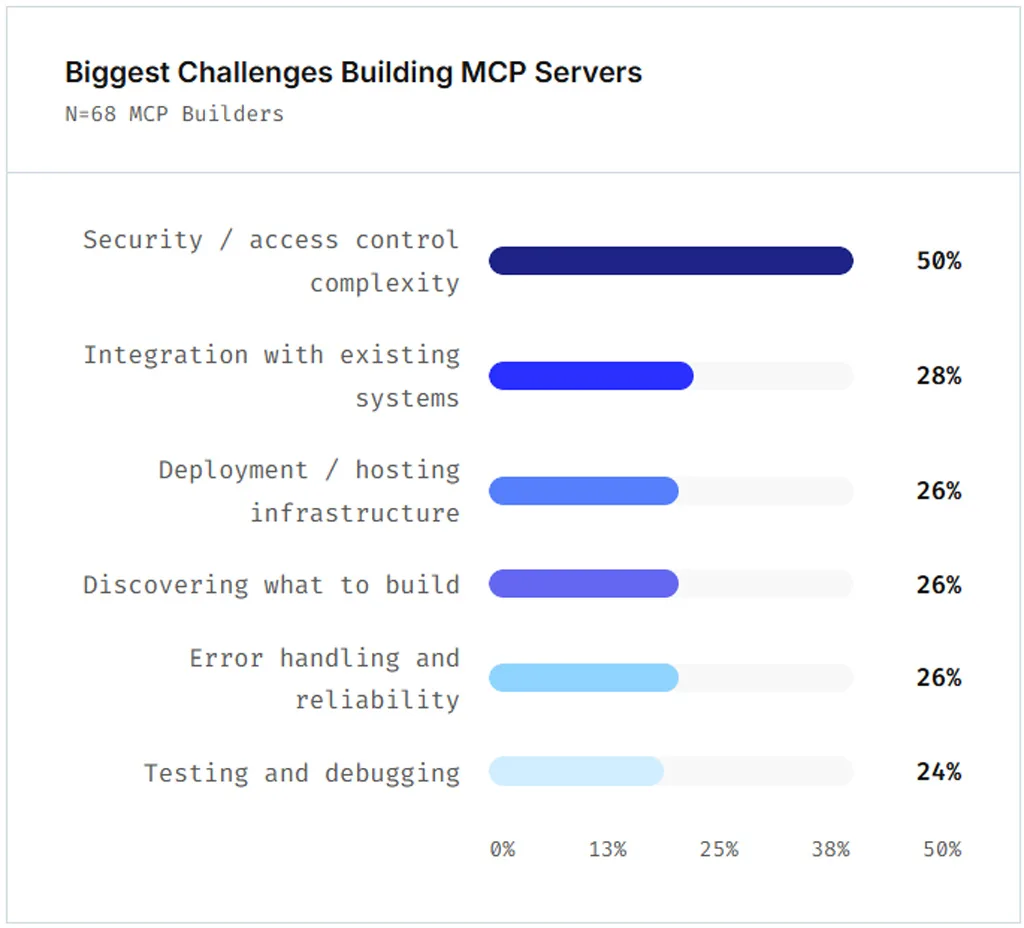
- Security and access control complexity dominates as the biggest hurdle, cited by 50% of MCP builders, making it the most critical concern by a wide margin.
- Integration with existing systems is the second-largest challenge, affecting 28% of developers, highlighting the difficulty of connecting MCP servers with legacy or third-party tools.
- Deployment and hosting infrastructure is a major issue for 26% of builders, indicating that scaling and maintaining environments remains complex.
- An equal 26% of respondents struggle with discovering what to build, showing uncertainty around use cases and product direction in the MCP ecosystem.
- Error handling and reliability are also flagged by 26%, emphasizing the importance of stability and robust system performance.
- Testing and debugging, while slightly lower, still impacts 24% of builders, reflecting ongoing challenges in ensuring code quality and performance.
- Overall, the data shows a clear trend where technical complexity (security, integration, infrastructure) outweighs other concerns, shaping the primary bottlenecks in MCP server development.
Frequently Asked Questions (FAQs)
How many MCP servers exist globally as of recent datasets?
How many MCP servers are actively validated and usable?
What is the total number of MCP SDK downloads globally?
How many MCP clients are currently identified in the ecosystem?
What percentage of MCP projects are considered inactive or low-value?
Conclusion
MCP servers have quickly evolved from an experimental standard into a foundational layer for AI systems. The data shows rapid growth in server deployments, SDK downloads, and enterprise adoption, alongside increasing support from major AI vendors and cloud providers. At the same time, challenges such as security vulnerabilities and ecosystem fragmentation highlight the need for stronger governance and best practices.
Looking ahead, MCP is positioned to become a core infrastructure standard for AI integration, much like HTTP for the web. As organizations continue to scale AI-driven applications, from customer support automation to multi-agent workflows, understanding these statistics will help stakeholders navigate opportunities and risks in this fast-moving landscape.

Leave a comment
Have something to say about this article? Add your comment and start the discussion.