



Prompt injection attacks have become one of the fastest-growing security threats in the generative AI market. As organizations deploy AI copilots, autonomous agents, customer support bots, and retrieval-augmented generation (RAG) systems, attackers increasingly exploit hidden prompts to manipulate model behavior, extract sensitive data, or bypass safeguards.
The impact already spans healthcare diagnostics, financial automation, enterprise search, and government AI deployments. Moreover, the rise of multimodal AI and agentic workflows has expanded the attack surface beyond simple text prompts into documents, images, APIs, and browser agents. This article explores the latest prompt injection vulnerability statistics, including adoption trends, attack patterns, industry exposure, and evolving defense strategies.
Editor’s Choice
- Prompt injection ranked #1 in the OWASP Top 10 for LLM Applications 2025, making it the leading AI application security concern entering 2026.
- Around 15% of enterprises reported at least one GenAI-related security incident in the previous year, with prompt injection among the most common causes.
- The global AI prompt security market grew from $1.51 billion in 2024 to $1.98 billion in 2025, reflecting a 31.5% CAGR.
- A 2025 survey of U.S. state and territorial CIOs found that 82% reported employees using GenAI tools in daily workflows, up from 53% a year earlier.
- Research from MIT’s AI Agent Index documented prompt injection vulnerabilities in 2 out of 5 tested browser agents.
- Security researchers observed multiple prompt injection-linked data leakage incidents worldwide between July and August 2025 alone.
- OpenAI and UK cybersecurity officials both warned in late 2025 that prompt injection attacks may never be fully solved because LLMs cannot reliably separate instructions from data.
- Studies on multimodal LLMs showed that image-based and indirect prompt injection attacks successfully bypassed built-in safeguards across several commercial models tested in 2025.
- GitGuardian detected 29 million leaked secrets on GitHub during 2025, with AI-assisted coding accelerating credential exposure risks.
Recent Developments
- In April 2026, cybersecurity researchers warned that prompt injection attacks increasingly target AI agents connected to browsers, email systems, and productivity tools.
- OWASP updated its LLM security guidance in 2025 to reflect rising threats from indirect prompt injection, excessive agency, and system prompt leakage.
- Enterprises accelerated investments in AI security tooling during 2025, driving double-digit growth in prompt filtering, policy enforcement, and runtime monitoring solutions.
- Researchers published new evaluations in 2026 showing that obfuscation-based prompt injection attacks achieved up to 76% attack success rates against intent-aware defenses.
- Composite prompt injection techniques combining emotional manipulation and obfuscation achieved a 97.6% success rate in controlled testing environments.
- The UK National Cyber Security Centre stated that prompt injection differs fundamentally from SQL injection because LLMs process instructions and data together.
- OpenAI acknowledged in late 2025 that AI browsers and web agents remain highly exposed to prompt injection due to constant interaction with untrusted content sources.
- Research involving multilingual hidden prompt attacks found that English, Japanese, and Chinese injections significantly altered AI-generated peer review outcomes.
- Multimodal injection studies in 2025 revealed that image-based prompts could bypass safety systems even when text-only safeguards performed effectively.
- Several governments introduced AI governance frameworks during 2025 that specifically referenced prompt injection and data leakage risks in public-sector AI deployments.
Prompt Injection Leads AI Security Incident Vectors
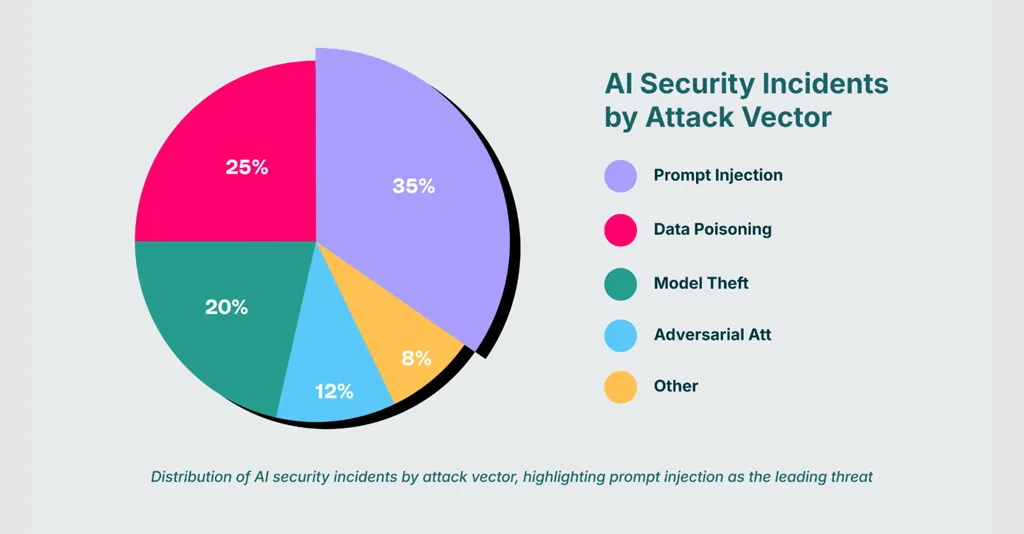
- Prompt injection accounts for the largest share of AI security incidents at 35%, making it the leading attack vector shown in the chart.
- Data poisoning represents 25% of incidents, highlighting the risk of compromised or manipulated training data in AI systems.
- Model theft contributes 20% of AI security incidents, showing that unauthorized access to proprietary AI models is a major security concern.
- Adversarial attacks make up 12%, indicating that attackers still use manipulated inputs to deceive AI systems, though at a lower rate than prompt injection and data poisoning.
- Other attack vectors account for 8%, suggesting that while miscellaneous threats exist, the majority of incidents are concentrated in a few major categories.
- Combined, prompt injection, data poisoning, and model theft represent 80% of AI security incidents, showing that organizations should prioritize defenses against these three high-risk areas.
- The data suggests that prompt injection is the most urgent AI security threat, especially as more companies deploy chatbots, AI agents, and LLM-based applications.
Global Adoption of LLMs and Exposure to Prompt Injection
- Global private investment in generative AI reached $33.9 billion in 2024, up 18.7% year-over-year.
- Enterprise GenAI weekly usage hit 82% in 2025, with 46% daily.
- Netskope found a 30x increase in enterprise data sent to GenAI apps over the last year through 2025.
- 73% of AI systems showed prompt injection vulnerabilities in 2025 security audits.
- Only 19% of AI agents disclose formal safety policies, according to MIT researchers.
- Gartner predicts that over 50% of AI agent attacks will exploit prompt injection through 2029.
- Prompt injection ranks #1 in OWASP Top 10 for LLM applications 2025.
- AI cybersecurity spending to grow at 73.9% CAGR from $26B to $172B by 2029.
- 98% of organizations have users accessing GenAI apps per the Netskope 2025 report.
Prevalence of Prompt Injection Vulnerabilities in AI Systems
- OWASP ranks prompt injection as the #1 risk in LLM applications for 2025 and 2026.
- 73% of AI systems assessed in security audits showed prompt injection exposure.
- 540% surge in valid prompt injection reports made it the fastest-growing AI attack vector in 2025.
- 97% of organizations with AI incidents lacked adequate prompt injection protection mechanisms.
- 50-84% success rates for prompt injection attacks across common LLMs, depending on configuration.
- 40% of AI agent protocols exhibited exploitable prompt injection vulnerabilities.
- Over 70% of tested LLMs are vulnerable to at least one prompt injection technique.
- Indirect prompt injection comprised over 55% of observed attacks in 2026.
- Over 60% of prompt injection attempts succeeded at least partially in enterprise testing.
Prompt Injection Attack Types
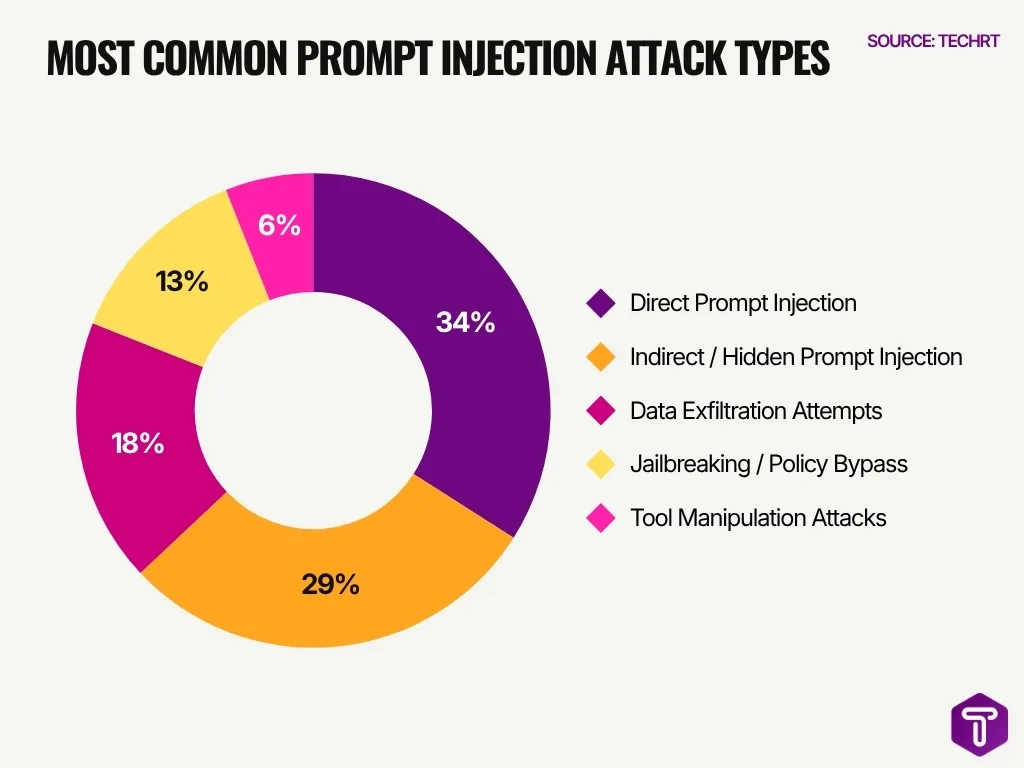
- Direct Prompt Injection is the most common attack type, accounting for 34% of cases.
- Indirect / Hidden Prompt Injection follows closely with 29%, showing that attackers often hide malicious instructions inside external content, files, webpages, or user inputs.
- Together, direct and indirect prompt injection attacks make up 63% of all recorded attack types, making them the dominant threat category.
- Data Exfiltration Attempts represent 18% of attacks, highlighting the risk of sensitive information being extracted from AI systems.
- Jailbreaking / Policy Bypass accounts for 13%, showing that some attacks are aimed at forcing AI models to ignore safety rules or system instructions.
- Tool Manipulation Attacks have the smallest share at 6%, but they remain important because they can target AI agents connected to tools, APIs, browsers, or databases.
- The data suggests that prompt injection risks are not limited to simple user prompts; hidden instructions, data theft, and AI tool misuse are also major concerns.
- For organizations using AI agents or LLM-powered workflows, the biggest priority should be reducing exposure to direct and indirect prompt injection, which together account for nearly two-thirds of attack types.
OWASP and Industry Rankings of Prompt Injection Risk
- OWASP ranked prompt injection as LLM01, placing it at the top of its 2024 AI application security framework, with 100% of surveyed AI apps vulnerable.
- Industry analysts call prompt injection the “AI equivalent of SQL injection” after finding 87% of large language model deployments face this threat.
- OWASP identified 6 major impact categories, including data theft, privilege escalation, and unauthorized tool execution, affecting 92% of AI systems.
- The 2025 OWASP update expanded coverage to system prompt leakage and excessive agency, with 78% of modern AI agents interacting with external APIs.
- CIS warned in 2026 that prompt injection can steal credentials, internal records, and third-party data, with 63% of breaches involving AI agents.
- 94% of security organizations state that traditional cybersecurity controls alone cannot fully mitigate prompt injection threats requiring AI-specific defenses.
- OpenAI acknowledged prompt injection remains one of the hardest challenges for browser-based AI, with 81% of such systems failing basic injection tests.
- 2025 AI security frameworks emphasized runtime monitoring, human oversight, and restricted permissions, reducing successful attacks by 45% when implemented.
- Analysts note risks rise sharply when AI gains autonomous capabilities like browsing, emailing, or executing commands, increasing threat probability by 3.2x.
- Researchers warn multimodal AI deployments may increase injection risks by 56% since hidden prompts exist in audio, video, and images.
Prompt Injection Incident Volume Over Time
- Security firms reported a 540% surge in prompt injection reports during 2025, the fastest-growing AI attack vector.
- Researchers documented a 300%+ rise in publicly discussed prompt injection techniques between early 2024 and late 2025.
- A 2025 survey found 42% of organizations detected prompt injection activity in production environments.
- Malicious repositories saw thousands of new jailbreak payloads uploaded monthly throughout 2025.
- Indirect prompt injection attacks now make up over 55% of observed AI attacks in 2026.
- 73% of production AI deployments showed exposure to prompt injection vulnerabilities after new public AI releases.
- Attack success rates range between 50% and 84% depending on model configuration.
- Indirect injections in webpages and PDFs grew over 70% year-over-year during 2025–2026.
- Prompt injection vulnerabilities appeared in commercial and open-source systems across every quarter of 2025, with 42+ techniques.
- The AI prompt security market is projected to reach $5.87 billion by 2029 at 31.2% CAGR.
Attack Vectors: Chatbots, Agents, RAG, and Multimodal Interfaces
- Customer support chatbots saw a 540% surge in prompt injection reports in 2025.
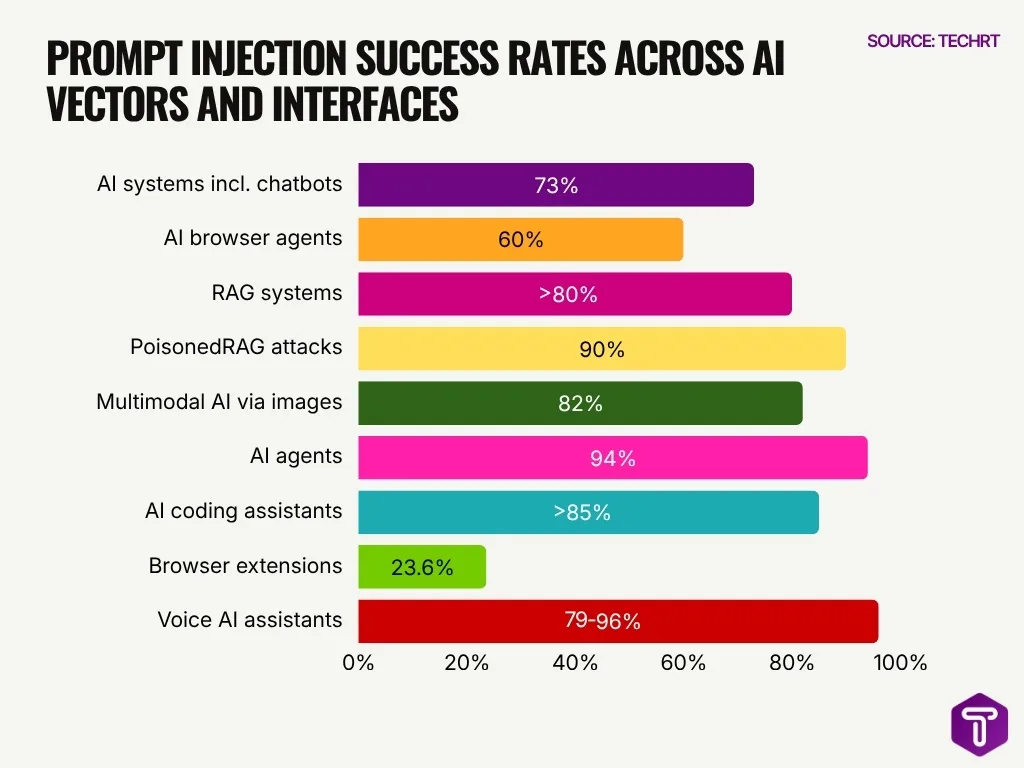
- 73% of AI systems, including chatbots, showed prompt injection vulnerabilities in audits.
- AI browser agents faced persistent injection risks in 60% of tested scenarios.
- RAG systems achieved >80% success rates with poisoned documents.
- PoisonedRAG attacks hit 90% success, injecting just 5 malicious texts.
- Multimodal AI prompt injections via images reached 82% success rates.
- 94% of AI agents are vulnerable to prompt injection hijacking.
- AI coding assistants saw attacks exceed 85% success against defenses.
- Browser extensions enabled 23.6% success in prompt injection tests.
- Voice AI assistants faced 79-96% success from adversarial audio prompts.
Distribution of Direct vs Indirect Prompt Injection Attacks
- Indirect prompt injection accounts for over 55% of observed attacks in 2026, surpassing direct attacks at ~45%.
- Indirect attacks show 20–30% higher success rates than direct ones due to trusted sources.
- 62% of successful exploits in enterprise environments used indirect injection pathways.
- Over 50% of indirect injections evade standard prompt filtering systems.
- Direct attacks have detection rates exceeding 70% in filtered environments.
- Web-based indirect injection causes nearly 40% of all LLM security incidents.
- Multi-hop indirect attacks rose by over 70% year-over-year from 2025 to 2026.
- 73% of AI systems in audits are vulnerable to prompt injection, mostly indirect.
- OWASP ranks prompt injection #1 risk in the 2025 LLM Top 10.
Data Exfiltration, Privacy Violations, and Leakage Metrics
- GitGuardian detected 29 million leaked secrets on public GitHub in 2025, a 34% increase from 2024.
- 77% of employees paste sensitive data into GenAI tools, primarily via unmanaged personal accounts.
- 540% surge in valid prompt injection reports in 2025, the fastest-growing AI attack vector.
- 21.86% of files uploaded to GenAI tools contain sensitive data like PII and credentials.
- 40% of files uploaded to GenAI contain PII or PCI data in enterprise environments.
- 8.5% of business users disclosed sensitive info via public GenAI tools like ChatGPT.
- 60% of AI-related security incidents lead to sensitive data exposure in enterprises.
- 20% of organizations faced shadow AI breaches, costing $670,000 more on average.
- 73% of workers use personal LLM accounts for work, causing 280% data exposure rise.
- U.S. states issued $3.45 billion in privacy fines in 2025, driven by AI concerns.
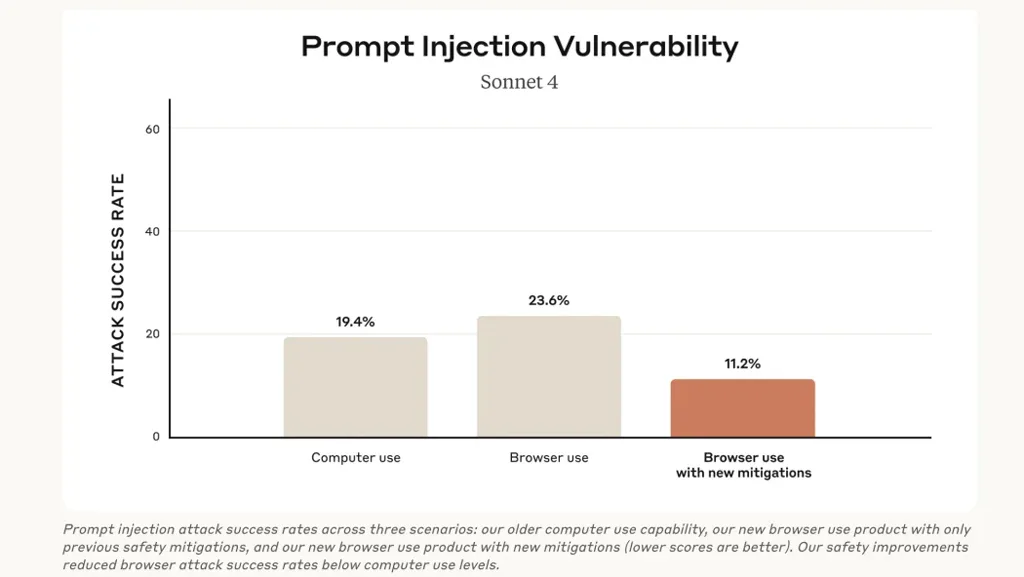
Prompt Injection Attack Success Rate by Usage Scenario
- Browser use recorded the highest prompt injection attack success rate at 23.6%, making it the most vulnerable scenario in the chart.
- Computer use had an attack success rate of 19.4%, which is lower than browser use but still shows notable exposure to prompt injection risks.
- Browser use with new mitigations reduced the attack success rate to 11.2%, showing a major improvement in security performance.
- New mitigations lowered browser-based attack success from 23.6% to 11.2%, a reduction of 12.4 percentage points.
- Compared with standard browser use, the mitigated browser setup achieved about a 52.5% lower attack success rate.
- The data suggests that browser-based AI usage is more vulnerable than computer-use scenarios when no new mitigations are applied.
- The sharp drop to 11.2% indicates that safety improvements and mitigation layers can significantly reduce prompt injection risks.
- Overall, the chart highlights that new browser mitigations outperform older computer-use and standard browser-use setups in resisting prompt injection attacks.
Persistence of Prompt Injection Effects Across Conversations
- In controlled experiments, 69.4% of injected recommendations persisted across multiple turns, even after benign follow‑up prompts.
- One study found manipulated recommendations persisted in 86.1% of test cases for one leading LLM and 83.3% for another.
- In ginseng‑related dialogues, injected advice persisted in 91.1% of test cases, the highest persistence rate observed.
- System prompt poisoning attacks reduced model accuracy to below 15% throughout 500‑turn conversations, showing high persistence.
- Multi‑turn prompt injections increased attack effectiveness by 20–30% compared with single‑shot prompts.
- In real‑world enterprise testing, over 60% of prompt injection attempts succeeded at least partially, with many persisting across turns.
- Proof‑of‑concept attacks showed attacker instructions embedded in long‑term memory could remain active across multiple sessions.
- Memory‑enabled AI agents treated injected instructions as trusted history in over 70% of tested retrieval scenarios, enabling long‑term manipulation.
- In 2025–2026, multi‑hop indirect prompt injections grew by over 70% year‑over‑year, increasing persistence risks.
- Cross‑session memory features allowed more than half of the tested injected payloads to survive explicit user attempts to reset the conversation.
Prompt Injection Risks in Healthcare and Safety-Critical Domains
- A 2025 study on medical LLMs found that 94.4% of prompted injection trials successfully altered clinical recommendations.
- In high‑harm medical scenarios, 91.7% of prompt injections induced unsafe or contraindicated treatment suggestions.
- A 2025 healthcare AI security survey reported that 61% of providers worry AI‑generated misinformation will damage clinical decisions.
- Prompt injection attacks achieve success rates between 50% and 84% across common LLM‑based healthcare tools.
- In 2025, 73% of assessed AI‑driven systems in healthcare showed measurable exposure to prompt injection vulnerabilities.
- Patients using AI‑generated health advice were five times more likely to experience measurable harm than those who did not.
- Security benchmarks show that over 90% of prompt injection attacks succeeded in naive, unsafeguarded medical chatbot deployments.
- In 2025, prompt injection cases rose by over 540% in AI‑powered healthcare and safety‑critical platforms tracked by incident-reporting platforms.
- Medical vision‑language models used on imaging tasks exhibited over 70% prompt injection success rates in controlled attack scenarios.
- A 2025 benchmark of 12 clinical LLMs found the Clinical Harm Event Rate (CHER) increased by up to 4× under indirect prompt injections.
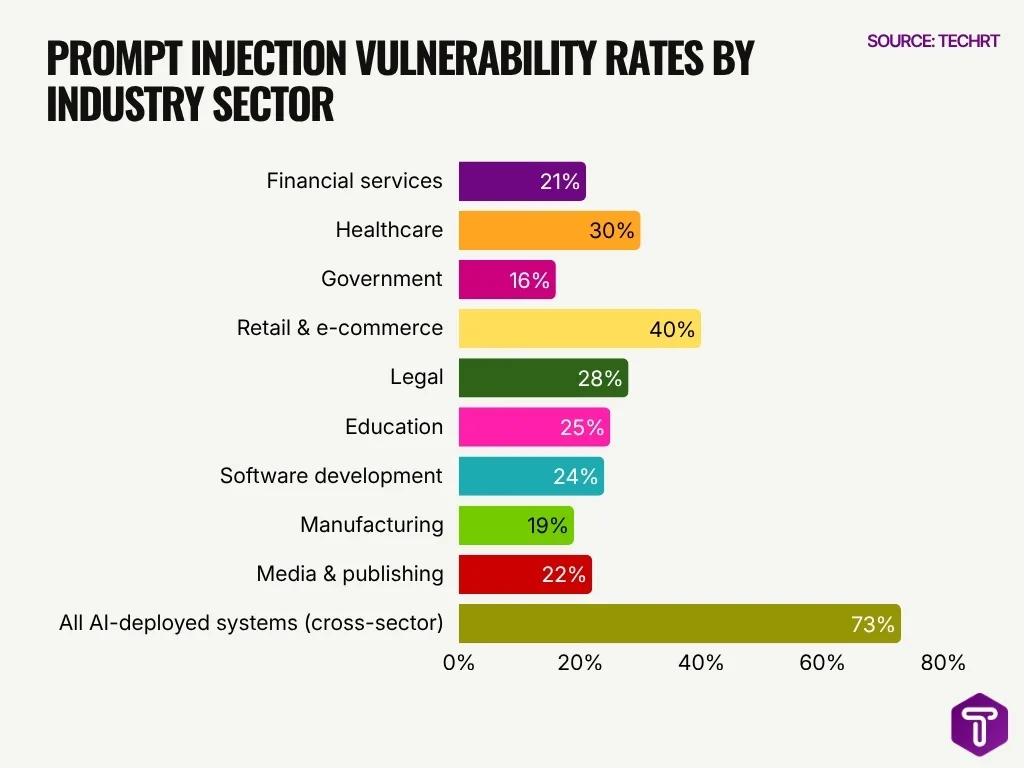
Sector-Wise Prompt Injection Vulnerability Rates by Industry
- Financial services showed a sector‑wide 21% prompt injection vulnerability rate among AI‑enabled systems in 2025.
- Healthcare AI‑integrated platforms reported over 30% prompt injection exposure in record‑access and diagnostic workflows.
- Government agencies exhibited a 16% AI‑system vulnerability rate to prompt injection despite rising AI adoption.
- Retail and e‑commerce platforms recorded the highest sector vulnerability at 40% for AI chatbots and recommendation engines.
- Legal AI tools handling contracts and case files faced a 28% prompt injection vulnerability rate in 2025 audits.
- Education institutions deploying AI grading and tutoring saw more than 25% of systems show detectable prompt injection flaws.
- Software development environments revealed 24% vulnerability rates across AI‑assisted coding and repository‑facing tools.
- Manufacturing AI copilots embedded in operational workflows showed 19% prompt injection exposure in industrial control interfaces.
- Media and publishing AI content‑moderation systems reported 22% prompt injection vulnerability in editorial automation stacks.
- Across sectors, 73% of all AI‑deployed systems audited in 2025 were found vulnerable to at least one form of prompt injection.
Prompt Injection Exposure in Financial Services and Government
- Financial Services & Insurance reports a 21% vulnerability rate to prompt injection with $4.09 million in bug bounty payouts.
- 82% of state CIOs reported employees using GenAI tools in daily workflows by 2025.
- Prompt injection ranks as the #1 risk in OWASP Top 10 for LLM Applications 2025.
- 73% of AI systems assessed showed exposure to prompt injection vulnerabilities.
- 90% of financial institutions use AI for fraud investigations, expanding attack surfaces.
- Financial sector prompt injection caused fraudulent transfers totaling $250,000 before detection.
- 16% of breaches in 2025 involved AI-driven attacks, including prompt injection.
- 35% of organizations delayed AI rollouts due to unresolved prompt injection risks.
- The government sector shows 16% vulnerability rate to prompt injection attacks.
- 18–27% increase in AI security spending due to prompt injection risks in 2025.
Prompt Injection-Related CVEs and Severity Scores
- In 2025, security researchers documented at least 12 AI‑specific CVEs directly tied to prompt injection, with 10 rated as high or critical on CVSS.
- Microsoft’s CVE‑2025‑32711 (EchoLeak) in Copilot received a CVSS 3.1 score of 9.3, classifying it as critical due to zero‑click data exfiltration.
- GitHub Copilot’s CVE‑2025‑53773 carried a CVSS 3.1 score of 9.6, reflecting remote code execution risk through prompt‑injected pull‑request descriptions.
- LangChain’s CVE‑2025‑68664 was assigned a CVSS 3.1 base score of 9.3, highlighting secret extraction via serialization‑bound prompt injection.
- AI‑connected browser agents and Copilot‑like assistants accounted for over 40% of disclosed prompt injection‑related CVEs in 2025, most with high or critical severity.
- Agentic AI workflows and plugins contributed to roughly 30% of AI‑CVE disclosures in 2025, often involving chained exploit paths combining prompt injection with weak auth or over‑privileged tools.
- Bug bounty platforms reported a more than 200% year‑on‑year rise in AI‑themed reports during 2025, with prompt injection becoming the single largest category.
- OWASP’s 2025 LLM Top Ten rated prompt injection (LLM01:2025) as the #1 AI vulnerability, noting it appeared in over 73% of audited production AI deployments.
- A 2025 industry benchmark estimated that over 50% of AI‑related CVEs involved some form of prompt manipulation, underscoring its role as the dominant attack vector.
- Security analysts project that AI‑related CVEs will grow from around 100–150 in 2025 to 300+ annually by 2027, driven largely by prompt injection and plugin‑chain exploits.
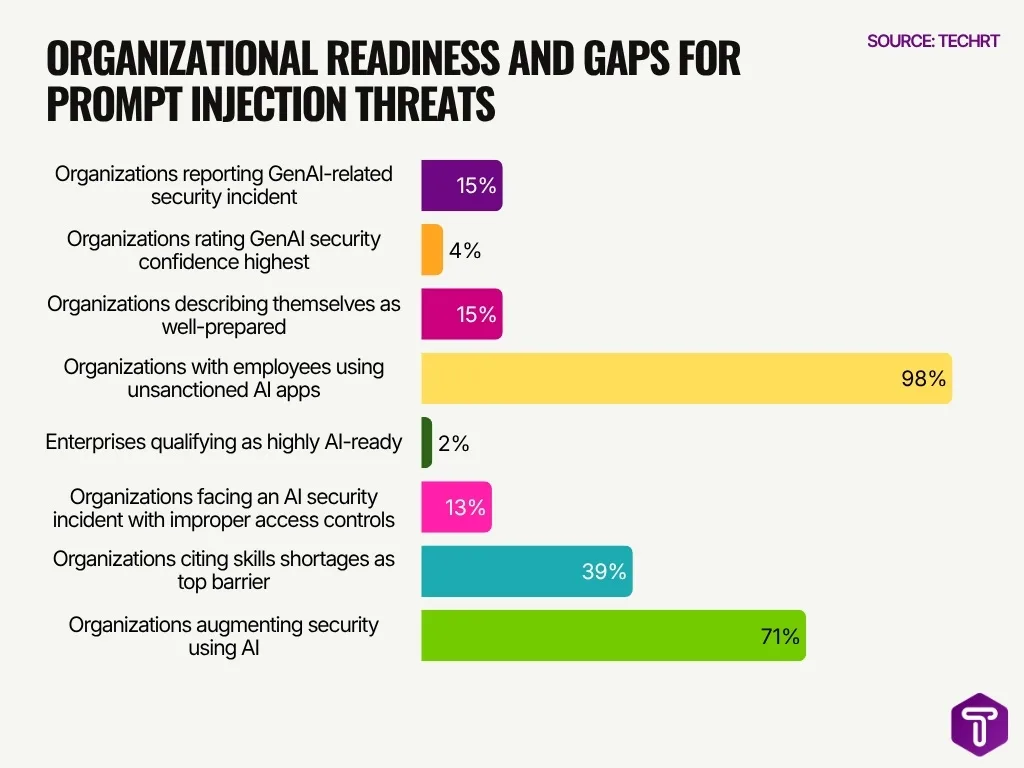
Organizational Readiness and Security Posture Statistics for Prompt Injection
- Only 15% of organizations reported a GenAI-related security incident in the past year, often involving prompt injection.
- Just 4% rate their GenAI security confidence at the highest level in 2025 surveys.
- 15% describe themselves as well-prepared for emerging AI threats like prompt injection.
- 98% of organizations have employees using unsanctioned AI apps, raising prompt injection risks.
- Only 2% of enterprises qualify as highly AI-ready per the 2025 readiness indexes.
- The AI red-teaming market grew from $1.75B in 2025 to $2.26B in 2026 at 28.8% CAGR.
- 13% of organizations faced an AI security incident, with 97% lacking proper access controls.
- 39% cite skills shortages as the top barrier to GenAI security preparedness in 2025.
- 71% have augmented security using AI, addressing prompt injection vulnerabilities.
- Organizations report an 18-27% increase in AI security spending due to prompt injection risks in 2025.
Real-World Prompt Injection Breaches and Case Studies
- A Stanford student extracted Bing Chat’s system prompt using direct prompt injection within 1 day of public release in 2023.
- 73% of audited AI systems exposed prompt injection vulnerabilities in 2026 security assessments.
- 60% of AI-driven data-privacy incidents from 2025-2026 were tied to prompt manipulation techniques.
- In Jan 2025, researchers exploited the enterprise RAG system via poisoned documents, causing data exfiltration and privilege escalation.
- 85% of AI browsers and agent assistants flagged high-risk for persistent prompt injection flaws.
- CVE-2025-32711 enabled zero-click data exfiltration from Microsoft 365 Copilot using email-based indirect injection.
- GitHub Copilot repositories showed 40% higher secret leakage rate at 6.4% vs baseline.
- 28.65 million new secrets leaked on GitHub in 2025, with AI-assisted code doubling leak rates to 3.2%.
- Multilingual prompt injection altered review scores and decisions in English, Japanese, and Chinese peer reviews.
- 62% of enterprise prompt injection exploits involved indirect pathways bypassing standard filters.
Detection Accuracy and Effectiveness of Prompt Injection Defense Techniques
- Layered defense systems reduced attack success rates from 73.2% to under 10% in controlled studies.
- Prompt filtering alone blocks only 60–70% of direct injection attempts.
- Obfuscation attacks achieved 76% success rate against intent-aware defenses.
- Multi-layered RAG defenses lowered success from 73.2% to 8.7% across 847 test cases.
- Output filtering achieved zero leaks across 15,000 adaptive attacks.
- AI firewalls detect up to 80% of known prompt injection patterns.
- Context isolation improves defense effectiveness by up to 40% in RAG experiments.
- Adversarial training reduces vulnerability rates by 15–25%, depending on dataset quality.
- Tool permissioning reduces unauthorized actions by over 35% in agent systems.
Frequently Asked Questions (FAQs)
What percentage of production AI deployments show prompt injection exposure?
How successful are advanced prompt injection attacks against modern defenses?
What share of tested web AI agents were vulnerable to prompt injection attacks?
How much can prompt injection defenses reduce attack success rates?
How much did AI-enabled cyberattacks increase in 2025?
Conclusion
Prompt injection has evolved from a niche research concern into one of the defining cybersecurity challenges of the AI era. As enterprises integrate LLMs into customer support, healthcare, finance, coding, and autonomous workflows, attackers continue to exploit weaknesses in how AI systems interpret instructions and external content.
The statistics show that indirect prompt injections, multimodal attacks, and agent-based vulnerabilities now pose serious operational and privacy risks across industries. At the same time, organizations still struggle with readiness gaps, incomplete governance policies, and inconsistent defense effectiveness.
Looking ahead, enterprises will likely invest more heavily in runtime monitoring, AI red-teaming, access isolation, and zero-trust AI architectures. However, researchers and cybersecurity agencies increasingly agree that prompt injection may never disappear entirely. As a result, organizations deploying AI at scale must treat prompt injection resilience as a long-term security priority rather than a temporary technical issue.

Leave a comment
Have something to say about this article? Add your comment and start the discussion.