




Multimodal AI combines text, images, audio, and video into a single system, enabling smarter and more context-aware decision-making across industries. Unlike traditional AI models that rely on a single data type, multimodal systems process multiple inputs simultaneously, delivering deeper insights and more accurate outcomes. This capability is already transforming clinical diagnostics in healthcare, where AI analyzes medical images alongside patient records, and personalized product recommendations in e-commerce, where systems blend browsing behavior, visual preferences, and purchase history.
As organizations look to unify data and streamline operations, multimodal AI is quickly becoming a core driver of automation, analytics, and user experience innovation, making it essential to understand the statistics behind its rapid growth.
Editor’s Choice
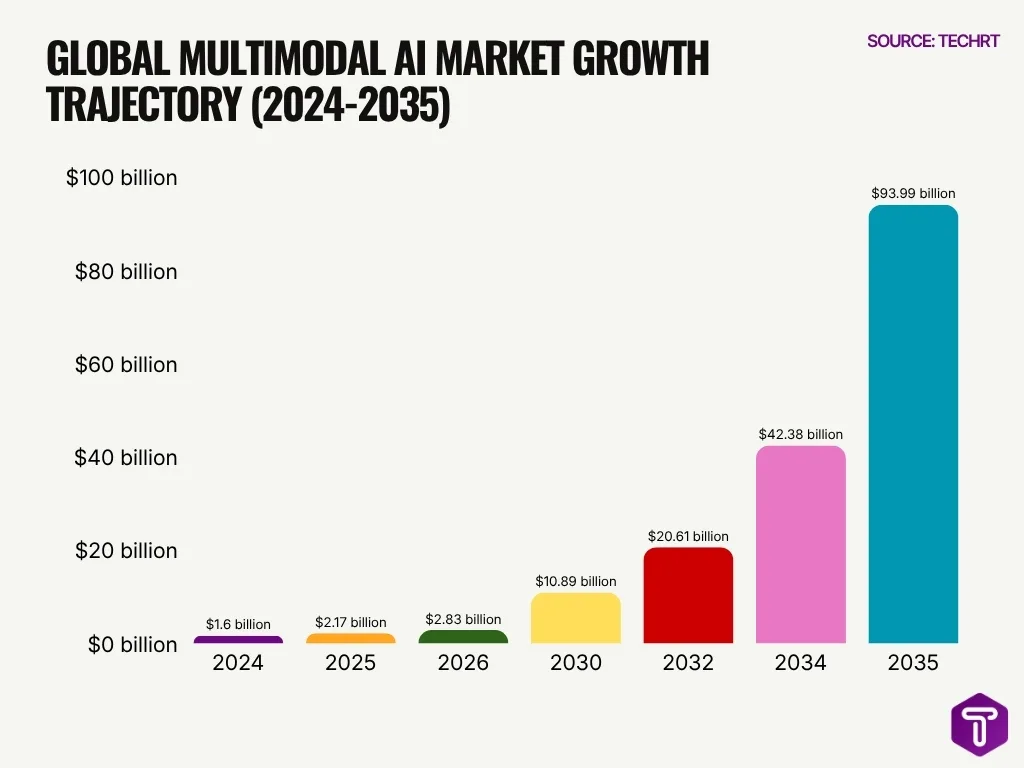
- The global multimodal AI market reached $2.83 billion in 2026, up from $2.17 billion in 2025.
- Market projections estimate growth to $10.89 billion by 2030, reflecting strong enterprise demand.
- Another forecast shows the market hitting $42.38 billion by 2034, with a CAGR of 36.9%.
- In 2026 alone, the market size is expected to reach $3.85 billion, up from $2.99 billion in 2025.
- Generative multimodal AI accounted for $740.1 million in 2024, highlighting its rapid adoption.
- Enterprises contribute roughly 65% of multimodal AI revenue, dominating adoption trends.
- The broader AI market is projected to exceed $4.2 trillion by 2030, with multimodal systems playing a key role.
Recent Developments
- Multimodal AI funding continues to surge, with a single startup raising $900 million to advance AGI capabilities.
- Global private investment in AI reached $33.9 billion in 2024, signaling strong momentum for advanced models.
- Enterprises increasingly demand unified AI platforms that combine text, vision, and audio processing.
- Multimodal AI systems now integrate IoT and edge computing, enabling real-time decision-making.
- Healthcare research shows multimodal AI improves predictive accuracy by over 6 percentage points in AUC compared to unimodal models.
- Companies are increasing content budgets by 43% to support AI-generated multimodal content.
- Multimodal AI is becoming a baseline expectation in enterprise AI platforms rather than a premium feature.
- Advanced transformer and diffusion models are accelerating adoption across industries.
Global Multimodal AI Market Size and Growth Statistics
- The global market was valued at $1.6 billion in 2024.
- It is expected to grow at a CAGR of 32.7% through 2034.
- Another estimate places the 2025 market size at $2.51 billion.
- The market is projected to reach $3.43 billion in 2026.
- By 2030, the market could hit $10.89 billion.
- Long-term projections estimate $93.99 billion by 2035.
- Another forecast suggests $20.61 billion by 2032.
- The market grew from $2.17B (2025) to $2.83B (2026), reflecting rapid annual expansion.
- CAGR estimates range between 30.6% and 39.8%, depending on methodology.
Regional Multimodal AI Market Breakdown and CAGR by Geography
- The U.S. market generated $746.8 million in 2024.
- It is expected to reach $4.07 billion by 2030, growing at 33.6% CAGR.
- The U.S. accounted for 43% of global multimodal AI revenue in 2024.
- North America is projected to reach $11.7 billion by 2034.
- Asia-Pacific is the fastest-growing region, driven by enterprise adoption.
- India’s market was $67.1 million in 2024 and will reach $538.5 million by 2030.
- India is expected to grow at a 42.5% CAGR, among the highest globally.
- The Middle East is investing heavily, including a $40 billion AI fund in Saudi Arabia.
- Latin American markets like Brazil and Mexico show steady growth tied to industrial AI adoption.
Multimodal AI Revenue by Component (Software vs Services)
- Software accounted for the largest revenue share in 2024 globally.
- Services are the fastest-growing segment due to enterprise demand.
- The generative multimodal segment alone reached $740.1 million in 2024.
- Explanatory multimodal AI accounted for $109.8 million in 2024.
- Computer vision-based multimodal AI generated $310 million in 2024.
- Enterprise software tools dominate due to integration with analytics and automation workflows.
- Cloud-based AI services are driving recurring revenue growth across vendors.
- Services segment growth is fueled by consulting, integration, and training needs.
Multimodal AI by Technology Type
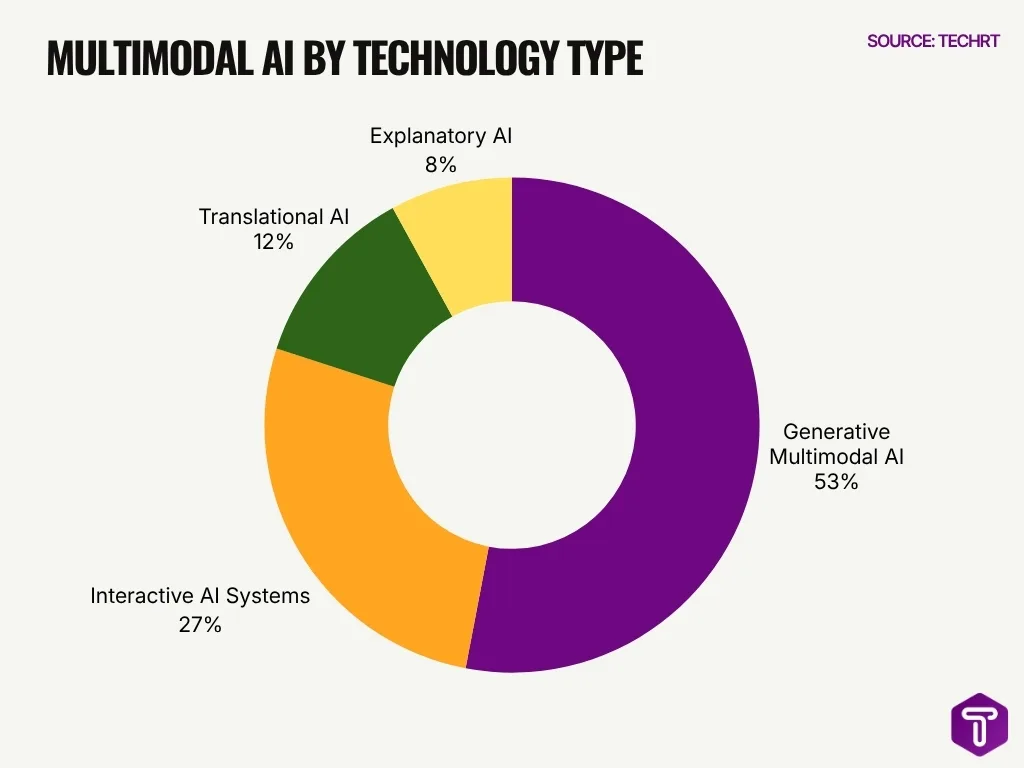
- Generative Multimodal AI dominates the market with a 53% share, indicating strong demand for content creation, synthesis, and advanced AI-generated outputs.
- Interactive AI Systems account for 27%, highlighting significant adoption in chatbots, virtual assistants, and real-time user interaction platforms.
- Translational AI holds 12%, reflecting its growing role in cross-modal translation such as text-to-image, speech-to-text, and multilingual AI applications.
- Explanatory AI represents 8%, showing a smaller but critical segment focused on AI transparency, interpretability, and decision explainability.
- The top two segments (Generative + Interactive) together contribute a dominant 80% share, underscoring a market heavily driven by user-facing and creative AI applications.
- Lower shares of Translational (12%) and Explanatory AI (8%) suggest these areas are still emerging but are essential for future scalability and trust in AI systems.
Multimodal AI Adoption by Deployment Model (Cloud vs On-Premises)
- Cloud‑hosted multimodal AI accounts for roughly 57% of the market share, while on‑premises deployments hold about 40%.
- Around 75% of enterprises are projected to adopt hybrid AI models by 2027 to optimize workload placement across cloud and on‑premises.
- Cloud deployment dominates multimodal AI for early pilots, with over 70% of new enterprise AI projects initially launched in the public cloud.
- Edge‑based multimodal AI deployments are forecast to grow at a CAGR of 21–22% through 2030–2033, driven by real‑time IoT and industrial use cases.
- Nearly 48% of enterprises are expected to deploy multimodal large language models (MLLMs) via cloud platforms by 2025 for customer‑facing workloads.
- SaaS‑based multimodal AI platforms are seeing over 30% year‑on‑year growth in SME adoption, primarily due to lower entry costs and plug‑and‑play integrations.
- Regulated industries such as healthcare and finance still allocate about 30–35% of their multimodal AI workloads to on‑premises environments for compliance and data control.
- Multimodal AI revenue from healthcare alone represented approximately 17% of total market revenue in 2025, with a majority delivered via cloud‑native architectures.
- Hybrid multimodal AI deployments are used by roughly 68% of U.S. firms running AI in production, combining cloud elasticity with on‑premises data‑residency safeguards.
- Cloud‑based multimodal AI spending is projected to contribute to a trillion‑dollar AI market by 2030, with cloud infrastructure capturing over two‑thirds of total deployment value.
Enterprise Adoption of Multimodal AI by Organization Size
- Large enterprises account for over 68% of multimodal AI deployments due to higher data volumes and infrastructure readiness.
- Around 72% of Fortune 500 companies reported piloting or deploying multimodal AI in 2025, up from 58% in 2024.
- Small and mid-sized businesses’ adoption grew by 27% year-over-year in 2025, driven by SaaS platforms.
- Nearly 61% of enterprises use multimodal AI for cross-channel data analysis.
- About 49% of mid-sized firms cite cost reduction as the primary driver for adoption.
- Enterprises with over 10,000 employees are 2.3x more likely to deploy multimodal AI at scale.
- Around 38% of SMBs use multimodal AI for customer support automation.
- Organizations investing over $5M annually in AI are 3x more likely to adopt multimodal capabilities.
- Startups leveraging multimodal AI reported 30% faster product iteration cycles compared to traditional AI users.
Adoption of Multimodal AI Across Key Industries
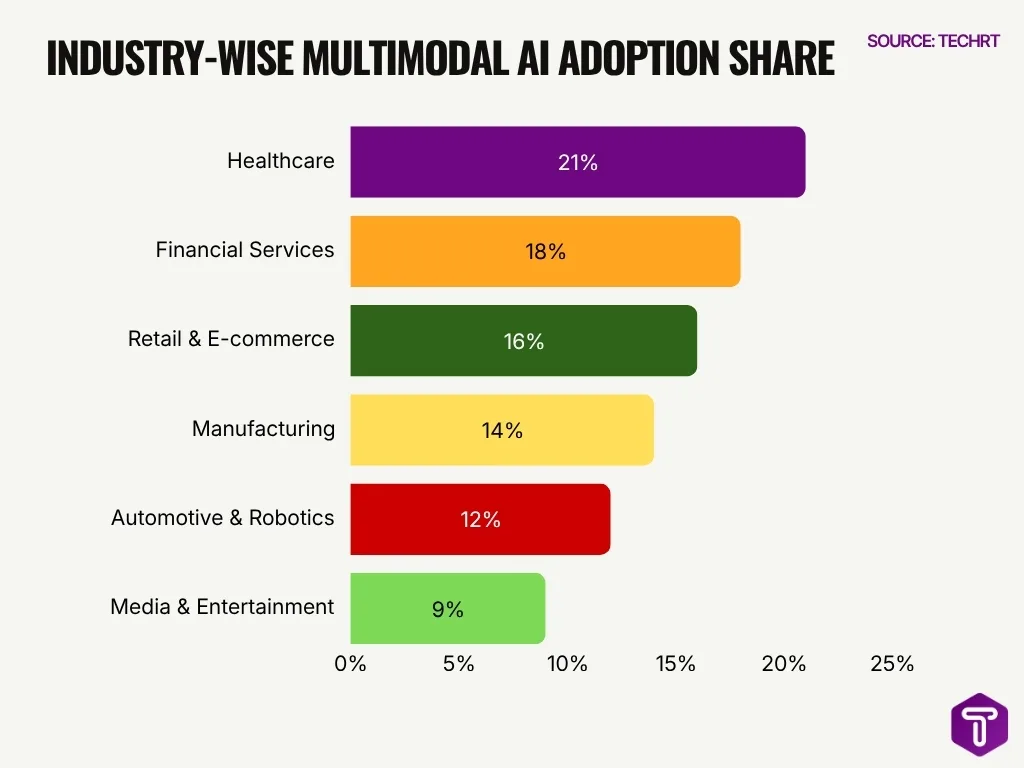
- The healthcare sector leads with 21% of total multimodal AI adoption share globally.
- Financial services account for 18% of enterprise deployments, driven by fraud detection.
- Retail and e-commerce contribute 16% of adoption, mainly for personalization.
- Manufacturing represents 14% of multimodal AI use cases, especially in quality control.
- Automotive and robotics sectors account for 12% of deployments, largely in autonomous systems.
- Media and entertainment industries show 9% adoption, focusing on content generation.
- Education technology adoption increased by 34% in 2025, using multimodal AI for adaptive learning.
- Government sector adoption grew by 22% year-over-year, especially in surveillance and analytics.
- Logistics and supply chain industries saw a 19% increase in adoption, improving route optimization.
Usage of Multimodal AI in Healthcare and Life Sciences
- Multimodal AI improves diagnostic accuracy by up to 20% compared to traditional methods.
- Hospitals using multimodal AI reported 15% faster diagnosis times.
- Around 48% of healthcare providers adopted AI tools integrating imaging and patient data by 2025.
- Clinical trials using multimodal AI reduced recruitment time by 30%.
- AI-powered radiology systems increased detection rates of early-stage diseases by 12%.
- Drug discovery timelines shortened by up to 40% using multimodal datasets.
- About 36% of life sciences firms use multimodal AI for genomics and imaging analysis.
- AI-driven patient monitoring systems reduced hospital readmission rates by 18%.
- Multimodal AI in pathology increased classification accuracy by over 10 percentage points.
Usage of Multimodal AI in Finance, Banking, and Insurance
- Banks using multimodal AI reduced fraud losses by 25% on average.
- Financial institutions saw a 35% improvement in risk assessment accuracy.
- Around 52% of banks deployed multimodal AI systems by 2025.
- Insurance firms reduced claims processing time by 40% using multimodal AI.
- Customer service chatbots using multimodal AI improved resolution rates by 28%.
- Multimodal AI-based credit scoring improved prediction accuracy by 15%.
- Fraud detection systems integrating video and transaction data reduced false positives by 22%.
- About 41% of fintech startups use multimodal AI for customer onboarding.
- Regulatory compliance automation improved efficiency by 30% in banks.
Usage of Multimodal AI in Retail and E-commerce
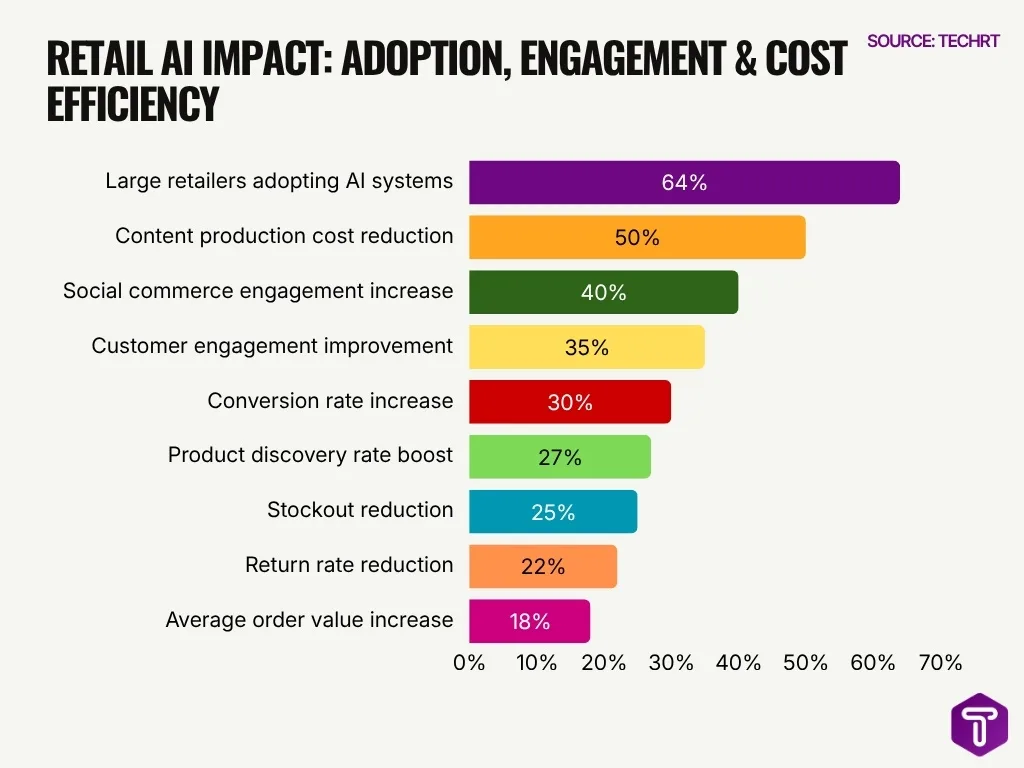
- Retailers using multimodal AI saw up to 30% increase in conversion rates.
- Personalized recommendations powered by multimodal AI increased average order value by 18%.
- Around 64% of large retailers adopted AI systems integrating text and image data.
- Visual search tools boosted product discovery rates by 27%.
- Retailers reported a 22% reduction in return rates using AI-driven sizing and recommendations.
- Chat-based shopping assistants improved customer engagement by 35%.
- Multimodal AI in inventory management reduced stockouts by 25%.
- Social commerce platforms using AI saw 40% higher engagement rates.
- AI-generated product descriptions reduced content production costs by 50%.
Usage of Multimodal AI in Manufacturing and Industrial Automation
- Manufacturers using multimodal AI systems improved overall production efficiency by up to 20%.
- Predictive maintenance powered by AI algorithms reduced unplanned downtime by 20–50%.
- Advanced computer vision systems achieved up to 98–99% accuracy in defect detection.
- Roughly 45% of large manufacturers had deployed AI in at least one automation function by 2023.
- AI-driven cost optimization engines helped manufacturers lower operational costs by up to 30%.
- Production-ready predictive AI systems delivered a 95% positive ROI for industrial applications.
- Factories utilizing AI-optimized robotic automation lines achieved a 22% increase in throughput.
- Sensor fusion applications for industrial automation represented 12% of total multimodal AI use cases.
- Multimodal AI platforms combining NLP and computer vision increased engagement rates by 25% over single-modality solutions.
Usage of Multimodal AI in Autonomous Vehicles and Robotics
- Autonomous vehicles using multimodal AI reduced accident rates by up to 40% in controlled environments.
- Sensor fusion systems improved object detection accuracy by 30%.
- Around 70% of AV systems rely on multimodal AI combining LiDAR, cameras, and radar.
- Robotics companies reported 25% faster decision-making using multimodal models.
- Industrial robots with multimodal AI achieved 20% higher productivity.
- Autonomous delivery systems improved route efficiency by 28%.
- Drone navigation accuracy improved by 32% using multimodal AI.
- AI-powered robotics reduced operational errors by 18%.
- Investment in autonomous AI systems grew by 26% year-over-year in 2025.
Multimodal vs Unimodal AI Adoption Insights
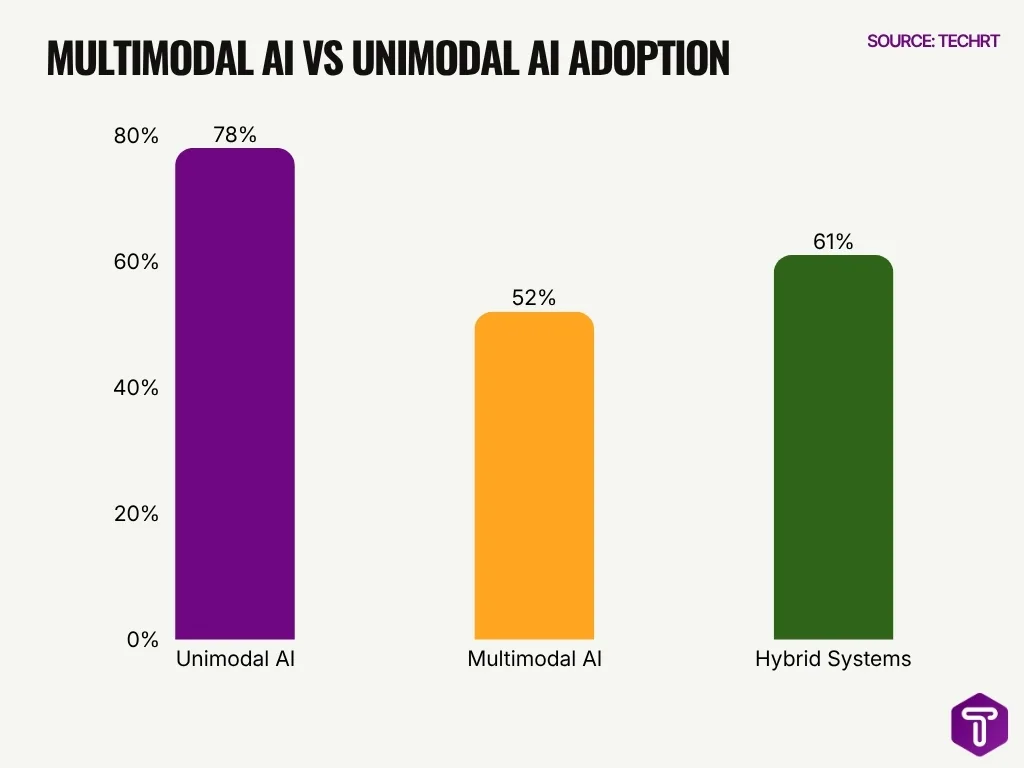
- Unimodal AI dominates adoption with a strong 78%, making it the most widely used AI approach across industries.
- Hybrid systems show significant traction at 61% adoption, indicating a growing shift toward combining multiple AI capabilities.
- Multimodal AI adoption stands at 52%, highlighting that while emerging, it is still in the growth phase compared to traditional systems.
- The 26 percentage point gap between Unimodal (78%) and Multimodal (52%) reflects a slower enterprise transition to more complex AI models.
- Hybrid AI systems outperform pure Multimodal AI by 9 percentage points (61% vs 52%), suggesting organizations prefer incremental integration strategies.
- Over half of organizations (52%+) have already adopted Multimodal AI, signaling a strong future growth trajectory.
- The data indicates a clear trend toward diversification, with businesses gradually moving from single-mode AI to hybrid and multimodal approaches.
Performance of Multimodal AI Models vs Unimodal Models
- Multimodal models improve overall prediction accuracy by 10–20% compared to unimodal systems across benchmark datasets.
- In healthcare imaging, multimodal AI achieved 6–8% higher AUC scores than single-modality models.
- Vision-language models like GPT-4V showed up to 30% better performance in complex reasoning tasks.
- Multimodal systems reduce error rates by 25% in object detection compared to vision-only AI.
- Speech-text multimodal models improve transcription accuracy by 18% in noisy environments.
- Cross-modal retrieval systems outperform unimodal baselines by 15–25% in recall metrics.
- Autonomous systems using multimodal fusion show 40% better environmental awareness.
- Multimodal AI reduces data sparsity issues and improves robustness by up to 22%.
- Training multimodal models increases computational cost by 1.5x–2x but delivers significantly higher output quality.
Business Impact, Productivity, and ROI from Multimodal AI Deployments
- Companies deploying multimodal AI report up to 35% productivity gains across operations.
- AI-driven automation reduces operational costs by 20–30% in enterprise environments.
- Businesses using multimodal AI saw revenue increases of 10–15% through improved personalization.
- Customer experience improvements led to 25% higher retention rates.
- Multimodal AI reduced manual data processing time by 40%.
- Organizations using AI at scale achieved 2.5x higher ROI compared to early adopters.
- Marketing teams using multimodal AI reduced campaign production time by 50%.
- Enterprises reported 30% faster decision-making cycles with multimodal insights.
- Supply chain optimization with AI resulted in 15% cost savings globally.
Investment, Funding, and M&A Trends in Multimodal AI
- Global AI investment reached $33.9 billion in 2024, with multimodal AI attracting a growing share.
- Venture capital funding in generative and multimodal AI startups grew by over 60% year-over-year.
- A single multimodal AI startup raised $900 million in 2025, highlighting investor confidence.
- Tech giants increased AI infrastructure spending by 45% in 2025.
- M&A activity in AI saw over 120 deals globally in 2024, many focused on multimodal capabilities.
- Corporate investment in AI startups accounted for 25% of total funding rounds.
- Governments globally pledged over $50 billion in AI funding initiatives.
- Private equity firms increased AI portfolio allocations by 28% in 2025.
- The U.S. leads global AI funding, contributing over 40% of total investments.
Key Challenges & Risks of Multimodal AI
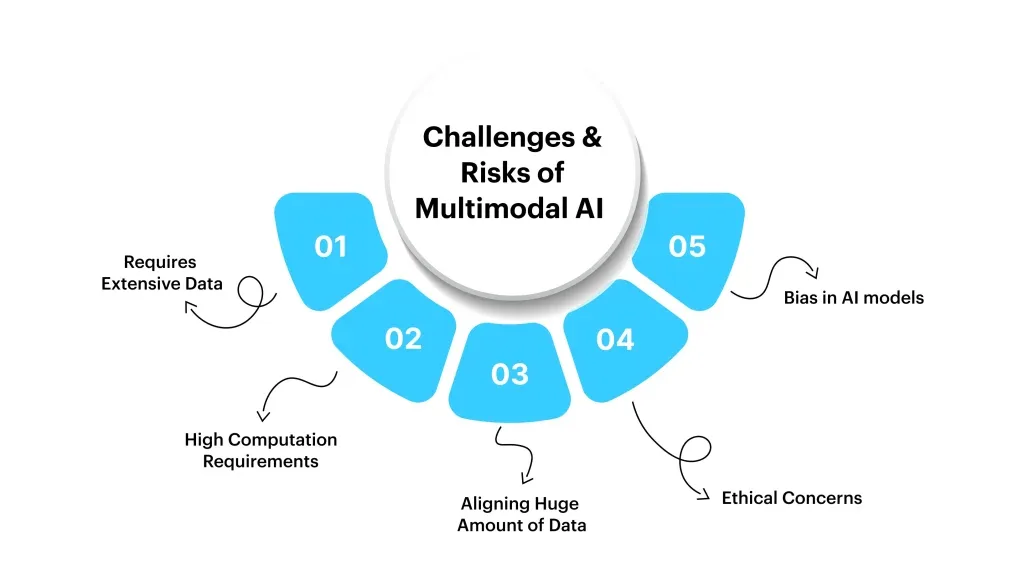
- Massive Data Dependency: Multimodal AI requires extensive and diverse datasets (text, images, audio, video), making data collection and management highly complex.
- High Computational Demand: These systems need significant computing power, including advanced GPUs/TPUs, leading to higher infrastructure costs and energy consumption.
- Complex Data Alignment: Integrating and synchronizing multiple data modalities is challenging, especially when dealing with huge volumes of heterogeneous data.
- Ethical & Privacy Concerns: There are serious risks around data privacy, misuse, and responsible AI deployment, particularly when handling sensitive multimodal inputs.
- Bias in AI Models: Multimodal systems can inherit and amplify biases from training data, resulting in unfair or skewed outputs.
- Scalability Challenges: Scaling multimodal AI systems efficiently across real-world applications requires robust architectures and optimization strategies.
- Increased Development Complexity: Building and maintaining multimodal models involves advanced expertise, cross-domain integration, and longer development cycles.
Ethics, Bias, Privacy, and Governance Statistics for Multimodal AI
- Around 62% of organizations cite data privacy as their top concern in AI adoption.
- Bias incidents in AI systems increased by 32% between 2022 and 2024.
- Only 28% of companies have formal AI governance frameworks in place.
- Multimodal AI models trained on diverse datasets reduce bias by up to 18%.
- About 55% of enterprises conduct regular AI audits for fairness and compliance.
- Data breaches involving AI systems rose by 21% in 2025, emphasizing security risks.
- Regulatory frameworks influence over 35% of global AI deployments.
- Transparency remains a challenge, with 47% of executives unable to explain AI model decisions clearly.
- Ethical AI adoption improved brand trust by up to 20% among consumers.
Forecasts for Multimodal AI Adoption, Revenue, and Market Share to 2030 and Beyond
- The multimodal AI market is projected to reach $10.89 billion by 2030.
- Long-term forecasts estimate $42.38 billion by 2034, growing at 36.9% CAGR.
- Some projections suggest $93.99 billion by 2035, driven by enterprise adoption.
- Over 80% of enterprises are expected to adopt multimodal AI by 2030.
- AI-powered automation could contribute $15.7 trillion to the global economy by 2030.
- Multimodal AI will account for 35–40% of all AI workloads by 2030.
- Edge AI deployments are expected to grow at over 20% CAGR through 2030.
- Generative multimodal AI will dominate content creation, with 70% of digital content AI-assisted by 2030.
- Enterprise AI spending is forecast to exceed $300 billion annually by 2030.
Frequently Asked Questions (FAQs)
What is the global multimodal AI market size in 2026?
What CAGR is the multimodal AI market expected to grow at?
What will the multimodal AI market size reach by 2030?
What share of the multimodal AI market does software hold?
What is the projected market size of multimodal AI by 2034?
Conclusion
Multimodal AI is no longer an emerging concept; it is rapidly becoming a foundational layer of modern AI systems. The data highlights consistent gains in performance, operational efficiency, and measurable business outcomes, especially when organizations integrate multiple data types into a unified framework. From improving diagnostic accuracy in healthcare to driving higher conversion rates in retail, multimodal AI continues to deliver tangible value across industries. At the same time, growing investment, evolving governance frameworks, and advances in model performance signal that adoption will accelerate further in the coming years.
Organizations that focus on scalability, responsible AI practices, and real-world applications will be better positioned to capture long-term value, as multimodal AI reshapes how businesses operate, compete, and innovate well beyond 2030.

Leave a comment
Have something to say about this article? Add your comment and start the discussion.