




Employee engagement has become a defining factor in how companies perform, retain talent, and adapt to rapid workplace change. In today’s environment, where hybrid work, AI adoption, and shifting employee expectations reshape the workplace, engagement is no longer just an HR metric; it is a core business driver. For example, organizations use engagement data to improve productivity in distributed teams and reduce costly turnover in competitive labor markets. At the same time, HR leaders rely on these insights to design better workplace policies, enhance employee experience, and build stronger organizational culture.
However, recent trends show that engagement levels are declining globally, raising concerns for business leaders. Lower engagement directly affects productivity, innovation, and employee well-being, while increasing burnout and attrition. As companies navigate this evolving landscape, understanding the latest data becomes essential for making informed decisions. Let’s explore the latest employee engagement statistics and what they mean for the future of work.
Editor’s Choice
- Only 20% of employees globally are engaged in 2026, while 64% are not engaged and 16% are actively disengaged (Gallup).
- Global employee engagement declined from 23% in 2023 to 21% in 2024, marking one of the sharpest drops in over a decade.
- In the U.S., employee engagement held at 31% in 2025, unchanged from 2024 but still below the 36% peak in 2020.
- 17% of U.S. employees are actively disengaged, signaling rising workplace detachment.
- Disengagement cost the global economy an estimated $8.8 trillion in lost productivity in 2024.
- Around 70% of team engagement depends directly on managers, highlighting leadership’s impact.
- 40% of employees globally experienced stress daily in 2026, linking engagement closely with wellbeing.
Recent Developments
- In 2026, 50% of U.S. employees report using AI at work, signaling major shifts in engagement and workflows.
- 28% of employees now use AI weekly or more, up from 21% in 2023.
- 65% of employees say AI improves productivity, suggesting a positive engagement link with automation.
- Engagement among managers dropped from 30% to 27% globally in 2024, weakening team performance.
- Only 46% of employees clearly understand job expectations, a key driver of engagement.
- U.S. engagement reached an 11-year low in 2024, reflecting shifting workforce expectations.
- Nearly 50% of U.S. employees report thriving in life, a record low tied to engagement declines.
- Manager burnout is rising, with 75% of leaders feeling exhausted frequently in distributed work environments.
- Only 27% of managers globally feel engaged, creating ripple effects across teams.
Key Global Workforce Engagement Insights
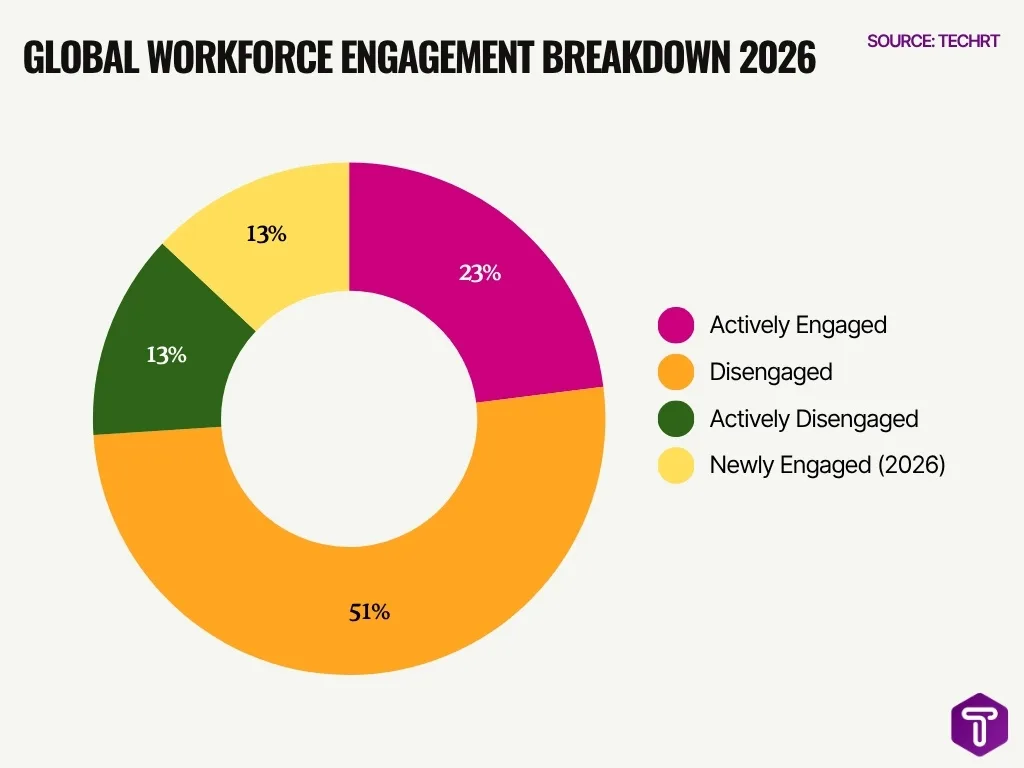
- Only 23% of employees are actively engaged, meaning less than 1 in 4 workers are truly motivated, innovative, and contributing at a high level.
- A massive 64% of the global workforce is not engaged, highlighting a critical productivity gap across organizations worldwide.
- The largest segment, 51% of employees, are disengaged; they are present at work but not productive, representing the biggest missed opportunity for businesses.
- 13% of employees are actively disengaged, meaning they are counterproductive and negatively impact team morale, posing a direct risk to company culture and performance.
- On a positive note, 13% of workers are newly engaged in 2026, indicating a growing shift toward engagement, especially in emerging markets.
- The gap between actively engaged (23%) and disengaged (51%) workers is 28 percentage points, showing a significant imbalance in workforce motivation.
- Combining actively disengaged (13%) and disengaged (51%), nearly 2 out of every 3 employees (64%) are not fully contributing to organizational success.
- The data suggests that improving engagement even by 10–15% could unlock substantial gains in productivity, retention, and profitability.
- With a global workforce of approximately 3.4 billion people, this means over 2.1 billion workers are not engaged, emphasizing the scale of the challenge.
- The rise of newly engaged employees (13%) signals that targeted HR strategies, leadership, and workplace improvements are beginning to show measurable impact.
U.S. Employee Engagement Statistics
- 31% of U.S. employees were engaged in 2025, unchanged from 2024.
- Engagement peaked at 36% in 2020, meaning millions fewer employees feel engaged today.
- 17% of employees are actively disengaged, contributing to workplace inefficiency.
- U.S. engagement hit its lowest level in over a decade in 2024.
- The engagement ratio dropped to 1.8 engaged employees for every actively disengaged worker.
- Younger workers saw engagement declines of 6–9 percentage points between 2020 and 2025.
- About 50% of U.S. employees are thriving in life, a record low.
- Only 46% of employees clearly understand expectations, a core engagement factor.
- Engagement decline equates to roughly 8 million fewer engaged U.S. workers since 2020.
Employee Engagement Trends Over Time
- Global engagement has declined twice in 12 years, most recently in 2024.
- Engagement rose steadily until 2020, then dropped from 23% to 21% by 2024–2025.
- U.S. engagement climbed to 36% in 2020 before declining to 31% in 2025.
- Manager engagement declined from 30% to 27% globally, weakening long-term trends.
- Engagement among younger employees dropped by up to 9 percentage points since 2020.
- The ratio of engaged to disengaged workers has steadily worsened since 2023.
- Global engagement losses translated into massive productivity declines year over year.
- Workplace satisfaction metrics also declined alongside engagement in 2024.
- Engagement trends show a shift from growth (2010–2020) to stagnation and decline (2021–2026).
Employee Engagement by Region and Country
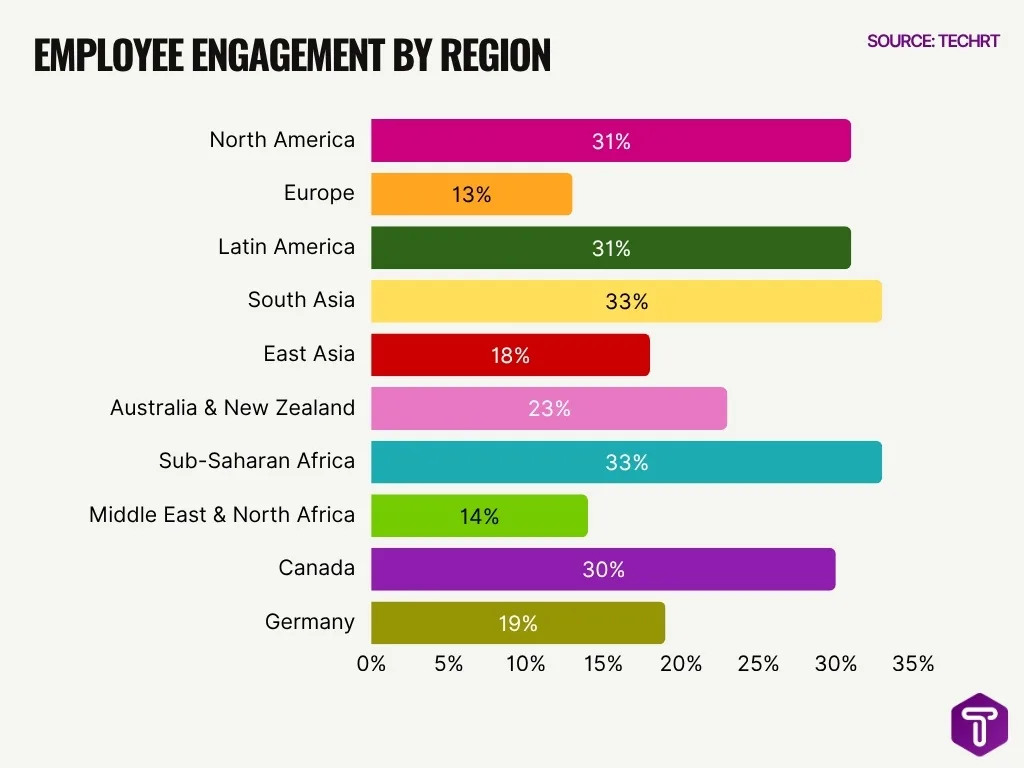
- North America reports one of the highest engagement rates globally at 31%, driven largely by U.S. workplace initiatives.
- Europe’s engagement levels remain lower at 13%, reflecting slower adoption of engagement-focused HR strategies.
- In Latin America, engagement stands at 31%, showing strong employee connection despite economic volatility.
- South Asia records engagement rates of around 33%, among the highest globally, due to younger workforce demographics.
- East Asia shows lower engagement at 18%, influenced by long work hours and cultural factors.
- Australia and New Zealand maintain engagement levels near 23%, slightly above the global average.
- Sub-Saharan Africa reports 33% engagement, driven by entrepreneurial workforce trends.
- The Middle East and North Africa show engagement rates of 14%, among the lowest globally.
- Canada mirrors U.S. trends with engagement hovering around 30%, though declining post-2020.
- Germany reports engagement levels below 20%, reflecting structural workplace rigidity.
Post-Pandemic Employee Engagement Trends
- Engagement peaked during the early pandemic years, reaching 36% in 2020, then declined afterward.
- Post-pandemic disengagement contributed to the “Great Detachment” trend among workers.
- Hybrid work increased productivity for 73% of employees, boosting engagement in flexible setups.
- 83% of employees now prioritize work-life balance, reshaping engagement drivers.
- Manager engagement dropped significantly post-pandemic, impacting team morale.
- Employees report increased burnout, with 75% of leaders feeling exhausted frequently.
- Global stress levels rose to 40% daily, reflecting post-pandemic pressure.
- Employees increasingly seek flexibility, with hybrid models becoming the preferred structure.
- Job mobility concerns persist, with only 52% seeing good job opportunities locally.
Employee Engagement by Company Size
- Large enterprises (10,000+ employees) report engagement levels around 28%, often challenged by complexity.
- Mid-sized companies show higher engagement at 32%, benefiting from a balanced structure and flexibility.
- Small businesses (<100 employees) report engagement levels near 34%, driven by closer leadership relationships.
- Startups often achieve engagement rates above 36%, fueled by innovation and ownership culture.
- Companies with fewer management layers see 20% higher engagement scores than highly hierarchical firms.
- Organizations with strong internal communication report 4.5x higher engagement, regardless of size.
- Companies with employee recognition programs see engagement increase by up to 14%.
- Remote-first companies report engagement levels similar to mid-sized firms at 30%+.
- Large corporations experience higher disengagement due to the limited personalization of employee experience.
- Fast-growing companies report engagement rates rising by 10–15% during expansion phases.
Employee Engagement by Industry and Sector
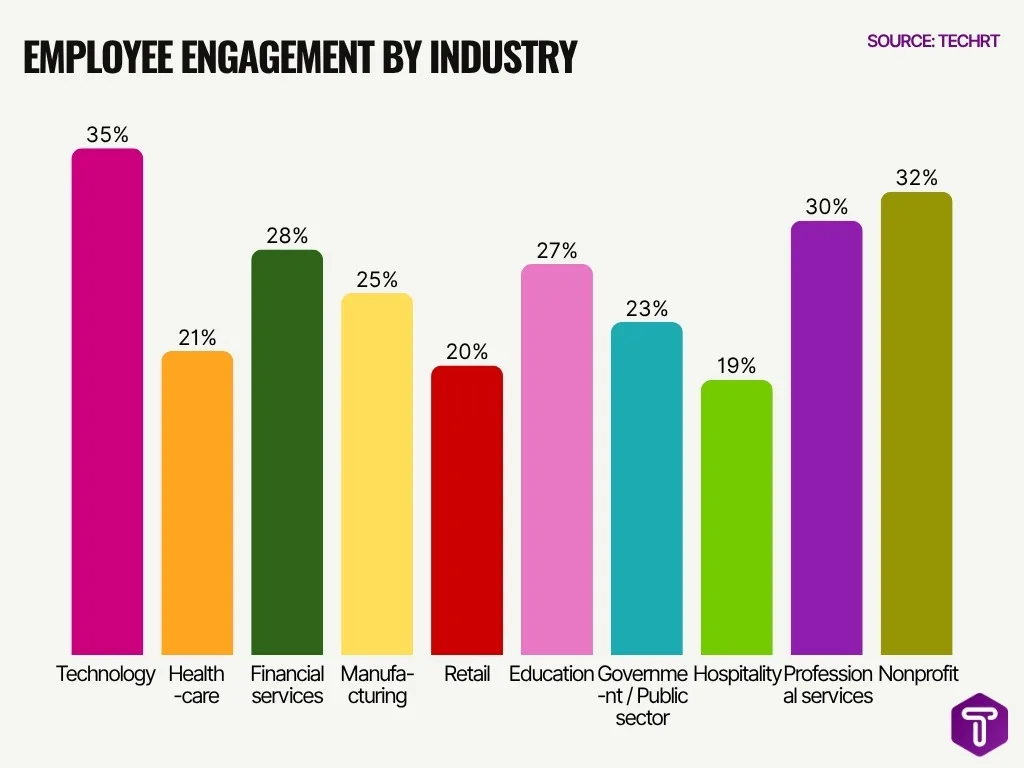
- The technology sector reports engagement rates above 35%, driven by innovation-driven cultures.
- Healthcare engagement dropped to 21% in 2025, reflecting burnout and staffing shortages.
- Financial services report engagement levels near 28%, slightly above the global average.
- Manufacturing engagement averages around 25%, impacted by automation and repetitive tasks.
- Retail sector engagement remains low at 20%, with high turnover rates affecting morale.
- Education sector engagement stands at 27%, influenced by workload pressures.
- Government and public sector engagement averages 23%, often hindered by bureaucracy.
- Hospitality industry engagement remains below 20%, reflecting irregular schedules and stress.
- Professional services firms show engagement near 30%, tied to career growth opportunities.
- Nonprofit sector engagement is relatively high at 32%, driven by mission alignment.
Employee Engagement by Age Group and Generation
- Millennials and Gen Z employees report engagement levels around 30%, but show higher volatility.
- Gen Z engagement declined by 6–9 percentage points between 2020 and 2025.
- Baby Boomers maintain higher engagement at 33%, driven by experience and job stability.
- Younger workers are less likely to feel connected to the company’s mission, impacting engagement.
- Employees under 35 are more likely to switch jobs, reflecting lower engagement levels.
- 60% of Gen Z workers prioritize purpose-driven work, influencing engagement outcomes.
- Millennials represent the largest workforce segment and drive engagement trends globally.
- Older employees report higher job satisfaction and engagement stability.
- Younger workers show stronger engagement in flexible and hybrid environments.
- Career development opportunities increase engagement by over 20% among younger employees.
Employee Engagement by Gender and Diversity Groups
- Engagement rates are similar across genders, with men at 31% and women at 30% in the U.S..
- Women report slightly higher engagement in purpose-driven roles.
- Diverse teams show 19% higher engagement levels compared to less diverse organizations.
- Employees in inclusive workplaces are 2.3 times more likely to be engaged.
- LGBTQ+ employees report higher engagement when workplace inclusion policies are strong.
- Ethnically diverse companies are 36% more likely to outperform competitors, correlating with engagement.
- Employees who feel respected are 4.6 times more likely to feel empowered to perform their best work.
- Inclusion initiatives improve engagement scores by up to 30% in global organizations.
- Women in leadership roles drive higher team engagement outcomes.
- Organizations with strong DEI strategies see measurable gains in retention and engagement.
Employee Engagement by Job Level and Role
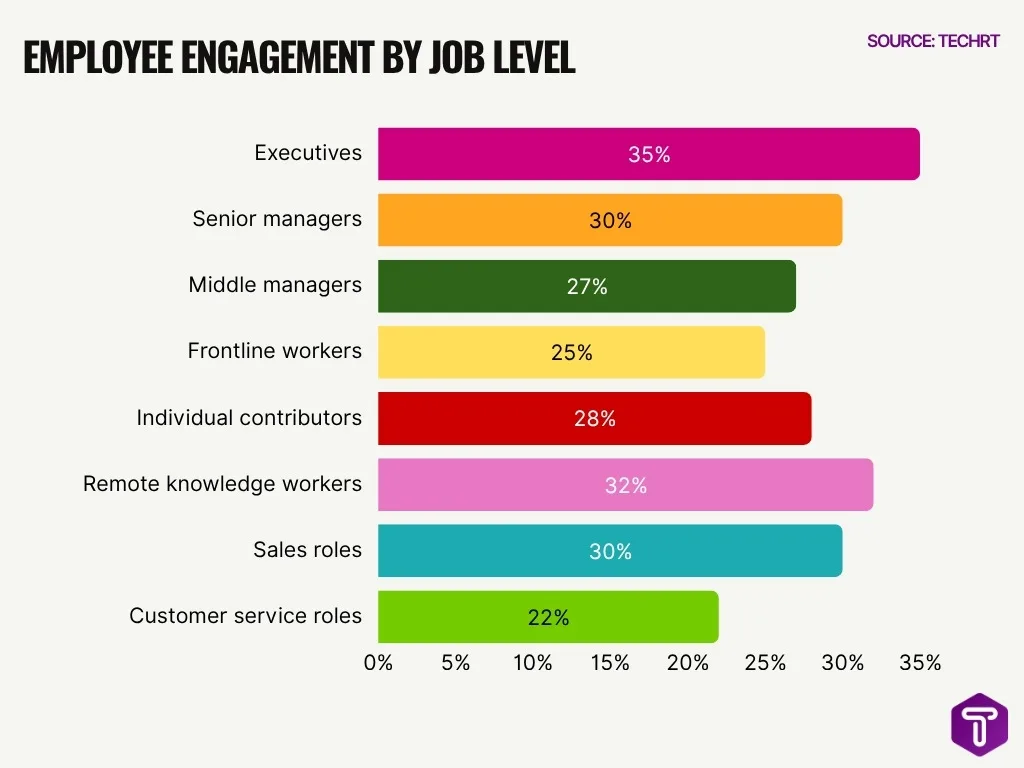
- Executives report the highest engagement levels at 35%, driven by autonomy and influence.
- Senior managers show engagement around 30%, though declining in recent years.
- Middle managers report engagement at 27%, reflecting pressure from both leadership and teams.
- Frontline workers have engagement levels below 25%, often due to limited control over work.
- Individual contributors report engagement around 28%, varying widely by role type.
- Remote knowledge workers show engagement rates of 32%, higher than on-site roles.
- Sales roles often show engagement near 30%, influenced by incentives and performance metrics.
- Customer service roles report lower engagement at 22%, linked to stress and burnout.
- Managers account for 70% of the variance in team engagement, reinforcing their influence.
- Entry-level employees experience the largest engagement decline, dropping by up to 9 percentage points since 2020.
Engagement Levels by Work Model (Remote, Hybrid, On-Site)
- Hybrid workers report the highest engagement at 35%, combining flexibility and collaboration.
- Fully remote employees show engagement levels around 32%, slightly below hybrid.
- On-site workers report lower engagement at 27%, especially in rigid environments.
- 73% of employees say hybrid work improves productivity, boosting engagement.
- Remote workers report better work-life balance, with 80% citing flexibility as key to engagement.
- Employees forced back to offices report lower engagement and higher dissatisfaction.
- Hybrid models reduce burnout by up to 25%, improving long-term engagement.
- Companies offering flexible work see higher retention and engagement rates.
- Fully on-site roles report higher stress levels, negatively impacting engagement.
- Remote work adoption continues to grow, with over 40% of employees working in hybrid setups in 2026.
Employee Engagement and Productivity Statistics
- Companies with highly engaged employees report 21% higher profitability, showing a direct link between engagement and financial performance.
- Highly engaged teams experience 17% higher productivity compared to disengaged teams.
- Organizations with strong engagement see 41% lower absenteeism, improving operational efficiency.
- Businesses in the top quartile of engagement report 23% higher profitability than those in the bottom quartile.
- Disengaged employees cost the global economy approximately $8.8 trillion annually, highlighting productivity loss.
- Companies with engaged employees report 10% higher customer ratings, linking engagement to customer experience.
- Engaged employees are 87% less likely to leave, reducing productivity disruption.
- Organizations with high engagement see 18% higher sales productivity, particularly in customer-facing roles.
- Employees who feel heard are 4.6 times more likely to perform their best work, boosting output.
- Companies investing in engagement programs see productivity gains of up to 14%, especially in knowledge-driven industries.
Employee Engagement Differences
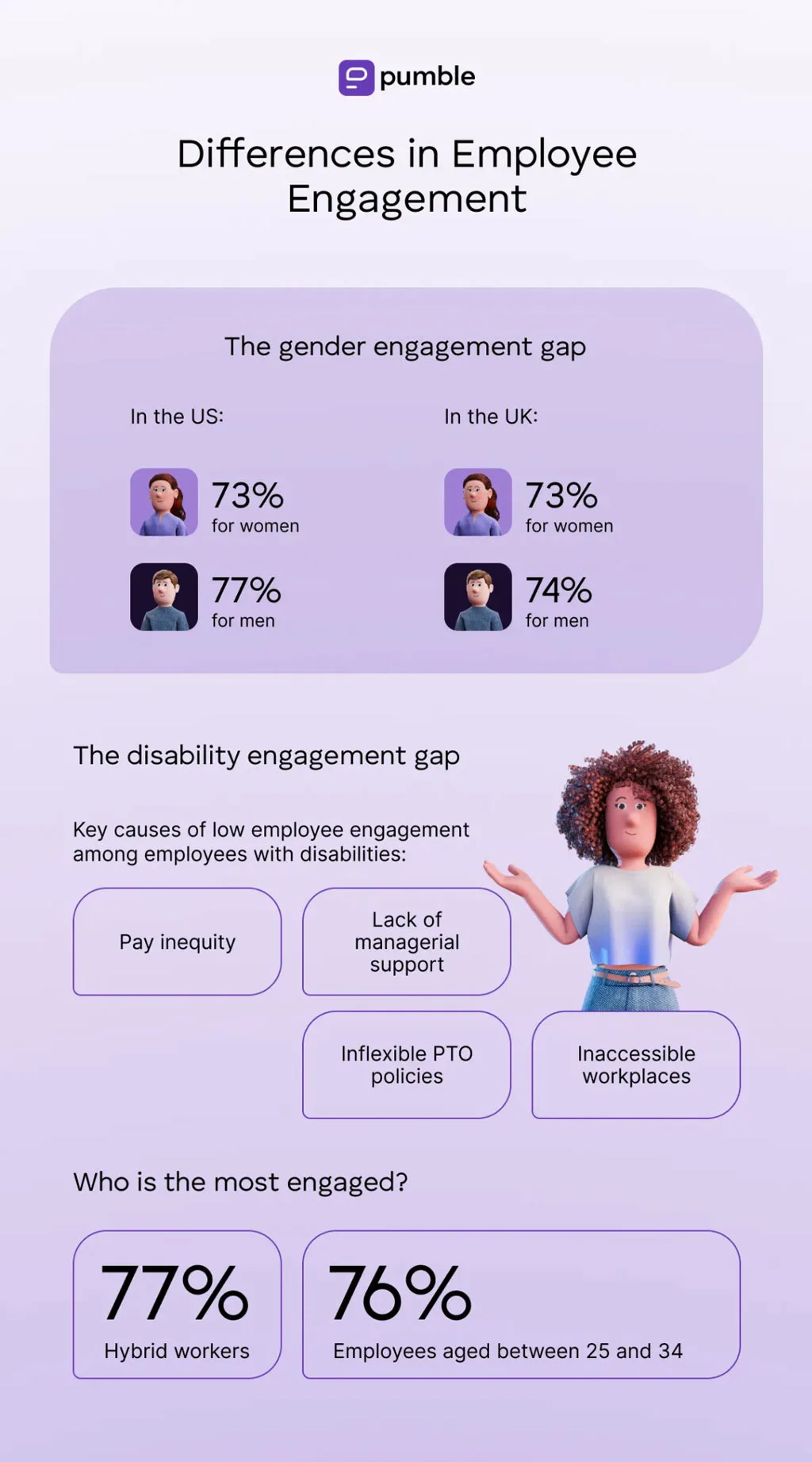
- Gender engagement gap remains consistent across regions: In both the US and UK, women report 73% engagement, while men show higher engagement at 77% (US) and 74% (UK).
- Men are slightly more engaged than women overall: The gap is +4 percentage points in the US and +1 percentage point in the UK, indicating a persistent but narrowing disparity.
- Regional variation is minimal for women: Female engagement is identical at 73% in both countries, suggesting systemic rather than regional factors.
- Disability-related engagement gaps are driven by structural issues: Key barriers include pay inequity, lack of managerial support, inflexible PTO policies, and inaccessible workplaces.
- Workplace policies play a critical role: Factors like managerial support and flexibility directly influence engagement levels among employees with disabilities.
- Hybrid work model leads engagement trends: Hybrid workers show the highest engagement at 77%, highlighting the value of flexibility and work-life balance.
- Young professionals are highly engaged: Employees aged 25–34 report 76% engagement, making them one of the most engaged demographic groups.
- Engagement correlates with flexibility and inclusion: Groups with greater autonomy (hybrid workers) and career growth stages (25–34 age group) demonstrate higher engagement levels.
- Inclusivity gaps present major opportunities: Addressing accessibility and equity issues could significantly boost overall employee engagement.
Employee Engagement and Retention Statistics
- Organizations with strong engagement experience 43% lower turnover rates, reducing hiring costs.
- Highly engaged employees are 87% less likely to leave their organization, strengthening workforce stability.
- Companies with low engagement report turnover rates up to 18% higher than competitors.
- Replacing an employee can cost 33% of their annual salary, making engagement a key retention strategy.
- Employees who feel recognized are 63% more likely to stay, emphasizing the role of appreciation.
- 52% of employees are actively seeking or open to new jobs, indicating engagement gaps.
- Companies with strong onboarding processes improve retention by 82%, directly influencing engagement.
- Employees with career development opportunities are 2x more likely to stay with their employer.
- Poor management is cited as a top reason for leaving by 50% of employees, tying leadership to engagement.
- Organizations with high engagement reduce voluntary turnover by up to 59% in low-turnover industries.
Employee Engagement, Leadership, and Manager Relationship Statistics
- Managers account for 70% of the variance in team engagement, making leadership the key driver.
- Only 27% of managers are engaged globally, affecting team morale.
- Employees who trust their managers are 2.7 times more likely to be engaged.
- Teams with highly engaged managers show 48% higher profitability.
- Employees receiving regular feedback are 3.6 times more engaged than those who do not.
- Poor management contributes to 50% of employee departures, highlighting leadership impact.
- Managers who focus on strengths can increase engagement by up to 23%.
- Employees who meet weekly with managers are 3 times more likely to be engaged.
- Recognition from managers increases engagement by up to 14%, reinforcing positive behaviors.
- Leadership transparency improves engagement scores across organizations.
Employee Wellness and Engagement Statistics
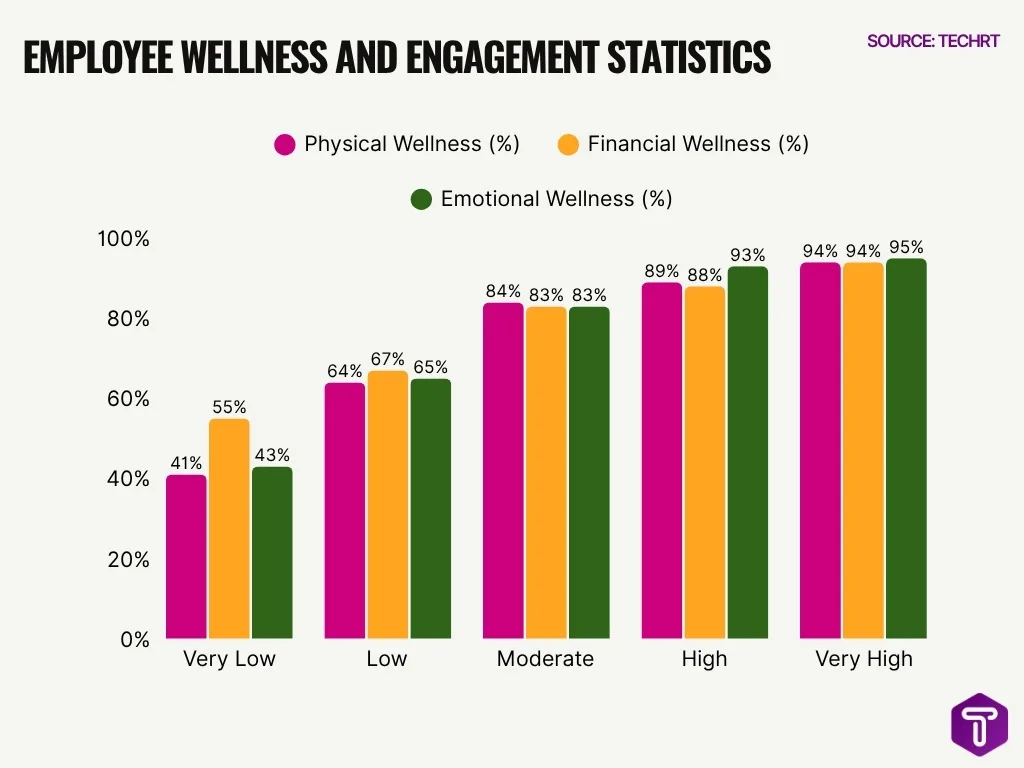
- Employee engagement rises sharply with better wellness levels
Engagement scores increase consistently from Very Low (41%–55%) to Very High (94%–95%), showing a strong positive correlation. - Financial wellness leads at the lowest engagement level
At Very Low wellness, Financial Wellness (55%) is significantly higher than Physical (41%) and Emotional (43%), indicating money-related stability plays a critical early role. - Balanced growth across all wellness dimensions at moderate levels
At Moderate wellness, all three areas converge around 83%–84%, suggesting a tipping point where overall well-being aligns closely with engagement. - Emotional wellness becomes the top driver at higher levels
At High wellness, Emotional Wellness peaks at 93%, outperforming Physical (89%) and Financial (88%), highlighting the growing importance of mental and emotional health. - Near-max engagement achieved at very high wellness levels
At Very High wellness, engagement reaches 94%–95% across all categories, indicating diminishing gaps between wellness types. - Physical wellness shows the largest improvement over time
Physical engagement jumps from 41% (Very Low) to 94% (Very High), a +53 percentage point increase, the highest among all categories. - Emotional wellness records the highest overall engagement score
The peak value in the dataset is 95% (Emotional Wellness at Very High level), making it the strongest contributor at the top end. - Narrowing the gap between wellness types as engagement improves
The disparity between categories shrinks from 14 points (41% vs 55%) at Very Low to just 1 point (94% vs 95%) at Very High, indicating alignment at higher wellness levels. - Clear evidence of a linear upward trend
Each wellness category demonstrates a steady, step-by-step increase with no declines, reinforcing the reliability of the relationship. - Strategic implication for organizations
Investing in holistic wellness programs (physical, financial, emotional) can drive engagement from below 50% to above 90%, delivering substantial workforce performance gains.
Drivers of High Employee Engagement Statistics
- Employees who understand expectations are 2.8 times more likely to be engaged.
- Recognition programs increase engagement by 14% or more, especially in large organizations.
- Career development opportunities boost engagement by over 20%, particularly among younger workers.
- Employees who feel their work has purpose are 4 times more engaged.
- Strong communication increases engagement by up to 4.5x, making it a core driver.
- Flexible work options improve engagement rates by up to 30%.
- Organizations with inclusive cultures see engagement increase by 2.3x.
- Employees with supportive managers are 70% more engaged, reinforcing leadership importance.
- Real-time feedback systems improve engagement by up to 12%, especially in tech-driven workplaces.
- Companies aligning employee goals with business objectives report significantly higher engagement scores.
Frequently Asked Questions (FAQs)
What percentage of employees are engaged globally in 2026?
What is the employee engagement rate in the U.S. in 2025?
How much productivity loss is caused by low employee engagement globally?
What percentage of employees experience daily stress at work globally?
How much more profitable are companies with highly engaged employees?
Conclusion
Employee engagement reflects a clear shift from steady growth to a more complex and fragile landscape shaped by hybrid work models, AI integration, and evolving workforce expectations. While engagement continues to drive productivity, retention, and profitability, declining global rates signal that many organizations are struggling to keep employees connected and motivated. This shift highlights a growing gap between what employees expect and what workplaces currently deliver.
At the same time, the data makes one thing clear: companies that invest in strong leadership, flexible work environments, and employee well-being consistently outperform their peers. Factors such as clear communication, career development, recognition, and inclusive culture play a critical role in sustaining engagement. Moreover, the influence of managers remains central, reinforcing the need for better leadership development and support systems.
Looking ahead, organizations that treat engagement as a strategic priority rather than a periodic initiative will be better positioned to succeed. As the workforce continues to evolve, these statistics offer a practical roadmap for building more engaged, resilient, and high-performing teams in an increasingly dynamic world of work.

Leave a comment
Have something to say about this article? Add your comment and start the discussion.