



Biometric payments are changing how consumers verify transactions across retail stores, banking apps, airports, and transit systems. Instead of entering passwords or PINs, users now confirm payments with fingerprints, facial scans, voice recognition, or palm authentication. Major payment networks like Visa and Mastercard continue to expand biometric checkout systems as merchants push for faster and more secure digital payments.
Retail chains use biometric authentication to reduce checkout friction, while banks rely on it to prevent account takeover fraud and identity theft. At the same time, governments and fintech companies are integrating biometrics into digital identity programs and mobile wallets. This article explores the latest biometric payment statistics, market trends, forecasts, and adoption data shaping the industry.
Editor’s Choice
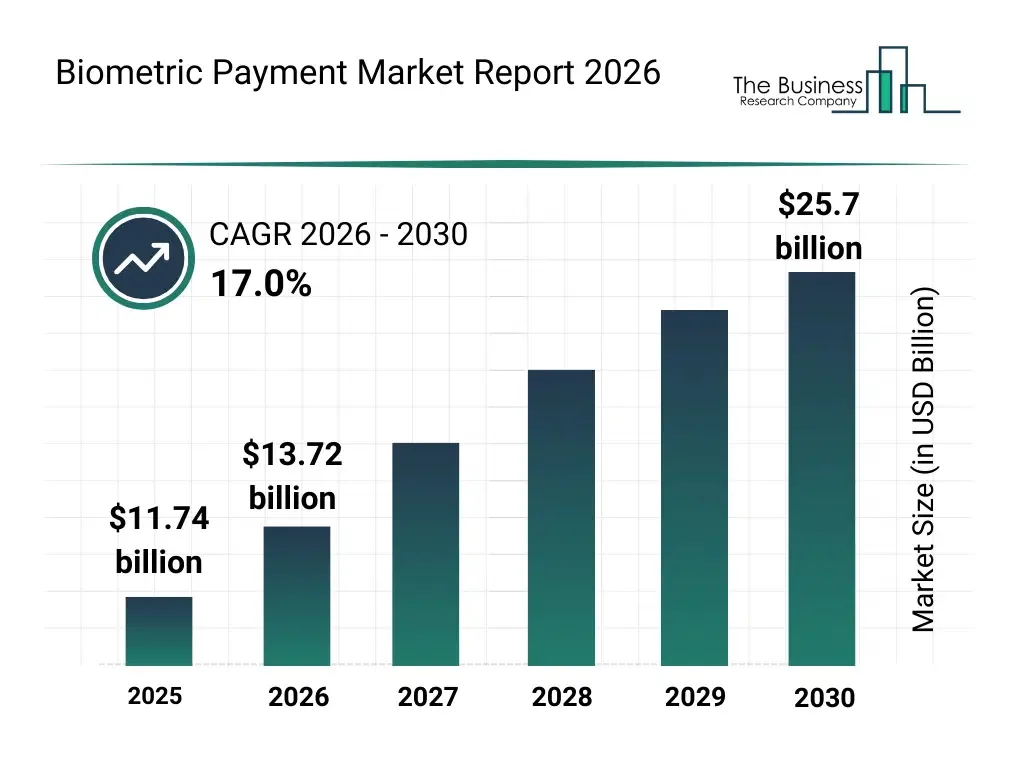
- The global biometric payment market is expected to reach $13.72 billion in 2026, up from $11.74 billion in 2025.
- The market could expand to $44.69 billion by 2034, reflecting long-term demand for password-free payment authentication.
- More than 2 billion biometric payment transactions are projected globally in 2025.
- Around 83% of consumers worldwide believe biometric payments are safer than passwords or PINs.
- Facial recognition represents nearly 62% of biometric payment methods currently used worldwide.
- Contactless transactions accounted for over 75% of Mastercard network transactions in 2025.
- Biometrically authenticated remote mobile payments may reach 39.5 billion transactions by 2027.
- Nearly 70% of US financial institutions planned biometric payment integration by 2025.
- The biometric payment card market could grow from $289.6 million in 2024 to $5.7 billion by 2030.
Recent Developments
- Mastercard announced plans to phase out manual online card entry across Europe by 2030 using biometrics and tokenization.
- Visa launched its first African data center in Johannesburg in 2025 to support rising digital payment demand across Africa.
- Africa’s digital payment economy is forecast to reach $1.5 trillion by 2030, increasing demand for biometric payment security.
- In South Africa, more than 60% of face-to-face transactions now use contactless payment methods.
- India’s UPI platform handled 83% of India’s digital payment volume in 2024, creating new opportunities for biometric verification layers.
- Major payment firms increased AI investments in fraud detection during 2025 and 2026, with Visa operating over 300 AI models for payment security.
- Biometric payment card vendors such as IDEX Biometrics, Infineon Technologies, and NXP Semiconductors expanded partnerships with banks in 2025.
- Europe saw accelerated adoption of digital IDs and biometric authentication services in 2025 payment ecosystems.
- Payment companies increasingly integrated biometric checkout into transit systems, airport boarding, and e-commerce one-click payments in 2025.
Biometric Payment Market Size Statistics
- The biometric payment market is projected to grow from $11.74 billion in 2025 to $25.7 billion by 2030.
- In 2026, the market size is expected to reach $13.72 billion, showing strong early-stage growth.
- The market is forecast to expand at a 17.0% CAGR from 2026 to 2030.
- Between 2025 and 2030, the market could add nearly $13.96 billion in value.
- The 2030 market size of $25.7 billion is more than 2x larger than the 2025 value.
- Rising adoption of biometric cards, facial recognition payments, fingerprint authentication, and mobile biometric wallets is likely supporting this growth.
- The steady upward trend indicates that biometric payments are moving from a niche security feature toward a mainstream digital payment method.
- Financial institutions, fintech firms, and retailers may increase biometric payment integration as demand grows for faster, safer, and password-free transactions.
- The forecast suggests strong commercial opportunities for companies operating in payment security, biometric sensors, authentication software, and digital banking infrastructure.
Biometric Payment Market Growth Statistics
- The biometric payment market is forecast to grow at a 16.8% CAGR between 2025 and 2026.
- Market Research Future projects a 16.4% CAGR for the sector through 2035.
- The biometric payment card market may expand at an aggressive 64.3% CAGR through 2030.
- The global biometric payments industry could grow from $3.87 billion in 2024 to $19.64 billion by 2031.
- Biometric in-store payments are expected to register around 24% CAGR over the next several years.
- Fingerprint biometric technology is forecast to grow from $26.3 billion in 2025 to $69.3 billion by 2035.
- Biometrically authenticated mobile payment transaction volume may rise by 383% between 2022 and 2027.
- Asia-Pacific currently leads biometric transaction adoption, with around 60% of consumers using biometric authentication for payments.
- Europe’s biometric payment adoption reportedly increased by 45% in recent years, especially in the UK and Germany.
Biometric Payment Market Forecast
- The biometric payment market could reach $25.7 billion by 2030.
- Fortune Business Insights forecasts the market will hit $44.69 billion by 2034.
- Market Research Future predicts the industry may climb to $53 billion by 2035.
- The biometric payment card market may exceed $5.7 billion by 2030.
- Biometrically authenticated remote mobile payments may generate $1.2 trillion in value by 2027.
- Industry analysts estimate nearly 3.5 billion biometric payment users by 2030.
- Biometric supplier revenue from payment technologies may surpass $11.5 billion by 2030.
- The biometric technology market could reach $363.2 billion by 2034 across industries, including payments, healthcare, and government.
- Global biometric systems revenue is projected to approach $95.14 billion by 2030.
Biometric Payment Adoption Statistics
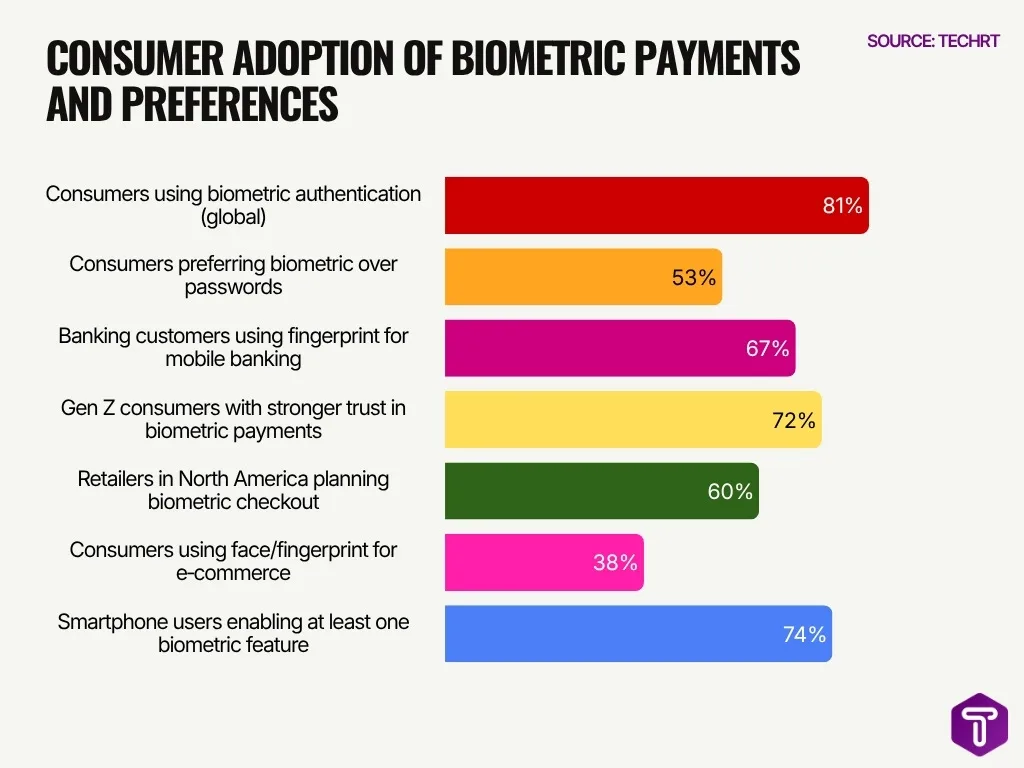
- Around 81% of consumers globally used some form of biometric authentication in 2025 for banking or payments.
- Nearly 53% of consumers said they prefer biometric authentication over passwords for digital payments.
- In the US, over 148 million people actively used facial recognition payment features on smartphones in 2025.
- About 67% of banking customers worldwide accessed mobile banking apps using fingerprint authentication in 2025.
- China continued leading biometric payment adoption, with more than 900 million users relying on facial recognition payment systems through Alipay and WeChat Pay.
- Approximately 72% of Gen Z consumers reported stronger trust in biometric payment systems than in traditional passwords.
- More than 60% of retailers in North America planned to expand biometric checkout systems between 2025 and 2026.
- Contactless biometric card pilots across Europe showed transaction approval times below one second in 2025.
- Around 38% of consumers globally already use face or fingerprint authentication for e-commerce purchases.
- Nearly 74% of smartphone users enabled at least one biometric security feature on their mobile devices in 2025.
Biometric Payment Market Trends
- The biometric payment market was valued at $11.54 billion in 2025 and is projected to reach $44.69 billion by 2034.
- The market is expected to grow at a 16.20% CAGR from 2026 to 2034.
- Fingerprint recognition held the largest biometric mode share at 47.46% in 2026, while facial recognition is set to post the highest CAGR.
- Contactless biometric authentication is the fastest-growing technology segment, with facial, iris, and voice verification helping drive touchless payments post-pandemic.
- The retail & e-commerce segment accounted for 30.41% of the market in 2026, supported by faster checkout and lower fraud risk.
- North America led the market with a 36.20% share in 2025, reflecting strong adoption by banks, merchants, and tech firms.
- The hardware segment captured 57.84% of the market in 2026, showing that device-based authentication still dominates deployment.
- ABI Research said biometric payment card shipments could rise from 14,000 in 2021 to 20.6 million by 2025 in the conservative forecast.
- ABI Research also estimated that Europe and Asia-Pacific could ship nearly 8 million biometric payment cards in 2024, with an aggressive forecast of 55 million.
- North America was forecast to ship only 20,000 biometric payment cards in 2024 in ABI Research’s conservative outlook, showing the region’s slower uptake.
Biometric Payment Market Drivers
- Rising digital payment adoption remains a major growth driver, with global cashless transaction volume projected to exceed 2 trillion transactions by 2026.
- Financial fraud losses worldwide surpassed $485 billion annually, increasing demand for stronger biometric authentication systems.
- Around 91% of consumers expressed concerns about identity theft and online fraud in 2025.
- Smartphone penetration reached more than 7.2 billion devices globally, creating a larger user base for biometric-enabled payments.
- More than 80% of modern smartphones now include fingerprint sensors or facial recognition capabilities.
- Governments across Europe and Asia accelerated digital identity programs linked to biometric verification for financial services.
- AI-driven fraud detection tools reduced payment fraud exposure by up to 40% in some banking systems using biometric verification layers.
- Retailers implementing frictionless checkout technology reported up to 25% shorter checkout times after adding biometric authentication.
- More than 65 countries introduced digital identity initiatives that support biometric verification for payments and banking.
- Remote work and digital banking growth pushed mobile banking users beyond 3.6 billion globally in 2025, increasing biometric login demand.
Password Replacement Technologies
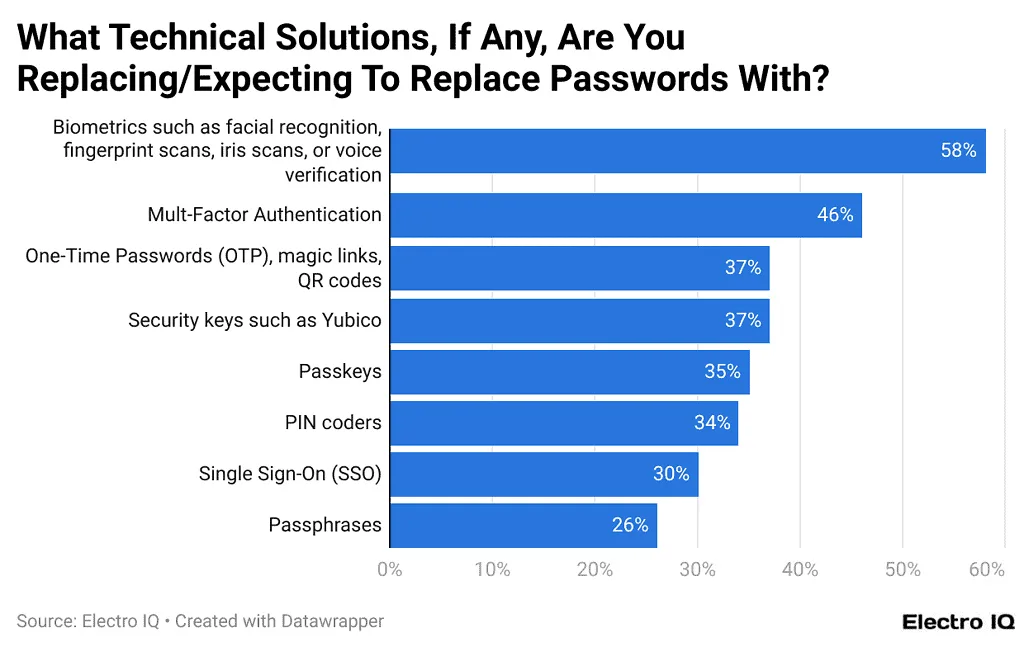
- Biometrics are the leading password replacement method, with 58% of respondents using or expecting to use facial recognition, fingerprint scans, iris scans, or voice verification.
- Multi-Factor Authentication ranks second at 46%, showing that many organizations still prefer layered security rather than removing passwords entirely.
- One-Time Passwords (OTP), magic links, and QR codes are used or expected by 37% of respondents, making them a major alternative for secure login flows.
- Security keys such as Yubico also account for 37%, highlighting growing interest in hardware-based authentication.
- Passkeys are selected by 35% of respondents, indicating strong adoption momentum for passwordless authentication.
- PIN coders represent 34%, showing that PIN-based authentication remains relevant despite newer biometric and passkey options.
- Single Sign-On (SSO) is used or expected by 30%, suggesting that centralized identity access continues to be important for enterprise security.
- Passphrases are the least selected option at 26%, but they still remain a notable password alternative because they are easier to remember than traditional complex passwords.
- The data shows that organizations are moving toward a multi-solution passwordless future, combining biometrics, MFA, OTPs, security keys, and passkeys rather than relying on one single method.
- The gap between the top option, biometrics at 58%, and the lowest option, passphrases at 26%, shows a 32 percentage-point difference in preference among password replacement technologies.
Biometric Payment by Technology
- AI-powered biometric authentication platforms accounted for nearly 41% of new deployments in 2025.
- NFC-enabled biometric payment cards continued expanding globally, with shipments expected to surpass 100 million units by 2028.
- Cloud biometric authentication systems reduced infrastructure costs for banks by nearly 30% compared with traditional on-premise models.
- Edge AI biometric processing became more common in smartphones and POS systems to improve authentication speed and privacy.
- Blockchain-based identity verification projects increasingly integrated biometric authentication into payment ecosystems in 2025.
- More than 55% of biometric payment providers incorporated liveness detection technology to combat spoofing attacks.
- Tokenization technology paired with biometrics helped reduce card-not-present fraud rates by up to 26% in e-commerce.
- AI-powered fraud monitoring systems processed over 500 billion payment events annually among major global payment processors.
- Embedded biometric chips in payment cards improved transaction security without requiring batteries in several 2025 deployments.
- Quantum-resistant encryption research gained traction among biometric payment technology vendors during 2025 and 2026.
Biometric Payment Market Segmentation
- Hardware solutions accounted for nearly 58% of biometric payment revenue in 2025 due to fingerprint scanners, sensors, and biometric cards.
- Software and AI authentication platforms continue growing faster than hardware segments, with a projected CAGR above 18% through 2030.
- The retail sector represented more than 35% of biometric payment deployments globally in 2025.
- Banking and financial services accounted for roughly 30% of the biometric payment market share in 2025.
- Mobile-based biometric payment systems generated over half of the global biometric transaction volume in 2025.
- Cloud-based biometric authentication platforms gained momentum, with adoption rising by nearly 40% year over year.
- Enterprise deployments dominated the market, representing approximately 68% of industry revenue.
- Contactless biometric payment cards emerged as one of the fastest-growing segments due to rising demand for secure offline payments.
- E-commerce applications accounted for more than 28% of biometric payment use cases globally in 2025.
- Small and medium-sized businesses increased biometric POS adoption by roughly 22% in 2025 compared with the previous year.
Biometric Payment by Biometric Mode: Fingerprint Recognition Dominates
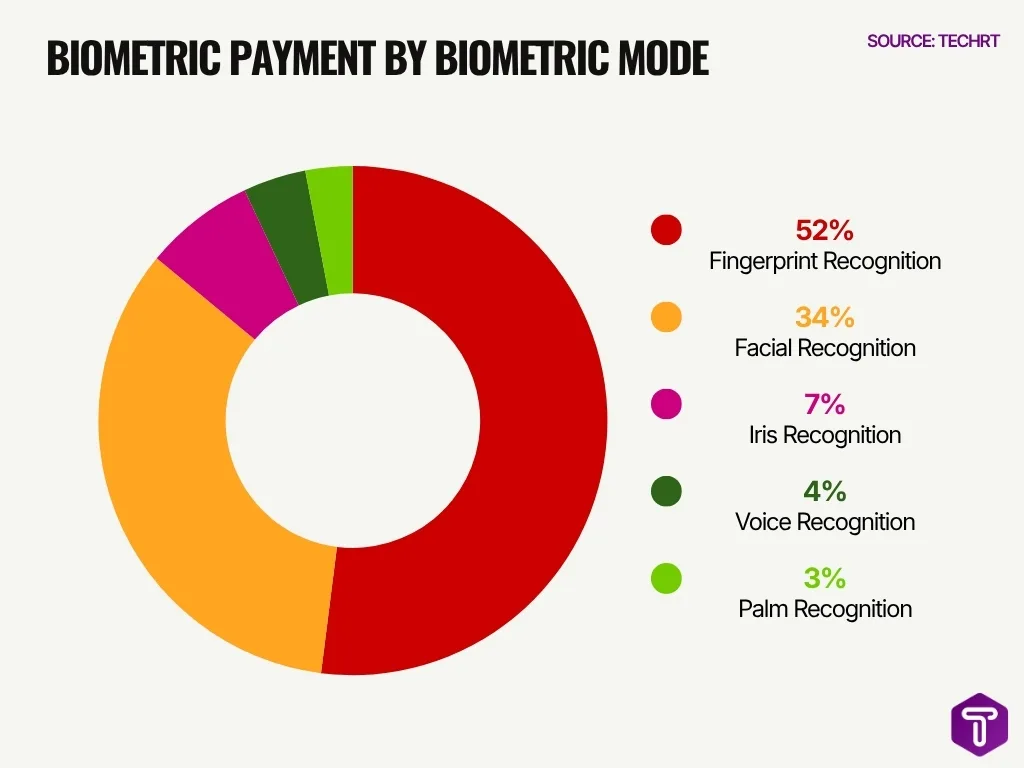
- Fingerprint recognition holds the largest share in biometric payment technology at 52%, making it the most widely used authentication method.
- Facial recognition ranks second with a 34% share, showing strong adoption in mobile wallets, retail checkouts, and digital payment platforms.
- Together, fingerprint and facial recognition account for 86% of the total biometric payment technology share.
- Iris recognition represents 7% of the market, indicating limited but growing use in high-security payment environments.
- Voice recognition holds a smaller share of 4%, mainly due to concerns around background noise, spoofing risks, and lower payment-use adoption.
- Palm recognition has the lowest share at 3%, but it is emerging in contactless retail payment systems.
- The data shows that biometric payment adoption is currently led by convenience-focused technologies such as fingerprint and facial authentication.
- Advanced biometric methods such as iris, voice, and palm recognition together account for only 14%, suggesting they remain niche compared to mainstream options.
- The dominance of fingerprint recognition reflects its widespread use in smartphones, payment cards, and point-of-sale authentication systems.
- Overall, the biometric payment technology market is highly concentrated, with the top two technologies controlling more than four-fifths of total share.
Biometric Payment by Application
- Retail & e-commerce captured the highest market share at 30.41% in biometric payments in 2026.
- BFSI held 36.7% of the biometric in-store payments application demand globally.
- The healthcare biometrics market is projected to reach $22 billion by 2030 to fight fraud, costing 5-10% of insurer revenue.
- Fingerprint recognition dominated biometric payments with 47.46% share for fast authentication.
- Contact-based technology led with 76.4% market share in biometric payments.
- North America dominated global biometric payments with 36.2% share in 2025.
- Facial recognition payments will be used by over 1.4 billion people globally by 2025.
- Global consumers using biometric authentication reached 84% by early 2026.
- Retailers implemented biometric payments at 42% globally by late 2025.
- Banks & financial institutions achieved 60-75% biometric adoption for secure transactions.
Biometric Payment Security and Fraud Prevention Statistics
- Biometric authentication can reduce account takeover fraud risks by up to 80% compared with password-only systems.
- Around 91% of consumers globally expressed concern about online identity theft and financial fraud in 2025.
- AI-powered biometric fraud systems processed more than 500 billion payment events annually among major payment providers.
- Tokenization combined with biometric authentication helped reduce card-not-present fraud rates by up to 26%.
- Behavioral biometrics adoption among banks and fintech firms increased by roughly 22% year over year.
- More than 55% of biometric payment providers integrated liveness detection technology to combat spoofing attacks in 2025.
- Financial institutions using AI-enhanced biometric fraud systems reported faster fraud detection response times in 2025.
- Multimodal biometric systems combining fingerprint and facial recognition achieved authentication accuracy rates above 99% in banking environments.
- Around 63% of consumers still expressed concerns about biometric data privacy and storage practices.
- Banks implementing biometric authentication layers reported stronger customer trust and lower password-reset costs during 2025.
Key Advantages Driving Biometric Payment Adoption
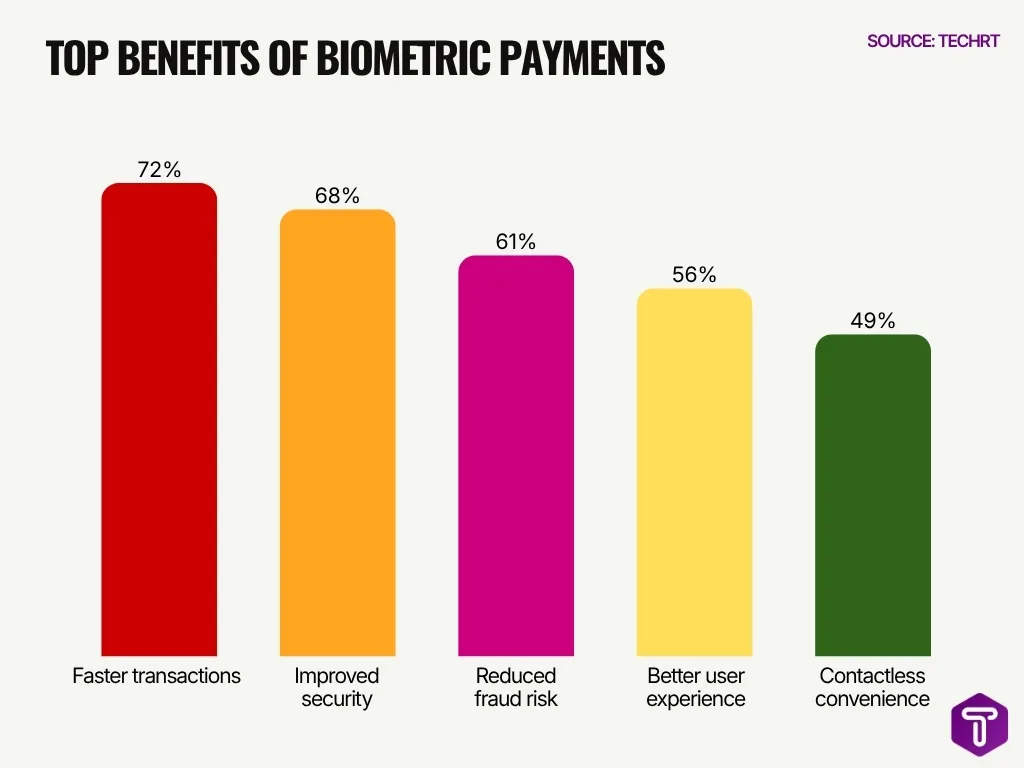
- Faster transactions are the leading benefit, with 72% share, showing that speed is the strongest reason users and businesses adopt biometric payments.
- Improved security ranks second at 68%, highlighting biometric authentication as a major trust-building factor in digital payments.
- Reduced fraud risk accounts for 61%, indicating that biometric verification helps lower risks linked to stolen cards, PINs, and passwords.
- Better user experience holds a 56% share, showing that convenience and ease of use are important adoption drivers.
- Contactless convenience represents 49%, reflecting growing demand for touch-free and seamless payment methods.
- The top two benefits, faster transactions and improved security, both exceed 65%, making them the strongest value propositions for biometric payment systems.
- All listed benefits score close to or above 50%, suggesting that biometric payments deliver value across speed, safety, fraud prevention, and convenience.
Biometric Payment by Region
- North America held 36.2% of the global biometric payment market in 2025.
- Asia-Pacific biometric payments market to grow at 20% CAGR from 2025 to 2033.
- Europe biometric payments projected 16.5% CAGR during 2025-2033.
- Middle East & Africa biometric payments achieved 17.7% CAGR from 2024 onward.
- Latin America biometric payments market reached $448 million in 2024 with 17.4% CAGR.
- Africa’s digital payments economy is set to hit $1.5 trillion by 2030.
- North America dominated biometric payment cards with over 35% share in 2025.
- Over 20 countries operated live national digital ID systems with biometrics in 2026.
North America Biometric Payment Statistics
- The US biometric payment market generated more than $3.5 billion in revenue during 2025.
- Around 74% of US consumers used some form of biometric authentication for mobile banking or payments in 2025.
- More than 148 million Americans used facial recognition payment authentication on smartphones in 2025.
- Approximately 65% of US banks offered biometric login and payment verification features by 2025.
- Contactless payments represented over two-thirds of in-person card transactions in the US during 2025.
- Retailers deploying biometric checkout technology reported checkout speed improvements of up to 25%.
- Canada expanded biometric verification programs in banking and government digital identity systems in 2025.
- More than 50% of US Gen Z consumers preferred biometrics over passwords for online payments.
- AI-based biometric fraud detection tools helped North American banks reduce account takeover fraud exposure in 2025.
- The US remained one of the top markets for biometric payment card pilots led by Visa and Mastercard.
Europe Biometric Payment Statistics
- Europe accounted for nearly 28% of the biometric payment market in 2025.
- PSD2 regulations accelerated biometric authentication adoption across European banking and payment ecosystems.
- The UK led biometric banking adoption in Europe, with more than 70% of digital banking users relying on biometric login methods.
- Germany increased biometric payment card pilot programs in retail and transportation networks during 2025.
- France expanded facial recognition payment trials in airports and public transit systems.
- Around 45% growth in biometric payment adoption was recorded across several European markets in recent years.
- European banks increasingly integrated behavioral biometrics into fraud monitoring systems during 2025.
- Contactless payment usage exceeded 75% of card transactions in several European countries by 2025.
- The EU digital identity framework strengthened biometric verification standards for cross-border financial services.
- Biometric authentication helped reduce certain online banking fraud incidents across Europe in 2025.
Asia Pacific Biometric Payment Statistics
- Asia-Pacific biometric payments market reached $2.063 billion in 2024 and is projected to grow at 20% CAGR through 2031.
- China’s facial recognition payment ecosystem has been estimated at over 900 million users across Alipay and WeChat Pay.
- India’s Aadhaar system recorded 2.21 billion authentication transactions in August 2025, showing the scale behind biometric payment layers.
- India’s UPI has moved toward biometric authentication, with on-device fingerprint and face approval for payments up to ₹5,000.
- Japan’s palm vein authentication has been used by banks since 2004, and testing cited a false acceptance rate of 0.00008% or lower.
- South Korea is expanding AI-driven biometric security, with biometric verification being positioned for broader deployment across digital finance in 2025–2026.
- Singapore’s Singpass provides secure access to 340+ government services and is connected to banks and private services.
- Australian financial services show strong biometric momentum, with 77% already implementing or planning facial recognition within 12 months.
- Asia-Pacific is the fastest-growing biometric payment-card region, with the card market projected to reach $7.2 billion by 2035.
Biometric Payment Market Challenges
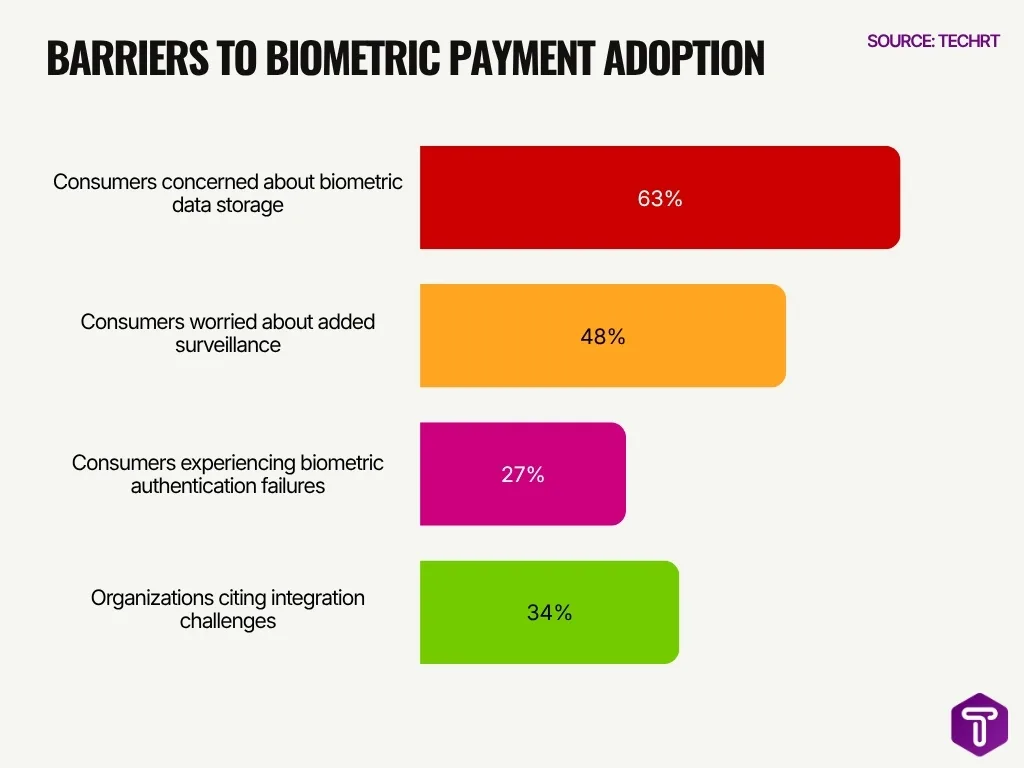
- Around 63% of consumers remain concerned about how companies store and use biometric data.
- Data breaches exposed more than 353 million individuals’ records globally in 2025, raising privacy concerns around biometric databases.
- Nearly 48% of consumers worry that biometric systems could increase government or corporate surveillance.
- High implementation costs continue to slow adoption among smaller merchants, with biometric POS systems costing up to 30% more than standard payment terminals.
- Around 27% of consumers reported occasional fingerprint or facial recognition authentication failures during payment attempts.
- Regulatory compliance remains complex because biometric payment providers must follow GDPR, CCPA, PSD2, and regional privacy laws simultaneously.
- Cybersecurity experts warned that biometric identifiers cannot be “reset” like passwords after a breach, creating long-term security risks.
- Roughly 34% of organizations cited integration challenges between legacy banking systems and biometric technologies.
- Consumer trust varies sharply by region, with adoption resistance still higher among older demographics in North America and Europe.
- False acceptance and false rejection rates continue to challenge large-scale deployments in airports, banking systems, and retail chains.
Frequently Asked Questions (FAQs)
What is the projected size of the biometric payment market by 2034?
How fast is the biometric payment card market growing?
How many biometric payment users are expected globally by 2030?
What share of the biometric payment market does North America hold?
How large could the biometric system market become by 2030?
Conclusion
Biometric payments continue moving from pilot programs into mainstream financial ecosystems across retail, banking, transportation, and e-commerce. Growing smartphone penetration, rising fraud concerns, and stronger digital identity frameworks are accelerating adoption worldwide. At the same time, payment providers are combining biometrics with AI, tokenization, and cloud authentication to improve transaction security and user convenience.
Asia-Pacific currently leads biometric payment adoption, while North America and Europe continue expanding contactless and biometric card deployments. Fingerprint authentication remains dominant, although facial recognition, palm vein scanning, and behavioral biometrics are gaining momentum across high-growth markets.
Despite strong market growth, the industry still faces challenges around privacy, regulation, integration complexity, and consumer trust. However, ongoing investment from banks, fintech firms, governments, and payment networks suggests biometric authentication will become a standard part of digital payments over the next decade.

Leave a comment
Have something to say about this article? Add your comment and start the discussion.